Will Agentic AI Become the Internet's Next Gateway? BofA's Take on Google, OpenAI, and the KPI Shift for E-Commerce
Bank of America argues agentic AI is the next gateway to the internet, with Google leading via AI Mode and UCP. Here is how OpenAI, Anthropic, and Perplexity are pushing back, and how e-commerce operators should rewire their KPIs.

Key Takeaways
- Bank of America Securities frames agentic AI as the next internet gateway and names Google as the leading candidate to own it
- Google AI Mode has reached 1B monthly users and AI Overviews 2.5B, letting Google ride its search dominance straight into the agent era
- OpenAI, Anthropic, and Perplexity are countering with their own protocols and AI browsers, forcing e-commerce operators to rebuild their traffic-based KPIs from scratch
The BofA Framing: A New Gateway, Not Just a New Search
Can Agentic AI become the internet's next gateway?
www.investing.comOn May 31, 2026, Investing.com surfaced a Bank of America Securities technology note asking head-on whether agentic AI can become the internet's next gateway. The bank's answer was direct: as AI systems take over shopping, bookings, and other online tasks, Google is the best positioned company to own that gateway.
What is striking is how the question has shifted. The industry used to ask "how does AI change search?" Now the question is "who owns the entry point that runs the agents?" The role once played by the URL bar and a list of blue links is being replaced by agents. BofA argues that in this transition Google is ahead on multiple layers at once: the Universal Commerce Protocol (UCP), AI Mode, Universal Cart, and Search Agents.
Why Google Owns the Gateway Today: A Billion AI Mode Users and a Protocol Stack
If there is one number to remember, it is this. Google AI Mode reached 1 billion monthly users within twelve months of its I/O 2025 launch, while AI Overviews now serves 2.5 billion. Against Google's roughly 4.5 billion total users, more than half now see AI-generated content every day (Digital Applied).
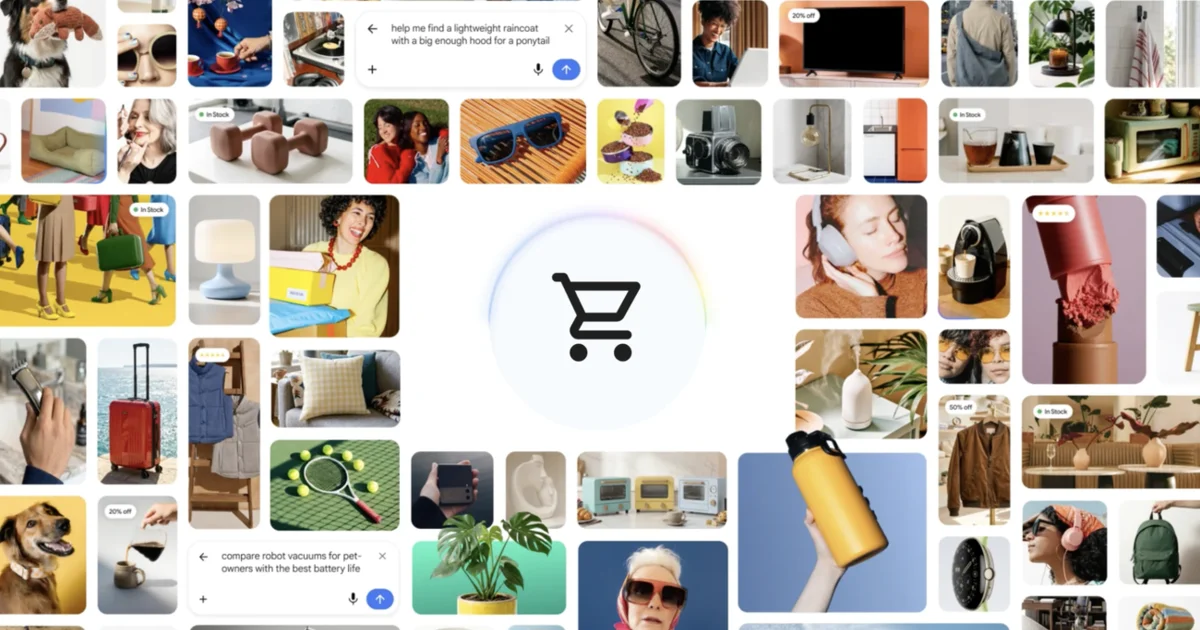
On top of that audience Google built the Universal Commerce Protocol (UCP). More than 20 companies are aligned with it, including Shopify, Etsy, Wayfair, Target, Walmart, Visa, Mastercard, and Stripe, and the protocol is designed so that AI agents can compare products, verify inventory, and complete checkout in a single flow (Google blog). Universal Cart sits on top, carrying a cross-merchant shopping context as the agent moves between surfaces.
Even more important is the payments layer Google has spun out: the Agent Payments Protocol (AP2). With 60+ launch partners such as Mastercard, PayPal, Coinbase, and American Express, AP2 lets agents carry the user's intent and spending limit as three signed Mandates: Intent, Cart, and Payment (Google Cloud blog). Google has also donated AP2 to the FIDO Alliance to keep the standard vendor-neutral.
It is the simultaneous build-out of all three layers — discovery (AI Mode), bundling (UCP / Universal Cart), and payment (AP2) — that BofA points to as the reason Google can carry its search dominance into the agent era. Unlike the Web 1.0 to Web 2.0 handover, this transition could leave the incumbent on top.
The Counterattack: OpenAI, Anthropic, Perplexity, and the Rise of AI Browsers
BofA still warns that competition is intensifying fast. OpenAI's ChatGPT now has roughly 1 billion weekly active users, and its own Agentic Commerce Protocol (ACP) has brought in Target, Sephora, Nordstrom, Lowe's, Best Buy, The Home Depot, and Wayfair (OpenAI Developers). After scaling back the Stripe-powered Instant Checkout, OpenAI has pivoted toward in-ChatGPT merchant apps that hand the actual transaction back to the retailer. The bet looks less like "own the checkout" and more like "own the discovery and intent layer."
OpenAI's other bet is ChatGPT Atlas, the AI browser launched for macOS in October 2025, complete with a sidebar assistant, agent mode, and cross-site browser memory. The Associated Press described Atlas as OpenAI's way to reach users without depending on Google or Apple. In March 2026, Atlas, the ChatGPT app, and Codex are due to merge into a single OpenAI desktop surface.
Perplexity is not far behind. Its Comet browser ranked #3 globally on the iOS App Store in March 2026, and its annualized revenue is reported to have crossed roughly $450M that same month (MWM). Monthly active users now exceed 100 million, AI chatbot market share sits at 6-8%, and the company is targeting 15-20% within 18 months. Comet, Atlas, and Gemini are colliding head-on as "the browser as the agent's runtime," which has become the defining battleground of 2026.
Anthropic is approaching the gateway from a different angle. Claude Computer Use reached agent-grade availability in March 2026, watching the user's desktop, clicking through apps, and filling spreadsheets on its own. The Dispatch feature inside Claude Cowork even lets the agent keep working while the user steps away. By skipping the browser entirely and operating across every app on the OS, Anthropic is going after a different kind of meta-gateway.
What E-Commerce Operators and Marketers Should Rewire Now
Here is where it gets practical. When the owner of the gateway changes, the KPI stack that e-commerce teams built around traffic loses its meaning. If the agent does the comparison, decision, and payment internally, the visit to the merchant's site simply does not happen.
The early signal is already visible. BrightEdge's internal data shows that agent-driven crawling now accounts for roughly 33% of organic search activity, and LLM bot crawls are 3.6x higher than Googlebot (Position Digital). Yotpo's analysis adds that on pages with AI summaries, organic CTR drops 61% and paid CTR drops 68%, but brands cited inside the AI summary see CTR rise by 35%. Volume matters less than how often AI picks you.
For 2026, the KPIs change accordingly. Search rank gives way to citation frequency inside AI answers. Clicks give way to Answer Inclusion rate. Conversion rate gives way to agent-mediated checkout and reorder rate. Clickrank summarized the shift as "not a race for traffic, but a race for influence over the AI's decision" (Clickrank).
Operationally, agent-ready product data and feed consistency become the top priority. An audit of one Shopify store found that AI shopping assistants ignored more than 40% of inventory once GTINs and MPNs were missing. The moment a Merchant Center feed and on-site structured data disagree, UCP-aware agents silently drop the SKU from recommendations.
Budget allocation is in motion too. Yotpo recommends pushing at least 10% of e-commerce marketing spend into AI-driven product discovery — not as new budget but as a reallocation from existing SEO and SEM lines. On the vendor side, AEO-focused agencies are multiplying, and "AI citation rate" is starting to appear as a contracted KPI.
Why a Single Winner May Still Not Emerge
A reality check is in order. BofA's conclusion lands on Google, but the agent-era gateway has structural reasons not to collapse to a single owner.
First, agents are designed to span services, which means the protocols (UCP, ACP, AP2, MCP, A2A) are pulling toward interoperability rather than lock-in. As a16z put it, 2026 is the year the input box disappears: users stop thinking about which service they are using and just tell their agent to handle it. When several agents collaborate behind the scenes, the data and the protocols, not the front door, do most of the work (a16z Big Ideas 2026).
Second, every failed agent interaction taxes the gateway's brand. OpenAI scaled back Instant Checkout because fewer than 30 of Shopify's millions of merchants actually went live with it (Lengow). Each time an agent picks the wrong SKU or grabs an out-of-stock item, users switch to "let me try Google" or "let me try Amazon." Gateway ownership is rewritten in real time by experience quality, in a way that the search era never had to deal with.
Wrap-Up
To BofA's question — can agentic AI become the internet's next gateway — the most honest answer right now is "yes, but the owner is undecided." Google leads with search share, UCP, AP2, and Universal Cart, but OpenAI's Atlas and ACP, Perplexity's Comet, and Anthropic's Computer Use are all reaching for the same entry point from different angles.
The mandate for e-commerce operators is clear. Move the KPI stack off pure traffic and onto AI citation rate, agent-mediated conversion, and protocol coverage. Structure product data so it works across both UCP and ACP. And design the experience so the brand still feels right no matter which agent the buyer arrives through. Trying to guess which gateway will win matters less than being the brand that every gateway chooses.