Why Agentic Commerce Beats ChatGPT Ads — The Product Data E-commerce Sellers Must Fix Before Ad Budgets
Before pouring budget into ChatGPT Ads, e-commerce sellers should make their product data agent-ready. Here is why AI-driven buying matters more than ads, and what to prepare now.

Key Takeaways
- A Search Engine Land essay argues that behind the ChatGPT Ads hype, the real story is agentic commerce, where the checkout flow itself becomes the ad unit.
- ChatGPT Ads carries structural weaknesses, a flat U.S. user base and heavy losses, while Google's Universal Cart and Amazon's Alexa for Shopping quietly build infrastructure that completes the purchase.
- E-commerce sellers should prioritize the product data that AI agents read, not ad-account optimization. Adobe's measured data shows AI-driven traffic converts better than non-AI traffic.
What the ChatGPT Ads narrative misses

Google, Amazon, and OpenAI are building AI-powered buying. Here's why your product data matters more than your next ad platform.
searchengineland.comOpen a LinkedIn feed and the ChatGPT Ads discourse never stops: product feed integrations, the Ads Manager beta, and the inevitable comparisons to Google's grip on search advertising. Writing for Search Engine Land, Rémi Kerhoas of Eskimoz calls the excitement compelling for agencies chasing new business but short-sighted all the same.
His starting point is a stat: referral traffic from ChatGPT grew 206% in 2025, according to Semrush's analysis of 17 months of U.S. clickstream data. Most people stop at that headline. The footnote tells a different story: that growth comes from deeper engagement by existing users, not from audience expansion. ChatGPT's U.S. user base has been essentially flat since September 2025.
Ad revenue scales with reach, and reach requires a growing audience. Without new users arriving, the standard playbook, build an audience then monetize at scale, is running backward.
The cost structure makes the challenge heavier. OpenAI's leaked financials reported by Fortune show $13 billion in revenue against $34 billion in total costs and expenses in 2025, an operating loss of nearly $21 billion. The company spent $2.37 to generate each dollar of revenue in 2024, improving to $1.60 in 2025, still far from profitability. Amazon lost $30 million the year it went public, and Google and Meta were profitable before their IPOs. The essay's core claim: ads are a defensive move to help fund a capital-hungry master plan, not the strategic prize itself.
The real battleground sits inside the checkout flow
The shape of OpenAI's master plan becomes clearer when you watch its rivals. What Kerhoas points to is infrastructure where an AI agent completes the purchase itself.
Google introduced Universal Cart at Google I/O 2026. This is not a shopping-tab redesign but a transaction layer, built on the Universal Commerce Protocol (UCP), that lets AI agents complete purchases on a user's behalf, with Gemini deciding what gets recommended and bought. It is live today, not a distant vision, and UCP onboarding has already begun.
Amazon is heading the same way. It merged Rufus, its shopping assistant used by more than 300 million customers in 2025, and Alexa+, its personal AI across hundreds of millions of devices, into a unified experience called Alexa for Shopping. It automates deal-finding and routine repurchases and, like Gemini, can complete the transaction. The distance from ad impression to purchase collapses.
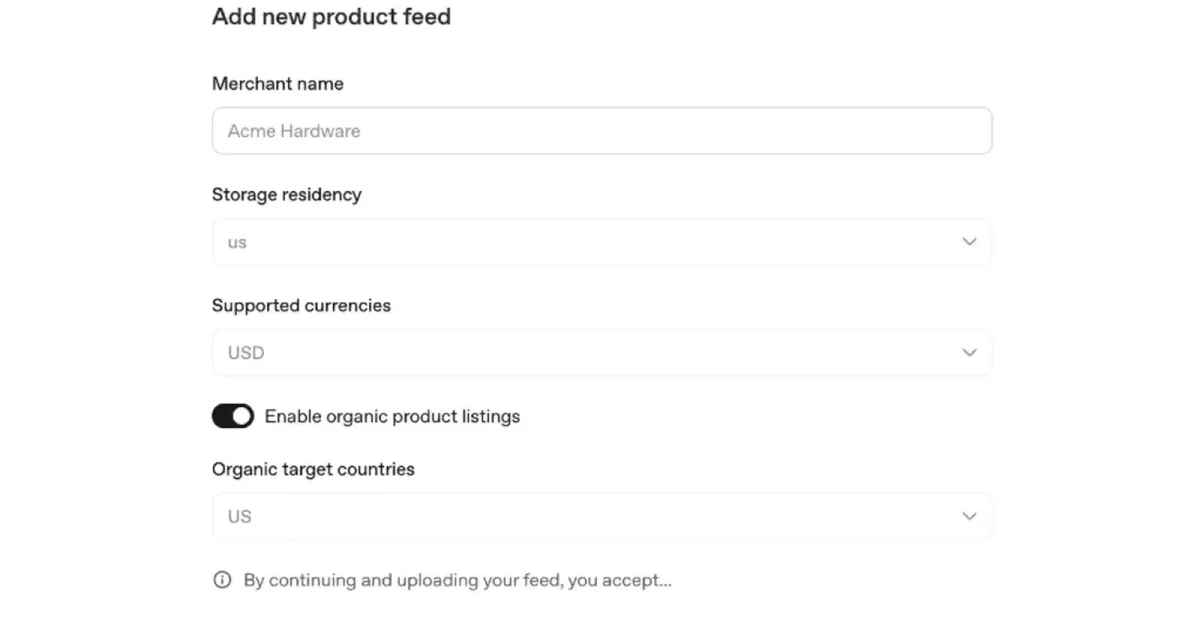
OpenAI runs the same play through Instant Checkout and the Agentic Commerce Protocol (ACP), codeveloped with Stripe, which lets users buy inside the ChatGPT conversation. It began with U.S. Etsy sellers and plans to reach more than a million Shopify merchants, including Glossier and SKIMS. Stripe published ACP as an open standard, and merchants supply a structured feed of identifiers, pricing, inventory, and fulfillment. The product feed ads in Ads Manager are just the entry point to an architecture, forming beneath the surface, in which the transaction becomes the ad unit.
The data behind AI-driven buying
The argument rests on measured data, not intuition, and this is the heaviest input for deciding between ads and product data.
According to Adobe Analytics' Q1 2026 report, AI-sourced traffic to U.S. retail sites grew 393% year over year, spiking to 693% during the November-December 2025 holiday season. Volume is not the whole story. As of March 2026, AI traffic converted 42% better than non-AI traffic, a sharp reversal from March 2025, when AI referrals converted 38% worse.
Quality diverges too. Visitors arriving from AI sources spend 48% longer, browse 13% more pages, and generate 37% more revenue per visit than non-AI traffic, Adobe reports. TechCrunch also covered the data, noting the lift in retailer revenue is real.
Supply-side readiness lags, however. Adobe's visibility check scored individual product pages an average of 66% for machine readability by LLMs. Demand arrived first, but merchant infrastructure was never built for agents, and that asymmetry is now sitting in front of every seller.
Ads or agent-readiness: where should you invest
Here is the most practical question for e-commerce sellers. Kerhoas dismisses "Should I test ChatGPT Ads?" and "Should I diversify beyond Google?" as questions with obvious answers, yes to both. The question that matters is "Is my product data ready for agentic commerce?"
The logic is direct. When Alexa or Google's shopping agent recommends a purchase for a user, it pulls from your product feed, not your campaign creatives. The cleanliness and completeness of that feed decide whether your product enters the recommendation at all. No amount of polished ad copy changes that, because the agent never reads it.
This mirrors transitions the industry has lived through before. When Google shifted from keywords to audiences to intent signals, the winners had cleaner conversion tracking and stronger first-party data. When Meta moved to Advantage+ black-box optimization, the winners built better creative systems. Data is king, and agentic commerce applies that rule to the transaction layer.
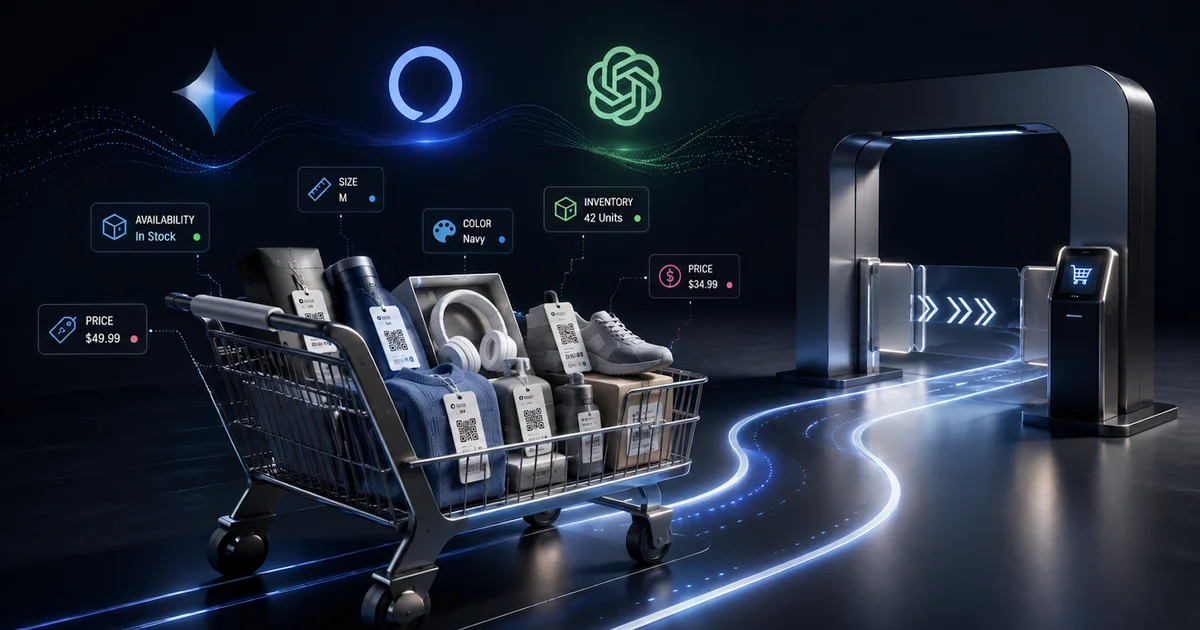
So what should you actually do? The checklist is unglamorous but clearly ordered. First, keep product feeds complete, accurate, and refreshed in near real time. Second, implement structured data, product attributes, availability, profitability, across the full catalog. In practice, Schema.org Product markup and JSON-LD are the floor that lets an agent read your catalog without rendering the page, with name, brand, description, image, price, availability, and rating as the non-negotiable basics. Third, invest in API integrations with the platforms building agentic infrastructure. Merchants on Shopify, automatically eligible for ACP, shorten that step considerably.
In short, give product data the attention you should have given conversion tracking for the last decade. It is a competitive advantage, not a maintenance task. Before chasing numbers in an ad account, confirm that your feed is being read correctly by agents. Getting that order right is the fork in the road for the AI era.
Conclusion
ChatGPT Ads will generate some revenue and produce some case studies. But given the audience ceiling, the cost structure, and the absence of the moat that made Google's search ads irreplaceable for 20 years, the essay doubts it becomes the next Google Ads. The tidal wave is not in the ad console; it is in the infrastructure being built around task completion, automated purchasing, and agent-to-agent commerce. The brands that show up there will win on data quality, not bidding strategy. Before reallocating ad budget, auditing your product feed and its structured data is the highest-leverage move you can make right now.