Asos Launches 'ASOS Stylist' AI Shopping App in ChatGPT as Fashion Moves Into Conversational Commerce
UK fashion retailer Asos releases an AI stylist app inside ChatGPT. We break down the Apps SDK mechanics, video commerce integration, and strategic implications for fashion and D2C brands.

Key Takeaways
- Asos launches "ASOS Stylist," a ChatGPT app for UK and US shoppers, built with video commerce platform Bambuser to deliver shoppable, conversational discovery
- OpenAI's Apps SDK opens a new model where brands "live inside" ChatGPT — and fashion has now joined the party
- Fashion and D2C operators must pivot from "drive traffic to our site" to "be discoverable inside the conversation," which means restructuring product data and video assets now
Asos Becomes a Stylist Inside ChatGPT
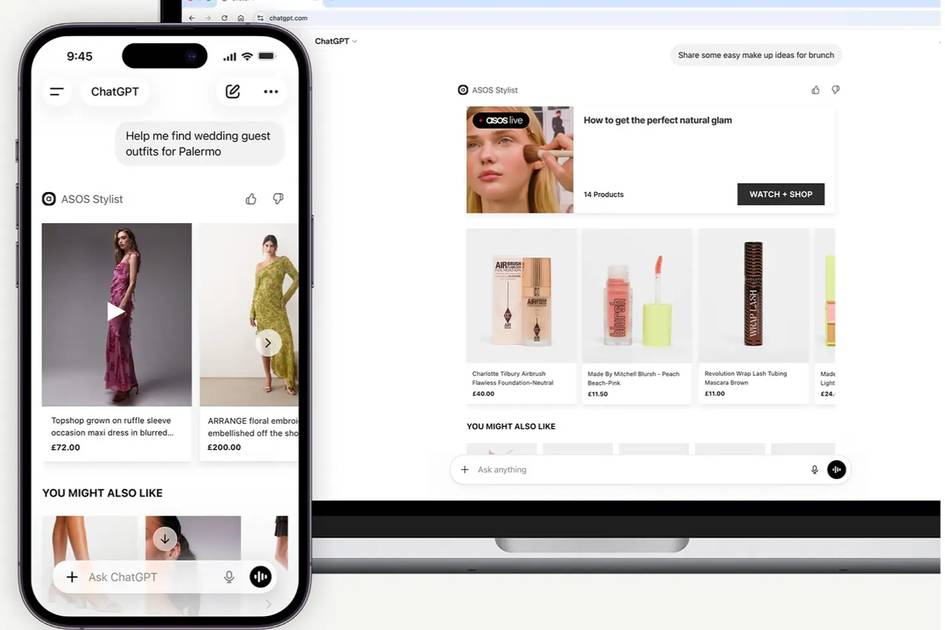
Asos introduces an AI shopping app within ChatGPT, offering product search, trend browsing, and styling recommendations for UK and US customers.
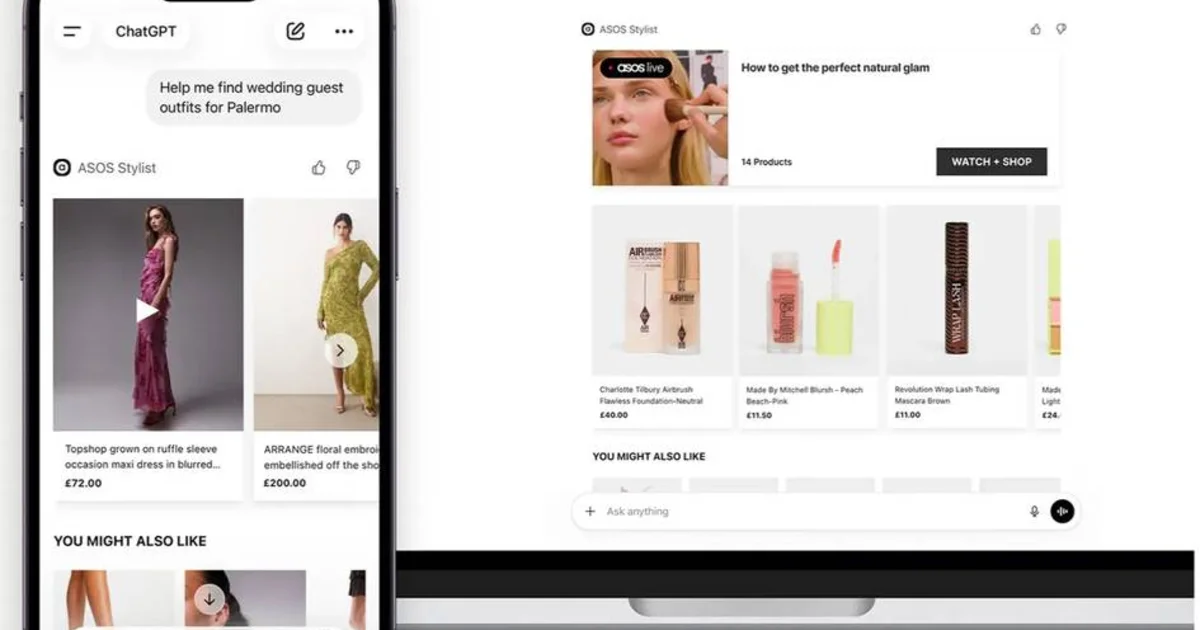
fashionunited.ukOn May 20, 2026, UK online fashion giant Asos launched ASOS Stylist, a native app that runs inside ChatGPT. The rollout targets shoppers in the UK and US, letting them search products, browse trends, and receive styling recommendations entirely within the ChatGPT conversation.
The app was co-developed with Swedish video commerce platform Bambuser, combining its new Intelligence Layer capability with a shoppable video player widget. According to Asos's official press release, the Intelligence Layer converts Asos's product catalogue and video library into structured, machine-readable data that large language models can process in real time and return as shoppable videos.
As FashionUnited reports, a prompt like "show me pastel floral A-line dresses for spring" instantly searches across the Asos brand portfolio and returns a curated edit, video clips, and styling suggestions in line with the conversation context. Tapping a product expands details such as pricing, and the actual checkout flow continues seamlessly on Asos.com.
Why Live Inside ChatGPT — The Apps SDK Foundation
Rather than dragging users back to its own site, Asos planted a "store" where users already are: ChatGPT itself. The technical foundation that makes this possible is OpenAI's Apps SDK and the Model Context Protocol (MCP), announced in October 2025.
Apps SDK is a developer kit for building third-party apps that fit naturally inside ChatGPT conversations, built on top of the open MCP specification. MCP acts as a shared language between AI models and external tools, and as the OpenAI Developers documentation puts it, MCP is "the backbone that keeps server, model, and UI in sync."
For developers, the work boils down to three things: define tools with JSON Schema contracts on an MCP server, ship inline HTML components returned alongside tool results, and implement authentication and state management. With that in place, ChatGPT can invoke the tools based on user intent and render rich, in-conversation UI — maps, playlists, and now, in Asos's case, video-enabled product grids.
As Sam Altman has reported, ChatGPT has reached 800 million weekly active users. The right way to read Apps SDK is as the first time OpenAI has opened up that conversation surface for brands to plug their own UI into.
Where Asos Sits Among the Earlier ChatGPT Apps
The initial Apps SDK launch partners were Booking.com, Canva, Coursera, Expedia, Figma, Spotify, and Zillow — all categories where a conversation naturally leads into a structured action like search or booking. In December, Instacart shipped a fully end-to-end app covering grocery search, cart building, and Instant Checkout, while DoorDash launched a similar recipe-to-delivery flow.
In physical goods, Walmart deployed its in-house agent "Sparky" as a ChatGPT app in March 2026, and Etsy followed with a gifting-focused app. Until now, the bench has been dominated by big retail, marketplaces, and C2C platforms. Asos is effectively the first standalone fashion brand to take up residence inside ChatGPT.
Asos's differentiator is video. Most AI shopping experiences to date have been built around text and still images. Asos brought its existing lookbook clips and livestream footage, structured them through Bambuser's Intelligence Layer, and dropped products in motion into the conversation. Bambuser's Kristina Brjazgunova told FashionUnited the partnership aims to "set the standard for how brands can activate video and AI content analysis inside answer engines like ChatGPT."
The Strategic Weight — and the Side Effects — of Living in the Conversation
For several years now, Asos has been quietly training its own in-app AI Stylist on how shoppers describe what they want. ASOS Stylist on ChatGPT is essentially that capability ported outside Asos.com.
The strategic calculation is clear. As search-driven traffic increasingly gives way to "discovery within the conversation," brands without a presence inside ChatGPT will literally not appear in the consideration set. Asos's Melissa Lim describes the gap in the official release: customers are turning to AI for shopping and style inspiration, but the experience still feels "fragmented and hard to visualise."
ASOS Stylist brings fashion discovery, styling advice, and shoppable products together in one seamless, conversational experience. It's an important step in how we're using AI to reduce friction and enhance the way customers shop with ASOS.
That move comes with side effects. First, platform dependence. UI visibility, surfacing order, and recommendation ranking are ultimately decided by ChatGPT's algorithm. Walmart already learned the hard way that generic in-ChatGPT checkout converted at roughly one-third the rate of its own site, which is exactly why the current playbook keeps payment on the retailer side. Asos follows the same "discover in ChatGPT, buy on Asos.com" split.
Second, data ownership. The signals about which words trigger which products, and where users drop off, accrue in the first instance to OpenAI. Brands need to plan for the fact that the resolution of customer understanding they can train on will not be the same on their own site as it is inside ChatGPT.
The Re-Architecture of ChatGPT Shopping — and Where Asos Lands
To read the timing correctly, it's worth recalling OpenAI's own pivot. In September 2025, OpenAI launched Instant Checkout with Etsy and Shopify, attempting to close purchases entirely inside ChatGPT. By March 2026, it had reversed course, stating that "Instant Checkout didn't provide the flexibility we aimed for. We're enabling merchants to use their own checkout experiences while we focus on product discovery."
The result is that ChatGPT shopping now runs on two layers. The first is the Agentic Commerce Protocol (ACP) for distributing product data; the second is the Apps SDK for building experiences. Walmart Sparky and ASOS Stylist both chose the second layer — "a brand owns its own UI inside ChatGPT" — over the lighter-weight ACP-only catalog approach.
Fashion in particular leans heavily on video and imagery for explanation; text alone struggles. That is why the "structure your video assets and feed them to the LLM" infrastructure layer, exemplified by Bambuser, is emerging as the fashion-specific pattern on top of Apps SDK.
Implications for Fashion and D2C Operators
ChatGPT's shopping features still have geographic limitations — the European Economic Area, Switzerland, and previously the UK were excluded — but Asos's rollout explicitly includes UK shoppers, suggesting the unwind is now in motion. For US and UK-facing brands, and for any Japanese or APAC brand planning expansion, three preparations are worth starting now.
The first is making product data "LLM-edible." Names, prices, size runs, style attributes, occasion tags, and stylist commentary need to be expressed as structured data — JSON schemas or product feeds — that can be exposed externally. This is the shared substrate for both Apps SDK integration and ACP catalog feeds.
The second is structuring video assets. Following Asos's lead with Bambuser, building a pipeline that links livestream and lookbook content to product IDs in a machine-readable way is rapidly becoming the fashion-specific differentiator. Expect a vendor layer here that looks a lot like Bambuser to mature quickly.
The third is redefining your own site as a "conversion-only outpost." If discovery moves to AI assistants, your site's job narrows to converting the referred shopper. Landing-page optimization, shortened checkout flows, immediate inventory and shipping visibility — the operating model that won Walmart its 3x conversion advantage is the one to run toward.
Summary
Asos's ChatGPT app marks the moment fashion brands begin operating experiences outside their own site as a first-class strategy. Discovery happens on conversational AI; purchase closes on the brand's own site. After Walmart and Etsy, fashion now joins that division of labor.
The next thing to watch is which competing fashion brands — luxury, D2C, mass-market — land on the same surface, and how quickly. The operators that finish structuring their video and product data first will take the shelf inside the conversation. That shelf grab has already started.