Circle x Nium, Decoded: How USDC Settlement Plus a 190-Country Payout Rail Becomes the Payments Layer for Always-On Agentic Commerce
Circle plugs Nium into its Payments Network so USDC settlement connects directly to last-mile payouts in 190 countries. A close read of what the deal means for agentic commerce.

Key Takeaways
- Circle has wired Nium into its stablecoin payments network (CPN), connecting USDC settlement directly to last-mile payouts in 190 countries and 100 currencies through a single API.
- Once AI agents run commerce 24/7, traditional rails bottlenecked by banking hours and FX cycles cannot keep up, and stablecoins are quickly becoming the working answer.
- The deal is not just a remittance upgrade. Read it as another layer falling into place in an "AI agent payment stack" that already includes Coinbase x402, Stripe Tempo, and Visa Intelligent Commerce.
Circle and Nium Plug USDC Settlement Into a 190-Country Payout Rail

The companies are connecting their tools in an effort to streamline the complexities involved in payments that use digital assets and advanced artificial intelligence.
www.americanbanker.comOn June 1, 2026, American Banker reported that Circle and Nium had stitched their payment stacks together. The structural change is that veteran cross-border payments firm Nium has joined Circle's Circle Payments Network (CPN) as a global payout partner, letting the two companies route USDC settlement through a single connection into Nium's last-mile network.
Circle's Spencer Spinelli, VP of global payments and enterprise partnerships, told American Banker that "agentic commerce will require payment infrastructure that can support increasingly automated and real-time decision making." The shared diagnosis is straightforward: AI can initiate transactions all day, but moving stablecoin value across borders and delivering it as local currency still needs a real rail underneath.
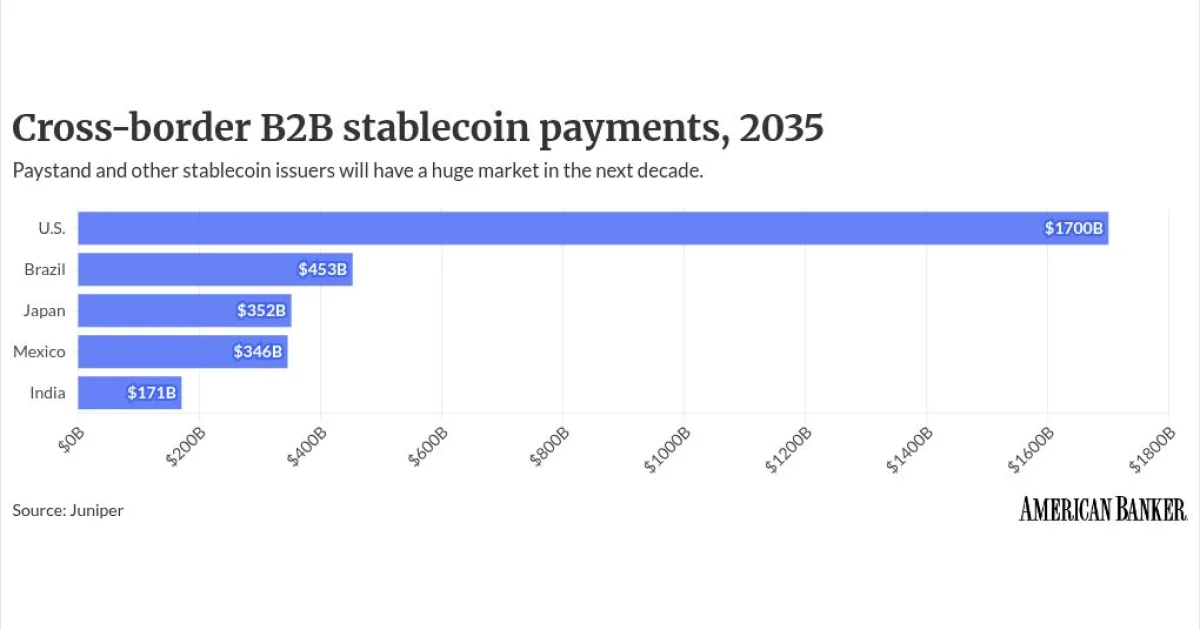
A few numbers to anchor the scale. CPN processed more than $8.3 billion in annualized volume based on the 30-day window ending March 31, 2026. Juniper Research projects the B2B payments market will grow from $187 trillion in 2025 to $224 trillion by 2030, with 85% of stablecoin transaction value flowing through B2B within the next decade. The underlying market is huge, and stablecoins are visibly cutting into it.
Why "AI Agents Plus Stablecoins" Actually Makes Sense
Step back for a moment and ask why stablecoins keep showing up in the agentic conversation. The honest answer is that existing card rails were never designed for machine-to-machine commerce.
Card networks are tuned for humans making a few mid-size purchases per day. Interchange fees crush sub-cent ticket sizes, chargeback windows assume a human dispute period of weeks, and final settlement runs on banking hours. AI agents, by contrast, generate sub-cent payments per API call, run 24/7, and treat a few seconds of latency as a broken user experience.
That mismatch is what gives protocols like Coinbase's x402 their oxygen. According to Coinbase data summarized by Stablecoin Insider and a Keyrock report, roughly 69,000 active AI agents on x402 have already processed 165 million transactions worth around $50 million, and 98.6% of machine payments settle in USDC. The numbers are still tiny next to global card volume, but within machine commerce specifically, USDC has effectively become the default.
Forecasts for how big the agentic side actually gets vary widely. Some analysts put agentic commerce at 25 to 30% of all online purchases by 2030, while Gartner projects AI agents will intermediate around $15 trillion in purchases by 2028. The spread is loose, but the operational read is the same: payment infrastructure that does not adapt now will fall behind.
What the Deal Actually Does: Bonding CPN to the Last Mile
A closer look at the mechanics is worth the time.
Cross-border payments look simple from the outside but split internally into two very different problems: moving funds (settlement) and delivering them locally (payout), often handled by separate providers on separate systems. Stablecoins can sharply accelerate the first part, but the last mile of crediting a local bank account or e-wallet in the right currency remains. Spinelli put it bluntly to American Banker: stablecoins move funds efficiently, but the last mile still involves multiple counterparties and operational complexity, and when AI agents run the transactions, that web has to be collapsed into a single connection.
The Circle-Nium integration is exactly that collapse. According to Circle's announcement and reporting from The Block, financial institutions on CPN now reach Nium's 190-country, 100-currency payout network through a single integration, instead of stitching together a fresh connector per stablecoin.
Celent's Gareth Lodge captures the point: "Payments is about reach. The more end points, the greater the value." With the network, the stablecoin, and the last mile sitting on different layers today, banks benefit because one Nium connection covers multiple stablecoin paths and lifts a real connector-management burden. For Circle, plugging into Nium's local payouts pushes USDC into more downstream destinations. The structure is genuinely complementary.
Where the Deal Sits in the Competitive Map
The "stablecoins plus agentic commerce" arena already has a long roster. To place Circle x Nium in three-dimensional context, here is a quick map of the major players.
| Player | Position | Key Product / Protocol | Role in AI Agent Payments |
|---|---|---|---|
| Circle | Stablecoin issuer / payments network | USDC / Circle Payments Network / Agent Stack | USDC-denominated machine-to-machine settlement and Nanopayments |
| Nium | Cross-border payments rail | Payout network in 190 countries, 100 currencies | Last-mile delivery from stablecoins into local fiat |
| Coinbase | Onchain infrastructure / protocol | x402 / Base / Agentic Wallets | HTTP-native micropayment standard for AI agents |
| Stripe | Payment processing / developer tools | Tempo / Machine Payments Protocol | Competing protocol pitched at AI agent payments |
| Visa / Mastercard | Card networks | Intelligent Commerce / Agent Pay | Tokenized agent payments layered on existing card rails |
The interesting part is that these players are not pure substitutes. They divide the stack by layer and then overlap at the seams. Circle brings USDC and the network, Coinbase brings the x402 protocol and Base, and Nium brings the fiat-side last mile, each leaning on its own strength to make agentic transactions actually settle. Nium underscored this in April 2026 by announcing a Coinbase partnership that already converts USDC received via x402 into local currency. Read in combination with the Circle deal, Nium is positioning itself as the stablecoin-to-fiat switching layer across multiple routes.
The card networks deserve a line too. Visa invested in Replit to claim agentic payments through the developer surface, while Mastercard has layered an AI-oriented tokenization layer onto card rails via Agent Pay. Stablecoin players sell low network fees and machine-friendly economics, while card players counter with installed-base reach into existing merchants, and each is racing to set the standard on its preferred turf.
What This Means for Merchants and EC Operators
Translating all of this into operating decisions.
The first issue to confront is false declines. The Fintech Times summarized industry numbers showing global revenue lost to false declines now sits around $443 billion per year, roughly nine times the actual cost of EC fraud (around $48 billion). This already chips away at merchant margins, and when AI agents become buyers, the problem deepens because their behavior pattern looks like an "unnatural human" to legacy fraud rules, and legitimate transactions get blocked more often. As Chargebacks911 told PYMNTS, "the fraud systems most merchants rely on today were built to detect bad human behaviour. They were not designed for a world where a legitimate AI agent and a malicious bot look almost identical."
Against that backdrop, the practical opening for stablecoin-based payments is payment-method redundancy. If card-side false declines climb, offering a USDC route for agent-initiated purchases starts to look prudent. Cross-border EC, B2B supplier flows, and metered SaaS pricing in particular can benefit from receiving USDC through a provider like Nium and then converting into local currency on the merchant's own terms, which gives more control over FX exposure, credit risk, and working capital.
Product-data readiness is the other half of the conversation. If AI agents are picking "cheapest, fastest to deliver" automatically and paying without human intervention, pricing, inventory, and shipping conditions all have to be machine-readable, or you simply do not show up in the comparison set. As covered separately under agent-ready product data, this work moves in lockstep with the payments-route question rather than independently.
Closing Thoughts
Circle x Nium can look like a low-key API integration. But once you accept that AI agents will run commerce around the clock, fusing stablecoin settlement with local payout into a single rail is one of the structural moves that quietly rewrites how payment infrastructure is composed.
Two things worth watching next. First, which additional stablecoin issuers Nium plugs into alongside Coinbase and Circle, and which banks join CPN. Second, where the agent-payment protocol race (x402, ACP, UCP, TAP, and others) meets the stablecoin last-mile buildout. Either could shift meaningfully in the next six to twelve months.
For teams already rethinking commerce around an agentic future, it is worth adding "stablecoin acceptance and local-currency payout options" to the criteria you score payment providers on, and stress-testing whether your operations can actually take advantage of those rails.