Kurly Takes 1G Labs In-House as Korea's AI Commerce Race Enters End Game
Kurly's all-stock acquisition of AI startup 1G Labs (Wonji Labs) signals an AI-native pivot amid Korea's e-commerce reshuffle against Coupang and Naver.


- Kurly is taking AI solution specialist 1G Labs (Korean name: Wonji Labs) fully in-house through a small-scale stock swap at a 1 to 1.8437990 ratio, issuing 453,518 new common shares on August 4. Founder Gwak Geun-bong will simultaneously head Kurly's newly elevated AX Center, putting AI insourcing under a single chain of command.
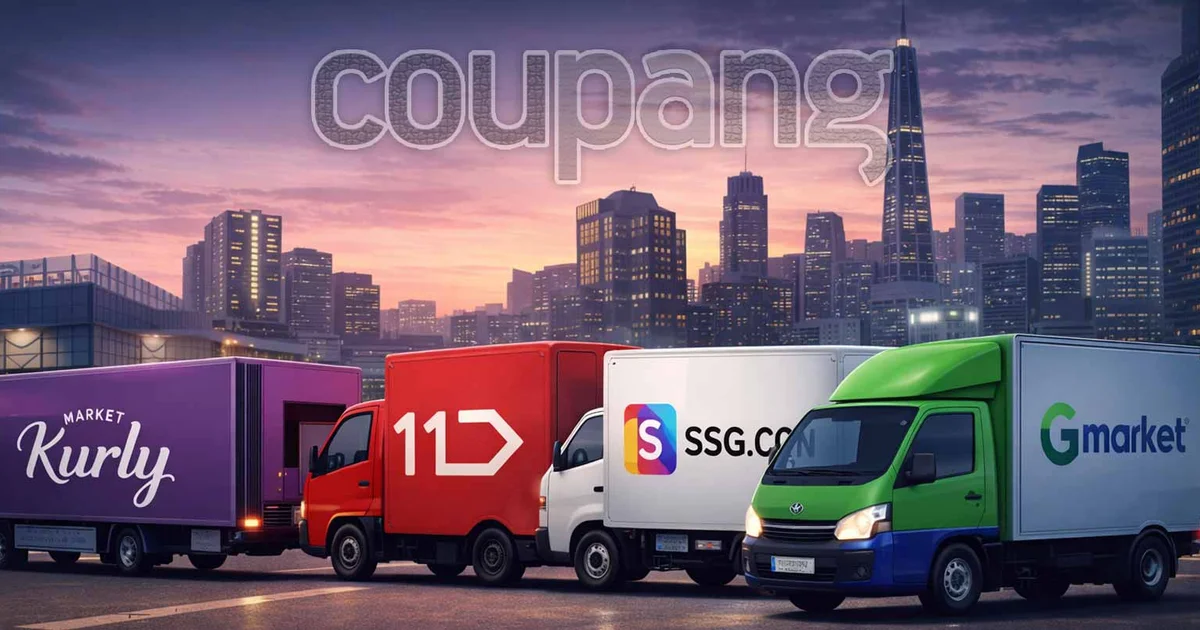
- The deal lands against a striking earnings split: Kurly's Q1 operating profit rocketed 1,277% year-on-year to KRW 24.2 billion while Coupang swung to a $266 million net loss after a data breach forced costly retention spending. Operators that can differentiate with AI and those that cannot are now showing visibly different P&Ls.
- Naver has already loaded a shopping agent into its main app, and Coupang's demand-forecasting AI cuts fresh-food spoilage by 30%. The era of outsourcing AI is closing in Korea, and whether you can absorb the engine room of agentic commerce is becoming the central question of the country's e-commerce reshuffle.
An All-Stock Deal That Pulls the AI Engine Room Inside
Kurly is acquiring AI solution specialist 1G Labs and moving to strengthen its AI-based commerce capabilities.
biz.chosun.comOn June 1, 2026, Kurly (formerly Market Kurly) announced it would acquire AI solution specialist 1G Labs as a wholly owned subsidiary through a small-scale stock swap. The exchange ratio is 1.8437990 shares of 1G Labs for each Kurly common share, with Kurly issuing 453,518 new shares on August 4 to complete the deal. No cash changes hands, so the integration timeline is as short as it can plausibly be.
The structural detail worth pausing on is that 1G Labs founder Gwak Geun-bong is being appointed head of Kurly's AX Center at the same time. The AX Center is Kurly's in-house body overseeing AI adoption and operationalization, and putting a single executive in charge of both the acquired company and the parent's AI strategy is a textbook play for firms that want to insource AI quickly rather than let an acquisition drift.
Known in Korean as Wonji Labs (원지랩스), 1G Labs is an AI SaaS startup that has already been co-developing creative AI, AI customer service (AICS), and an in-house ad serving platform (DSP) with Kurly. AICS in particular is already live in Kurly's customer center, where it handles roughly 40 percent of inquiries received on the same day. The acquisition formalizes a working relationship that has been delivering real production traffic for months, and forecloses the option of a competitor poaching the team.
Sophie Kim, Kurly's CEO, framed the deal as a way to "maximize AX synergy and rapidly insource AI capabilities" and to "combine commerce and AI technology to lead innovation in the e-commerce market." The wording is measured, but as we will see, the move is strategically sharp once placed alongside the structural competition with Coupang and Naver.
Coupang Stumbles, Kurly Surges, and the Earnings Split Tells the Story
To understand the timing, start with the latest numbers from Korea's two most-watched e-commerce balance sheets. Kurly's Q1 2026 results were almost unrecognizable next to the company of two years ago: revenue of KRW 745.7 billion (+28.4% YoY), operating profit of KRW 24.2 billion (+1,277% YoY), and net income swinging to a KRW 20.3 billion profit. The quarterly operating profit was already 1.9 times the full-year 2025 figure, giving the company strong tailwind for a renewed IPO attempt.
The market's long-reigning incumbent told the opposite story. Coupang reported a Q1 net loss of $266 million and adjusted EBITDA collapsed from $382 million a year earlier to just $29 million. The damage traces back to a late-2025 customer data breach, the retention vouchers Coupang issued to keep churn down, and the network inefficiencies that came with them. A single quarter does not erase Coupang's lead, but for a Nasdaq-listed company that had compounded profits with metronomic consistency, the slide was startling.
The important point is that this is not a normal cyclical wobble. Kurly logged its first-ever half-year profit in 2025, opened a Kurly N Mart storefront inside Naver's Plus Store, and saw March transactions there grow roughly ninefold against September 2025. The company has been quietly polishing operations across fresh food and beauty, scaling its "Saetbyeol" overnight delivery network, and refining its Gimpo, Pyeongtaek, and Changwon logistics centers. Years of operational improvements are now compounding into profit, and the 1G Labs deal is best read as the move that completes the AI side of that work.
What 1G Labs Actually Builds, Beyond the Headline Label
English coverage describes 1G Labs simply as an "AI solution specialist," but the joint development backlog with Kurly reveals a more specific picture. The team has been building three things, and each maps cleanly to a different chokepoint in modern e-commerce operations.
Creative AI handles the end-to-end production of ad banners and product imagery, from planning through publication. Kurly carries an unusually wide assortment by Korean standards — fresh produce, processed food, beauty, fashion, electronics — and the daily creative output runs into the thousands of unique assets. The unit economics of that creative workflow flow directly into gross margin, which is why automating it is more than a cost-cutting story.
AICS handles inquiry response, cancellations, and returns, and already processes about 40 percent of same-day tickets. Fresh-food e-commerce attracts a disproportionate share of high-urgency complaints — "it didn't arrive," "the produce is bad" — and staffing those manually scales costs faster than revenue. An AI tier that absorbs the front line lets human operators focus on genuine edge cases, lifting both quality and unit economics.
The DSP insourcing is the most strategically loaded piece. Most operators rent ad infrastructure from third-party adtech vendors, but that severs purchase data from the system that decides which ad to serve. An agent trained on first-party purchase data that can also place its own media is, in effect, the substrate of agentic commerce, and pulling 1G Labs entirely inside Kurly is what makes that substrate ownable rather than rented.
Why Now: The AI Insourcing Race Is Already Past Halftime
So why does Kurly need to swallow an AI company whole in 2026, rather than continuing to partner? The answer is in what its rivals have already shipped.
Naver loaded a shopping agent into the Naver Plus Store in Q1 and is adding an AI tab to its main app in Q2. Backed by a search monopoly and a vast user base, Naver's AI personalization has already lifted click-through rates by double digits in reported tests, and the company is now positioning itself as the orchestrator of agentic commerce. Kurly benefits from Naver's traffic via Kurly N Mart, but if it shows up to that partnership with weak AI capabilities, it risks becoming a commodity supplier on Naver's platform.
Coupang, even amid its loss-making quarter, sits on 14 million WOW members and has accumulated meaningful internal AI — its demand-forecasting models reportedly cut fresh-food spoilage by 30 percent. The current weakness is partly a one-off, not a pause in AI investment. If Kurly waits and Coupang rebuilds, the gap widens again.
Beyond pure-play e-commerce, Korea's fashion leader Musinsa rolled out a review-summarization AI on product pages in 2025 that lifted conversion rate by 13 percent, and LF, Samsung C&T Fashion, and Hansae have all deployed virtual try-on, AI review generation, and AI design tooling. Across the Korean retail stack, AI has been re-classified from "nice feature" to "table-stakes infrastructure", and the migration from buying AI to owning AI is happening simultaneously across multiple categories. Kurly is moving before the window closes rather than after.
Three Signals for Operators Watching from Japan
The Korean reshuffle is not a parochial story. Korea tends to lead Japan by a few steps on AI deployment and platform consolidation, and Kurly's decision offers at least three signals worth thinking through.
First, hiring is no longer a viable insourcing strategy at this stage. A company of Kurly's scale (annual revenue around KRW 3 trillion) still concluded that recruiting AI engineers individually would be too slow, and chose instead to acquire a working team. Given the global scarcity of AI engineers and the even sharper scarcity of those who understand commerce operations, organizational acquisition is the more rational path on both speed and certainty. Expect more equity stakes and joint ventures with AI startups in Japan over the coming year.
Second, the substrate of agentic commerce is the trinity of creative, customer service, and ad delivery. The three areas Kurly and 1G Labs co-developed map precisely onto this trinity: how the product is shown, how the customer is engaged, and how traffic is acquired. Deploying these in isolation does not produce an agent. Running them on a single foundation centered on first-party purchase data is what does.
Third, IPO narratives and AI strategy are now inseparable. Kurly's renewed IPO push relies on the combination of Naver alliance, profitability, and AI insourcing to convince investors. The company's valuation had returned to KRW 2.8 trillion (about $1.86 billion) by May 2026, and post-acquisition that figure has further upside. For Japanese operators, whether public or private, business plans without a clear AI story will increasingly struggle to clear capital-markets bar.
Closing Thought
On the surface, Kurly's full absorption of 1G Labs reads as a mid-sized Korean tuck-in. Placed against Coupang's quarterly stumble, Naver's serious agent rollout, and the wave of AI deployment across Musinsa, LF, and others, the deal is better read as a signal that Korea's e-commerce market has entered an active reshuffle phase organized around agentic commerce.
After August 4, the questions are operational: how quickly Kurly can stand up the AX Center, how deep the insourced creative AI, AICS, and DSP can embed into daily operations, and whether the next two quarters of earnings and the IPO narrative bear out the bet. For operators and executives in Japan, the experiment unfolding next door is a case study worth studying as you decide whether your own AI strategy is structurally sound or merely fashionable.