AI Shopping Agents Are Pulling Fashion's Search Budget Toward Machine-Readable Product Data
AI shopping agents are shifting fashion e-commerce competition from keyword bids to machine-readable product data. What Adobe's data, ASOS, and True Fit reveal about where budgets move next.

Key Takeaways
- Fashion e-commerce competition is shifting from keyword bidding to product data that AI agents can actually read
- Adobe data shows AI-sourced retail traffic surged year over year, with AI visitors now converting at higher rates than non-AI traffic
- ASOS's ChatGPT Stylist app and True Fit's agentic fit recommendations point to implementations that assume machine-readable product data as the baseline
From Keyword Bidding to Answering Constraints — A Tectonic Shift in the Unit of Competition

AI shopping agents are reshaping fashion e-commerce by shifting competition from keyword visibility to machine-readable product data
www.fibre2fashion.comA June 1, 2026 analysis published by Fibre2Fashion delivered a pointed warning to the fashion retail industry. The argument runs as follows. With the rise of AI shopping agents, the unit of competition is migrating from keyword visibility to machine-readable product data.
For two decades, fashion retailers have spent budget bidding on high-intent phrases like "linen shirt," "occasion dress," and "organic cotton T-shirt." In a world where AI shopping agents mediate discovery, the way consumers ask changes entirely.
A shopper might now say: "Find breathable office trousers for humid weather, with easy returns." The agent does not render a search results page. It filters, compares, and recommends autonomously. The bidding battlefield itself disappears from the consumer's view.
Adobe Data Confirms Explosive AI Traffic Growth
This shift is no longer hypothetical — it is measurable. According to the latest Adobe Digital Insights report, AI-sourced traffic to U.S. retail sites grew 393% year over year in Q1 2026. By March 2026, AI-referred visitors converted 42% better than non-AI traffic, a new record high.
The conversion gap represents a dramatic reversal compared to just twelve months earlier. In March 2025, AI traffic was converting 38% worse than traditional channels. An 80-percentage-point swing in a single year is no small adjustment.
A Search Engine Journal analysis attributes this jump to two forces: AI agents themselves becoming more accurate, and a subset of retailers whose product data has caught up enough to be usable. Apparel accounts for roughly $80 billion of holiday online spend, which makes the implications hard to ignore at the industry level.
What Agents Actually "Read" — Size, Fabric, Fit, Returns
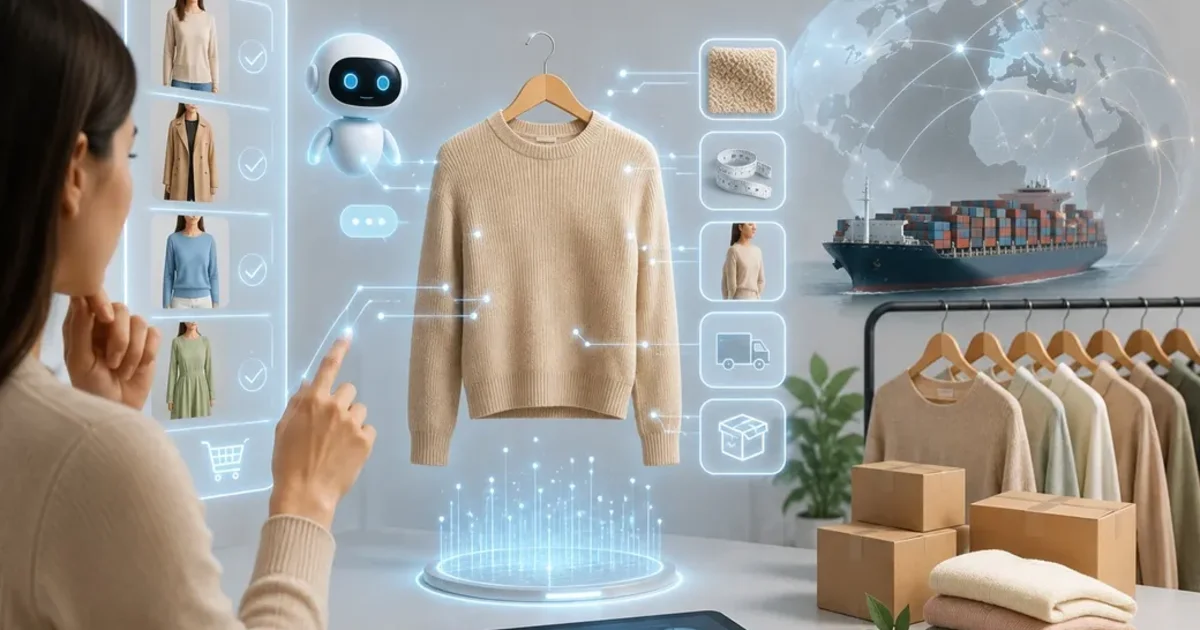
This is where the story sharpens. Even as AI-mediated traffic grows, not every brand stands to benefit. Agents do not judge products through visual intuition or curated photography. They consume structured attributes — size charts, fabric composition, fit, delivery terms, and return policies — and use them as inference material.
Bold Metrics' explanation makes the point bluntly: unless SKU-level measurements for chest, body length, inseam, and sleeve are exposed in machine-readable form, the agent cannot enter the product into its recommendation set at all. A PDF size chart or an image of measurements is, from the agent's perspective, functionally invisible.
Returns economics raise the stakes further. The 2025 global apparel return rate hit 24%, climbing near 40% for online purchases, with more than 52% of returns driven by sizing mismatch. The industry-wide cost runs to roughly $45 billion annually. The high conversion rate Adobe reports for AI traffic likely reflects agents recommending products only after parsing fit data. Brands without that data face a double penalty: fewer recommendations, and higher return rates when they are recommended.
Implementations on the Ground — ASOS × ChatGPT, True Fit's Agent Layer
The conversation has moved past theory. Concrete implementations are already shipping.
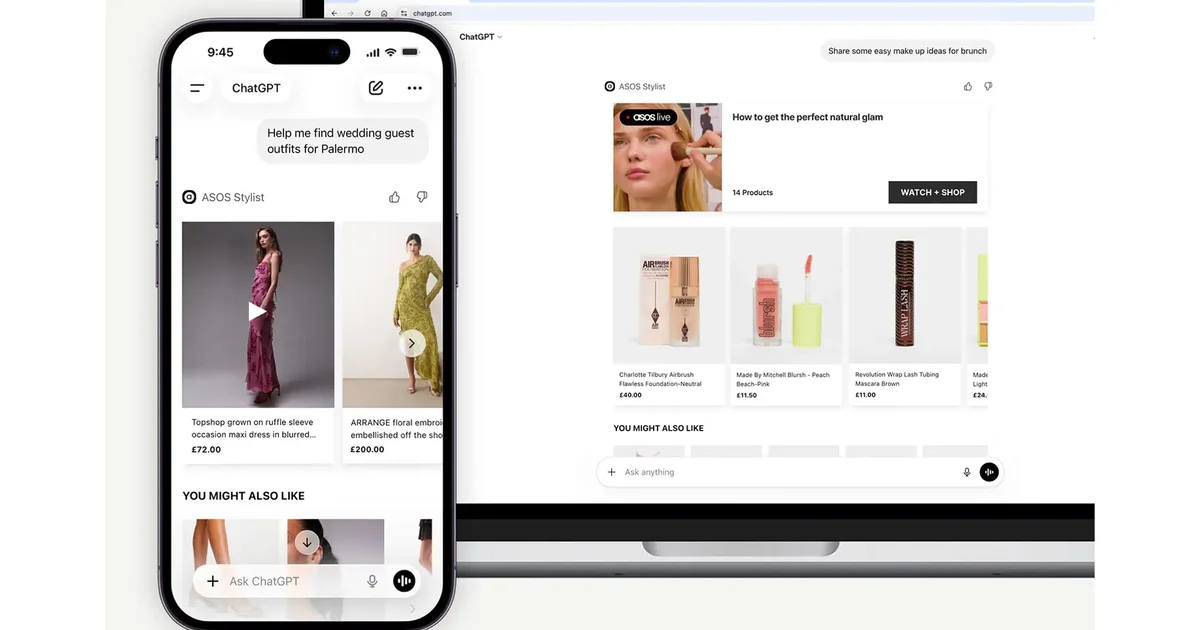
On May 20, 2026, ASOS launched the "ASOS Stylist" app inside ChatGPT for UK and US customers. Shoppers can discover outfits by category, occasion, or trend and receive styling suggestions across ASOS own-brands and partner labels. The backend matters here. Bambuser's video commerce platform supplies an "Intelligence Layer" that converts the ASOS product catalog and video library into structured, machine-readable data that an LLM can process in real time.
The implementation underscores the prerequisite that has emerged: machine-readable product data is the foundation of any agent-mediated purchase experience. Rich video and imagery alone are not enough — without structure that the LLM can interpret, they do not function inside the agent surface.
Fit-specific moves are advancing in parallel. In February 2026, True Fit announced an agentic AI shopping experience trained on twenty years of purchase and returns data. Their "Fit Intelligence" is delivered via the Model Context Protocol (MCP), allowing external AI systems to consume the same fit recommendation logic. Industry-wide standardization of sizing recommendations across agents is already beginning.
Where Does Search Advertising Budget Actually Flow?
As traffic migrates to AI channels, headwinds are hitting traditional search advertising. U.S. retail media search spend reached roughly $38 billion in 2025, but Gartner forecasts a 25% decline in traditional search volume in 2026. On the consumer side, 41% have used AI platforms for product discovery, with 33% saying they have fully replaced prior methods.
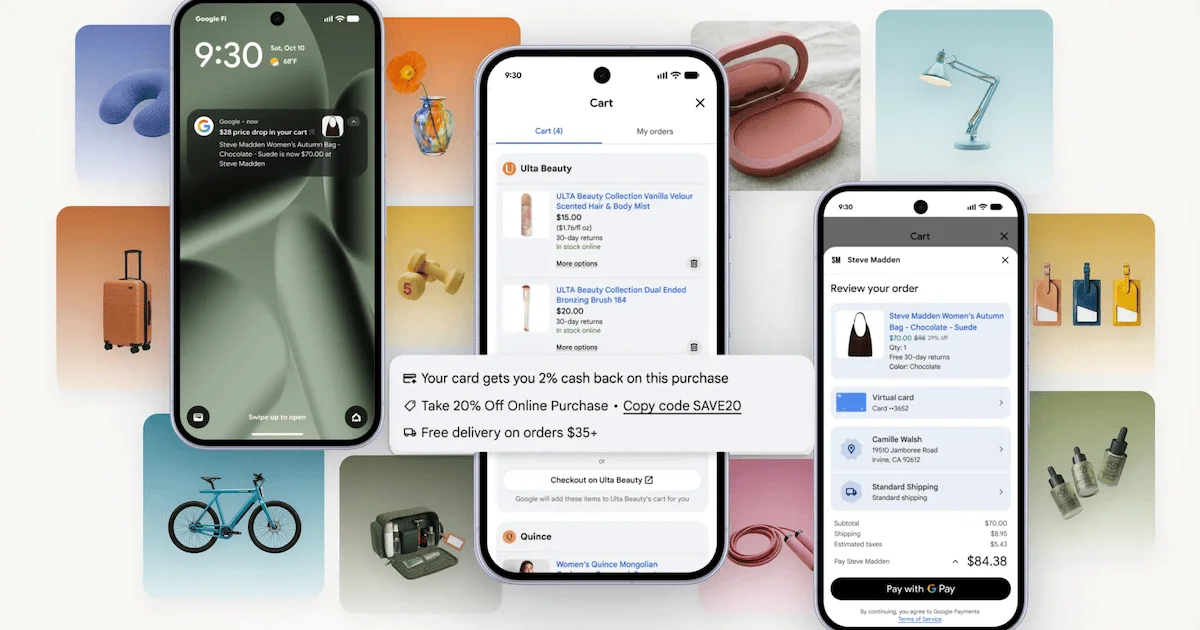
Where the budget actually lands is still in flux. Some of it will move short-term into sponsored placements inside AI responses — Amazon's Rufus ads, Google AI Overviews' sponsored products, and OpenAI's ChatGPT ad experiments. The larger and more durable destination, however, is investment in the product data foundation itself. That means JSON-LD structured data, SKU-level measurements and fabric data, machine-readable reviews and return reasons, and identifier coverage across GTIN and MPN.
Enterprise PIM (Product Information Management) vendors and digital shelf management tools are already showing this shift in their revenue patterns. The center of gravity is moving from ad inventory toward the product data asset, and the line between the marketing and product data management functions is starting to dissolve.
What Fashion E-Commerce Operators Should Do Now
Given these dynamics, the priorities are clear. The first step is a "machine-readability audit" of product data. Brands should check whether size charts live in PDFs or images rather than structured fields, whether fabric composition is described as structured data, and whether delivery terms and return policies are defined in JSON-LD Offer schema.
The second priority is qualitative depth in fit information. Beyond standard S/M/L notation, exposing SKU-level measurements, stretch behavior, and recommended body profiles raises agent recommendation accuracy. Connecting to MCP-delivered fit services like True Fit is a technical option worth evaluating.
Structuring review data and making return reasons machine-readable is equally important. When "the size did not fit" returns become quantified data the agent can consume, the AI can proactively suggest size adjustments for shoppers with similar body profiles. Return rates fall and conversion improves at the same time.
Finally, measurement metrics need updating. Alongside legacy indicators like CTR and impression share, brands need to track brand mention rate on AI platforms (Share of Model), agent-mediated session counts, and conversion rates for AI-sourced traffic. The work translates the principles of AEO (AI Engine Optimization) into fashion-specific attributes — fit, fabric, and use-case scenarios.
Conclusion
The structural shift Fibre2Fashion describes — AI shopping agents pulling fashion's search budget — is now supported on both the statistical and implementation fronts. As the bidding interface fades from view, a new competitive axis is emerging: the quality of product data that AI agents can interpret accurately.
ASOS's partnership with Bambuser, True Fit's agentic delivery, and Adobe's data on AI traffic growth all point in the same direction. Fashion e-commerce is at the point where it should move the center of gravity of its marketing budget toward data infrastructure. The gap between brands that leave size charts as images and brands that publish SKU-level measurements as structured data will surface as a revenue gap over the coming years.