DaVinci Commerce Launches Agentic BrandStore Enterprise: Discovery to Purchase Across ChatGPT and Other AI Platforms
DaVinci Commerce, backed by Accenture, launches Agentic BrandStore Enterprise to run agentic commerce end to end across multiple AI platforms. As ChatGPT handles 50 million shopping queries a day, here is how brands build AI storefronts and secure visibility.

Key Takeaways
- Backed by Accenture, DaVinci Commerce has launched Agentic BrandStore Enterprise, running discovery to purchase end to end across multiple AI platforms including ChatGPT and Gemini
- ChatGPT now handles 50 million shopping-intent queries a day, and AI is becoming the new front door to shopping in place of search
- The key is adding conversational context to product data. Submitting existing feeds as is no longer gets a brand discovered by AI
AI is becoming the store, and the fight starts at discovery

DaVinci Commerce and Accenture are building agentic commerce infrastructure as ChatGPT handles 50 million shopping queries daily.
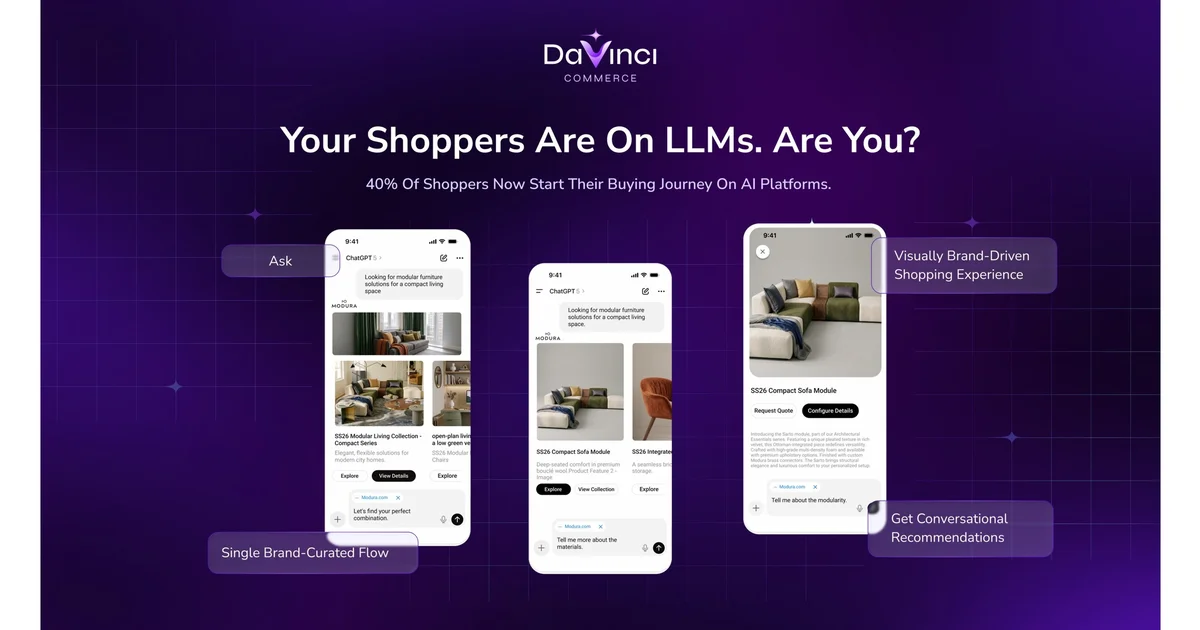
www.forbes.comOn June 22, 2026, AI commerce platform DaVinci Commerce announced the general availability of Agentic BrandStore Enterprise. It comes just three months after the company first shipped the experience layer of Agentic BrandStore in March. What is new this time is the reach: the announcement extends the journey of a brand's products being discovered, experienced, and purchased so it can run entirely across several AI platforms, ChatGPT among them.
The numbers explain the urgency. ChatGPT now processes 50 million shopping-intent queries a day and has reached 900 million weekly active users, a figure that doubled in twelve months, according to reporting. Adobe Analytics further found that AI-sourced traffic to U.S. retail sites grew 393% year over year in Q1 2026, and that traffic converts 42% better than non-AI traffic. This looks less like a test channel and more like infrastructure.
Even so, most brands are barely prepared for this new entry point. Writing in Forbes, Sandy Carter notes that search is stepping back from its role as the primary shopping surface while conversational AI takes its place. The gap between surging demand and brand readiness has opened a window in which first movers can lock in durable advantage.
Why your existing product data does not get found by AI
The most important idea in this story is not a technical spec but the notion of conversational context. When a shopper asks ChatGPT, "I'm going to a friend's wedding this weekend and it might get a little hot, what should I wear?" they are not searching by product name. They are describing a need in their own words.
The trouble is that most product content is written for search engines. Ingredient lists, technical specs, model numbers. None of it maps cleanly to how people talk to an AI agent. When the way a question is asked diverges from how the product data is written, the brand never even enters the running. Brands that pushed their existing product data straight into Google's Merchant Center or OpenAI's affiliate commerce feed have run into exactly this: generic listings do not survive large language model retrieval logic.
DaVinci Commerce founder and CEO Diaz Nesamoney frames this weak point as a discovery problem. "LLMs are where many consumers start their shopping journeys," he said, adding that being discoverable "requires contextually enriched product content: ACP/UCP/GEO to get you found, and a branded storefront experience to get you chosen. All these together can make first-movers the category leader on these platforms," in his words. A product listing can describe what something is, but not how it is used or what customers say about it. What is missing is not feed precision but context itself.
The two layers Agentic BrandStore Enterprise solves
At the core of the product sits the Content Enrichment Engine. Starting from a brand's existing catalog, it enriches every SKU with context pulled simultaneously from many sources: verified customer reviews, social conversations from Reddit and YouTube, consumer intent signals from GEO platforms, lifestyle content from brand sites, and real-time data on the questions consumers are actually asking LLMs. A scalable swarm of content agents works in parallel, and a RAG (retrieval-augmented generation) and context-engineering architecture keeps the answers accurate and current.
The clever part of the design is that this enriched content splits into two outputs with different jobs.
The first is the discovery layer. Enriched product descriptions are submitted to LLM platforms as ACP+ and UCP+, and published back to retailer PDPs so crawlers pick up context-rich content as GEO+. The "+" in each case signals intelligence added on top of the feed, matched to how consumers actually phrase their questions.
The second is the experience layer, the storefront. The same enriched content, every review, every social signal, is vectorized and stored to power the Answer Agent inside the Agentic Storefront. Where feed submissions are bound by character and field limits, the storefront has access to the full contextual dataset and can answer almost any question a consumer asks. Crucially, CRM data, personalization context, and proprietary brand content never leave DaVinci's platform. Only the answers reach the LLM, not the underlying data.
For enterprises, the update adds support for multiple LLMs such as Gemini and Claude, website and mobile-app chat integration via an MCP server, compliance checking that automatically blocks non-compliant content based on uploaded guidelines, multi-agent support that pulls content across PIM, review, and CRM systems, and a ratings-and-reviews tool to build trust before purchase. Three tiers are offered, and a no-code Studio can stand up a storefront in roughly two to four weeks.
How it differs from the competition
June alone brought a string of announcements around brand visibility in the AI era. Compare them and you see each vendor going after a different face of the same problem.
| Aspect | DaVinci Agentic BrandStore Enterprise | Adobe Brand Visibility | Pacvue Prism |
|---|---|---|---|
| Primary role | Build the brand store on AI and close the purchase | Measure and improve visibility in AI search | Cross-channel media planning and measurement |
| Product data handling | Adds conversational context via Content Enrichment Engine | Suggests GEO/AEO content optimization | Integrates media delivery data |
| Surfaces covered | ChatGPT (ACP+), Gemini (UCP+), brand sites, PDPs (GEO+) | ChatGPT, Google AI Mode, Copilot, Perplexity | ChatGPT, DSPs, social, retail media |
| Closes the purchase | Yes (discovery to purchase inside the Storefront) | No (visibility focused) | No (media measurement focused) |
Adobe announced Brand Visibility on June 17, layering Semrush data on top of LLM Optimizer to measure and improve how brands are mentioned across ChatGPT, Copilot, Perplexity and more. Pacvue launched Prism on June 22, an "agentic commerce grid" for planning and measuring cross-channel media, conversational formats included. Where those tools center on visibility measurement and media operations, DaVinci's distinction is building the store itself, end to end from discovery to purchase. Its stance is plain: visibility alone does not sell.
What e-commerce operators should do now
In practical terms, the priorities are clear. The first move is to audit your product data on the assumption that it will be sent to AI. Rather than a list of model numbers and ingredients, check whether the data carries the conversational context of who uses it, in what situation, and how. Whether AI finds you is largely decided here.
Next comes thinking about optimization across multiple AI platforms at once. ChatGPT runs on ACP-style feeds and Gemini on UCP-style ones, while your own PDPs need to be picked up by crawlers from a GEO standpoint. Rather than stacking up separate optimizations, holding enriched product content centrally and distributing it to each surface keeps operations lighter. The information design of sharing only answers with the LLM while keeping source data in house is also worth weighing for brands that hold CRM and proprietary content.
Adopters already include Nestle, Diageo, Giant Eagle, and Nordstrom, a sign that first movers are moving to claim their spot on these platforms. A quick way to gauge whether you are behind is to ask ChatGPT or Gemini a question in your own category and see whether your brand surfaces as a candidate.
Conclusion
The significance of this announcement is that it turns the abstract slogan of "AI becoming the store" into a concrete structure of discovery, experience, and purchase. Add conversational context to product data, get found through ACP, UCP, and GEO, and get chosen in the storefront. With that flow assembled into a product, the question for brands shifts from whether to set up shop on AI to how.
Given that ChatGPT is fielding 50 million shopping queries a day, securing AI visibility is no longer an experiment but an operational task. From here, the expansion of supported LLMs, Accenture-led deployments, and how the category divides up against adjacent players like Adobe and Pacvue will define its shape.