DoorDash Rolls Out AI Local Commerce Tools, Pushes Into Shopify Territory With AI-Built Branded Sites
DoorDash unveils AI-powered merchant tools: 35% faster onboarding, AI-built branded websites with ~10% conversion rates, and event-triggered marketing automation, days before Q1 2026 earnings.

Key Takeaways
- DoorDash launches three AI-driven merchant tools (self-serve onboarding, branded website generator, automated campaigns), cutting launch time by 35%
- AI-generated branded sites are seeing ~10% order conversion on average, positioning the commission-free direct ordering channel as a counter to Shopify
- Timed two days before Q1 2026 earnings, the rollout caps the "operating system for local commerce" narrative alongside Wolt and Deliveroo integration
DoorDash's Bid for the "Local Commerce OS"
DoorDash has introduced several new AI-powered tools to help merchants onboard faster, launch branded websites and automate campaigns.
www.pymnts.comOn May 4, 2026, DoorDash unveiled a sweeping set of AI-driven tools for its merchants. According to PYMNTS and the DoorDash press release, the suite includes self-serve onboarding, a Video Library, AI photo editing, and upgrades to branded websites and marketing campaigns.
The timing matters. DoorDash reports Q1 2026 earnings two days later on May 6, with guidance of $31.0–$31.8 billion in Marketplace GOV and $675–775 million in adjusted EBITDA. Bundling a wide-ranging merchant AI release right before that investor moment is not coincidental.
CFO Ravi Inukonda told analysts last quarter that DoorDash intends to become "the operating system for local commerce." This release is the product-side proof point for that framing.
Three Tool Bundles, Three Strategic Bets
The announcement reads as a long feature list, but mapped to merchant workflows it resolves into three strategic bets.
The first is onboarding compression. The new self-serve flow uses AI to crawl a merchant's existing website and surface photos, hours, and menu items automatically. Merchants only review and edit, rather than typing everything in. DoorDash claims this cuts launch time by 35%.
The second is content production at scale. The Video Library lets merchants tag menu items inside videos so customers can order directly from what they see. Photo editing arrives as three modes: AI Retouch cleans up backgrounds and lighting, AI Replate matches dishes with appropriate plating and surroundings, and Match the Style uses another image as a reference to keep visuals consistent. Importantly, all three preserve the actual food, an explicit guardrail against mismatch between menu photo and reality.
The third is the most strategically loaded: upgrades to the DoorDash Commerce Platform. AI-Powered Websites turn a merchant's existing DoorDash menu, branding, and images into an SEO-optimized branded site in minutes. DoorDash reports an average ~10% order conversion rate on these AI-built sites. AI-Powered Marketer rounds it out, automating email campaigns timed to occasions like Mother's Day and local events.
Why This Reads as a Shopify Counter
Neither PYMNTS nor DoorDash explicitly frames this as a Shopify play. Three reasons make that framing hard to avoid.
First, the positioning of DoorDash Commerce Platform itself. The platform is sold as commission-free direct ordering with three subscription tiers: Starter (free), Boost ($54/month), and Pro ($249/month). Branded direct site, email marketing, loyalty program—the core feature surface is squarely on Shopify's turf.
Second, AI just removed the setup barrier. Compressing site builds from "hours to minutes" effectively absorbs the work that Shopify Plus partners and agencies have been doing for restaurants and small retailers. For a local bakery or pizzeria with no e-commerce expertise, the choice set just expanded.
Third, the data asset gap. DoorDash sees billions of orders monthly across its marketplace. A merchant choosing between a self-built Shopify storefront and an AI-generated DoorDash site gets fundamentally different demand signal and personalization quality on day one.
The differentiator is not feature parity but the integration of local last-mile delivery with the storefront layer.
Beyond Restaurants, Toward General Local Retail
A subtler signal in this release is the expansion beyond food. The case studies in the press release include pizza, burgers, and sushi—but also Fishhook Seafood and other retail-leaning operators. That tracks with DoorDash's launch on May 1 of SNAP/EBT grocery delivery across nearly 2,700 Kroger stores.
The broader the merchant base, the more leverage AI tooling produces. Retailers carry far more SKUs than restaurants do, which makes batch photo enhancement, automated onboarding, and event-triggered campaigns more valuable per merchant than they are in food.
This timing also rhymes with Amazon. The same week, Amazon opened Supply Chain Services to third parties, exposing its full logistics stack in an AWS-style move. Both companies are pushing toward the same posture: the proprietary network becomes infrastructure that other businesses run on.
Contrast With Uber Eats and Gemini
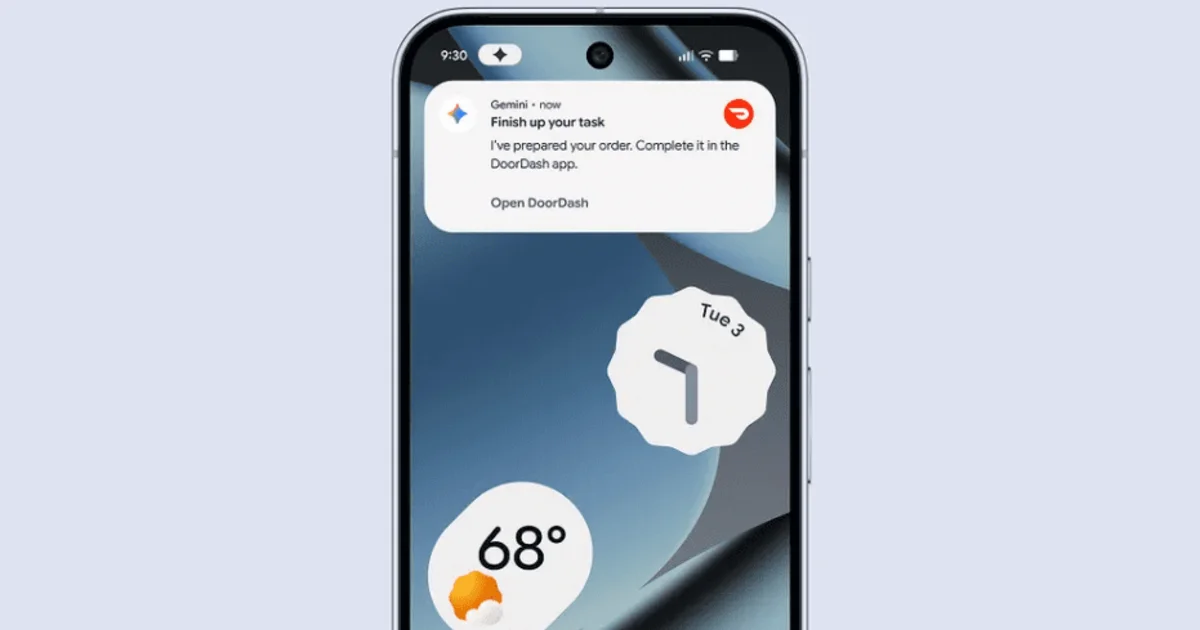
DoorDash is not the only protagonist in local commerce. Uber Eats has been testing autonomous AI ordering through Google Gemini since early 2026, covered in DoorDash and Uber Test "True Agentic Ordering" in Google Gemini.
The two emphases differ. Uber Eats is leaning into riding external AI platforms—Gemini, ChatGPT—to capture demand routed through agentic interfaces. DoorDash, while present in those same Gemini and ChatGPT integrations, is also pushing AI deep into the supply side, embedding it in the tools merchants use to set up shop and run operations.
Demand-side AI (the consumer ordering experience) and supply-side AI (the merchant launch and operations experience). DoorDash is now investing on both sides; this release weighs heavily on the supply side.
What Local Merchants Should Take From This
For merchants, the question is no longer a clean "Shopify versus DoorDash Commerce Platform."
Restaurants and prepared-food businesses where in-store, takeout, and delivery blur together get genuine integration value from DoorDash Commerce Platform. The same marketplace order history that powers acquisition also fuels repeat campaigns on the direct site, a loop Shopify cannot easily replicate.
Retailers with broader SKU catalogs and a heavier brand-experience emphasis still benefit from Shopify's theme ecosystem, app marketplace, and international payment flexibility. The likely shape going forward is a layered stack: Amazon Supply Chain Services for nationwide warehousing and shipping, DoorDash for local last-mile, and Shopify (or platform-native sites) for the branded storefront. Hybrid stacks across all three become the default for ambitious local merchants.
The deeper shift is that small merchants no longer assemble back-end commerce from independent vendors. Amazon's Supply Chain Services opening, DoorDash's merchant AI, and Shopify's agent-readiness moves all push the same direction: "outsource the hard parts to a large platform." Optionality goes up, but the set of platforms doing the lifting consolidates.
Wrap-Up
This is not a one-off feature release. It is a coordinated capstone two days before Q1 earnings. A 35% faster launch, ~10% conversion on AI-built branded sites, and event-triggered campaign automation each address concrete merchant pain. Bundled, they describe a single trajectory: turn DoorDash into the platform layer where local commerce gets done end-to-end.
For local merchants, the practical change is that running marketplace presence and a branded direct-ordering site can now happen on the same platform with shared data. Whether the Q1 numbers validate this platformization push will set the tone for how the local commerce market is read for the rest of the year.