AI Commerce News Digest (May 1, 2026)
Mastercard's Q1 2026 earnings position agentic commerce as a structural tailwind even with travel headwinds, framing Agent Pay and virtual cards as infrastructure; The Information reveals Shopify is securing money-transmitter licenses across more than a dozen US states to deepen its fintech push; ByteDance launches an independent e-commerce arm inside its Hongguo short-drama app to monetize a fast-growing user base; Mastercard and Stripe back Marc Lore's Wizard for personalized agentic shopping; Experian announces an Agent Trust framework; Amazon Prime Day moves to June and Rufus users surge 115%. May 1, 2026 EC and AI commerce news digest.


Key Takeaways
- Mastercard's Q1 2026 earnings framed agentic commerce as a structural tailwind even with travel headwinds, with CFO Sachin Mehra saying Agent Pay, Mastercard Send and virtual cards are becoming the infrastructure layer for AI-driven purchasing — combined with Visa's Q2 FY26 commentary on April 29, this marks a historic week where both card-network giants took the same posture
- The Information exclusively reported that Shopify has already secured money-transmitter licenses in more than a dozen US states and is pursuing additional state and federal approvals — a step change that takes Shop Pay, Shopify Balance and Shopify Capital to the level of regulatory capital, not just partner-led financial features
- ByteDance set up an independent e-commerce department inside its Hongguo short-drama app, signaling a second commerce hub alongside Douyin. Combined with the Wizard / Mastercard / Stripe partnership, Experian's Agent Trust framework, Amazon Rufus users up 115% YoY and Amazon Prime Day moving to June, May 1 was a day when card networks, SaaS platforms and content-led platforms all simultaneously entered the agentic commerce race
Today's Highlighted News
Mastercard's Q1 2026 Earnings Frame Agentic Commerce as a Structural Growth Axis Despite Travel Headwinds
Mastercard's latest quarter shows a network adapting to AI-driven commerce, with Agent Pay and virtual cards becoming infrastructure.
www.pymnts.comMastercard reported Q1 2026 earnings, with CFO Sachin Mehra explicitly calling agentic commerce a structural tailwind for the network. He framed Agent Pay, Mastercard Send and virtual cards as becoming the infrastructure layer for AI agent purchasing. Even with weaker travel demand, the network kept cross-border volumes up 11% and global payment counts up 10%.
Notably, CEO Michael Miebach drew an explicit comparison between Europe and China, saying "Europe is shaping trusted adoption, China demonstrates speed and scale." That public framing makes how Mastercard navigates DSA / data-sovereignty rules for agentic commerce in the EU a clear differentiator in a global payments race.
Combined with Visa CEO Ryan McInerney's April 29 remarks calling Intelligent Commerce a long-term growth engine, this is a historic week — both card-network leaders adopted nearly identical agentic commerce rhetoric and positioning. For merchants and PSPs, this is the cue to bundle Agent Pay compliance, virtual card support and 3-D Secure agent extensions into a standard go-to-market package.
Shopify Has Already Secured Money-Transmitter Licenses in More Than a Dozen US States — The Information's Exclusive

Commerce giant Shopify is seeking regulatory approvals to take a bigger role in offering financial and payments services to the millions of merchants using its software.
www.theinformation.comIn an April 30 scoop, The Information reported that Shopify has already secured money-transmitter licenses in more than a dozen US states, allowing it to hold and move funds itself. The company is also pursuing additional state and federal-level approvals, signaling a strategic shift from partner-led financial services toward fully regulated, in-house operations.
Until now, Shopify has run Shop Pay, Shopify Balance and Shopify Capital with a relatively thin reliance on direct regulatory standing. The new licenses move it from that model to regulatory capital — operating payments, transfers and merchant deposits on its own license stack.
In commerce SaaS, the Mercado Libre / Mercado Pago model of "commerce platform plus neobank" is now arriving in earnest in North America and Europe. Shopify's move puts direct pressure on BigCommerce, WooCommerce and Wix to articulate their own financial services strategy, and signals risk for Stripe and Adyen if a portion of Shopify GMV starts to bypass their rails.
Agentic Commerce
Mastercard × Stripe × Wizard — Marc Lore's AI Shopping Platform Lands a Personalization Partnership

Wizard, the native AI shopping platform co-founded by Jet.com's Marc Lore, has launched a partnership with Mastercard and Stripe.
www.pymnts.comWizard, the native AI shopping platform co-founded by Jet.com founder Marc Lore, announced a partnership with both Mastercard and Stripe. By integrating Mastercard's Agent Pay / Agent ID with Stripe's Agentic Commerce Suite, Wizard can provide a personalized, tokenized end-to-end path from AI-driven recommendation to checkout.
The core of the deal is the binding of Mastercard's Agent ID tokens with Wizard's recommendation engine — purchase history and preferences are exchanged as encrypted tokens. Combined with Stripe Shared Payment Tokens, Wizard implements three-stage optimization (right product, right merchant, secure transaction) in a single flow.
The partnership marks Marc Lore's high-profile re-entry into commerce, and signals that independent native AI shopping agents like Wizard, when bound to card networks and payment platforms, can emerge as a viable third buying surface alongside Amazon, Shopify and Walmart.
Experian Announces Agent Trust Framework — A New Standard for the Trust Layer of AI Commerce
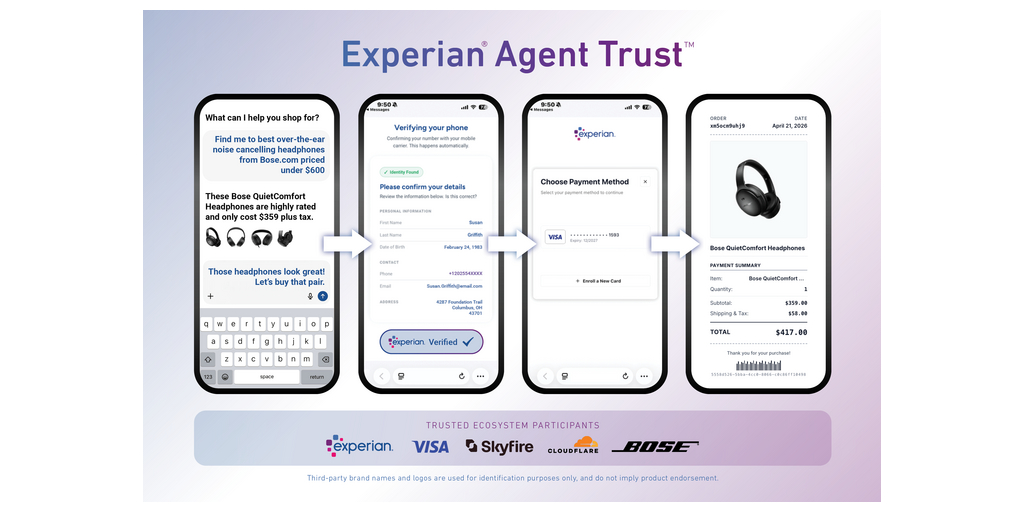
Experian Announces Agent Trust to Power Trusted AI Driven Commerce.
www.businesswire.comCredit bureau Experian launched Agent Trust, a framework designed to act as the trust layer for AI-driven commerce. When AI agents purchase on behalf of consumers, merchants need a real-time mechanism to determine whether the agent is legitimate, whether it's spoofed, and whether its delegated authority is still valid. Core capabilities include "Know Your Agent" identity verification, real-time authority validation and fraud detection.
Combined with the FIDO Alliance × AP2 standardization talks (April 29) and the FIS "proof, not promises" governance argument (April 30), this is now a fast-moving competition over which company supplies the trust layer of agentic payments at which level. Experian's angle is to extend its consumer-side credit / identity infrastructure into agent identity verification.
For merchants, the picture is clear: FIDO/AP2-compliant agent authentication combined with a third-party verification layer such as Experian Agent Trust is becoming the standard intake requirement for accepting agent transactions.
Amazon's Rufus: Users Up 115%, Engagement Up 400% — A Distinctive Agentic Commerce Position

Rufus, Amazon's artificial intelligence-powered shopping assistant, is gaining traction as engagement is up 400%.
www.modernretail.coOn Q1 earnings, Amazon CEO Andy Jassy disclosed that AI shopping assistant Rufus has 115% YoY user growth and 400% YoY engagement growth. Modern Retail and PYMNTS reporting suggests Amazon is running a hybrid strategy of internal agents plus external agent intake — Rufus and Alexa+ as the inner buying funnel, ChatGPT and Perplexity as outside intake.
This dovetails with Amazon's recent move to join the UCP (Universal Commerce Protocol) technical council, suggesting a stance of being both a creator of agent standards and a participant in industry standards.
Amazon's Strategy Shift — Joining Google's Universal Commerce Protocol Effort

Amazon has joined the technical council overseeing Google's Universal Commerce Protocol after initially sitting out.
www.modernretail.coAmazon formally joined the technical council of UCP (Universal Commerce Protocol), the Google-led standard. Modern Retail's Marketplace Briefing notes Amazon initially sat out, so the move is a clear strategic shift. Together with Microsoft, Salesforce, Stripe and Meta joining in late April, the technical council has now doubled to 10 members.
Amazon's decision to align with UCP while still owning Rufus / Buy For Me / Alexa+ reads as "we don't want to fully cede standards leadership to outsiders." Merchants should now treat the likelihood of UCP becoming the de facto standard for agent discovery and cart binding as elevated, and bring UCP-compatible catalog optimization into their plan.
Anthropic / OpenAI / Google in Agentic Commerce — Three Different Approaches (Digital Commerce 360)

Anthropic's latest Claude experiment shows it cares about ecommerce, even if OpenAI and Google have been building agentic commerce capabilities more publicly.
www.digitalcommerce360.comDigital Commerce 360 published a side-by-side comparison of Anthropic, OpenAI and Google in agentic commerce. Anthropic continues experimenting with browser-driving e-commerce on Claude Sonnet, signaling that e-commerce is a serious target. OpenAI is pivoting from Shopify-tied Instant Checkout toward smaller marketplaces such as Etsy. Google doubles down on AP2/UCP standardization plus Gemini × Stripe integration, building a "house" position.
Merchants need to understand the differences — Anthropic (browser-driving, SDK-led) / OpenAI (standards plus Instant Checkout) / Google (standards plus Gemini integration) — and choose which channel(s) to source agent-driven discovery traffic from.
Fraud Systems Misclassify Legitimate AI Shopping Agents as Malicious Bots — Merchants Lose Revenue

Learn what agentic commerce fraud is, why it bypasses traditional detection, and how to protect your ecommerce business from bot takeover.
www.signifyd.comFinextra and Signifyd report that as agentic commerce scales, merchant-side fraud detection systems are increasingly misclassifying legitimate AI shopping agents as malicious bots, generating real revenue loss. Today's fraud detection is built around human behavior patterns, and the rapid, repetitive, structured access pattern of AI agents is being blocked as bot traffic.
Vendors such as Kount and Sift are racing to ship "Trusted Agent" logic that integrates with FIDO/AP2 agent credentials, with Experian Agent Trust and Mastercard Agent Pay-style identity hookups emerging as the leading solutions.
Global E-Commerce
ByteDance Sets Up an Independent E-Commerce Department Inside Its Hongguo Short-Drama App

ByteDance has established an independent department to integrate shopping features into its Hongguo short drama app.
kr-asia.comKrASIA reports that ByteDance has set up an independent e-commerce department inside its rapidly growing Hongguo short-drama app. Hongguo, launched in 2024 as a free short-drama app, is one of ByteDance's strategic content bets alongside Tomato Novel.
ByteDance already runs one of the world's largest social commerce footprints via Douyin and TikTok, so spinning up another e-commerce unit inside Hongguo means building a second commerce hub alongside Douyin. It will likely become a testbed for content-driven e-commerce built on user behavior data captured during short-drama viewing — and it could also serve as a hedge against the regulatory risks TikTok Shop faces in the West.
Amazon Prime Day Moves to June — Announced Alongside Q1 Earnings, Reshaping Seller Promotion Plans

The e-commerce company's sales event happened in July last year. Meanwhile, Q1 earnings showed strong growth in online store net sales.
www.retaildive.comAmazon used Q1 earnings to announce that Prime Day moves from July to June. Retail Dive frames it as a play to capture pre-summer demand and a preemptive strike against rival summer events such as Walmart Deals and Target Circle Week.
For sellers, the implications are operational: inventory replenishment, FBA inbound timing and promotional spend allocation all shift forward by a month. Sellers with long lead times from China and Southeast Asia may need to redesign inventory operations by early May. Online store net sales also held double-digit growth in Q1, so the Prime Day pull-forward is consistent with carrying that momentum into Q2.
Marketplace Pulse — Amazon's 1P Unit Share Rises Two Quarters in a Row, 3P Share Falls

Third-party sellers accounted for 60% of paid units sold on Amazon in Q1 2026, down from 61% in Q4 2025 and 62% the quarter before that.
www.marketplacepulse.comMarketplace Pulse reports that Amazon's 3P seller unit share fell to 60% in Q1 2026, down from 61% in Q4 2025 and 62% the quarter before. Since Amazon began publishing the metric in 2004, this is the first time the 3P share has declined for two consecutive quarters.
The flip side is rising 1P unit share, indicating Amazon is reasserting its own retail buying through Vendor Central. 3P sellers should plan a two-pronged response: invest in their own DTC and direct e-commerce, while sharpening the differentiation of their Amazon assortment relative to Amazon's growing private label.
Etsy Q1 2026 GMS Up 5.5% — Handmade and Personalized Goods Lead Growth

Etsy reported a strong Q1 performance in 2026, with gross merchandise sales on its core marketplace increasing 5.5% year-on-year to $2.5bn.
www.retail-insight-network.comEtsy reported Q1 2026 with core marketplace GMS up 5.5% YoY at $2.5bn. BTIG and other analysts highlight that handmade, customized and small-lot products — Etsy's core SKU mix — are getting reappraised as a logical pivot destination for OpenAI Instant Checkout, reinforcing Etsy as the optimal long-tail discovery surface for the AI agent era.
Coupang Data Breach Becomes a US-South Korea Trade Friction Point (Rest of World)

A massive data breach at South Korea's biggest online retailer, which is registered and listed in the U.S., has both countries claiming the right to act.
restofworld.orgRest of World reports that the data breach at Coupang — South Korea's largest e-commerce operator — has escalated into a trade-friction issue with both the US and South Korea each claiming jurisdiction. Coupang is incorporated and listed in the US while running its main operations in Korea, so the question of whether Korean PIPA or US state-level privacy laws apply is now contested.
Combined with the South Korean FTC's April 29 designation of Coupang founder Bom Kim as the de facto controlling person of the platform, the incident adds new friction to US-Korea trade. The deeper question — how a US-listed global e-commerce company resolves regulatory mismatches between its incorporation country and its main operations country — is now front and center.
Delivery Hero Q1 GMV Growth Accelerates — Everyday App Strategy and Quick Commerce Drive It
Delivery Hero - Always delivering an amazing experience.
www.deliveryhero.comGermany-based food delivery operator Delivery Hero said Q1 2026 GMV growth accelerated quarter-over-quarter. The group runs Talabat (Middle East) and foodpanda (Southeast Asia), among others, and points to its Everyday App strategy (extending from food delivery into groceries, drugstore and retail) and Quick Commerce momentum as the drivers. Combined with Talabat Egypt activating MENA's largest AI quick-commerce hub last week, the Delivery Hero group is consolidating its lead in real-world AI × Quick Commerce execution.
Regulation and Compliance
France Finds 75% of Foreign Marketplace Products Breach EU Rules

France's DGCCRF said that 75% of products tested from major e-commerce platforms in 2025 did not meet European Union (EU) standards.
www.retail-insight-network.comFrance's DGCCRF (consumer protection authority) reported that 75% of products sampled from major e-commerce platforms in 2025 failed EU standards. The probe is widely read as targeting Chinese marketplaces such as Shein and Temu, with violations centered on safety standards, labeling and chemical regulations.
The EU is doubling down on marketplace operator accountability under DSA (Digital Services Act) and GPSR (General Product Safety Regulation), so regulatory pressure on Shein, Temu and similar platforms is set to intensify. For Japanese cross-border sellers shipping to Europe, compliance investment is no longer optional.
EU's One-Click Cancellation Rule Takes Effect in 2026 — New Implementation Burden for Subscription E-Commerce

The EU's one-click cancellation rule will require retailers to offer clear, fast and fully digital cancellation processes that match the ease of sign-up.
www.retail-insight-network.comThe EU is moving forward with a one-click cancellation rule in 2026, requiring subscription-style services to offer cancellation flows that are as easy as signup. The rule is similar to the US FTC's Click-to-Cancel mandate and explicitly targets dark patterns (intentionally complicated cancellation paths).
Subscription DTC, streaming and SaaS businesses operating in the EU need to redesign cancellation UIs, and granular requirements — accessibility, time-to-cancel, max number of confirmation steps — are still being finalized.
Logistics and Fulfillment
Easyship Launches a Global Shipping MCP Server — Targeting the Infrastructure Layer of Agentic Commerce
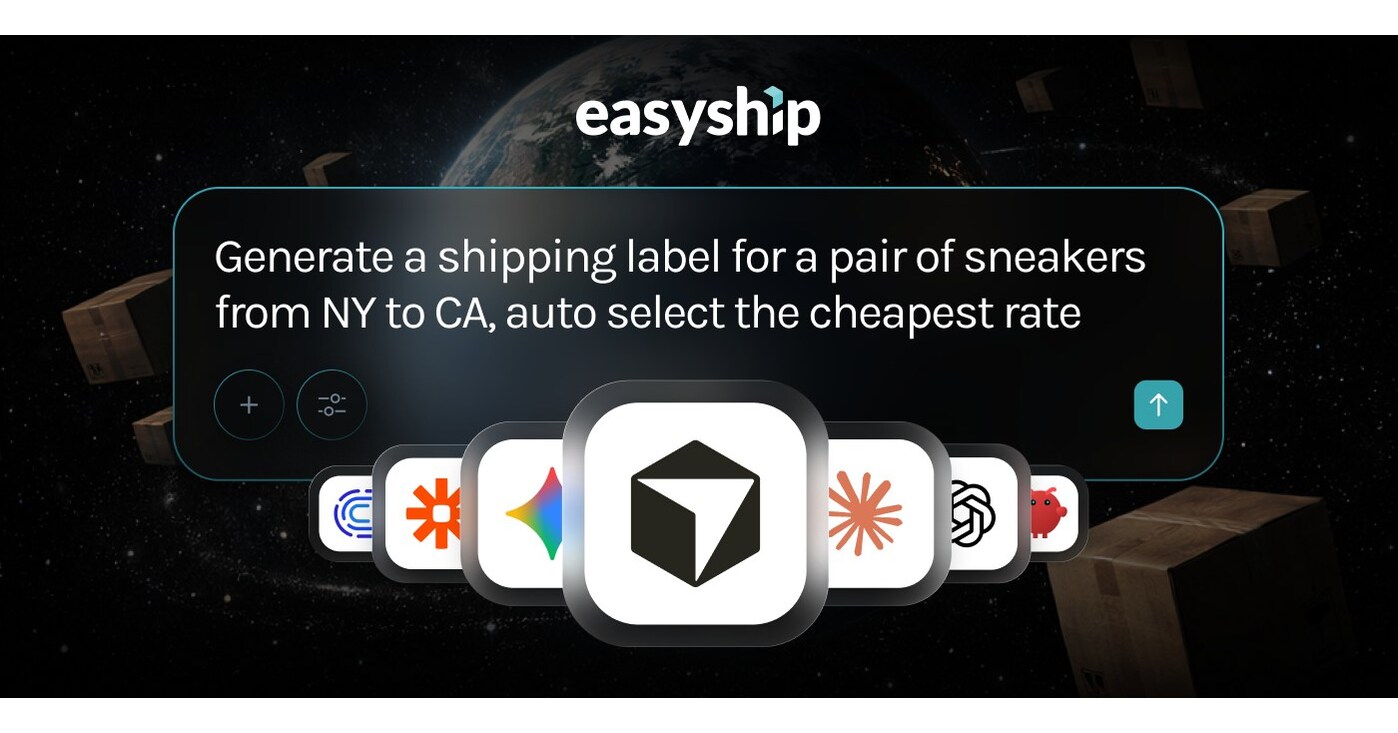
Easyship's new MCP server lets AI agents query global shipping rates, calculate import taxes/duties across 200+ countries, and book labels across 550+ couriers from Claude, ChatGPT, Cursor, Gemini and other MCP-compatible AI platforms.
www.prweb.comInternational shipping SaaS Easyship announced a Model Context Protocol (MCP) server that AI agents can query directly. Built to Anthropic's MCP spec, the server lets agents compare rates across more than 250 carriers and book labels end-to-end.
In the agentic commerce stack, the layers from discovery to checkout are quickly being standardized, but the layers from shipping quote to label generation to tracking have lagged. Easyship's MCP server is the first move into that gap, and it foreshadows logistics SaaS MCP support as the next competitive battleground.
Wrap-Up
May 1, 2026 was a defining day where card networks, SaaS platforms and content-led platforms all entered the agentic commerce contest at once. Mastercard's Q1 print combined with Visa's Q2 FY26 commentary on April 29 confirmed full alignment of the two card-network giants, and The Information's scoop on Shopify's licenses signaled the start of a new phase of SaaS e-commerce verticalizing into financial services. ByteDance's Hongguo e-commerce arm hints at a second wave of content-led social commerce rising from China.
For tomorrow and beyond, the watchpoints are Mercado Libre's May 7 earnings (LATAM e-commerce × AI strategy), Anthropic Claude's progress on browser-driving e-commerce, the EU's regulatory rollout cadence (one-click cancellation and DSA / GPSR enforcement) and growth rates of new AI shopping surfaces like Wizard, Rufus and Hongguo. Merchants should now bring three priorities into May planning: card-network agent standards compliance, in-house fintech / payment capabilities, and exposure optimization across the multiplying agent discovery surfaces.