Mirakl Agentic Activation Goes Live — The First Marketplace-Native Agent Discovery Solution Reshapes the LLM Commerce Stack
Mirakl unveiled Agentic Activation on April 29, 2026, combining Agentic Product Enrichment for LLM-ready catalogs and Agentic Channels for direct sales on Microsoft Copilot. We compare it with Topsort Sponsored Prompts and Feedonomics ACE, and outline what it means for marketplace operators.

Key Takeaways
- On April 29, 2026, Mirakl launched Agentic Activation, the first marketplace-native enterprise solution for AI agent discovery and transactions.
- The offering pairs Agentic Product Enrichment, which restructures catalogs for LLM comprehension, with Agentic Channels, which connects merchants to LLM platforms beginning with Microsoft Copilot.
- Alongside Topsort's Sponsored Prompts and Feedonomics' Agentic Catalog Exports, marketplace operators must now redesign discovery, connectivity, and monetization as a unified stack.
The First Marketplace-Native Agent Discovery Solution Arrives

Prepare your eCommerce business for agentic commerce. Learn how Mirakl Agentic Activation helps retailers and brands get discovered and sell on AI platforms.
www.mirakl.comOn April 29, 2026, marketplace SaaS leader Mirakl formally announced Mirakl Agentic Activation, an integrated solution for agentic commerce. Mirakl frames the offering as the first production-ready enterprise infrastructure built specifically for marketplaces, capable of converting product pages into a form LLMs can read while handling AI-driven sales end-to-end.
For two decades the search bar served as the gateway to digital commerce. That gateway is now migrating to conversational platforms like Gemini, Copilot and Perplexity. Mirakl's official blog opens with shoppers asking complete, intent-loaded questions such as "find everything I need for a ski trip in the French Alps."
Mirakl cites Gartner's projection that by 2028 brands will see organic search traffic decline by 50% or more. McKinsey separately estimates global agentic commerce volume reaching $3 to $5 trillion by 2030. The discovery surface is shifting, but product data has barely moved with it.
What "Not Ready" Actually Looks Like
ChannelX's coverage details Mirakl's own GEO Readiness Analyzer study, which scored 427 product pages across 35 countries. The average GEO score landed at 48 out of 100, well below the 61-point threshold the company considers competitive on AI surfaces.
The gaps are structural. Only 9% of pages provide machine-readable structured data, 86% have product images that AI cannot fully parse, and 43% lack reviews, ratings, or Q&A altogether. Mirakl summarizes the picture bluntly: less than 1% of eCommerce currently meets the minimum standards for LLM recommendation.
LLMs do not read products the way Google does. They need contextual depth, structured attributes, and clear comparison points before they can confidently recommend an item to a specific shopper. A title optimized for SEO does not automatically deliver the context an LLM needs.
Protocol fragmentation amplifies the problem. OpenAI's Agent Commerce Protocol (ACP), Google's Universal Checkout Protocol (UCP), Microsoft's implementation, and Anthropic's direction each impose different technical requirements and data formats. Building bespoke integrations for every LLM produces operational cost that scales exponentially rather than linearly.
The Two-Sided Architecture of Agentic Activation
Mirakl's response is to integrate two function sets onto a single platform: optimization for discovery and connectivity for sales.
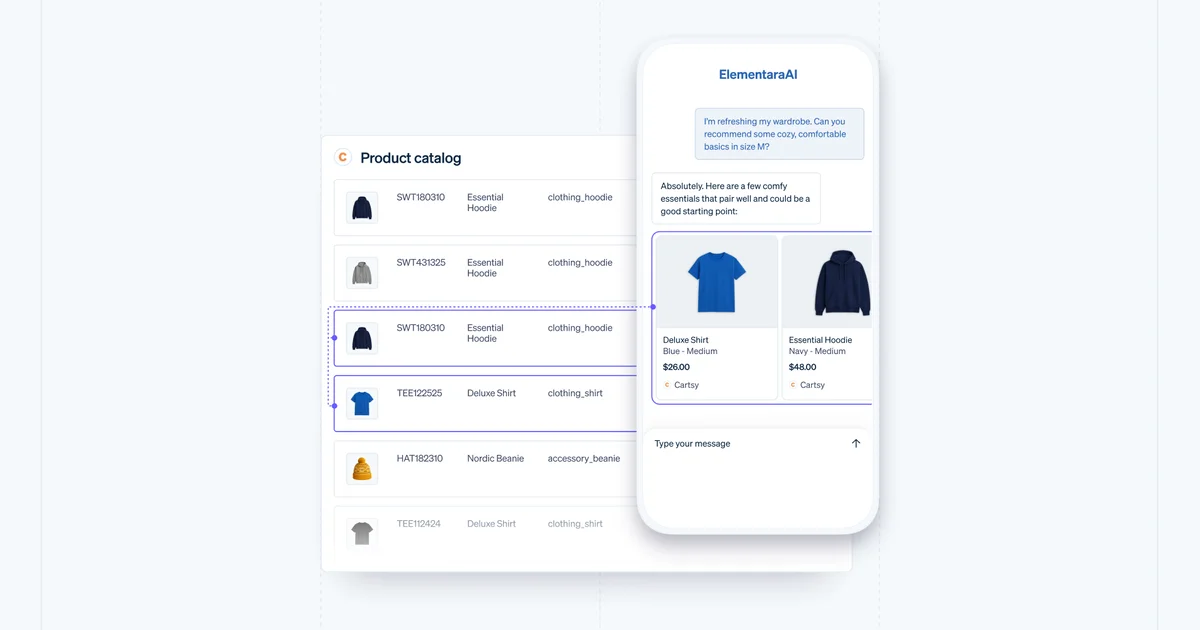
Agentic Product Enrichment (the optimization layer). This component automatically transforms catalogs into formats LLMs can understand, compare, and recommend. It rewrites titles and descriptions, generates contextual attributes, and creates agent-readable metadata. The engine underneath is Mirakl's Catalog Transformer, built on more than ten commerce-specialized generative AI models and proven across 47 million product transformations at a 98% success rate. Mirakl also references BCG data showing AI-referred visitors spend 32% more time on site, browse 10% more pages, and bounce 27% less than traditional traffic.
Agentic Channels (the connectivity layer). Rather than building integrations for each LLM, Mirakl abstracts the connection layer. Inventory, pricing, and delivery data sync automatically; evolving commerce protocols are handled centrally; orders generated on LLM surfaces flow into existing order management systems. The launch focus is direct integration with Microsoft Copilot, with the agent able to complete the transaction end-to-end including inventory checks, fulfillment, and after-sales.
What stands out is that LLM-driven sales feed naturally into a merchant's existing back-end workflow. Not having to rebuild order management lowers the barrier for enterprise adoption considerably.
Where Topsort and Feedonomics Fit
Three significant announcements arrived inside a single week, and once you sort them out the layers become visible.
Topsort's Sponsored Prompts, launched April 22, 2026, is positioned as the first agent-native ad format. Through a dedicated MCP server it parses shopper prompts semantically and matches them with relevant advertiser campaigns, blending sponsored and organic product tiles. It reuses the sponsored listings auction infrastructure marketplaces already operate, extending retail media monetization into chat surfaces.
Feedonomics' Agentic Catalog Exports (ACE), released April 27, 2026, is an enterprise service that delivers product data to OpenAI/ChatGPT, Google Gemini, Microsoft Copilot, Perplexity, PayPal, Stripe, and Amazon. Dell is an early adopter, with roughly 7,000 SKUs prepared for AI-driven discovery surfaces. Backed by the BigCommerce ecosystem, Feedonomics is anchoring the upstream pipeline of data transformation and syndication.
Mirakl, building on its marketplace SaaS foundation and seller network, fuses discovery optimization with sales connectivity. If Topsort owns conversational monetization (advertising) and Feedonomics owns catalog syndication (pipeline), Mirakl unifies both inside the marketplace operator's context. The three companies look less like competitors and more like firms staking out distinct standards on adjacent layers.
Ana Luisa as Proof Point and Why Copilot First
Mirakl's blog quotes Adam Bohbot, co-founder of jewelry DTC brand Ana Luisa: "With Agentic Activation, we've enriched our catalog with a new set of attributes that make our products more discoverable, and for the first time, shoppable directly through an AI channel like Copilot."
Starting with Microsoft Copilot is a deliberate choice. Microsoft's own data indicates Copilot-driven shopping journeys are 194% more likely to result in a purchase. AI-referred traffic tends to arrive with stronger intent and exhibit better engagement metrics across multiple studies.
Mirakl Connect's curated network of more than 100,000 sellers and over 450 retail and brand customers becomes, from the agent's perspective, a single supply source spanning a vast assortment. AI agent exploration favors marketplace structures over single-merchant catalogs. Agentic Activation effectively packages that structural advantage into a buyable product.
Implications for Marketplace Operators and Brands
Now the practical part for your own roadmap.
LLM-readability of product data must move to the top of the agenda. Only 9% of pages currently carry machine-readable structured data, which means addressing it puts you in the top 9% almost by default. Attribute completeness, image metadata, reviews, and Q&A are the starting points. Mirakl's free GEO Commerce Analyzer lets you score your own pages, which is the most concrete first step.
Agentic SEO and Agentic SEA now belong on the same roadmap. Mirakl Agentic Activation handles organic discovery optimization while Topsort Sponsored Prompts addresses paid placement on conversational UIs. Together they recreate the SEO/SEA dual approach for the agentic era, and marketplace operators benefit from evaluating both in parallel.
Choose protocols with vendor lock-in in mind. With ACP, UCP, MCP, and various proprietary implementations coexisting, an orchestration layer that bundles multiple channels — like Mirakl Agentic Channels or Feedonomics ACE — provides better resilience than committing to a single LLM or protocol. The selection criteria for marketplace SaaS and feed management SaaS are increasingly defined by AI channel coverage.
Conclusion
The arrival of Mirakl Agentic Activation marks the moment agentic commerce shifted from proof-of-concept to production. More than 98% of product data is unprepared, Gartner forecasts a structural decline in search traffic, and McKinsey sees a $3-5 trillion market opening. Three pressures rising in parallel push marketplace operators to design discovery, connectivity, and monetization as one system.
The fact that Topsort, Feedonomics, and Mirakl all landed decisive moves in the same April reveals the shape of the market. Their respective standards complement more than they compete, and the winners will be operators who first articulate how to assemble the three layers into one coherent stack. Mirakl's repeated framing of itself as "neutral infrastructure" reflects the broader truth: the bridge between AI agents and merchants is becoming a layer that belongs to no single player and could belong to several. For e-commerce businesses, the realistic move is to measure discoverability today and start work on the catalog at hand. The next six months will be decided there.