AI Commerce News Digest (May 27, 2026)
Alipay launches AI Wallet and Token Pay for shopping agents, Stord raises $250M at a $3B valuation for physical-AI commerce, Coinbase ships a new MCP for the Base network, Mastercard and AWS detail agent payment infrastructure, and Global-e acquires Passport for $350M — a digest of EC and agentic commerce news for May 27, 2026.


Key Takeaways
- Alipay unveiled its next-generation AI payment infrastructure, AI Wallet and Token Pay, enabling shopping agents to pay on behalf of consumers. Following Visa, Mastercard, and Stripe, China's payment giant has now entered the race to define agent payment infrastructure
- Stord raised $250M at a $3B valuation to expand its AI- and robotics-driven "Physical AI" commerce platform. Positioned as an Amazon alternative, it offers brands a fulfillment network that lets them stay competitive while owning their customer relationships
- From Coinbase's MCP for Base, to Mastercard's agentic commerce vision, AWS's AgentCore payments deep dive, and the "KYC to KYA" trust-layer debate, agent payment infrastructure dominated the day's announcements
Today's Top Stories
Alipay unveils next-generation AI payment infrastructure, AI Wallet and Token Pay, for shopping agents

Alipay added AI Wallet and Token Pay for agent shopping, as payment teams face new trust, fraud, and authorization questions.
www.techrepublic.comAnt Group's Alipay announced next-generation payment infrastructure, "AI Wallet" and "Token Pay," that enables AI agents to shop and pay on behalf of consumers. The system supports the flow where shopping agents discover and compare products and then execute payment, addressing authorization, identity verification, and fraud prevention.
This announcement matters because China's massive payment platform has now formally joined the standardization race led by Western players such as Visa (Intelligent Commerce), Mastercard (Agent Pay), and Stripe. With over a billion users and a vast merchant network, Alipay is positioned to shape the direction of agentic commerce payments across Asia.
For merchants, this means the question of "which payment infrastructure to support" for agent-driven transactions will increasingly diverge by region.
Full article: Alipay unveils AI Wallet and Token Pay — the front line of the agent payment infrastructure race
Stord raises $250M at a $3B valuation — an Amazon-alternative "Physical AI" commerce platform

Stord offers a network of physical warehouses and inventory management software for e-commerce. It bills itself as a sort of anti-Amazon, giving brands the speed to compete while still owning their customer relationships.
techcrunch.comE-commerce fulfillment and inventory management platform Stord raised a $250M Series F at a $3B valuation, to be used to expand its AI- and robotics-driven "Physical AI" commerce platform.
Stord combines a network of physical warehouses with inventory management software and positions itself as an "anti-Amazon." It pitches brands on getting the delivery speed they need to compete without depending on Amazon FBA, while retaining ownership of their customer relationships.
In an era where agentic commerce makes demand harder to forecast, investment is accelerating in logistics infrastructure that supports delivery speed and inventory optimization. Alongside the payment-side moves, this shows the "execution layer" of commerce is getting thicker.
Full article: Stord raises $250M at a $3B valuation — how "Physical AI" is changing EC logistics
Payments & Agent Payment Infrastructure
Coinbase strengthens AI payments with new MCP for the Base network

The launch is the latest development in the fast-emerging world of agentic commerce being built by Stripe, Coinbase and others.
fortune.comCoinbase released a new MCP (Model Context Protocol) for its Layer 2 blockchain "Base," deepening its push into AI payments. The system lets AI agents execute payments in crypto and sits within the fast-emerging agentic commerce landscape being built by Stripe and others.
MCP is a common standard for AI models to interact safely with external tools and services. Applying it to blockchain payments lays the groundwork for agents to make payments programmatically. Crypto-based agent payments are seen as a good fit for small, high-frequency machine-to-machine transactions.
Standardization of agent payments is advancing on both the card rails (Visa, Mastercard) and the crypto side. For merchants, this is a signal of which payment rails agents will ride on.
Full article: Coinbase releases MCP for Base — how AI agent payments work
From KYC to KYA — the new trust layer in AI commerce

The shift from Know Your Customer to Know Your Agent as the new trust layer for AI commerce.
www.unite.aiUnite.AI published an analysis on the shift from traditional identity verification, "KYC (Know Your Customer)," to "KYA (Know Your Agent)," which verifies an AI agent's identity, permissions, and trustworthiness. The argument: agentic commerce needs a new trust layer to confirm "who (which agent) is transacting."
In a world where AI agents pay on behalf of humans, mechanisms to verify whether an agent is legitimate, how much authority it has been delegated, and that it is not impersonating someone become essential. While the means of executing payments are being built out, the framework for trusting the transacting party is still being established.
For merchants and payment providers, agent authentication becomes a new front in fraud prevention and user protection. Trust-layer design is being questioned in parallel with payment infrastructure.
Full article: From KYC to KYA — the mechanism for "trusting agents" in AI commerce
Mastercard presents its vision for trusted agentic commerce

Mastercard is advancing agentic commerce with AI agents, secure payments and trusted technology for smarter, more personalized transactions.
www.mastercard.comMastercard formally laid out its vision for "trusted agentic commerce," combining AI agents, secure payments, and trusted technology. The direction: smarter, more personalized transactions delivered while safeguarding security.
It was also reported that Mastercard is deepening ties with JD.com and Amazon to drive AI commerce growth. The payment network giant is beginning to map how it applies its tokenization and authentication technology to agent transactions.
Following the May 25 coverage of Mastercard's research on customer experience and agentic AI expectations, the company's agentic commerce strategy is taking on a more concrete shape.
AWS publishes a technical deep dive on AgentCore payments and agentic commerce
A technical deep dive on AgentCore payments and innovation in agentic commerce.
aws.amazon.comAmazon Web Services (AWS) published a technical deep dive on payment capabilities in its agent development platform "AgentCore" and on innovation in agentic commerce. The piece explains, for developers, implementation patterns for AI agents to execute payments safely.
While payment platforms announce their "mechanisms," AWS shows how payments are embedded as infrastructure on the side that builds and operates agents. It signals that payments are becoming a standard feature in agent development.
With payment rails and development platforms advancing in tandem, the barrier to implementing agentic commerce keeps falling.
AI Commerce Tools
Alibaba International's PicCopilot partners with Google Ads to boost e-commerce ROI

Alibaba International announced that its AI-powered creative platform PicCopilot has integrated with Google Ads.
www.prnewswire.comAlibaba International announced that its AI-powered creative platform "PicCopilot" has integrated with Google Ads. The partnership automates ad creative production for merchants and aims to improve ad ROI.
The flow generates ad creatives from product images via AI and connects them directly to Google Ads delivery. It reduces the effort and cost of creative production while speeding up ad operations. The move to embed AI into ad operations is spreading across platforms.
Thrad x Cursor host first ad tech hackathon on agentic commerce infrastructure

Thrad and Cursor are hosting a hackathon on agentic commerce this month with over 150 developers and founders.
www.exchangewire.comAd tech company Thrad and AI code editor Cursor are co-hosting the first ad tech hackathon themed on agentic commerce infrastructure. More than 150 developers and founders will build products over a single evening.
It shows that agentic commerce has become a subject of experimentation not just for payments and platforms but for the developer community. At the intersection of advertising, commerce, and AI, fertile ground is forming for new tools and protocols.
Global EC Trends & Companies
Global-e acquires cross-border logistics firm Passport for $350M
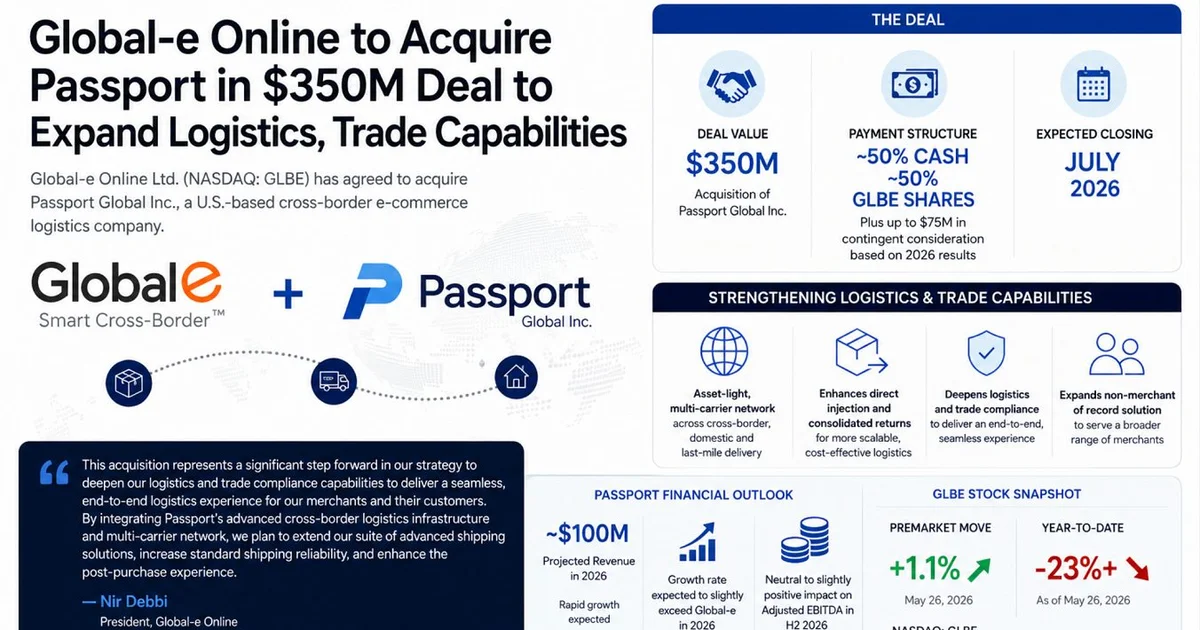
Global-e Online to acquire Passport in a $350M deal to expand logistics and trade capabilities.
www.citybiz.coCross-border commerce solution provider Global-e Online announced it will acquire U.S. cross-border logistics firm Passport for $350M, aiming to enhance logistics capabilities and the post-purchase experience.
Global-e is a platform that powers brands' cross-border sales, and this acquisition brings logistics layers such as shipping, returns, and customs handling in-house. It signals that the competitive axis in cross-border commerce is broadening from front-end sales enablement to total logistics-and-experience capability.
China's AI super apps redefine e-commerce, exposing how far the rest of the world lags
China's AI-powered super apps are redefining e-commerce and why the world needs to take note.
www.campaignasia.comCampaign Asia published an analysis on how China's AI-powered super apps are redefining the e-commerce experience and how far other countries lag behind. It highlights the sophistication of the Chinese model, where payments, delivery, content, and AI are integrated within a single app.
Super apps complete everything from discovery to payment as a single experience. In a sense, China has already implemented the "seamless purchasing" that agentic commerce aims for, via a different approach. For global merchants, China's experience design is a leading reference point.
G2A x Juniper Research predict "Trust Advantage" as the next growth driver
G2A and Juniper Research predict 'Trust Advantage' as the next growth driver in global digital commerce.
mcvuk.comDigital-product marketplace G2A and research firm Juniper Research published a joint report predicting that the next growth driver in global digital commerce will be "Trust Advantage."
As fraud, misinformation, and opacity become challenges, the view is that businesses able to guarantee trustworthiness will gain a competitive edge. The theme resonates with today's KYA (Know Your Agent) debate: in agent-era commerce, "trust" is becoming a core competitive resource.
JD.com weighs acquisition of UK's Very Group (follow-up)

Chinese e-commerce giant JD is evaluating a potential £2 billion bid for the British online shopping platform The Very Group.
insideretail.asiaChinese e-commerce giant JD.com is reportedly evaluating a roughly £2 billion bid for UK online retailer The Very Group, according to follow-up reports. It is part of the European push by Chinese platforms following Temu and SHEIN.
The plan uses an established UK retail asset as a foothold to strengthen cross-border commerce and local logistics. Still at the speculative stage, it would affect competition in the UK's EC and logistics markets if realized.
Conclusion
Today's EC and agentic commerce landscape centered on Alipay's AI Wallet and Token Pay launch and Stord's large raise at a $3B valuation. Big moves came in two layers that underpin commerce: the payment "mechanism" and the logistics "execution capability."
In payments especially, Alipay, Coinbase, Mastercard, and AWS stacked announcements on the same day, making clear that standardization is advancing from multiple directions — card rails, crypto, and cloud development platforms. Alongside, debates over frameworks for trusting agents, such as "KYC to KYA" and "Trust Advantage," have surfaced. The more the means of executing payments mature, the more the trust layer for verifying the transacting party matters.
What to watch next: how Alipay's China-style agent payments connect with or compete against Western standards, and who standardizes trust layers like KYA. The twin wheels of payments and trust will determine the pace at which agentic commerce gets implemented.