Stord Raises $250M Series F at a $3B Valuation: Inside Its Robotics-Powered Physical Intelligence Layer and the Anti-Amazon Bet
E-commerce logistics startup Stord raised $250M at a $3B valuation to build the Physical Intelligence Layer for commerce with Stord Labs. We break down its AI- and robotics-driven anti-Amazon model that lets brands keep their customer relationships.


Key Takeaways
- E-commerce logistics company Stord raised $250M in a Series F at a $3B valuation, doubling its valuation in a single year and bringing its total funding to roughly $775M
- Alongside the round, Stord opened Stord Labs at its Atlanta headquarters to validate agentic AI and robotics on its live fulfillment network, putting Physical Intelligence at the center of its strategy
- As an anti-Amazon alternative, Stord lets brands keep their customer relationships and data while gaining Prime-level speed, a model drawing fresh attention in the AI commerce era
Why Stord doubled its valuation in a year

Stord offers a network of physical warehouses and inventory management software for e-commerce. It bills itself as a sort of anti-Amazon, giving brands the speed to compete while still owning their customer relationships.
techcrunch.comOn May 26, 2026, Stord, which runs a fulfillment and inventory management platform for e-commerce, announced that it had raised a $250M Series F round at a $3B valuation. Given that its round a year earlier valued the company at $1.5B, this represents a doubling of its valuation in just twelve months.
The round was led by Strike Capital, which doubled down after leading the prior round, with participation from Kleiner Perkins, Founders Fund, Franklin Templeton, Baillie Gifford, G Squared, Bond, and Lux. Stord was founded in 2015 by Sean Henry and Jacob Boudreau while they were students at Georgia Tech, and reached unicorn status in 2021. The new capital brings its total funding to roughly $775M.
The timing is worth noting. Stord's revenue has grown about 10x over the past four years, but the company says the inflection point arrived in 2023, roughly six months after the launch of ChatGPT. The read here is that the AI boom is acting as a tailwind even for a business rooted in the deeply physical world of logistics.
What the Physical Intelligence Layer means
The concept Stord put front and center with this raise is the Physical Intelligence Layer for Commerce. It refers to a system that combines agentic AI, robotics, and advanced automation to continuously make warehouse operations smarter, faster, and cheaper.
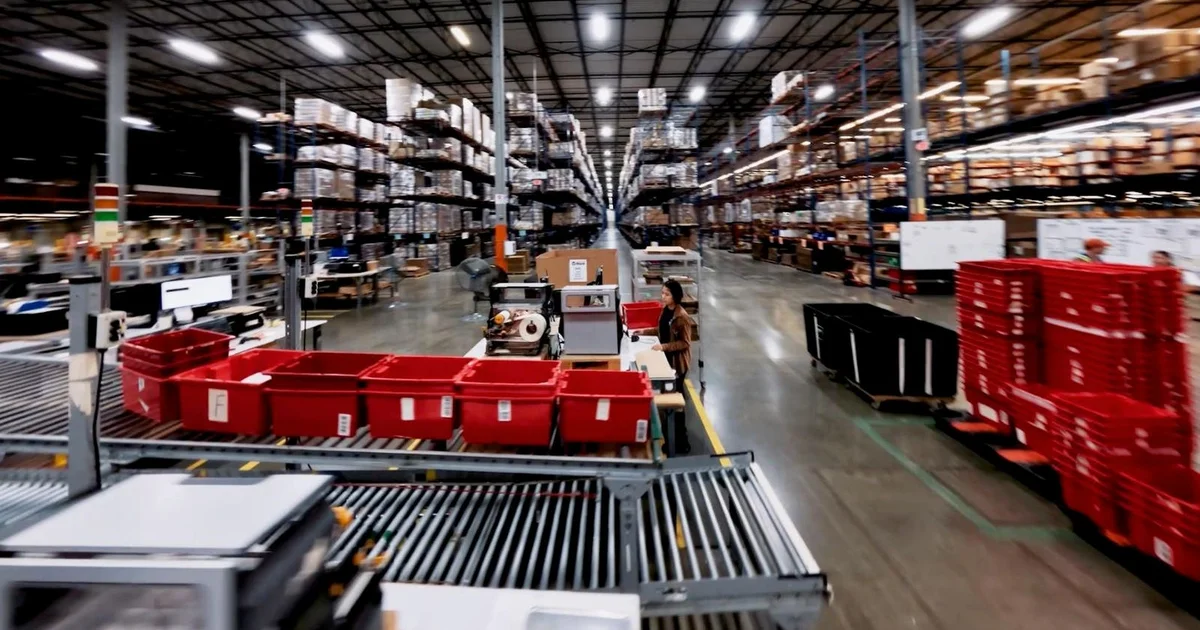
The venue for putting this into practice is the newly created Stord Labs at its Atlanta headquarters. There, new AI and robotics are validated against real orders, running on the same live operating system that powers the production network. Rather than a closed research environment, the approach tests innovations under near-production conditions, and proven technologies can be deployed across nearly 100 facilities immediately, with no re-integration.
Underpinning this physical intelligence is the vast data Stord handles. It uses 8 billion annual data points drawn from $15B in annual GMV to continuously train models that optimize operations. Because Stord owns both the software and the physical facilities in a vertically integrated stack, the logic is that digital intelligence can flow directly into real-world warehouse work. Stord now employs more than 4,000 people, with over 200 dedicated to software engineering, data science, and physical infrastructure.
Why it calls itself anti-Amazon
There is a reason Stord repeatedly positions itself as a sort of anti-Amazon. For many brands, fulfillment has effectively offered only two choices: hand operations to Amazon's marketplace and give up customer data, pricing control, and margin, or build a logistics network from scratch on their own.
What Stord offers is a third path that sits between the two. It bundles a network of about 100 facilities and inventory management software into a shared layer, opening up the warehouse density, software integration, and AI-driven inventory management that normally only the largest retailers can afford to independent brands. Sean Henry has said that every independent brand has been left to figure out on its own how to compete against Amazon.
| Dimension | Handing fulfillment to Amazon FBA | A Stord-style fulfillment platform |
|---|---|---|
| Customer data and relationship | Amazon holds it; brands struggle to know who their buyers are | Brands keep the customer relationship and data for re-engagement and cross-sell |
| Delivery speed | Enjoys Prime-level speed | Prime-rivaling speed delivered under the brand's own name across ~100 facilities |
| Margin and control | Subject to fees and marketplace rules | Brands keep full margins and control over pricing and experience |
The decisive point here is that brands get to keep the customer relationship and data. Selling through Amazon obscures who the buyer is, making re-engagement, related-product suggestions, and loyalty building harder. In Stord's model, brands can deliver Prime-rivaling speed while never letting go of the customer relationship, the data, and full margins. Reconciling speed with control is the heart of the value proposition.
How the AI interface drove renewed attention
A large part of why Stord is back in the spotlight at this moment is that it added an AI interface to its software. By letting customers operate and analyze inventory, order, and shipping data through AI, the company accelerated the growth of its software business.
That momentum shows up in the numbers. Stord's software business tripled in 2025 and is growing faster than the company overall. New bookings then more than doubled quarter over quarter in Q1 2026, as reported. Within a heavy, capital-intensive business, software and AI are clearly becoming the growth engine.
Stord was also showcased as a notable startup at Google Cloud Next in April 2026. AI agents are working their way into the logistics floor, intelligently handling everything from demand forecasting to inventory placement and shipping decisions. As a frontier of this physical AI commerce, Stord is drawing the attention of investors and the broader tech industry alike.
What this means for e-commerce operators
This news is more than a story about a far-off U.S. funding round. In an era where AI agents are starting to mediate purchasing and discovery, it shows that fulfillment is becoming not just a cost center but a source of competitive advantage and brand experience.
The question Stord's strategy poses is clear: are you giving up your touchpoints and data with customers in exchange for logistics efficiency? Relying on a marketplace delivers speed and reach, but it can dilute the single most valuable asset, customer understanding. The more that AI-driven personalization and re-engagement become the basis of competition, the heavier the question of who holds the customer data grows.
At the same time, the idea of a physical intelligence layer points toward operating software and hardware (warehouses and robots) as one integrated whole through data, rather than keeping them apart. For e-commerce operators everywhere, it is an invitation to reframe how they work with 3PLs and marketplaces, not only around cost optimization but around control of the customer relationship.
Conclusion
Stord's $250M raise illustrates how the AI boom has rippled all the way into the physical domain of logistics, generating enough growth to double a valuation in a single year. The keys are a Physical Intelligence Layer that refines agentic AI and robotics on a live network, and an anti-Amazon value proposition that lets brands hold on to their customer relationships.
Discussion of AI commerce tends to cluster around checkout and discovery experiences, but the same AI wave is washing over the fulfillment side that quietly, reliably, quickly, and cheaply gets orders to the door. The challenge of reconciling speed with customer control offers a useful lens for any e-commerce operator rethinking dependence on a marketplace to audit their own logistics strategy.