AI Commerce News Digest (June 25, 2026)
Google/IBM/Circle back the Legal Context Protocol, Salesforce Agentforce Commerce delivers revenue, Forter launches new AI agents, Pinterest tests AI shopping, plus Prime Day's record first day and India's quick-commerce war. The key June 25 stories, explained.

Key Takeaways
- Google, IBM, and Circle introduce the Legal Context Protocol, giving AI-agent transactions verifiable legal terms and dispute resolution
- Agentforce Commerce revenue results and Forter's new agents show agentic commerce moving into the implementation-and-operations phase
- Sensor Tower reports ChatGPT hitting 1 billion MAU and Prime Day's first day reaches $8.3 billion, data showing AI reshaping the entry point of purchasing
Today's Top Stories
Google, IBM, and Circle Back the Legal Context Protocol

A coalition including Google, IBM, and Circle introduced the Legal Context Protocol (LCP), an open standard providing a legal framework for AI-driven commerce.
pluang.comA coalition including Google, IBM, and Circle has introduced the Legal Context Protocol (LCP), an open standard that gives AI-driven transactions a legal framework. As AI agents increasingly handle negotiation, procurement, and payment autonomously, LCP aims to embed verifiable contract terms, governing law, and dispute-resolution mechanisms into each transaction.
Until now, the agentic commerce conversation has centered on the "money and identity" layers of payment and authentication. LCP adds a legal layer that answers the question of who bears responsibility, under which jurisdiction. It complements existing protocols such as UCP, MCP, and Agent Pay rather than replacing them.
With AI expected to intermediate enormous volumes of commerce, ambiguity over liability keeps enterprises from full adoption. Building legal certainty in as a standard could be a crucial foundation for moving agent transactions from experiment to everyday operation.
Full article: What Is the Legal Context Protocol (LCP)? Why Google, IBM, and Circle Are Adding Legal Liability to AI-Agent Transactions
Agentic Commerce
Salesforce's Agentforce Commerce Moves From Hype to Revenue

Salesforce's Agentforce Commerce shifts agentic AI from hype to results, with retailers deploying shopper agents achieving 59% faster sales growth.
futurumgroup.comResearch firm Futurum published a report describing Salesforce's Agentforce Commerce as a move that pushes agentic AI from hype to real revenue. It cites figures showing significantly faster sales growth among retailers that deploy shopper-facing agents.
The key point is that the story is told in concrete business metrics rather than demos or proofs of concept. By having AI agents assist across discovery, add-to-cart, and support, the claim is that conversion and average order value improve. Salesforce's existing Commerce Cloud and Service Cloud base also lowers the friction of adoption.
It signals the agentic commerce conversation shifting from "does it work" to "how much does it move." For merchants, the next operational question is how to embed agents into their own data and workflows to drive results.
Full article: What Is Salesforce Agentforce Commerce? How Agentic AI Drives Real Retail Revenue and the Keys to Deployment
Forter Introduces Five New AI Agents, Modernizing Commerce Fraud Defense

Forter launched Forter Agents and early access to the Forter Model Context Protocol for commerce modernization.
www.prnewswire.comFraud-defense platform Forter announced Forter Agents, a set of five new AI agents, plus early access to Model Context Protocol support for data flows. It extends domains such as payment approval, chargeback defense, and identity verification toward autonomous, agent-driven judgment and execution.
In an era when AI agents transact on behalf of users, a trust layer that verifies "is a genuine user really requesting this transaction" becomes essential. Forter learns fraud signals from large volumes of transaction data and now opens that judgment capability externally as agents.
As with Mastercard Agent Pay and Visa's fraud solutions, the spread of agentic commerce is a new growth area for payment, authentication, and fraud-defense players. The picture of attacking AI and defending AI advancing in tandem is becoming clearer.
Full article: Forter Introduces Five New AI Agents: The Push to Automate Fraud Defense in AI Commerce
Nudge Raises $1.1M, Launches Agentic Commerce Platform for Consumer Brands
Nudge launched an agentic commerce platform for consumer brands alongside a $1.1M pre-seed round.
natlawreview.comStartup Nudge raised a $1.1M pre-seed round and simultaneously launched an agentic commerce platform for consumer brands. It helps brands structure their product data and inventory to be discovered and purchased through AI agents.
As products are increasingly recommended and bought through ChatGPT and other AI assistants, brands need a new kind of optimization to be "picked up correctly by AI." Tools like Nudge are emerging as the bridge for that.
Though a small pre-seed deal, it illustrates startup capital flowing into the edges of agentic commerce. A market for supply-side optimization tools is taking shape.
AI Commerce Tools
Pinterest Launches Ask Pinterest, Testing AI Personalized Shopping

Pinterest launches Ask Pinterest and new AI tools (MCP, Business Assistant) to transform product discovery.
www.ecommerce-nation.frPinterest announced Ask Pinterest, a new feature testing AI-powered personalized shopping. It also rolled out MCP support for external AI integration and a Business Assistant for advertisers.
Pinterest has long been strong as a place for discovering products and ideas. Layering conversational AI search on top aims to connect visual-led discovery through to capturing purchase intent in one flow.
As social and content platforms race to add AI shopping features, Pinterest leans on its discovery experience as its edge. It is another sign that the "places" where AI meets products keep expanding beyond search engines and chat.
Consumer Trends
Sensor Tower "State of AI 2026": ChatGPT Hits 1B MAU as AI Quietly Rewires E-Commerce
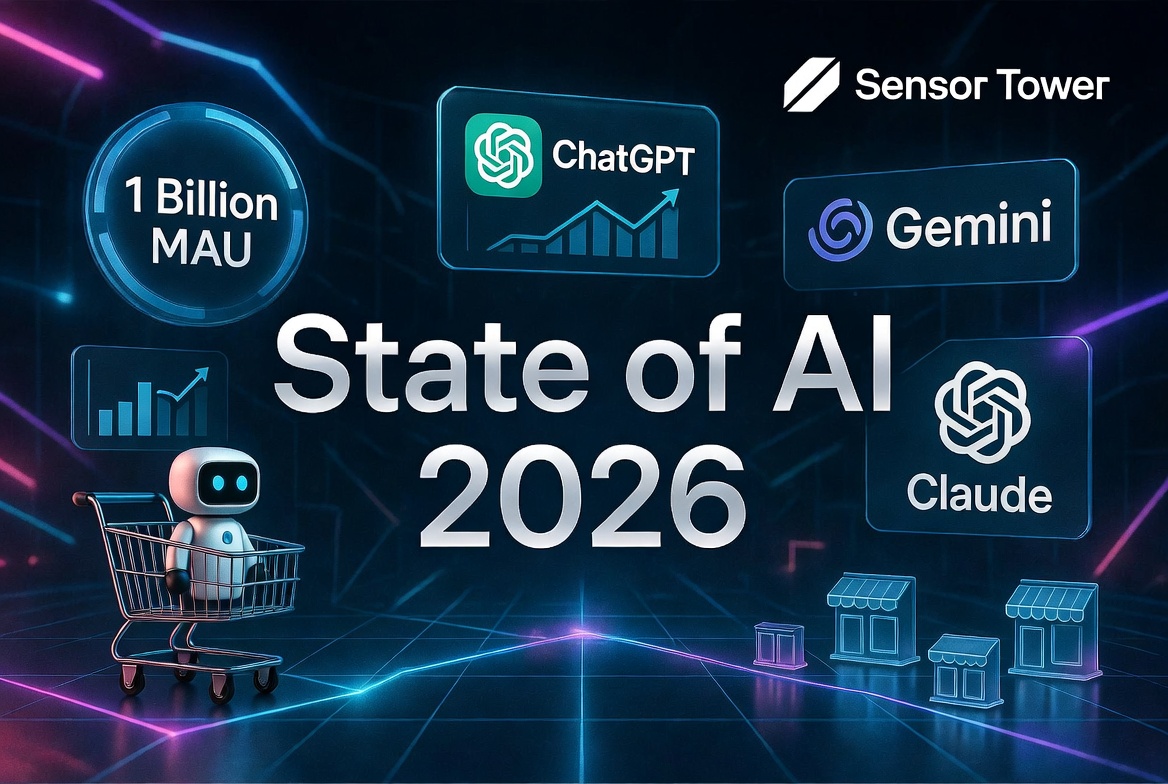
Sensor Tower released its State of AI 2026 report, an interactive 70+ page document on AI's reshaping of e-commerce.
quasa.ioApp-analytics firm Sensor Tower published its 70-plus-page "State of AI 2026" report. It shows ChatGPT reaching 1 billion monthly active users at record speed while AI quietly remakes the back end of e-commerce, backed by data.
The report depicts a behavioral shift in which consumers begin their product search through AI assistants. As more traffic bypasses search engines and in-app search, brand visibility can no longer be secured by traditional SEO or app optimization alone.
ChatGPT's vast user base means the potential "storefront" for agentic commerce has expanded dramatically. How to capture and optimize AI-driven traffic is becoming an unavoidable issue for merchants, in both measurement and strategy.
Global E-Commerce
Amazon Prime Day's First Day Hits $8.3B, the Biggest Online Shopping Day of 2026

Data from Adobe indicates the first day of Amazon Prime Day was the biggest U.S. e-commerce day so far in 2026.
chainstoreage.comAccording to Adobe, U.S. online spending on the first day of the moved-up Amazon Prime Day reached $8.3 billion, up 5% year over year, making it the biggest online shopping day of 2026 so far. Even amid talk of membership saturation, sale demand remains strong.
This Prime Day is also being watched as a bellwether for how AI-assistant-driven purchases and chatbot product suggestions affect spending. The question is how far the flow of AI nudging discovery through checkout shows up in the headline numbers.
While the scale of the sale itself is intact, the structure of traffic sources is quietly changing. Echoing Sensor Tower's findings, the biggest shopping event is beginning to confirm AI's encroachment on the entry point of purchasing.
Amazon CEO Visits India to Scale Amazon Now to 300 Cities; Flipkart Ramps Up Too

Walmart-backed Flipkart has crossed 1,000 micro-fulfillment centers as Amazon accelerates its own quick-commerce push in India.
techcrunch.comAmazon CEO Andy Jassy visited India and announced plans to expand the Amazon Now quick-delivery service to more than 300 cities. In response, Walmart-owned Flipkart, ahead of its IPO, has built out more than 1,000 micro-fulfillment centers and is pushing hard on quick commerce.
India's quick-commerce market has become a fierce battleground competing on deliveries within tens of minutes. Amazon and the Walmart camp are each pouring in their logistics networks and capital to grab territory.
Quick commerce is won or lost on inventory placement and last-mile efficiency. It is also an area where AI-driven demand forecasting and dispatch optimization matter, and the giants' investments are lifting the sophistication of the whole infrastructure.
Lazada Cuts 5% of Southeast Asia Workforce

E-commerce companies are laying off staff, reflecting industry maturation and the growing influence of AI.
www.straitstimes.comAlibaba-owned Lazada is reported to be cutting about 5% of its Southeast Asia workforce. Analysts read the move as a sign of the e-commerce sector's maturation rather than decline.
Behind it is progress in efficiency gains from AI and automation. The view is that with AI taking over customer support and operational tasks, headcount structures are being reassessed. It signals Southeast Asian e-commerce moving past its rapid-growth phase into a profitability-focused stage.
The shift from scale expansion toward AI-centered efficiency is common across e-commerce platforms. Employment adjustments are painful, but the industry overall is in a transition toward AI-native operations.
Conclusion
June 25 was a day when agentic commerce advanced a step from "concept" to "implementation and operation." The Legal Context Protocol stepped into the new layer of legal liability for transactions, while Agentforce Commerce and Forter's new agents framed AI's value in the practical metrics of revenue and fraud defense.
Running through it all is the keyword "trust." Forter's fraud defense and LCP's legal framework both point toward building the foundation for delegating transactions to AI. Going forward, watch how these trust layers translate into actual purchase and payment data, and how far AI-driven purchasing grows in sales events like Prime Day.