Marriott's Ask Bonvoy and the Channel Question: Do AI Agents Threaten OTAs, or Install New Intermediaries?
Marriott pairs the Ask Bonvoy launch with a direct-booking integration inside Google's AI Mode while its CEO argues AI agents threaten OTAs, not hotels. What travel's channel realignment teaches retailers about negotiating AI-channel terms, fees, and data ownership.


Key Takeaways
- Marriott launched its conversational AI search Ask Bonvoy in beta, and its CEO argues that AI booking agents threaten OTAs rather than hotels. An integration that processes bookings as direct sales inside Google's AI Mode is also being built
- Price comparison and referral, the OTA's core functions, overlap head-on with what AI agents do. Yet Google and ChatGPT could just as easily become the new intermediaries, so the channel structure itself is being rewired
- For operators, the question is no longer whether to connect to AI channels but on what terms: where the transaction is processed, who owns the customer data, and how exposure is paid for
The Channel Strategy Behind Ask Bonvoy
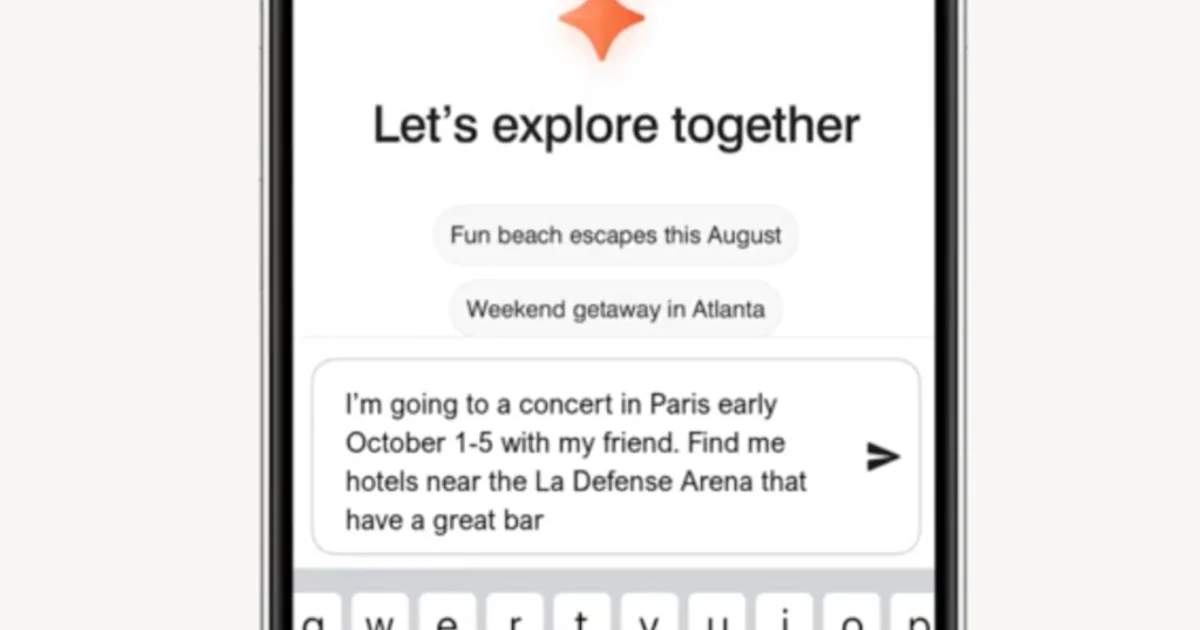
Marriott unveiled the beta launch of Ask Bonvoy, a conversational AI-powered search experience for nearly 10,000 properties in 146 countries.
loyalty360.orgOn June 16, 2026, Marriott International announced the beta of Ask Bonvoy, a conversational AI search covering roughly 10,000 hotels across 146 countries and territories. The rollout starts in U.S. English on Marriott.com and the iOS and Android apps, available to a subset of members. How the product works as a discovery engine, including its decision to ground every answer exclusively in Marriott's own verified property data, is something we unpacked in a separate article.
This piece is about the channel dynamics around it. About a week after the announcement, on June 24, CEO Anthony Capuano argued in a Wall Street Journal interview that the rise of AI booking agents threatens online travel agencies rather than major hotel brands. OTAs such as Booking.com and Expedia aggregate large numbers of properties, broker comparison and reservations, and earn commissions on the bookings they intermediate.
Read together, Ask Bonvoy stops looking like a standalone feature and starts looking like one move in a channel strategy. A supplier that owns the product is using the arrival of AI as a new discovery path to renegotiate its balance of power with intermediaries. For retailers and e-commerce operators who have wrestled with marketplace and search-engine dependency, this is not someone else's story.
AI Agents Overlap Head-On with What OTAs Do
There is structural logic behind Capuano's read. An OTA's value boils down to aggregating options, comparing them against a traveler's criteria, and handling the booking. Agentic commerce, meanwhile, describes the model in which an AI agent searches, compares, and completes purchases on the user's behalf. An agent that finds a matching stay and carries the arrangement through performs almost exactly the OTA's brokerage function. The business of building and operating hotels remains; it is the layer built on comparison and referral that takes the direct hit from agentification.
Capuano had set up this argument earlier in the year. On the February 2026 earnings call, he described AI as an opportunity to potentially redefine the customer-acquisition paradigm that has governed the sector for decades. Hotels have long paid steep distribution costs for bookings that arrive through search engines and OTAs. If the entry point of discovery moves to AI, the economics of customer acquisition are up for renegotiation.
Investors have started pricing in the same picture. In February 2026, as major chains revealed their agentic plans, Booking Holdings' share price fell roughly 30% over a few weeks, despite a strong earnings report shortly before. Concern about the future value of the intermediary layer surfaced directly in the stock.
The direction of force is not settled, though. That same February, Marriott and Hilton formally flagged in their annual filings a new risk: AI platforms like ChatGPT could steer guests toward OTAs and drive up distribution costs. Hilton's disclosure warned that the entry of major technology platforms, such as large language models, into travel bookings could divert reservations away from direct channels and raise the cost of sales. The CEO talks up the bullish read while the lawyers disclose the opposite risk. Will AI agents weaken intermediaries, or will AI become a new referral pipe that strengthens them? Because both remain plausible, Marriott is placing several bets at once.
Three Moves: Defending Direct, Connecting to External AI, Advertising Inside AI
Ask Bonvoy is the defensive move for the owned channel. It puts the first touchpoint of search inside Marriott's own site and apps, aiming to complete the journey from discovery to booking as a direct sale. A base of nearly 283 million Bonvoy members is what makes investing in a proprietary entry point rational. The company plans roughly $1.1 billion in investment spending in 2026, with more than a third of it going to digital technology transformation.
Toward external AI channels, the response is connection rather than blockade. Google's AI Mode added travel-planning capabilities announced in November 2025, letting users state what they want in plain language and move from suggestions toward arrangements within the conversation. On the February earnings call, Capuano revealed that Marriott began working with Google to design a priority search experience that facilitates bookings through AI Mode, with the booking processed inside AI Mode itself. Instead of ending in a link referral, the reservation is meant to land in Marriott's own booking systems and count as direct. One caveat: this integration was under construction as of the announcement, not a live autonomous payment agent.
On the advertising front, Marriott is participating in OpenAI's ChatGPT ad pilot in the U.S., securing sponsored exposure inside an external AI surface for users who never reach its own entry point. Defend with owned AI, connect to external AI on negotiated terms, and supplement visibility with ads. Rather than a binary choice between enclosure and openness, this is a deliberate combination of the open garden and the walled garden.
Or Has Marriott Simply Hired a New Intermediary?
There is a serious counterargument to this strategy. Industry outlet Hospitality Today contends that Marriott has merely traded one intermediary, the OTA, for another, Google. Even if the reservation is processed in Marriott's systems and counted as direct, the discovery-stage conversation data about which hotels were considered accumulates on Google's side. What Google will eventually charge for that priority search experience is also unknown today.
Others argue the OTAs will not exit quietly. BTIG analyst Jake Fuller called the agentification fears overstated. The vast majority of the world's lodging supply is independent properties that rely on OTAs for technology, payments, and customer service, and they lack the resources to build their own AI integrations the way chains can. AI-driven direct bookings, moreover, remain minimal so far.
This tug-of-war maps closely onto retail's own history. Listing on a marketplace traded reach for commissions and customer data. Dependence on search optimization and search ads shared the same structure of ceding the entry point to someone else. AI channels are now recreating that structure at a deeper layer. If agents take over purchase decisions themselves, whoever controls the entry point wields more influence than search ever did.
What the Marriott case demonstrates is not a way to escape that structure but a way to negotiate its terms. Whose system processes the transaction. Where the customer data resides. How exposure gets paid for. The agreements Marriott is hammering out with Google and OpenAI are precisely these terms of connection. A strong membership base and a viable direct channel are what let it extract favorable terms at the table.
What Retail and E-commerce Operators Should Take Away
The pressure of agentification lands first on the brokerage and comparison layer. Businesses whose value leans on aggregating assortment and making comparison easy need to face the fact that their function overlaps with what AI agents do. Conversely, operators with distinctive products, brands, and member relationships gain the option of connecting to AI channels directly, without an intermediary in between.
At that point, the question shifts from whether to connect to on what terms to connect. Whose system processes the transaction, and whose books record the sale? Who holds the pre-purchase conversation data and the post-purchase customer data? Is exposure paid for as a commission or as advertising? Marriott's moves show that designing these terms is the real substance of channel strategy in the AI era.
The source of negotiating leverage is easy to overlook. Marriott could win a direct-landing arrangement because it holds an alternative that works without the connection: nearly 283 million members and its own booking infrastructure. Loyalty programs and member-only value create differentiation that agents cannot reduce to price alone, and they double as collateral in negotiations with platforms.
What about operators without that kind of leverage? Just as independent hotels lean on OTA technology and payments, small and mid-sized e-commerce businesses will rarely win bespoke AI-channel deals on their own. Realistically, most will connect through the integrations their marketplaces and cart platforms provide. Even then, keeping product data machine-readable and steadily building direct customer relationships preserves room to negotiate better terms later.
Conclusion
The launch of Ask Bonvoy and the CEO's claim that it is OTAs, not hotels, that stand to lose together form a case study in how AI agents rewire channel economics. The value of the intermediary layer built on comparison and referral is being questioned, while the possibility that Google and ChatGPT emerge as the new intermediaries is just as real. Marriott is placing its bets simultaneously: defending direct sales with owned AI, connecting to external AI on the condition that bookings land as direct, and buying visibility inside AI surfaces, positioning itself as the party that writes its own terms of connection. The lesson for retail and e-commerce operators is clear. Your relationship with AI channels will be decided not by whether you connect but by the contract terms, and your leverage in that negotiation comes from the strength of your customer base and your direct channel.