
AI Commerce News Digest (September 11, 2026)
Ant International, Mastercard and Visa begin work on Know-Your-Agent interoperability, Amazon Ads pilots ChatGPT Ads through Amazon DSP, and PayU launches Agent HQ. The AI commerce news of September 11 for e-commerce operators.


Key Takeaways
- Ant International, Mastercard and Visa start collaborating on AI agent identity
- Advertisers can now pilot ChatGPT conversational ads through Amazon DSP
- PayU, Shopify and Walmart move to capture agent-driven commerce on their own rails
Here is the AI commerce news for September 11. Today's stories center on two foundations for AI agents that shop on behalf of consumers: verifying who the agent is, and monetizing the moment of product discovery. Yesterday we covered Mastercard's Agent Connect, which gives merchants a way to receive agent orders. Today, three card and wallet networks took a step toward shared principles for recognizing those agents in the first place. Meanwhile, the payments company PayU and executives from Shopify and Walmart explained in concrete terms how they plan to bring agent-driven transactions onto their platforms.
Today's Top Stories
Ant International, Mastercard and Visa begin collaborating on Know-Your-Agent interoperability
Ant International, Mastercard, and Visa have begun collaboration on a Know-Your-Agent (KYA) interoperability framework.
www.businesswire.comOn September 10, Ant International, Mastercard and Visa announced that they have started working together to make Know-Your-Agent (KYA), the process of verifying the identity of AI agents, work across networks. Each network keeps its own verification and decisioning processes, while the three align on shared principles for onboarding and identifying agents.
All three companies have already released their own frameworks: Visa's Trusted Agent Protocol, Mastercard's Verifiable Intent, and Ant International's Agentic Mobile Protocol. Rather than merging them, the collaboration aims to let each network recognize the others' trust signals through operator traceability, shared certification requirements and continuous transaction monitoring. The work will take place through BuildFin.ai, an industry platform convened by the Monetary Authority of Singapore (MAS).
For merchants, the potential benefit is less duplicated work verifying agents separately for each payment network. However, the announcement marks only the start of a collaboration. No timeline or merchant-side implementation requirements have been published, and it remains to be seen who will bear the integration cost while three protocols coexist.
Amazon becomes a buying channel for ChatGPT Ads with an Amazon DSP pilot

Amazon Ads has announced a partnership with OpenAI to support advertising in ChatGPT. Learn how to expand your campaigns with a conversational ad experience on ChatGPT.
advertising.amazon.comOn September 10, Amazon Ads announced a partnership with OpenAI that lets advertisers extend their Amazon Ads campaigns into ChatGPT. Select U.S. advertisers are currently testing ChatGPT Ads as part of a pilot. Advertisers reach ChatGPT users through Amazon DSP, Amazon's programmatic ad-buying platform.
According to press reports, Amazon Ads teams help advertisers set up and manage campaigns, while OpenAI's ad system makes the delivery decisions about which conversations show an ad. Ads appear as text or images beneath ChatGPT responses. Chris Conetta, Director of Omnichannel Supply at Amazon DSP, described conversational ads as "the fastest growing engagement opportunity for brands."
What stands out is that one of the largest retail media businesses has connected a buying path to the exact moment when users explore, compare and decide on ChatGPT. Product discovery on ChatGPT is becoming a two-track system of organic AI recommendations and paid placements. For brands and sellers already advertising on Amazon, this creates an entry point to test visibility on an AI assistant as an extension of existing campaigns.
Full article: Amazon Ads Brings ChatGPT Ads to Amazon DSP in a U.S. Pilot: What Changes for Brands Selling on Amazon
Agentic Commerce
PayU launches Agent HQ, an AI agent store for merchants
PayU Agent HQ enables SMB merchants to get discovered by AI shopping agents, grow sales, simplify day-to-day payment-related operations, and build their own custom AI assistants.
cxotoday.comIndian payments company PayU has launched Agent HQ, an AI agent store for small and medium-sized merchants. It is built into the PayU merchant dashboard, so merchants can "hire" an agent for each job in a few clicks.
The agents fall into two groups. The first is about growth: merchants can make their products and services discoverable and transactable on ChatGPT, Claude and WhatsApp, and can build conversational assistants for their own websites and apps. The second is about operations: agents automate transaction follow-ups, chargeback reconciliation, refund escalations and settlements. Policybazaar and DailyObjects are among the merchants already using it.
The move uses a payment provider's transaction data as the starting point for bundling customer acquisition and back-office work into agents. For smaller e-commerce businesses without in-house development teams, it offers a practical way to respond to agent-driven shopping.
Shopify executives say real agent-driven traffic is only 6 to 9 months in

Shopify used the Goldman Sachs Communacopia + Technology Conference 2026 to argue that artificial intelligence could expand, rather than weaken, its role in e-commerce.
www.investing.comAt the Goldman Sachs conference, Shopify CFO Jeff Hoffmeister and Head of Growth Archie Abrams described where agentic commerce stands today. They said the company is only 6 to 9 months into seeing real traffic in which shoppers research products on an LLM before buying, but that this traffic is already converting better than traditional search.
Both executives stressed that whether discovery starts on Meta or OpenAI, the transaction is still completed on the merchant's site and Shopify's infrastructure. For LLM discovery, they highlighted Shopify Catalog, which builds detailed product taxonomies and carries live inventory and pricing data. They also introduced SimGym, which uses agents to simulate how landing page, pricing and imagery variants will perform.
On SEO, they said search is shifting from broad queries like "black pants" toward brand queries like "Vuori pants." In their view, this change widens the opportunity for independent brands to be discovered through agents.
Full article: Shopify Lays Out Its Agentic Commerce Strategy at Goldman Sachs: How Catalog and Checkout Keep AI From Cutting It Out
Glance integrates its shopping technology into Apple iOS

The integration combines Glance's commerce intelligence with Apple's foundational models, keeping image generation processing on the consumer's iPhone.
www.thehindubusinessline.comGlance, part of InMobi, said it has integrated its shopping technology into Apple's iOS. The integration is built on Apple's on-device models and will be available on the iPhone 18 Pro, iPhone 18 Pro Max and iPhone Duo running iOS 27.
Glance grew by showing content and shopping suggestions on Android lock screens. According to COO Mansi Jain, image generation for the new integration runs entirely on the device, so the data never leaves the iPhone. CEO Naveen Tewari said the company worked with Apple to turn a consumer's shopping intent into discovery and action.
Glance has brought similar capabilities to Samsung smart TVs, and operating system surfaces are becoming new entry points for purchases. However, the detailed specifications of the experience, the markets covered and the path to payment have not been disclosed.
W3C and GS1 workshop finds agent purchases break down at product identification

An AI agent can navigate the entire digital funnel, yet still fail at the point of purchase if it cannot identify the exact physical item a user intends to buy.
forkast.newsW3C and GS1, together with co-host Google, held the workshop "E-Commerce for Humans and AI Agents" in Zurich on September 8 and 9. Discussion centered on the "last meter" problem: an agent can search, compare and pay, yet still fail because it cannot pin down the exact physical product the user intended to buy.
Google's Universal Commerce Protocol (UCP) and OpenAI's Agentic Commerce Protocol (ACP) both rely on the GTIN, the global standard product code, as the key identifier. The workshop showcased GS1 Digital Link as a way to connect a physical item to brand-authoritative data, with a pilot by Mars and K10X presented as an example. Participants also noted that vocabulary fragmentation among schema.org, GS1 Web Vocabulary and other standards remains unresolved.
For merchants, the takeaway is that clean GTINs and product attributes are becoming a prerequisite for agents to buy the right item. The workshop closed without a formal outcomes report.
Payments and Fintech
India's NPCI is building a registry for AI agents that pay on UPI (follow-up)

India's payments authority is building a registry to verify and monitor artificial intelligence agents making transactions on its homegrown payments network, three sources involved in the discussions said.
wtaq.comAccording to Reuters, the National Payments Corporation of India (NPCI), which runs the country's retail payment systems, is building a registry to vet AI agents that make payments on UPI. The registry will reportedly form part of NPCI's planned Unified Agent Protocol, adding detail to yesterday's report that NPCI is weighing an agent protocol for UPI.
Sources said the registry will initially cover agents paying on UPI and could later extend to cards and bill payments. Early use cases are expected to be small, frequent payments such as groceries, which agents could make without the user approving each transaction. Liability for wrong or unauthorized payments, however, will still need to be addressed through regulation.
As with the KYA collaboration above, agent identity management is starting to take institutional form in multiple countries.
Klarna goes live on Solidgate, giving European merchants flexible payments with no extra setup
The integration gives merchants on Solidgate's platform direct access to Klarna's flexible ways to pay, including Pay in Full, interest-free installments, and longer-term financing, at checkout, with no additional setup required.
www.globenewswire.comSolidgate, a Poland-based payment orchestration platform that connects many payment methods through a single integration, announced a partnership with Klarna. Merchants on Solidgate can now add Klarna's Pay in Full, interest-free installments and longer-term financing to checkout without additional setup.
Solidgate serves more than 500 merchants across SaaS, EdTech, e-commerce and mobility. For Klarna, the partnership opens a route to subscription-driven and cross-border merchants in the Baltics and Central and Eastern Europe. Klarna has more than 120 million active users worldwide.
By handling flexible payments at the orchestration layer, the deal further lowers the barrier for mid-sized online merchants to add payment options.
Mexico's Nelo secures a $100 million debt facility to move from installment app to commerce platform

Financial technology firm Nelo is moving beyond its consumer-credit roots with an artificial intelligence-powered commerce ecosystem that combines e-commerce, payments, and embedded credit.
mexicobusiness.newsMexican fintech Nelo announced a US$100 million debt facility from Victory Park Capital. The company is expanding from a consumer credit app into a two-sided marketplace that connects consumers directly with merchants. Nelo reports US$115 million in annualized revenue and 1 million active customers.
The new business rests on three products. In the in-app store Tienda Nelo, customers begin biweekly installments only after the product arrives, and one in three users makes their first online purchase there. Nelo Checkout lets partner websites offer Nelo as a payment option, and Nelo Capital lends merchants money to finance inventory. The company says it uses AI models to predict customers' ability to pay.
In a market where cash remains dominant, Nelo is using installment payments as a gateway to expand e-commerce adoption itself.
Advertising and Retail Media
Walmart says weekly active users of its Sparky shopping agent doubled, with 40% higher order values
Walmart used the Goldman Sachs Communacopia + Technology Conference 2026 to outline a wider ambition for its advertising arm, Walmart Connect.
www.investing.comAt the Goldman Sachs conference, Ryan Mayward, head of Walmart Connect U.S., said Walmart is expanding its advertising business from retail media into a full-scale ad platform. Along the way, he shared usage figures for Sparky, Walmart's own shopping agent.
According to Mayward, Sparky's weekly active customers have doubled year over year and rose 60% quarter over quarter. Average order value on Sparky trips is 40% higher than on non-Sparky trips. He said customers tend to use Sparky for considered purchases where they do not yet know what to buy, such as hosting a college football tailgate, and that the context they share leads to more relevant product suggestions.
He also noted that Walmart is partnering with Google and OpenAI so its products can be discovered in their agentic shopping interfaces, while acknowledging that this business is still small. The comments put numbers behind Walmart's strategy of investing in both its own agent and external agents.
AI Commerce Tools
Amazon expands shopping on Prime Video, using Amazon Lens to find items from a scene

Amazon announced a series of new features that will allow customers to discover products across thousands of Prime Video titles through integrations with its existing X-Ray experience and Amazon Lens.
techcrunch.comOn September 10, Amazon announced new ways to discover and buy products while watching Prime Video. X-Ray, which shows actor details and other information on Fire TV, now includes a Shop tab listing products related to what is on screen.
The Amazon Shopping mobile app is also getting upgrades. Opening the app while watching now takes viewers straight to that title's storefront. With Shop the Scene, the Amazon Lens visual search technology identifies products inspired by characters' outfits and home decor. Amazon acknowledges that matches will not always be exact. Shop the Scene is live on iOS and Android in the U.S. for more than 600 titles, and Shop the Show is expanding from 1,300 titles to more than 8,000.
The update turns viewing time into a product discovery surface, with image recognition AI linking what people watch to what they buy.
GAC México, Mercado Libre and Salesforce redesign the front end of new car buying with e-commerce and AI

GAC México, Mercado Libre and Salesforce are integrating e-commerce and artificial intelligence to digitize the early stages of new-vehicle sales in Mexico.
mexicobusiness.newsGAC México, the Mexican arm of the Chinese automaker, is offering its vehicle lineup through an official store on Mercado Libre and using Salesforce Agentforce and Automotive Cloud to automate how it handles prospective buyers.
Consumers compare models, prices and availability on Mercado Libre and register their interest. Salesforce technology then gathers information, evaluates the prospect's level of interest and connects them with an authorized dealer. Dealers remain responsible for financing, promotions and final availability, while e-commerce and AI handle the early stages of the decision. Mercado Libre first tested new-vehicle listings in Brazil and began pilot operations in Mexico in January 2026.
Even for high-priced products with long consideration cycles, marketplaces and AI agents are increasingly taking over the comparison and inquiry stages.
Consumer Trends
Similarweb's annual e-commerce report finds 89% of AI shoppers also use search

Similarweb's 2026 ecommerce study shows AI-guided discovery, mobile shopping, and app usage reshaping how consumers research and purchase online.
www.stocktitan.netSimilarweb released its State of Ecommerce 2026 report. It found that 89% of consumers who use AI in their shopping research also use search. "Consumers are not switching tools, they are stacking them," said the analyst who led the report.
Direct referrals from AI platforms to e-commerce sites grew more than 200% over the past year, but the volume is still small compared with search. AI buying recommendations, however, have an outsize influence on purchases, in some cases giving the recommended brand a 2-to-1 advantage. E-commerce app sessions are growing about 1.3 times faster than web visits, and 86.5% of U.S. consumers say they primarily shop on a smartphone or tablet.
AI looks minor when measured by traffic alone, yet its influence on purchase decisions is large. Merchants need ways to measure AI's impact beyond clicks.
Deloitte forecasts holiday e-commerce sales to grow up to 8.4%, outpacing total retail

Holiday retail sales are projected to total between $1.70 trillion and $1.71 trillion during the November 2026 through January 2027 period, according to Deloitte's annual holiday retail forecast.
www.prnewswire.comDeloitte forecasts that U.S. holiday retail sales from November 2026 through January 2027 will rise 4.0% to 4.8% year over year, reaching $1.70 trillion to $1.71 trillion. Sales grew 4.1% in the same period a year earlier.
E-commerce sales are expected to grow faster, rising 7.5% to 8.4% to between $316.1 billion and $318.9 billion. Deloitte pointed to the continued role of digital tools, promotions and comparison shopping in the holiday purchase journey. It projects disposable personal income to grow 4.5% to 5.2%.
A survey we covered yesterday found that more than half of holiday shoppers plan to use AI, while fewer than one in ten retailers are ready. How much of the e-commerce growth retailers capture may depend on how well they handle AI-assisted comparison shopping.
Global E-commerce Trends
India amends e-commerce rules to curb search manipulation and dark patterns

The government has tightened e-commerce rules on search results, sponsored listings and dark patterns.
www.storyboard18.comIndia's Department of Consumer Affairs announced amendments to the Consumer Protection (E-Commerce) Rules. Starting January 1, 2027, online platforms will face stricter rules against manipulated search results and misleading price discounts.
Under the amendments, platforms may not manipulate search results in ways that mislead users or reduce relevance, and sponsored listings must carry clear and prominent disclosures. On dark patterns, meaning design tactics that steer users into choices they did not intend, platforms must comply with the 2023 guidelines, conduct an annual self-audit and display a certificate of compliance. The use of consumer information without express consent is also restricted, and platforms must integrate with the government's National Consumer Helpline.
Transparency in search rankings and ad labeling remains a priority for regulators even as AI recommendations spread. E-commerce companies operating in India will need to prepare alongside the holiday season for the January 1 effective date.
France's e-commerce audience ranking: Temu loses 3.1 million visitors while Vinted enters the top five
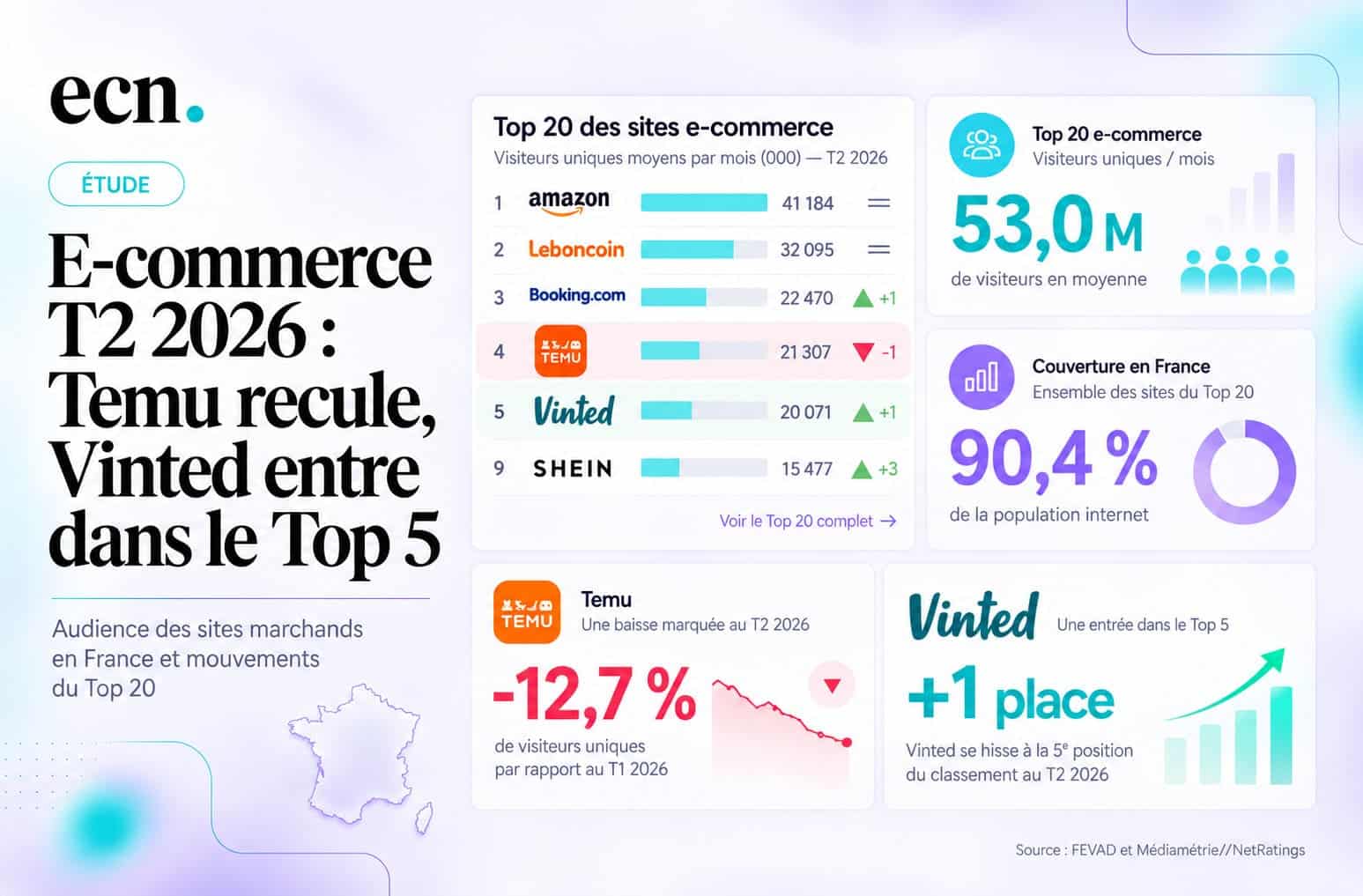
Le classement des sites e-commerce les plus visités en France bouge peu en tête, mais davantage juste derrière.
www.ecommerce-nation.frFrance's e-commerce federation Fevad and Médiamétrie published their ranking of the most visited e-commerce sites for the second quarter of 2026. Amazon remains first with 41.2 million monthly unique visitors, followed by Leboncoin with 32.1 million.
The notable shift was a pullback among Chinese marketplaces. Temu's monthly audience fell from 24.4 million in the first quarter to 21.3 million, a loss of 3.1 million visitors (12.7%) in three months. Shein climbed from 12th to 9th place, but its audience was nearly flat and down 7.1% year over year. AliExpress also declined, from 15.9 million to 15.1 million. Secondhand marketplace Vinted, meanwhile, entered the top five with 20.1 million.
These figures predate the new customs charge that took effect on July 1. Third-quarter data will show how much the measure affects low-cost cross-border e-commerce.
Corporate Moves and Partnerships
Commerce (formerly BigCommerce) announces $60 million to $80 million in annual cost cuts and a share buyback

Shares of e-commerce software company Commerce jumped after the company announced a strategic operating plan to reduce costs, improve profitability, and authorized a $50 million share repurchase program.
www.tradingview.comE-commerce software company Commerce, formerly BigCommerce, announced a plan to cut costs and improve profitability. It expects $60 million to $80 million in annualized savings and aims for full-year non-GAAP operating margins of at least 20% starting in 2027. Its shares jumped about 19% during the trading session.
The savings will come mainly from staffing, professional services, facilities, software and infrastructure. Commerce reaffirmed its 2026 revenue outlook of $336.5 million to $344.5 million and raised its non-GAAP operating income guidance by $3 million to $31 million to $37 million. It also authorized a $50 million share repurchase program effective through September 10, 2028.
About a month ago, its second-quarter revenue came in flat at $84.51 million and the stock fell sharply. The plan shows the challenge mid-sized e-commerce platforms face in balancing growth investment in agentic commerce with profitability.
Netflix signs its first Southeast Asian e-commerce partnership with Shopee, bundling streaming into ShopeeVIP+

Shopee is adding Netflix to its paid loyalty program in the Philippines, bundling entertainment with free shipping, shopping discounts, and digital services as it expands ShopeeVIP+ beyond e-commerce.
context.phShopee, owned by Sea, has launched a new paid membership program, ShopeeVIP+, through a partnership with Netflix. It is available to users in Indonesia, Thailand and the Philippines, and it is Netflix's first e-commerce partnership in Southeast Asia.
ShopeeVIP+ members get access to a Netflix Mobile plan, along with unlimited free shipping vouchers with no minimum spend and daily discount vouchers. Pricing starts at IDR 40,000 per month in Indonesia and PHP 140 per month on a multi-month plan in the Philippines. The bundle also includes perks from other partners such as Canva Pro, ChatGPT Go and Duolingo.
Like Amazon Prime, the program uses streaming to strengthen membership retention. E-commerce competition in Southeast Asia is increasingly about the depth of membership benefits, not just delivery and price.
Primark plans home delivery in Britain, reversing its cautious stance on online sales

Primark has said it plans to launch a home delivery service in Britain, four years after it made its first foray into e-commerce.
www.bbc.co.ukBudget fashion chain Primark said it plans to launch a home delivery service in Britain. It did not give a launch date, but it has bought a warehouse in Sheffield to ship products to homes.
Primark did not sell goods online until 2022, and even then limited itself to click and collect. Its owner, Associated British Foods, expects Primark's UK sales to grow about 1% in the fourth quarter, while like-for-like sales are expected to be broadly flat in the UK and down 3% globally. Analysts said competition from Shein, TikTok Shop and Vinted is behind the shift.
Retail analyst Julie Palmer said the real test is whether Primark can make home delivery profitable at the low prices its customers expect. The move, including how Primark handles returns, is a case study in how store-first retailers approach the economics of e-commerce.
Summary
Today brought parallel progress on two questions that matter once agents start shopping: who is accountable for an agent, and where products get discovered. The KYA collaboration among Ant International, Mastercard and Visa, together with India's NPCI registry, shows agent identity taking shape in both payment networks and national systems.
On the discovery side, Amazon became a buying channel for ChatGPT Ads, while Shopify made clear it intends to hold both ends of the journey through Catalog and its own transaction infrastructure. PayU's Agent HQ and Walmart's Sparky figures also show that the race among companies to bring agent-driven purchases onto their own platforms is already operational.
At the same time, Similarweb's report is a reminder that AI referral traffic is still small in volume and used alongside search. As the W3C and GS1 discussion highlighted, well-maintained product codes and attribute data are the common foundation for agents to buy the right item, whichever entry point they come from. Heading into the holiday season, how far these implementations progress is worth watching.