PayU Launches Agent HQ, an AI Agent Store for SMB Merchants That Builds ChatGPT and Claude Selling and Payment Ops Automation into Its Dashboard
Indian payments leader PayU launched Agent HQ, an AI agent store for SMB merchants. What its ChatGPT and Claude selling and chargeback agents actually do, how it differs from Razorpay Agent Studio, and what remains undisclosed.

Key Takeaways
- On September 10, 2026, Indian payments leader PayU launched Agent HQ, an AI agent store for SMB merchants built into its merchant dashboard. It puts agents that make merchants discoverable and transactable on ChatGPT, Claude and WhatsApp on the same shelf as operations agents that handle chargebacks, refunds and settlements
- Unlike Razorpay Agent Studio, which is explicitly positioned as an operations tool, PayU sells discovery and back-office work as one package. Pricing, the method for connecting to AI surfaces and the underlying model are all undisclosed
- For e-commerce merchants, the key shift is that AI agents are arriving through the payment provider's dashboard in one bundle. Being able to see the permissions and execution records of agents that read transaction data is a precondition for adopting them
PayU puts an agent store inside the merchant dashboard
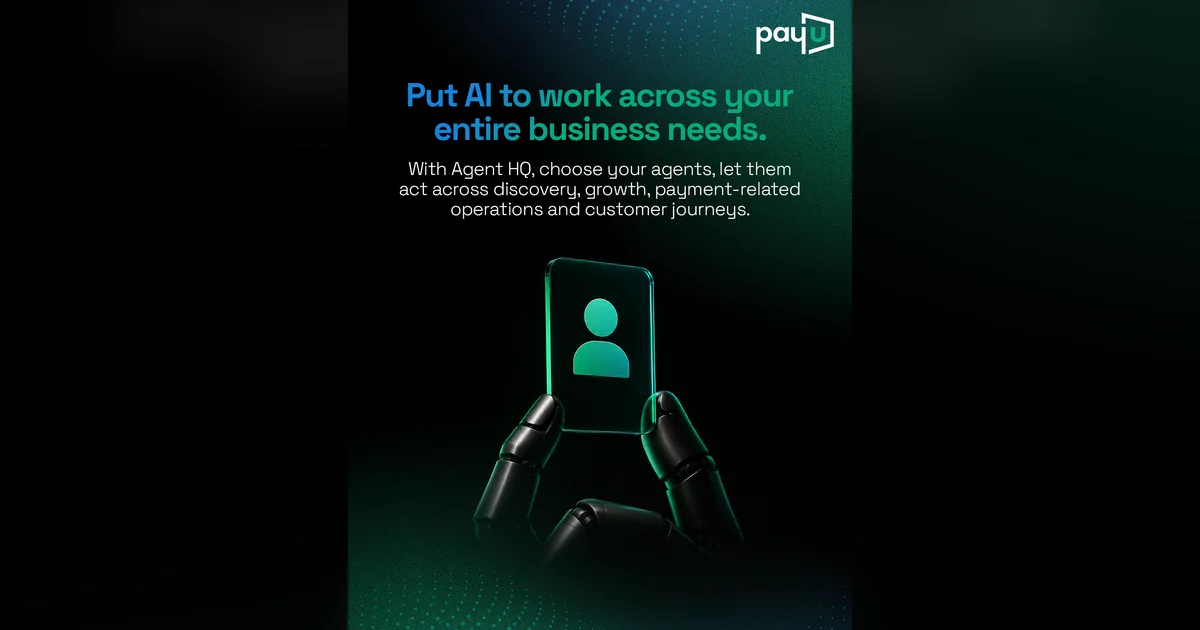
PayU announced the launch of its Agent HQ, an AI agent store for Indian SMB merchants, where they can choose and deploy an agent for each job in commerce, from making their business discoverable to AI shopping agents and driving growth, to simplifying payment-related everyday operations and powering their own conversational AI experiences.
cxotoday.comOn September 10, 2026, Indian payments leader PayU announced Agent HQ, an AI agent store for SMB merchants. It is not a store for consumers. It is a shelf where merchants pick an AI agent for each job in their business and hire it, and it already sits inside the PayU merchant dashboard.
Setup is said to take a few clicks. Merchants set how often an agent runs, monitor its activity in the dashboard and receive its output by email and WhatsApp. PayU contrasts this with standalone tools that require data connections and workflow configuration, calling Agent HQ no-code and zero-integration, and it states explicitly that no agent acts beyond the boundaries and limits defined by merchants.
Manas Mishra, Chief Product Officer of PayU and Wibmo, said the aim is to hand a team of agents everything from improving discoverability to managing chargebacks, reconciliations, refunds and settlements, so merchants can focus on growth.
Agent HQ is one of our biggest bets in that direction.
The merchants named as current users are insurance comparison platform Policybazaar; DailyObjects, a D2C brand selling phone cases and other accessories; and Pinq Polka, a D2C brand selling women's intimate and hygiene essentials. Indian Television's report lists the same three, but no results have been shared. PayU cites more than 450,000 merchants and ₹7.8 trillion in processed transaction volume as the foundation for the product, without specifying the period that volume covers.
Discovery and back-office work on the same shelf
Agent HQ's defining feature is that it puts two very different kinds of agents side by side. PayU splits the outcomes merchants can pursue into "building an AI-ready growth engine" and "running the business efficiently," and merchants can choose either or both.
Getting found and bought on ChatGPT and Claude
The core of the growth side is a set of agents that make products and services discoverable and transactable on ChatGPT, Claude and WhatsApp. Merchants can also build no-code conversational assistants for their own websites and apps to help shoppers in real time and answer post-purchase queries.
The open question is how "transactable" actually works. Neither the announcement nor the press coverage explains how Agent HQ connects to ChatGPT or Claude, or whether PayU has any partnership with OpenAI or Anthropic.
The best clue is PayU's developer guide for building your own ChatGPT merchant app. It describes a setup in which the merchant runs an MCP server (MCP is the standard that connects AI apps to external tools) compatible with OpenAI's Apps SDK and exposes tools such as product listing, payment link creation and payment verification. Payment does not happen in the chat. The buyer follows a payment link to PayU's hosted payment page to pay. Personal details are kept out of the chat as well, and the model only receives a reference ID. Whether Agent HQ automates this behind the dashboard is unclear, but what the public documentation shows is a division of labor: choose in the conversation, pay on a hosted page.
There is also a small tension. In an August 11 blog post, PayU argued that redirecting shoppers to a checkout page kills purchase intent, and promoted the "pay without leaving the chat" experience of the GoKwik and PayU D2C shopping on ChatGPT launched on July 28. A blog selling in-chat payment on one side, a redirect-based developer guide on the other. Which of the two experiences SMB merchants will get through Agent HQ cannot be judged until the onboarding screens are visible.
Operations agents only a payment provider could build
On the operations side, the listed tasks are transaction follow-ups, reconciliation of chargebacks (sales reversals triggered by cardholder disputes), refund escalations and settlements. These are jobs e-commerce staff handle by switching back and forth between the payment dashboard and their order management system.
Drawing on payment success and failure patterns, chargeback histories, settlement cycles and shopper behavior, the agents are said to handle fraud and disputes proactively and even suggest sales campaigns. That data already accumulates at PayU the moment a merchant routes payments through it. Read realistically, the zero-integration pitch is a claim only a payment provider that holds the data from the start can make.
The difference from Razorpay Agent Studio is whether discovery is included
The idea already has a precedent in India. On March 12, 2026, Razorpay announced Agent Studio, built on Anthropic's Claude Agent SDK (our breakdown).
| Item | PayU Agent HQ | Razorpay Agent Studio |
|---|---|---|
| Announced | September 10, 2026 | March 12, 2026 (at its FTX 2026 event) |
| Format | AI agent store built into the merchant dashboard | Agent marketplace and builder |
| Underlying model | Undisclosed | Anthropic's Claude Agent SDK |
| Operations agents | Transaction follow-ups, chargeback reconciliation, refund escalations, settlements | Cart abandonment recovery, dispute response, subscription recovery, cash flow forecasting, RTO (cash-on-delivery return) reduction, settlement summaries |
| Discovery and selling on AI surfaces | Makes merchants discoverable and transactable on ChatGPT, Claude and WhatsApp (connection method undisclosed) | Described as out of scope (positioned as an operational layer) |
| Custom agents | No-code conversational assistants | Build Your Agent (no-code, beta) |
| External systems | Emphasizes zero integration (details of external system connections undisclosed) | Connects to e-commerce platforms such as Shopify via OAuth |
| Pricing | Undisclosed | 30-day free trial in early access, then per action, monthly or outcome-based depending on the agent |
| Named merchants | Policybazaar, DailyObjects, Pinq Polka | No individual merchants named in launch materials |
The features overlap heavily, but the product definitions diverge. Razorpay CPO Khilan Haria told MediaNama that Agent Studio is not a new channel for product discovery but an operational layer for existing work. When OpenAI scaled back shopping inside ChatGPT shortly afterward and shifted purchases toward merchants' own apps, that definition ended up keeping Razorpay away from the uncertainty of selling on AI surfaces.
PayU went the other way and put AI surface discovery on the same shelf as its operations agents. The strategy pairs dependable efficiency gains with an uncertain but attractive AI channel and sells both to SMB merchants. Pricing will decide the comparison, yet while Razorpay has laid out per-action, monthly and outcome-based charges by agent after a 30-day free trial, PayU has not disclosed pricing for Agent HQ.
What the vendor's pitch leaves out
Start with the underlying numbers. PayU cites "industry reports" suggesting that about 50% of search traffic is shifting to AI agents and that AI-referred shoppers convert up to three times better, but names neither the reports nor who produced them. This article treats those figures as PayU's claim only.
Campaign suggestions built on transaction data leave questions open too. When Razorpay launched Agent Studio, MediaNama flagged the risk of AI-driven dark patterns and price discrimination creeping into payments infrastructure. Razorpay replied that merchants set discount caps, that every agent action is validated before it executes, and that an audit trail is kept. PayU's announcement offers only the line that agents stay within merchant-defined limits, and it does not describe audit logs or pre-execution validation.
On payment autonomy, regulators have started drawing lines. On September 10, the same day as the launch, NPCI (National Payments Corporation of India) non-executive chairman Ajay Kumar Choudhary said at Global Fintech Fest 2026 in Mumbai that AI may recommend, but authentication and final settlement must follow deterministic, auditable rules. A Reuters report that NPCI is building a registry of AI agents that make payments also surfaced that day, while the Unified Agent Protocol reported in July still has no launch date. For now, Agent HQ's "transactable" state is best understood as running on existing rails where a human approves the payment.
What merchants should ask their payment provider
The setting is India, but the pattern travels. AI agents are arriving not through separate SaaS contracts but through the dashboards of payment providers and cart platforms that already hold merchants' transaction data.
The operations agents are the easier ones to value. Razorpay's Haria has said a single chargeback takes two to three hours to handle and is won only about 23% of the time (figures from Razorpay's own account). Discovery agents are different. Until merchants can see which AI surfaces show their products, in what form, and where payment happens, they cannot even build a yardstick for results.
When your payment provider rolls out something similar, there are four things to check.
- What data the agents read, and how consent is handled when shopper data is used for campaigns
- Whether merchants can review execution logs, and whether the contract defines liability for wrong refunds or wrong information
- Whether sales on AI surfaces complete in the conversation or redirect (this directly affects measurement and drop-off)
- How billing works, and who defines the "outcome"
Conclusion
Agent HQ packages, for SMB merchants, the shift of payment providers from companies that process payments to companies that run merchants' operations for them. Where Razorpay narrowed its focus to operations, PayU made a bigger promise that includes discovery on AI surfaces.
The evidence to measure that promise is not in yet. The things to watch next are disclosure of pricing and the connection method, adoption beyond the three named merchants, and how autonomous "transactable" becomes once NPCI's agent registry goes live.