Ant International Open-Sources Agentic Mobile Protocol (AMP) - Alipay+'s 4.4B Wallet Network Emerges as a Third Pole in AI Commerce
Ant International unveils AMP, a mobile-native agentic payment protocol. We unpack how it differs from UCP and ACP, what Alipay+ integration means, and what e-commerce operators should do next.

Key Takeaways
- Ant International has open-sourced AMP, a mobile-first agentic payment protocol, and is rolling it out across the 4.4 billion wallet users connected via Alipay+
- Unlike UCP and ACP, which assume card rails, AMP is designed natively for digital wallets, super apps, and wearables in an AIOps-native architecture
- For e-commerce operators serious about Asia, AMP now stands as a third pole alongside UCP and ACP that cannot be ignored
From Mobile Payments to AI Commerce - The Setup Behind AMP

Ant International has launched the Agentic Mobile Protocol (AMP) for the agentic commerce industry.
futurecio.techOn April 28, 2026, Ant International announced from Kuala Lumpur the open-source release of the Agentic Mobile Protocol (AMP). It is positioned as the world's first agentic payment framework purpose-built for mobile interfaces, including digital wallets, super apps, banking apps, and wearable devices.
The "mobile-first" framing is the part that matters. Both OpenAI's ACP and Google's UCP are built on top of Visa and Mastercard card rails. AMP, by contrast, is built on Alipay+, a giant network of mobile wallets. The starting point of the protocol design is fundamentally different.
The numbers sharpen the picture. Global digital wallet users hit 4.4 billion in 2025 and are forecast to exceed 6 billion - over 75% of the world's population - by 2030 (Juniper Research). The agentic commerce market itself is projected to reach roughly USD 28 billion by 2030 at a 46% CAGR (Grand View Research). Capturing the huge segment of consumers who hold a wallet but not necessarily a card is becoming the key to AI commerce adoption.
What AMP Actually Specifies - Capabilities Card Rails Cannot Match
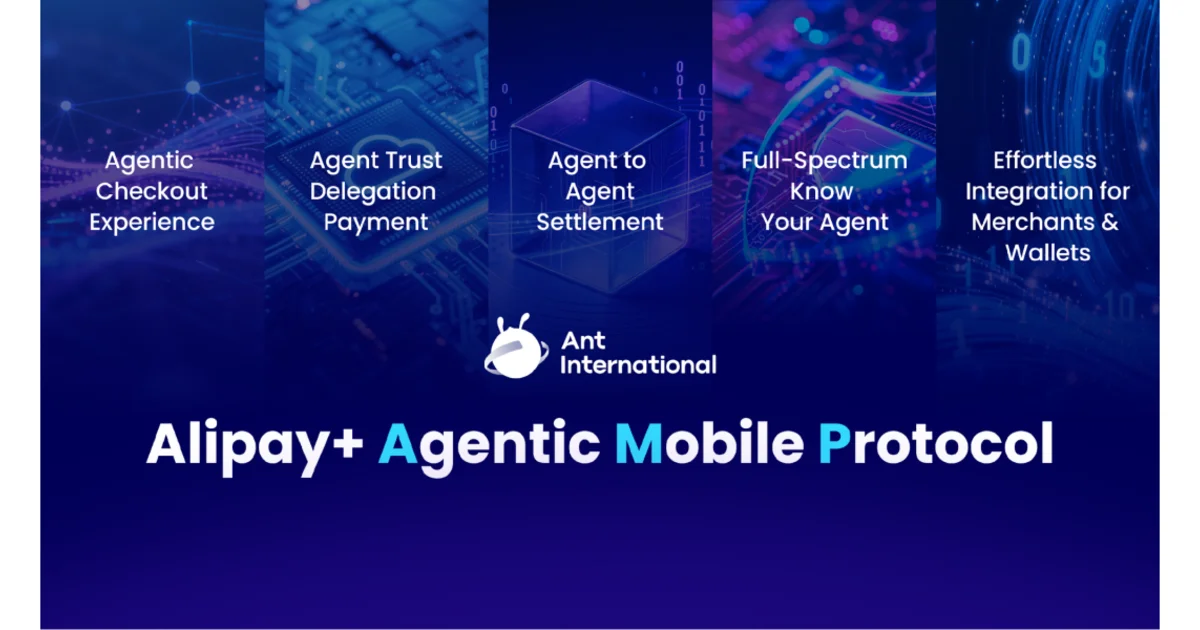
The AMP framework bakes in several mechanisms that are hard to implement on top of card-based protocols. The press release highlights the following:
| Feature | Details |
|---|---|
| Faster agent integration | Reduces the steps required to link a payment agent to a wallet by 50% versus traditional card binding |
| Money-back guarantee | Backs every agent-initiated transaction with a money-back mechanism for payment partners in cases of account takeover |
| Cross-device compatibility | Spans smartphones, smartwatches, AR glasses, and in-car systems |
| Trust architecture for delegation | Allows precise, revocable delegation of payment authority for tasks like ordering coffee, booking a ride, or planning a trip |
| A2A settlement | Real-time accounting and clearing for high-frequency, ultra-small transactions between agents (as low as $0.000001) |
| Know Your Agent (KYA) | Establishes an agent's digital identity and authorized capabilities, with a dynamic Agent Trust Rating |
The most striking item is the A2A settlement layer. Real-time accounting and clearing of transactions as small as one micro-dollar is structurally impossible on card rails. The design anticipates a "machine economy" where agents bill each other per API call, attacking the same problem x402 addresses but from the mobile side.
The other core idea is Know Your Agent (KYA). Mirroring KYC for human customers, KYA verifies whether a given AI agent is legitimate and what scope of authority it carries, evaluated dynamically through a proprietary Agent Trust Rating. This is a structural answer from the wallet side to the kind of agentic commerce fraud risk discussion that has been intensifying over the past year.
UCP, ACP, and AMP Side by Side
The agentic commerce protocol landscape has now crystallized into a clear three-way structure:
| Dimension | OpenAI ACP | Google UCP / AP2 | Ant International AMP |
|---|---|---|---|
| Lead organization | OpenAI + Stripe | Ant International | |
| Primary rail | Cards (via Stripe) | Cards + stablecoins, etc. (AP2) | Mobile wallets (Alipay+) |
| Design intent | Instant checkout inside chat | Common language for commerce end-to-end | Mobile- and AI-native |
| Target devices | PC and smartphone browsers | Multi-surface | Phones, watches, AR, in-car |
| Identity | Merchant/consumer-centric | Mandates (signed authorizations) | KYA + Agent Trust Rating |
| Strongest region | North America, Europe | Global | Asia (China, Southeast Asia) |
| License | Apache 2.0 (OSS) | OSS (AP2) | OSS |
It would be a mistake to read these as direct competitors. They are more likely to coexist as complementary layers. Ant International is in fact among the first partners piloting card-based agent transactions with Mastercard and Visa, and is collaborating separately with Google on agentic commerce and payment protocols.
For e-commerce operators, however, the priority of "which protocol to support first" varies sharply by region. North America-first means ACP. Serious global ambition means UCP/AP2. Winning in Asia means AMP cannot be ignored. The realistic strategy is not exclusive choice but stacked support across all three.
Alipay+'s Network Effect - 40 Wallets and 1.8 Billion Accounts
What gives AMP its execution power is Alipay+, Ant International's global wallet gateway. It already aggregates over 40 digital wallet partners, covering 1.8 billion user accounts and 150 million merchants. Reproducing that scale from scratch would be extremely difficult for any single player.
In Southeast Asia, GCash (Philippines), TrueMoney (Thailand), Touch 'n Go eWallet (Malaysia), and Dana (Indonesia) are all connected through Alipay+. In mainland China, Alipay itself serves over a billion users. Plug AMP-enabled agents into local commerce platforms like Lazada or Tokopedia, and the friction of payment drops dramatically.
A concrete scenario: a Japanese e-commerce business selling into Southeast Asia. Today, cross-border card payments come with high fees, FX risk, and fraud exposure. With AMP, identity verification and agent authentication happen on the local wallet side, while the merchant integrates a single protocol. The barriers that historically blocked Asian expansion get materially lower.
AMP also sits adjacent to Alipay AI Pay in mainland China, the in-car AI cockpit integration with Banma Intelligence, and other AI commerce products in Ant International's portfolio. AMP is not a standalone protocol; it functions as the entry point to a broader AI commerce stack Ant is assembling.
A Practical Playbook for E-commerce Operators
With all of that in mind, here is what e-commerce and payments leaders should be working through right now.
First, reassess the priority of Asia in your global expansion plan. Many operators have deferred Asian expansion because of cross-border payment friction. AMP can lower that wall. Conversely, if your strategy is North America-centric, ACP support and Visa Intelligent Commerce / Mastercard Agent Pay readiness should remain higher priorities.
Second, shift your protocol selection criterion from "card vs wallet" to "which market and which customer segment". Card rails are powerful in markets with high credit card penetration, but they hit limits in wallet-dominant Asian markets. The era when one protocol fits all is over. Build the architectural flexibility to layer protocols by market.
Third, borrow the KYA and Agent Trust Rating mindset for your own fraud controls. Even if you do not adopt AMP itself, the framework for distinguishing humans, trusted agents, and impersonation attempts at checkout is a useful reference. It pairs well with the broader trust and security frameworks discussion.
A final note of caution: AMP is open source, but Ant International remains the steward of its evolution. Access to the Alipay+ network is strategically managed, and geopolitical factors could shift the terms of access. Build that uncertainty into your scenario planning.
Closing Thoughts
AMP shifts the agentic commerce protocol conversation from "card rails first" to "cards and wallets in parallel." Its quantitative reach - 4.4 billion wallet users - combined with mobile- and AI-native design choices like A2A settlement and KYA, covers ground that UCP and ACP cannot easily reach.
The implication for e-commerce operators is straightforward. Optimal protocol coverage now varies by market and customer segment. If Asia is on your roadmap, AMP has just moved from "interesting option" to "must evaluate." The next things to watch: the concrete timeline for Alipay+ wallets to ship AMP support, and how deeply the Visa, Mastercard, and Google partnerships actually mature.