
AI Commerce News Digest (October 5, 2026)
AI commerce news for October 5, 2026. ChatGPT rolls out virtual try-on and Favorites worldwide, and Bunnings brings its Gemini-powered shopping agent to New Zealand. Plus Swap Commerce's acquisition of Vizby and a Lightspeed study showing AI recommendations favor big retailers.


Key Takeaways
- ChatGPT adds a Try on button and a Favorites library for shopping
- Bunnings expands its Gemini-powered shopping agent to New Zealand
- The race to turn AI visibility into revenue is heating up
This edition covers news from October 1 to October 4. The biggest story is ChatGPT's worldwide launch of virtual clothing try-on and a Favorites library for saving products. Checking whether something suits you and lining up options side by side used to happen inside retailers' own sites, and both are now moving into the AI conversation. On the retail side, Australian home improvement chain Bunnings and the pairing of Nestlé and Lazada are starting to treat AI agents as a storefront in their own right, on their own sites or on a marketplace. Where the October 1 digest focused on Mastercard and DoorDash building the paths agents use to buy, this round is about how brands get chosen once an agent is doing the looking.
Today's Top Stories
ChatGPT rolls out virtual try-on and Favorites worldwide, keeping product comparison inside the chat

OpenAI has introduced a virtual try-on feature alongside a dedicated 'Favorites' library in ChatGPT, moving the AI assistant beyond basic product recommendations into interactive visual commerce.
www.adgully.comOn October 1, OpenAI added a Try on button and Favorites to ChatGPT's shopping experience and began rolling them out globally. A Try on button now appears on clothing and accessory listings. Shoppers upload a selfie or a full-body photo, and ChatGPT generates an image of them wearing the item. It is not limited to products listed in ChatGPT: users can upload a screenshot of a garment from any online store and ask ChatGPT to try it on.
Favorites lets shoppers save products to a library and revisit them next to their try-on images. It is designed for purchases that take several sessions to narrow down rather than a single conversation. Both features run on the new ChatGPT Images 2.5 model. Google already offers a similar try-on feature, which shows how competition between AI assistants is moving from answering questions to helping shoppers compare and decide.
For apparel retailers, the issue is the product imagery and data that try-on images are built from. The more comparison happens inside ChatGPT, the more products get dropped from consideration before a shopper ever reaches the retailer's site. Whether try-on reduces pre-purchase doubt in high-return categories, and how accurate the generated images are, still needs to be tested.
Related article: ChatGPT Launches Virtual Try-On and Favorites: How It Differs from Google and What It Means for Apparel E-commerce
Bunnings launches its Gemini-powered shopping agent Buddy in New Zealand

Bunnings has become the first New Zealand retailer to launch a shopping agent using Google Cloud’s Gemini Enterprise for Customer Experience platform.
www.reseller.co.nzBunnings, the home improvement retailer operating in Australia and New Zealand, has launched its AI shopping assistant Buddy on its New Zealand website and app. It is the first shopping agent from a New Zealand retailer built on Google Cloud's Gemini Enterprise for Customer Experience. Bunnings had already rolled Buddy out in Australia.
Buddy breaks DIY projects into manageable steps, finds the right products and anticipates what customers may need next. Customers can type a question, upload a photo or snap a handwritten shopping list for Buddy to find the products. Much of its guidance draws on Bunnings' library of project and how-to content, and checkout continues through the Bunnings online store.
Home improvement purchases tend to involve many items for a single project. The test is whether an agent can recreate online the way customers used to assemble a basket by talking to store staff. According to Google Cloud's customer story, Buddy more than doubled online conversion in Australia, where it launched first. The baseline for that comparison has not been disclosed, and neither have usage numbers or New Zealand results.
Related article: Bunnings Rolls Out Gemini Enterprise for CX Shopping Agent Buddy in New Zealand After Doubling Online Conversion in Australia
Agentic Commerce
Nestlé expands its LazzieChat campaign on Lazada to five Southeast Asian markets

Nestlé and Lazada connect AI discovery, shopper insights and checkout in a five-market ecommerce campaign.
www.contentgrip.comFor October's Regional Super Brand Day, Nestlé and Lazada ran a five-market campaign across Malaysia, Singapore, Indonesia, Vietnam and Thailand built around Lazada's AI shopping assistant LazzieChat. The move scales an April pilot that covered part of Nestlé Nutrition to a much wider range of Nestlé brands, although the companies' announcement lists only four of the markets, excluding Vietnam, for the LazzieChat experience itself.
Shoppers find a hidden code in Nestlé's Lazada stores, move into LazzieChat for a preference quiz and end with a voucher they can use at checkout. The April pilot generated more than 60,000 interactions, and over 90% of buyers were new to Nestlé, according to the companies. These are brand-reported figures, and the incremental effect has not been independently verified. Still, it shows an AI assistant being used as campaign infrastructure that links discovery, preference data and purchase.
Related article: Nestlé Turns Lazada's AI Assistant LazzieChat into Campaign Infrastructure: Over 90% New Buyers in Pilot, Now Scaled to Five Southeast Asian Markets
Swap Commerce acquires AI visibility platform Vizby and launches Swap Discovery

Swap Commerce has acquired Vizby, a Shopify-native AI visibility platform, extending its e-commerce technology upstream into product discovery across AI platforms.
www.citybiz.coOn October 1, Swap Commerce, known for its agentic storefront, announced it had acquired Vizby, a Shopify-native AI visibility platform. It is the company's first acquisition. Vizby measures how brands appear and sell in answers from ChatGPT, Gemini, Perplexity, Claude and Microsoft Copilot.
Vizby's technology now powers Swap Discovery. It evaluates how a brand shows up for high-intent prompts, benchmarks it against competitors, identifies the gaps that keep it from being discovered and generates prioritized actions. Combined with its agentic Storefront and Checkout+, its checkout option bundling free returns and order protection, Swap aims to cover the full journey from AI discovery through checkout, delivery and returns. Swap's release says 62% of more than 100 brands in a study with Digiday named improved brand discovery as their single most important goal for agentic commerce, although the cited report describes a different sample size and question wording. The purchase price was not disclosed.
Related article: Swap Acquires AI Visibility Platform Vizby and Launches Swap Discovery, Owning the Path From ChatGPT Recommendations to Delivery and Returns
DataDome joins Experian Agent Trust to verify agent behavior throughout a transaction

Experian, a global data and technology company, today announced that DataDome, a leader in bot and agent trust management, has joined the growing Experian Agent Trust™ ecosystem, expanding the industry's open framework for trusted agentic commerce.
finance.yahoo.comOn October 1, Experian announced that bot and agent trust management company DataDome has joined Experian Agent Trust, its framework for trusted agentic commerce. Experian's Human to Agent Binding connects verified consumers and devices to the AI agents acting for them, while DataDome continuously evaluates whether an agent's behavior stays within the authority it was delegated.
Most of the discussion so far has focused on the entry check: whom does this agent represent? This partnership extends trust to what happens after authorization, monitoring whether an agent is behaving unexpectedly. DataDome says it plugs into existing checkout and security infrastructure without re-architecting it. Letting legitimate agents through while stopping abuse is becoming a practical operational problem for retailers.
AI Commerce Tools
Shopify launches Canvas, a workspace for designing stores by chatting with AI

Shopify’s new Canvas site builder lets merchants create and customize their online stores by chatting with its AI agent Sidekick, while watching the changes happen in real time.
techcrunch.comOn October 1, Shopify introduced Canvas, a design workspace where merchants build their stores by working with its AI assistant Sidekick, rolling it out to merchants over the following days. Canvas brings a store's pages and design elements into a single interface. Merchants can click on an element to edit it directly or describe changes in natural language, and the edits appear in real time.
Sidekick can now work directly on a theme's files, validate the code it writes and review screenshots of the result before handing the work back. Shopify says Sidekick made more than 25 million theme edits in the first half of 2026. The company also stresses that Canvas is early and does not yet replace the existing editor. Handing storefront design to AI is starting to become a standard part of the Shopify toolset.
PrestaShop 9.2 adds one-page checkout and an MCP-based AI assistant

PrestaShop 9.2 is available with One Page Checkout, Ask AI, Extra Properties, Klaviyo and Hummingbird 2.1.2. Here is what changes for merchants.
www.ecommerce-nation.frPrestaShop, an open-source e-commerce platform widely used in Europe, released version 9.2 on September 30. Its new One Page Checkout puts contact details, address, shipping and payment on a single screen, and guest checkout can start with just an email address. Merchants can switch between the new flow and the classic four-step checkout from the back office, which makes it easy to compare the two.
The back office also gains Ask AI, a conversational assistant for querying store data and triggering actions in natural language. It runs on the PrestaShop MCP Server, and merchants connect their own AI provider with an API key, including OpenAI, Gemini, Claude and Mistral. Actions that change the store require confirmation first. Beyond the big SaaS platforms, open-source commerce software is now shipping MCP as a standard entry point.
NIQ adds conversational AI and automation to its Spaceman planogram software

NielsenIQ (NYSE: NIQ), a leading consumer intelligence company, today announced new AI and automation capabilities for NIQ Spaceman®, its retail space planning and merchandising platform trusted by more than 600 retailers across 65+ countries. The enhancements help retailers create store-specific planograms up to 50 times faster, identify execution and compliance gaps, and scale merchandising decisions across their store networks through expanded cloud-based access.
finance.yahoo.comOn October 2, NIQ (NielsenIQ) announced new AI and automation capabilities for NIQ Spaceman, its space planning and merchandising platform used by more than 600 retailers in over 65 countries. The company says retailers can now create store-specific planograms up to 50 times faster.
At the center is NIQ Optiq, conversational AI that creates and optimizes planograms from natural-language requests. The update also automates store-specific planograms that reflect local assortments and shopper behavior across large networks, and uses AI to spot execution and compliance gaps in stores. Agentic AI is usually discussed in an e-commerce context, but it is also moving into the store-side work of assortment and shelf layout.
Advertising and Retail Media
How do you sell to an AI shopper? US brands rethink their pitch

By 2030, ‘agent-influenced spend’ may constitute up to 20% of total US e-commerce
www.businesstimes.com.sgA New York Times article, republished by The Business Times, looks at US startups and brands working on marketing aimed at AI agents. Aviv Shamny, CEO of Andreessen Horowitz-backed Limy, put it this way: advertising to humans targets emotions, while advertising to agents targets logic. The article cites Morgan Stanley research estimating that agent-influenced spend could reach up to 20% of US e-commerce, or $385 billion, by 2030.
One example is RTA Store, an online cabinetry retailer that noticed it had stopped appearing in LLM recommendations and paid New Generation $15,000 to rework its site. Beyond structuring product information and adding detailed descriptions, the work included an AI widget that answers questions from both humans and agents. New Generation, in partnership with Visa, also scores how ready a brand's site is for agents on a scale of 1 to 100. As the audience for advertising expands from people to agents, product information itself is becoming the substance of the pitch.
Consumer Trends
AI shopping recommendations favor big retailers, Lightspeed study of 460,000 answers finds

For decades, the internet has promised to level the playing field for retailers. Is AI taking that away?
fortune.comIn a Fortune op-ed, the CEO of retail POS provider Lightspeed Commerce shared research conducted with Vaer AI. The study analyzed 460,000 AI-generated shopping responses from ChatGPT and Google's AI products. When ChatGPT named retailers in its own web searches, 97% were large or mid-sized chains, and small and local retailers accounted for just 1% to 4%.
The striking finding is that large and small retailers each made up about 38% of the sources AI cited, yet big chains received 52% of top recommendations versus 20% for smaller businesses. The closer a query got to a specific product purchase, the lower small retailers' share fell, from around 30% to 10%. Adding the word "independent" to a prompt more than doubled the share of small and local retailers recommended. The data shows that being found by AI and being ranked at the top of its recommendations are two different problems.
Four in 10 shoppers frustrated by onsite search would switch to ChatGPT or Claude, Nosto finds
Consumers are growing frustrated with the online search experience on e-commerce sites and may turn to next-gen artificial intelligence assistants.
chainstoreage.comIn a survey of 2,000 US and UK consumers commissioned by agentic commerce platform Nosto, 59% said they often leave e-commerce sites because the search experience is poor. Forty percent said they would likely switch to an AI assistant such as ChatGPT or Claude when shown irrelevant results, and the same share agreed that AI assistants are now more helpful than many retailers' onsite search tools.
The top frustrations were having to use very specific terms and having too many results to scroll through, each cited by 70%. Seventy-two percent are open to retailers using AI to improve onsite search. At the same time, 73% worry that retailers will use their personal data and shopping behavior to train AI, and 69% worry they will be forced to use AI search with no option to switch back. Weak onsite search can become an exit to outside AI assistants.
Payments and Fintech
Agentic commerce had its biggest launch month, but nobody wants to own the risk

Agentic commerce just had its busiest launch month. The data says agents research a lot but still buy very little, and liability, not technology, is why.
www.fintechweekly.comFinTech Weekly looked back at the wave of agentic commerce launches in September and laid out what remains unresolved. Stripe Link checkout for Meta's Muse, agent-ready Stripe hosted checkout, Shopify turning on agent checkout by default and six banks' shared principles all arrived within weeks. Yet according to Checkout.com's survey, transactions involving AI agents still account for only 3% of merchants' transactions.
The article uses Fed Governor Christopher Waller's distinction between agent-assisted and agent-delegated models to argue that most of today's "AI commerce" is the assisted kind, where a person makes the final call. In a PYMNTS merchant survey, 93% said the AI or agent provider should bear the loss when an agent makes a wrong purchase. In this view, agreement on liability, not technology, is what is holding back adoption.
Wero, the European banks' wallet, moves into e-commerce payments in France (follow-up)

French consumers will soon be able to pay for online purchases on about 20 e-commerce sites using this digital wallet, which is currently dedicated to peer-to-peer payments.
www.lefigaro.frWero, the digital wallet developed by the European Payments Initiative bank consortium, is expanding into e-commerce payments in France. BNP Paribas will be the first bank to offer online payments in the coming weeks, with other banks following. Wero has grown as a peer-to-peer payment service with 40 million registered users in France and 60 million across Europe.
On the merchant side, EPI has signed around 20 retailers in France, including E.Leclerc, Veepee and Kiabi, and Wero has been available at Orange since September 2. Fnac Darty and Decathlon are due to follow within a few months. Shoppers click a Wero button, scan a QR code with their banking app and confirm with strong authentication, paying by instant bank transfer. It gives Europe a homegrown option that keeps card numbers off merchant sites, set against card networks and PayPal.
Scalapay brings pay-in-3 and pay-in-4 to AliExpress in four Southern European markets

AliExpress shoppers in Italy, France, Spain, and Portugal can now split purchases into three or four payments via Scalapay.
thepaypers.comItalian buy now, pay later provider Scalapay has partnered with AliExpress so shoppers in Italy, France, Spain and Portugal can split purchases into three or four instalments. It covers a wide range of categories, including electronics, fashion, home goods and beauty.
According to Statista, BNPL transaction value in Europe has grown from EUR 81.7 billion in 2022 to EUR 161.7 billion in the latest figures. Adoption is highest in the Nordics, where BNPL makes up 25% of domestic e-commerce payments in Sweden, while Southern Europe is still developing. It is one more example of a Chinese marketplace adopting the payment methods local shoppers already use to deepen its hold in Europe.
Yamato Transport's Kuroneko deferred payment service hit by unauthorized access, customer and merchant data possibly leaked
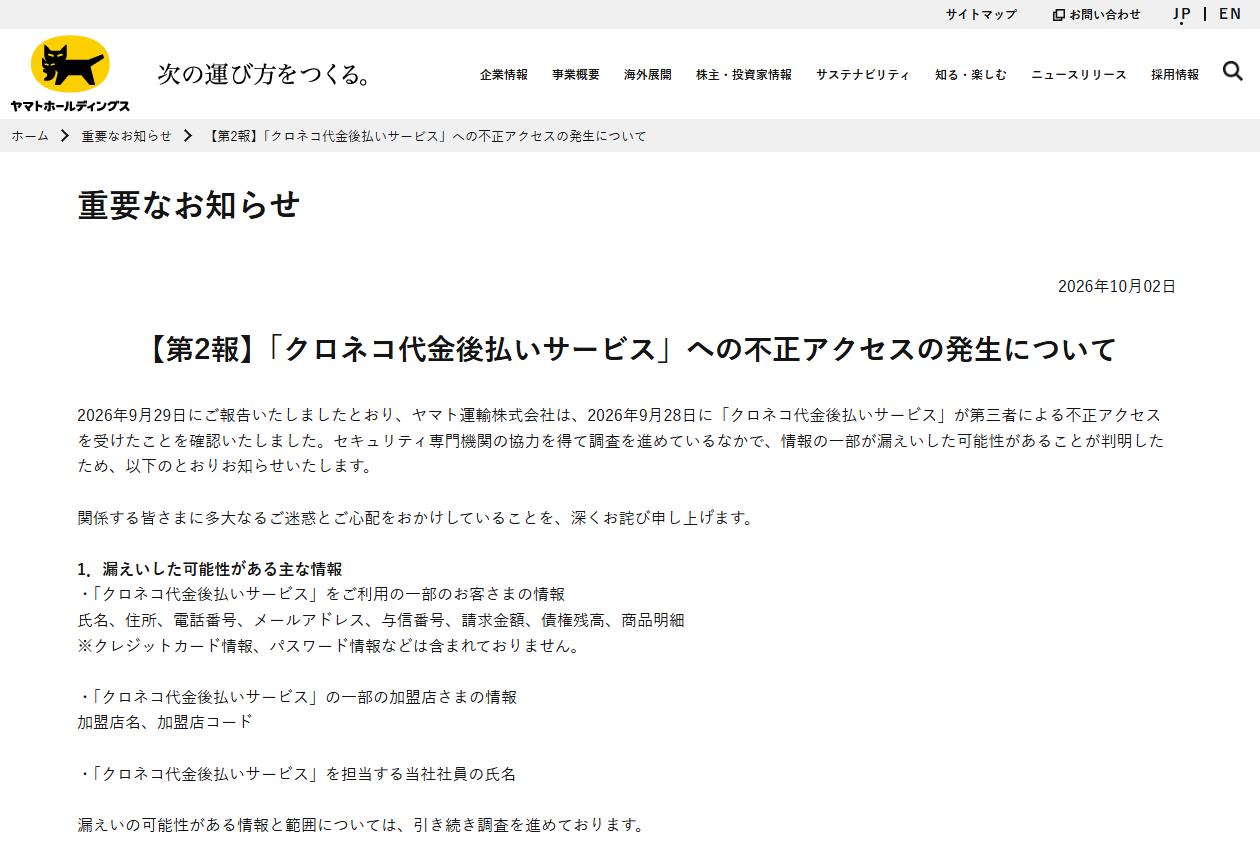
On October 2, Yamato Transport announced that unauthorized access to its Kuroneko Deferred Payment Service may have leaked some information.
internet.watch.impress.co.jpOn October 2, Yamato Transport said that unauthorized access to its Kuroneko Deferred Payment Service, a pay-later option for e-commerce, may have exposed some information. The company confirmed the intrusion on September 28, suspended the service and began investigating. The scope and number of affected records are still under investigation.
Data that may have leaked includes users' names, addresses, phone numbers, email addresses, credit screening numbers, billed amounts, outstanding balances and itemized purchase details, as well as merchant names and merchant codes. Credit card information and passwords were not included. Other services, including Takkyubin parcel delivery, are operating normally. For online retailers that offer the service, the immediate questions are what to offer customers while it is down and how to explain the situation.
Logistics and Fulfillment
Amazon doubles its ultra-fast Amazon Now service in India to more than 120 cities in two weeks

Amazon Now offers tens of thousands of products, including groceries, fruits and vegetables, frozen food, personal care items, fashion and beauty products, small appliances, and home and kitchen goods
www.business-standard.comOn October 2, Amazon said it had expanded Amazon Now, its ultra-fast delivery service in India, to more than 120 cities. That doubles its footprint in two weeks and pushes further into smaller cities, ahead of the Great Indian Festival sales season.
Amazon Now offers tens of thousands of products, from groceries to beauty and small appliances, fulfilled through a network of nearly 800 micro-fulfillment and urban fulfillment centers. Amazon says orders are doubling every quarter, making it the fastest-growing e-commerce business unit in Amazon India's history. Competition in Indian quick commerce is spreading from big cities to the rest of the country.
Global E-commerce Trends
Austria introduces a 2-euro parcel levy on online sellers with more than 100 million euros in sales

As of today, Austria has introduced a national levy of 2 euros per parcel for large online sellers with revenues over 100 million euros.
ecommercenews.euOn October 1, Austria introduced a levy of 2 euros per parcel on online stores and marketplaces generating more than 100 million euros a year in sales to Austrian customers. It is separate from the EU's 3-euro charge on small consignments from outside the bloc, introduced on July 1, and the 2-euro handling fee the EU will add from November.
Unlike the EU measures, the Austrian levy also applies to large domestic players. According to the Austrian Retail Association, around 4,000 domestic online stores selling through in-scope marketplaces will be affected indirectly, and half of all online orders are covered. Amazon, Otto and Zalando have objected, and critics expect the effective cost of 2.40 euros including VAT to be passed on to consumers.
Over 90% of EU online spending abroad goes to Temu, Shein and AliExpress, ECDB finds

Nine out of ten euros of online spending that left the European Union in 2025 went to Temu, Shein and AliExpress.
ecommercenews.euAccording to ECDB, EU consumers spent 421 billion euros online on physical goods in 2025. Of that, 86.9% stayed with stores based in the EU and 13.1%, or 55.1 billion euros, went abroad. 90.2% of the money leaving the EU, or 49.7 billion euros, went to Temu, Shein and AliExpress.
The United States received 4.8% of that outbound spending and the United Kingdom 4.6%. In the other direction, EU stores sold 3.9 billion euros to consumers outside the bloc, half of it to Switzerland. That imbalance is the backdrop to the parcel charges now piling up at the EU and national level.
Business Moves and Partnerships
JD.com set to win EU approval for its Ceconomy acquisition (follow-up)

Chinese e-commerce giant JD.com is set to secure European Union approval for its $2.5 billion bid for German electronics retailer Ceconomy after it tweaked its remedies to address regulators' concerns, a person familiar with the matter said.
www.reuters.comAccording to Reuters, Chinese e-commerce giant JD.com is set to secure EU approval for its $2.5 billion bid for German electronics retailer Ceconomy. The European Commission had been investigating under the Foreign Subsidies Regulation whether preferential financing, tax incentives or grants from the Chinese government helped JD.com offer a higher price.
In August, JD.com offered to give Ceconomy and smaller rivals access to its European logistics and technology capabilities on fair terms, and it has since improved that proposal after feedback from customers and competitors. The Commission will decide by November 4. If approved, the deal would give JD.com a major foothold in European electronics retail through MediaMarkt and Saturn.
Wrap-up
Over these four days, the question of how brands get found and chosen in front of AI agents came to the surface all at once. ChatGPT brought comparison into the chat with try-on and saved favorites, Swap Commerce bought a company that measures AI visibility, and Lightspeed's study showed small retailers who are found but still miss the top recommendations. The Nestlé and Lazada campaign and Bunnings' Buddy show brands and retailers starting to design agents as a sales channel of their own.
In payments, September's wave of launches left behind a question about who pays when an agent buys the wrong thing. Mechanisms that watch agent behavior after authorization, such as the DataDome and Experian partnership, are the next focus. In Europe, Wero's move into e-commerce and Austria's parcel levy arrived in the same week, shifting the cost structure of payments and delivery. How much control retailers keep over their product data and trust design will increasingly set them apart.