Google I/O 2026 Unveils Universal Cart — An Agentic Cart Spanning Search, Gemini, YouTube, and Gmail
At I/O 2026, Google introduced Universal Cart, a cross-merchant agentic cart, alongside expansions to UCP and AP2 — marking agentic commerce's shift from concept to mainstream consumer experience.

Key Takeaways
- At Google I/O 2026 on May 19, Google unveiled Universal Cart, a new cart that spans Search, Gemini, YouTube, and Gmail, with AI handling price tracking, restock alerts, and even compatibility checks automatically
- The Universal Commerce Protocol (UCP) is expanding to Canada and Australia, with new verticals like hotel booking and local food delivery. AP2 (Agent Payments Protocol) will roll out starting with Gemini Spark
- For merchants, the "brand as Merchant of Record" design is preserved, but more of the purchase journey happens inside Google's ecosystem — making dual support for UCP and ACP effectively mandatory
Universal Cart Opens the Door to "Agentic Shopping"

At Google I/O 2026, we introduced an intelligent cart that corrals everything you're shopping, expansions to UCP, tech to power agents that buy for you and more.
blog.googleOn May 19, 2026, at its annual developer conference Google I/O 2026, Google introduced Universal Cart, a centerpiece feature of its agentic commerce push. Google handles more than a billion shopping-related queries per day, backed by the Shopping Graph — a catalog of over 60 billion product listings. Universal Cart connects this catalog to Gemini models and effectively rebuilds the "cart" itself as an AI-native object.
In the official blog post, Vidhya Srinivasan, VP/GM of Ads and Commerce, framed Universal Cart as "the next step that brings together our common language for agents — the Universal Commerce Protocol — and the payments infrastructure for seamless agentic checkout." More than a single product launch, this announcement marks the convergence of UCP, AP2, and Gemini that Google has been assembling for years — and the formal start of agentic commerce's implementation phase.
The Cart Becomes a Companion, Not a Container
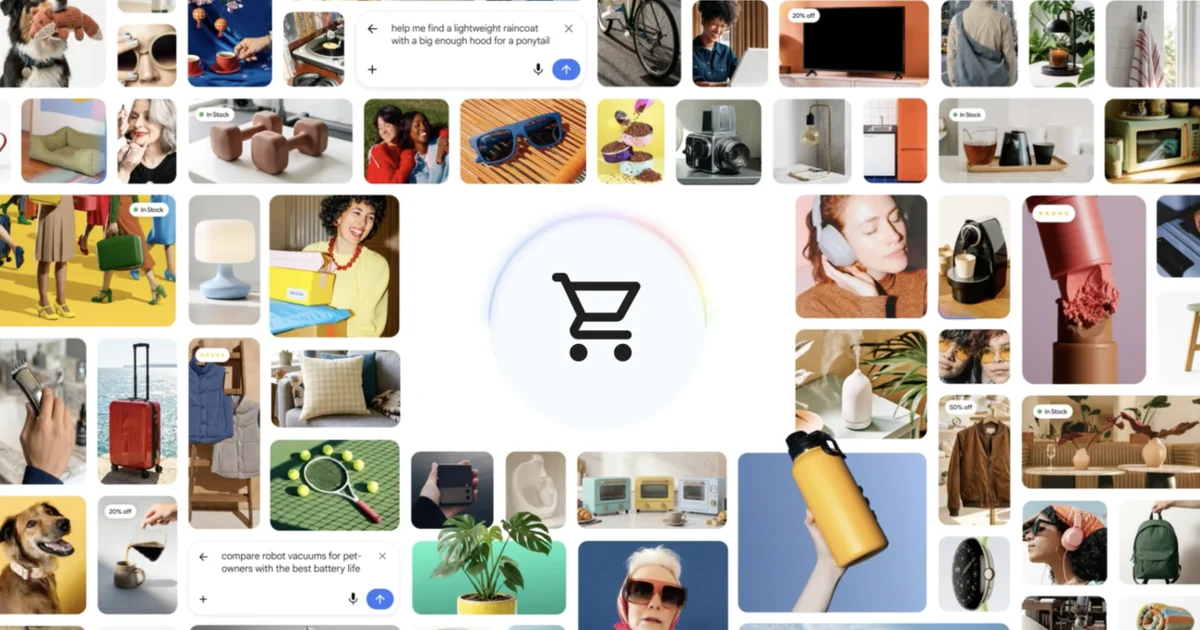
The defining characteristic of Universal Cart is that it is a cross-surface cart, not bound to any single site or app. Users can add the same items while browsing Search results, chatting with Gemini, watching YouTube, or even reading a newsletter in Gmail. It is designed around the modern reality that shopping happens "across multiple devices, multiple retailers, and over the course of many days."
TechCrunch characterizes Universal Cart as "an attempt to turn AI assistants from passive recommendation tools into active participants in online commerce." The moment a product enters the cart, Gemini models begin working in the background — surfacing price drops, summarizing price history, and alerting the user when an item is back in stock. If you assemble PC parts from several retailers, the cart will check CPU and motherboard compatibility automatically and propose alternatives when something does not fit.
Because Universal Cart is built on top of Google Wallet, it understands credit card perks, loyalty status, and merchant-side offers, and can recommend the most rewarding way to pay. Checkout itself can happen via Google Pay in a few taps, or by transferring the items to the merchant's own site — but in either case the brand remains the Merchant of Record.
As Chain Store Age reports, the initial checkout rollout includes Nike, Sephora, Target, Ulta Beauty, Walmart, Wayfair, and Shopify-based brands like Fenty and Steve Madden. Universal Cart begins rolling out across Search and the Gemini app in the U.S. this summer, with YouTube and Gmail to follow.
UCP Expansion: New Geographies and Crossing Beyond Shopping
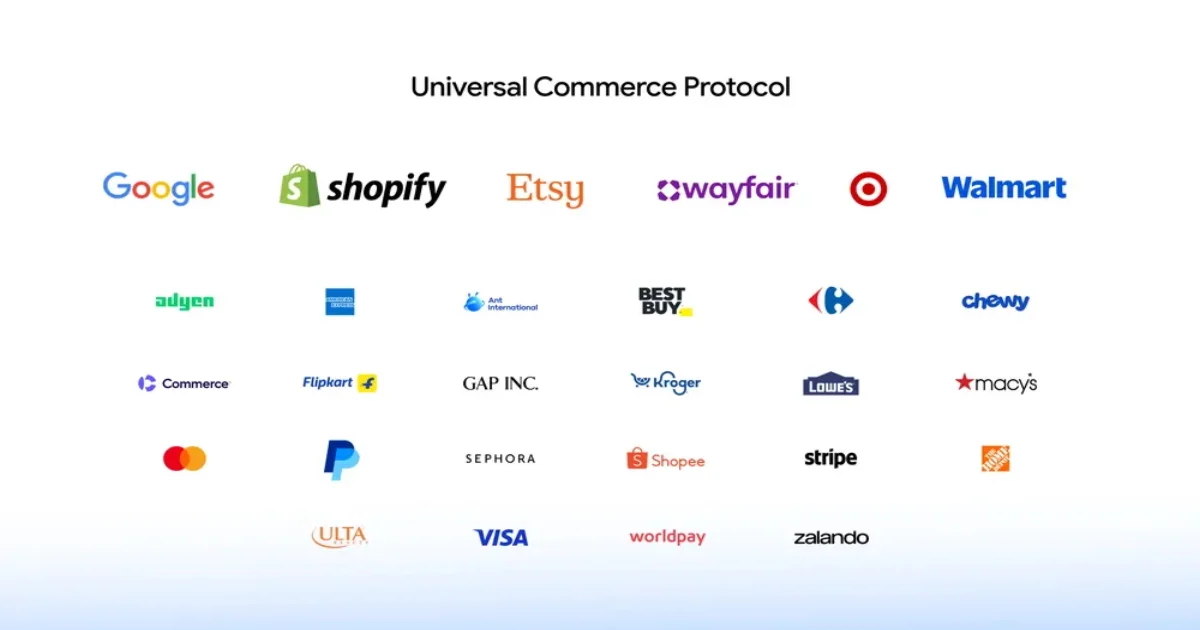
The other headline from I/O 2026 is a substantial expansion of the Universal Commerce Protocol. UCP — announced at NRF in early 2026 and co-developed with Shopify, Etsy, Wayfair, Target, and Walmart — already counts 20-plus endorsers across payments and retail, including Visa, Mastercard, American Express, Stripe, and Adyen.
Three updates stand out. First, UCP-powered checkout is rolling out beyond the U.S. to Canada and Australia within months, and to the U.K. soon after. Second, UCP is coming to YouTube in the U.S. Third, UCP is moving beyond retail into hotel booking and local food delivery as new verticals.
Google is quietly redefining "commerce" as a general-purpose primitive. As Shopify Engineering explains, UCP adopts a layered architecture inspired by TCP/IP, with a Shopping Service layer, a Capabilities layer (checkout, orders, catalogs), and Extensions for domain-specific schemas. The substantive meaning of the I/O update is that lodging and food delivery — entirely different domains — are now being absorbed as Extensions on this same protocol.
The Tech Council steering UCP has also expanded to include Amazon, Meta, Microsoft, Salesforce, and Stripe, positioning UCP as an industry-wide standard spanning search, marketplaces, social, enterprise SaaS, and payments — not a Google-only spec. Where OpenAI and Stripe's Agentic Commerce Protocol (ACP) optimizes for "in-chat instant purchases," UCP attempts to redefine the infrastructure layer of commerce itself.
AP2: A Safety Mechanism for Handing Agents a Wallet
Equally important is Google's plan to integrate the Agent Payments Protocol (AP2) across its products. AP2, led by Google Cloud, connects users, merchants, and payment processors with a verifiable, privacy-preserving link.
Users can give their agent guardrails in advance — "buy this specific brand and product, up to this dollar limit, automatically." When those conditions are met, the agent executes the purchase, and the transaction carries a tamper-proof digital mandate. If a return becomes necessary, both the user and the merchant reference the same record, eliminating ambiguity about who authorized what.
At I/O, Google announced AP2 will reach Google products starting with Gemini Spark. Functionally, AP2 plays a similar role to Stripe's Shared Payment Token (SPT) inside ChatGPT's Instant Checkout — but inside Google's ecosystem. Analyses such as Grid Dynamics increasingly compare ACP and AP2, but the two are less competitors than different granularities of safety mechanism that will likely coexist.
Positioning Among UCP, ACP, and MCP
Standardization in agentic commerce is no longer about "which protocol wins" — it is shifting into "which layer each protocol occupies."
OpenAI and Stripe's ACP, embedded in ChatGPT's Instant Checkout, has already onboarded Etsy, Walmart, and roughly one million Shopify merchants, and dominates the application layer of in-chat instant purchases. Anthropic's Model Context Protocol (MCP) handles context-sharing between agents and tools — a general-purpose foundation, not commerce-specific.
UCP sits between them as the infrastructure-layer framework covering discovery through checkout and post-purchase. Checkout.com frames it cleanly: ACP standardizes "the checkout conversation," while UCP standardizes "the entire shopping journey." ACP is easier to implement (hours to half a day), while UCP demands more architectural understanding but covers more ground.
A paz.ai analysis reports that "dual-protocol merchants" supporting both UCP and ACP see up to 40% more agent-driven traffic than single-protocol merchants. Walmart, Etsy, and Shopify already participate in both — a deliberate hedge against ecosystem lock-in.
What Universal Cart Means for E-Commerce Operators
Universal Cart matters even for merchants outside the U.S. UCP's near-term rollout focuses on North America, Australia, and the U.K., but the path through Shopify means Japanese and other international merchants on Shopify will inherit much of this stack soon. Three considerations deserve attention now.
First, what it means to have your "cart" placed outside your own property. With Universal Cart, the consumer adds items to Google's cart before reaching the merchant's. By the time they arrive at your site, price, inventory, compatibility, and perks have already been compared by Google's algorithms. Catalog accuracy, structured data in Merchant Center, and real-time inventory and price updates become competitive advantages in themselves.
Second, the Merchant of Record framing is preserved, but customer touchpoints become thinner. Post-purchase CRM and fulfillment remain the merchant's responsibility, but discovery, cart, and checkout now happen on Google's surfaces. Growing LTV requires a deliberate strategy for rebuilding direct relationships with customers acquired via Google after the first transaction.
Third, a multi-protocol strategy. Betting only on UCP or only on ACP is not prudent. Google's Universal Cart spans Search, Gemini, YouTube, and Gmail; ACP reaches ChatGPT and the third-party apps built on it. The realistic answer is to anchor payments on Stripe or Adyen, run commerce on Shopify or a stack capable of connecting to both UCP and ACP, and treat protocol coverage as a distribution decision.
Summary
Universal Cart finally collapses UCP, AP2, and Gemini into a single object — the cart — that lives in the consumer's hand. With I/O 2026, the shape of a world where AI selects products, negotiates prices, and completes purchases safely on the user's behalf has become much more concrete.
For merchants, the question is no longer "should we participate in agentic commerce." It is "can our catalog, inventory, payments, and CRM withstand being viewed simultaneously by Universal Cart and ACP, without breaking?" UCP and ACP will compete and complement each other, with agent-payment protocols like AP2 layered on top — and merchants will need to redesign their commerce stack around that multi-layered reality. The fact that "the cart no longer belongs only to the merchant" should be the starting point of any 2026 second-half plan.