xAI's Grok Partners With Gopuff to Launch 'Go': What Agentic Commerce Means for Quick Commerce
xAI's Grok partners with U.S. quick commerce leader Gopuff to launch 'Go,' an AI that builds your cart before you ask. We break down the LLM-meets-instant-delivery model and what it means for e-commerce.

Key Takeaways
- xAI's Grok has partnered with U.S. quick commerce leader Gopuff to launch "Go," an AI shopping assistant. The moment a customer opens the app, the AI has already assembled a cart, with delivery in as fast as 15 minutes. It joins ChatGPT, Google, and Perplexity as the latest case of an LLM moving into commerce.
- The core of this move is automating the decision, not the payment. Go fuses Gopuff's 13 years and hundreds of millions of orders with real-time cultural signals from X, running on Grok's reasoning models, to automate the stage before a shopper even thinks about what to buy.
- For e-commerce operators, the takeaway is that the point of purchase shifts from the app or site to "the AI's predicted cart." What gets a product chosen moves from search rank and shelf placement to AI recommendations grounded in purchase data and context signals, making your own data and inventory-context supply the new competitive axis.
Gopuff x Grok: a new touchpoint where quick commerce meets the AI agent

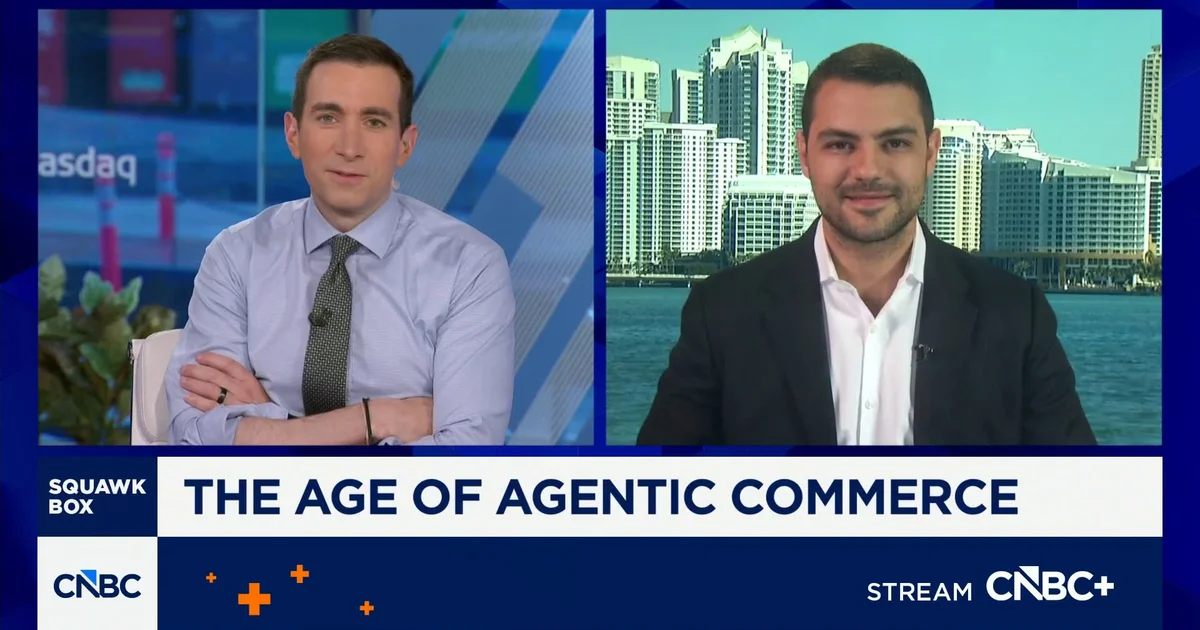
Yakir Gola, Gopuff co-founder and co-CEO, joins 'Squawk Box' to discuss the company's new agentic commerce partnership with Grok.
www.cnbc.comGrok, the chatbot from Elon Musk's xAI, has come down to the shopping floor. On June 3, U.S. quick commerce leader Gopuff launched "Go," an AI shopping assistant built on Grok, with co-CEO Yakir Gola explaining the rationale on CNBC's "Squawk Box." Open the app, and the AI has already prepared your cart.
Go inverts the conventional flow of searching for products and adding them to a cart. The instant the app launches, the AI builds a personalized cart in advance, based on time of day, location, order history, and real-time indicators. Returning customers can check out with a single tap. According to Gopuff's official announcement on June 2, 2026, orders arrive in as fast as 15 minutes from Gopuff's 400-plus micro-fulfillment centers across the U.S.
What stands out here is the combination itself. Where ChatGPT and Perplexity stepped into commerce by routing chat users to external merchants, this time an LLM has partnered directly with an instant-delivery operator that owns its own inventory and logistics network. Rather than the AI just making a suggestion and stopping there, a single operator controls everything from the suggestion through picking to delivery — a vertically integrated form of agentic commerce.
A design that automates "before you decide," not the payment
Go's design philosophy is captured plainly in Gola's words. In the official release, he says that now that Gopuff has delivered instant delivery and instant access to essentials, the greatest friction left in commerce lies not in delivery but in the step before it.
The greatest friction left in commerce is not delivery or instantaneous access to the essentials customers need. It's the moment before: the thinking, the deciding, the remembering. So, we're combining Gopuff's demand intelligence with xAI's frontier reasoning to create an everyday shopping experience that feels like a true extension of you.
Agentic commerce, as a term, has so far been discussed mainly at the layer of "the AI executing the payment on your behalf." Visa and Mastercard building tokenized payment for agents and competing over how to delegate payment to an AI sits in that context. What Go reaches into is the decision one step earlier: what to buy. Remembering what's in the fridge, judging what you need, putting it in the cart — eliminating that cognitive effort is what Gopuff is after.
What makes this work is the hundreds of millions of orders Gopuff has accumulated over 13 years, paired with real-time cultural signals pulled from X (formerly Twitter). Go runs both through Grok's reasoning, voice, and image-generation models. If a big game is happening in a customer's city, wings and drinks may appear in a living-room scene; on a snowy afternoon, the screen may fill with hot chocolate and cozy essentials — context-linked suggestions of this kind emerge.
On the experience side, three pillars are in place: predictive cart generation at app launch, a TikTok-style shoppable feed that shows products within their context, and a conversational chat powered by Grok's voice integration. In chat, vague requests like "snacks under 100 calories" or "a gluten-free sweet treat that's not too heavy" return shoppable products on the spot. Thanks to the low-latency voice integration, the flow of asking, adjusting, and checking out hands-free is also envisioned.
Following ChatGPT, Google, and Perplexity into commerce
Gopuff x Grok is not a standalone case; it sits within a larger wave of major LLMs descending into commerce one after another. Axios reports that both AI labs and retailers see AI-driven commerce as a mutually beneficial revenue driver.
OpenAI led the way. It tried Instant Checkout, completing purchases from conversation inside ChatGPT, then shifted its weight toward product feeds and advertising. Google has expanded AI experiences across search, shopping, and ads, and Perplexity has built shopping into its answers. Where those moves were largely about owning the discovery entry point — getting products found within a conversation — Grok enters from a different angle, wiring directly into an instant-delivery operator's inventory and logistics.
The significance for xAI is not small either. The company sits under SpaceX, and Grok is at a stage of broadening its consumer-AI touchpoints. Being embedded in the deeply everyday act of shopping is a lever to lift the chatbot's usage frequency. Axios also notes that xAI is pursuing this consumer push at a time when it heads toward a closely watched SpaceX IPO.
Why quick commerce became a testbed for AI agents is equally clear. Instant delivery has high order frequency, and purchases skew toward daily necessities and groceries, making purchase patterns easier to predict. Forecasting that "coffee or paper towels are about to run out" is far more reliable than for furniture or appliances, and the cost of being wrong is small. As a training ground for delegating decisions to an AI, few materials are better suited.
Are e-commerce operators ready to be chosen by "the AI's predicted cart"?
So what does this confront e-commerce operators with? The most fundamental change is that the place where products get chosen shifts from a site's search results or shelf to the cart an AI assembles in advance.
Conventionally, the starting point of a purchase was the user's active search or browsing. In Go's model, the AI has finished judging "what you need today" before you even open the app. What decides whether you're chosen here is not search rank or banner aesthetics but AI inference grounded in purchase history and context signals. How well a product appears to match "this person's situation right now" determines whether it lands in the cart.
Two assets that Gopuff turned into weapons matter under this structure. One is long-running first-party purchase data. The other is contextual information — inventory, locality, and real-time signals about the world. Few operators can hold this much data and logistics in-house, but the implication is shared even for those whose position is to "get found" by an external AI shopping platform. Whether you can structure product data and supply inventory status and usage context in machine-readable form is becoming the precondition for riding the AI's recommendations.
One more thing not to miss is the growing weight of suggestions that pair visuals with context. Go's shoppable feed places products not in isolation but within scenes like "a living room on game day" or "a snowy afternoon." Moving from a catalog-style presentation of product names and specs toward suggestions tied to scenes and needs, the very context in which a product is consumed is becoming part of the product data.
Conclusion
Go, born of the Gopuff-and-xAI partnership, shows that the main battleground of agentic commerce is moving one step earlier — from "automating payment" to "automating the decision." A vertically integrated model where the AI prepares the cart in advance and delivers it via its own logistics in as fast as 15 minutes is taking the lead in instant delivery, a domain where prediction works well.
For e-commerce operators, the question converges on how to organize the data and context needed to be chosen by the AI's predicted cart. This experience, launched in the U.S., has a UK rollout flagged within weeks — and how each LLM company partners with instant-delivery and retail players is the chain of deals worth watching next.