Nykaa x OpenAI Explained: What It Means for Beauty and Fashion to Become 'Connected Apps' Inside ChatGPT
India's leading beauty and fashion retailer Nykaa partners with OpenAI to build AI-native commerce as connected apps inside ChatGPT. We unpack the shift to conversational shopping and what it signals for e-commerce operators.

Key Takeaways
- Nykaa, India's largest beauty and fashion e-commerce player, is listing Nykaa Beauty and Nykaa Fashion as connected apps inside ChatGPT and partnering with OpenAI on a multi-year effort to build AI-native commerce
- Both companies frame search-and-scroll shopping as a transitional technology, betting that conversational, agentic purchasing becomes the default
- The model of designing commerce around getting shoppers to your own site is starting to crack, and making product data machine-readable for AI is emerging as the next axis of competition
Nykaa Becomes a 'Store Inside ChatGPT'
Nykaa, the company driving India's beauty and fashion commerce, has announced a strategic partnership with OpenAI. It is listing its two flagship businesses, Nykaa Beauty and Nykaa Fashion, as connected apps that run inside ChatGPT, letting users reach the product catalogue, recommendations, and shopping advice directly within their ChatGPT conversations.
Under the arrangement, Nykaa Beauty and Nykaa Fashion will be available as connected apps inside ChatGPT.
www.ndtvprofit.comThis is not a one-off feature add. The two companies say it will be executed as phased milestones over a multi-year period, building more intuitive and personal shopping experiences with AI over time. Within conversations about skincare advice, fashion suggestions, or fragrance recommendations, ChatGPT acts as the guide and Nykaa serves as the commerce destination. That is the division of roles being envisioned.
What matters here is that Nykaa is no small experimenter. Its parent, FSN E-Commerce Ventures, topped $1 billion in FY2026 revenue, up 26% year on year to ₹100.2 billion, with gross merchandise value (GMV) rising 28% to roughly ₹2 trillion. The platform draws more than 55 million highly engaged consumers and operates 313 physical stores across India. A business of that scale, already holding its own castle in the form of proprietary apps and sites, has chosen to place its products at someone else's doorway, ChatGPT. That is the heart of this move.
A Declaration That 'Search-and-Scroll' Is a Transitional Technology
The most telling part of the announcement is a line from Nykaa's Chief Product and Technology Officer, Rajesh Uppalapati.
Search-and-scroll shopping is a transitional technology. The future is conversational, agentic, and deeply personal.
It is a bold framing. Typing keywords into a search box and scrolling through a grid of products to choose, the default motion of e-commerce for over two decades, is positioned by Nykaa itself as an action that will eventually disappear.
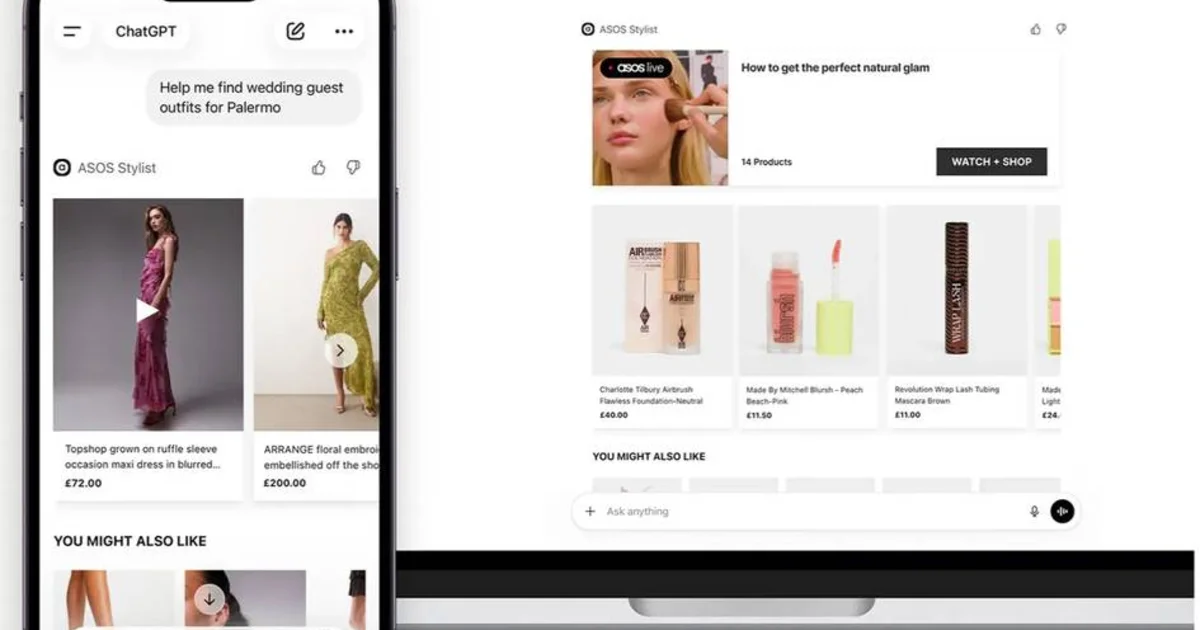
What replaces it is discovery through conversation. Vague, context-laden prompts such as "find me an outfit for work tomorrow" or "a sunscreen gentle enough for sensitive skin around 3,000 yen" get answered by AI that reads preference, budget, and occasion. In fact, the Korean fashion platform Musinsa launched a ChatGPT app in June 2026 that recommends products from conversational cues about weather, occasion, and price range. Nykaa's move shows this current is accelerating across beauty and fashion worldwide.
Nitin Bwankule, who heads enterprise sales for OpenAI in India, similarly notes that AI is starting to strongly influence product discovery and purchase decisions precisely in categories where personal preference is decisive, like beauty and fashion. Because there is no single right answer for everyone, the value of AI that draws out taste through dialogue stands out.
What Are ChatGPT 'Connected Apps'?
The technical foundation behind conversational commerce is ChatGPT's connected apps. It is worth breaking down how they work.
With the Apps SDK that OpenAI released at the end of 2025, each company stands up a server compliant with the Model Context Protocol (MCP) and connects its product data and capabilities to ChatGPT as "tools." When a user touches on a relevant topic in conversation, ChatGPT invokes the app as needed, pulling in the catalogue, inventory, and recommendations and weaving them into its answer. Where a richer display is needed, a sandboxed interface can be embedded inside the chat. ChatGPT now reaches around 800 million weekly active users, so opening a "store" here is far from trivial.
One design point worth watching is checkout. OpenAI opened Instant Checkout to all U.S. users in February 2026 as "Buy it in ChatGPT," but later found that users valued product research over completing payment inside ChatGPT, and adjusted course. ChatGPT now handles discovery while leaving the final purchase step to the merchant's own site or app. Nykaa being positioned as the commerce destination fits this design: discovery happens in the AI, payment happens on your own property.
OpenAI's retail partnerships are expanding fast. Etsy, Shopify brands like Glossier and SKIMS, Walmart, DoorDash, and Instacart have all joined the ChatGPT app family in quick succession. Nykaa adds the vast Indian market and a high-affinity category, beauty and fashion, to that lineup.
Reworking Not Just the Storefront, but Internal Operations on OpenAI
This partnership does not end as a customer-acquisition channel, because Nykaa intends to embed OpenAI's technology across its entire internal operation.
While integrating OpenAI's frontier models into customer-facing experiences, internally it is rolling out ChatGPT Enterprise and the coding agent Codex across marketing, customer support, legal, finance, supply chain, and operations. The engineering teams plan to use Codex to accelerate building and shipping new AI features.
From here, you can read the philosophy that AI-native commerce advances on two wheels: the front-end experience and back-end productivity. Beyond selling through conversation, the company runs the product data work, inquiry handling, and content production that support those conversations on AI as well. Behind the visible shopping experience, the work itself is being rebuilt around AI, which is part of why the partnership is a multi-year plan.
Note that what has been disclosed at announcement is the framework and direction; details such as the general availability timing of the connected apps and the specific countries and languages covered have not been spelled out. The phrasing remains a phased rollout, which readers should keep in mind.
What E-Commerce Operators Should Take From This
This is not a story to file away as a faraway Indian giant. It carries several points that operators and marketers cannot easily ignore.
First, the fact that commerce designed around visits is starting to wobble. The winning pattern used to be getting shoppers to your own site or app and having them browse, compare, and buy inside it. In conversational commerce, the first discovery and comparison may happen inside an AI like ChatGPT, with your own site relegated to catching the purchase. The first point of contact with a brand drifts to a place outside your control.
Second, the machine-readability of product data becomes a new axis of competition. For AI to understand products correctly and recommend them in the right context, structured product information, accurate attributes, and clear descriptions are essential. A product page built to be viewed by humans on a screen and data built to be interpreted by AI take different optimal shapes.
And third, the higher the affinity of a category, the more room there is for AI to intervene. For goods where "is this right for me" is the deciding factor, like beauty and fashion, AI that draws out preference through dialogue shows its value. Many of Japan's major e-commerce categories fall here: apparel, cosmetics, food, and interiors. This is not a call to rush something into place, but it is worth starting to prepare for an era in which your product data is read by AI.
Conclusion
Nykaa's move shows that AI-optimized commerce is now seriously underway in the high-affinity domains of beauty and fashion. Calling search-and-scroll a transitional technology reflects a reality in which the entrance to shopping is quietly shifting. The question is no longer how to defend your own castle, but how to present your products at a new doorway built on AI. The very framing of the question is beginning to change.