Sazo Raises $20M Round Backed by Japanese Megabanks to Automate Cross-Border Customs and Proxy Purchasing
Korean AI cross-border commerce startup Sazo raised a $20M round including credit financing from Japan's megabanks. How its AI automates tariffs, HS codes, and proxy purchasing, and what limits remain.

Key Takeaways
- Korean cross-border commerce startup Sazo raised $20.0M in this round (KRW 29.5 billion), combining a $10.3M Series A with credit financing from Japan's megabanks. Japan Post Capital and Suzuyo led, joined by Naver D2SF, PARTNERS FUND, and D4V.
- Sazo's AI calculates tariffs, VAT, and shipping costs and generates HS codes and customs paperwork automatically, whether the purchase happens on an integrated marketplace or via a pasted product URL.
- Automating proxy purchasing lowers the barrier to cross-border shopping, but final customs decisions still rest with national authorities, and dependency on partner-platform terms remains real. E-commerce operators should weigh both the applicability and the limits of this model for their own export strategy.
Japan's Megabanks Join Sazo's Series A
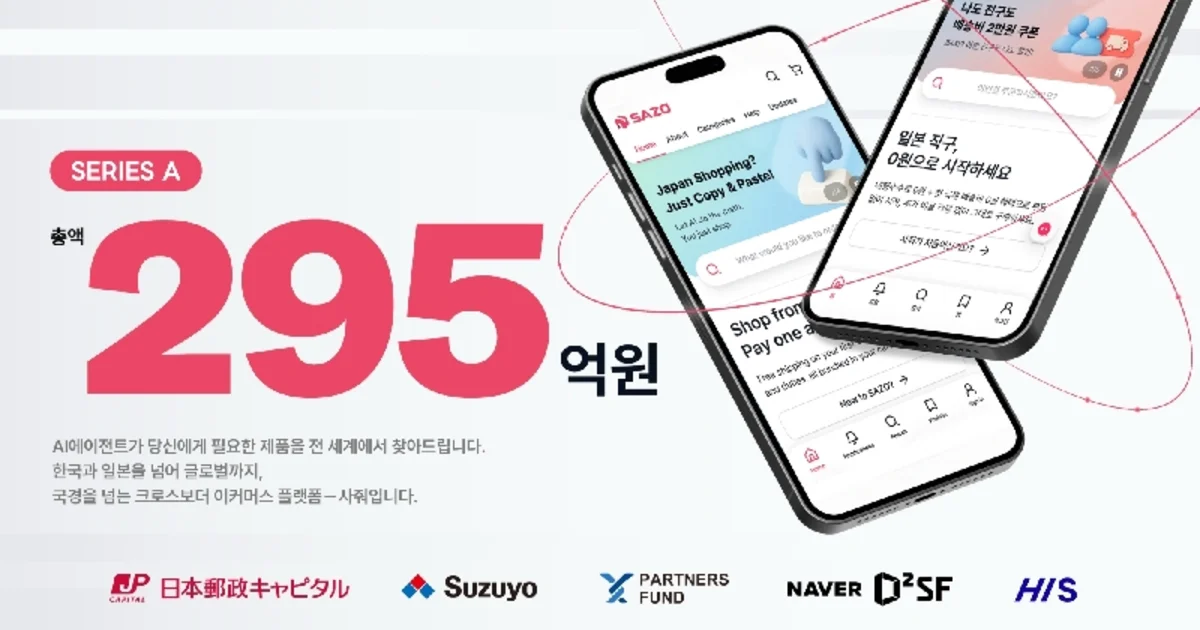
Sazo, an AI-powered cross-border commerce startup, has raised $10.3M (KRW15.2 billion) in a Series A round, along with additional credit-based financing from major Japanese financial institutions.
en.wowtale.netAccording to WOWTALE, Korean AI cross-border commerce startup Sazo was reported on July 22 to have closed $10.3M (KRW 15.2 billion) in a Series A round. Combined with credit-based financing from major Japanese financial institutions, the round's total funding reached $20.0M (KRW 29.5 billion).
Japan Post Capital and Suzuyo & Co. led the round, having also led Sazo's pre-Series A financing, a sign of continued confidence from the same backers. Naver D2SF, Japanese venture capital firm PARTNERS FUND, and D4V (Design for Ventures) joined as new investors. On the credit side, Sazo secured financing from Japan's three so-called megabanks, including Sumitomo Mitsui Banking Corporation (SMBC) and Mizuho Bank. The terms of the credit facility were not disclosed.
It is not common for a startup's funding round to be paired with credit financing from multiple megabanks at this stage. Tsuguhiro Nagata, director at Japan Post Capital, said, "Since our pre-Series A investment last year, Sazo has grown steadily as an AI-driven cross-border commerce platform. We will actively support Sazo's growth and enterprise value by leveraging Japan Post Group's extensive network and business assets to help realize its vision for global cross-border infrastructure."
How Pasting a URL Triggers Automatic Tariffs and HS Codes
At its core, Sazo's product hands off the tedious parts of cross-border shopping to AI. Korean consumers can already buy through Sazo from Mercari, Rakuten, and Rakuma. For sites that are not directly integrated with the platform, users simply paste the product page URL, and Sazo translates and localizes the listing while handling the purchase on the customer's behalf.
Behind that experience is an AI engine that calculates additional costs, tariffs, VAT, and shipping fees, based on a product's type and specifications. It also generates the HS code, the international classification system for traded goods, and prepares the corresponding customs documentation. The design targets a familiar pain point in personal cross-border shopping: not knowing the true landed cost until checkout. When Naver D2SF's investment was announced, Sazo said its prediction accuracy for shipping, customs duties, and fees reaches roughly 95%.
None of this automation is entirely new. Proxy-purchase services have existed for years; Hong Kong-based Buyandship received strategic funding from Cool Japan Fund back in 2023 and has since invested in its own AI and machine learning capabilities. What Sazo emphasizes is the precision of its cost estimates and having a single AI system own the process from purchase through customs paperwork.
From a Student Startup to 7x GMV Growth in Six Months
Sazo was founded in 2024 by Maro Gil, a Korean student who studied at the Nagoya Institute of Technology through an exchange program. A company that began as a university startup club project has, in roughly two years, reached the point of drawing credit financing from Japan's megabanks.
CEO Gil said of the round, "Our global service has grown rapidly, with monthly gross merchandise value increasing roughly sevenfold over the past six months. Building on this investment, we plan to hire talent across development, service operations, and other areas, and accelerate our efforts to build a cross-border ecosystem that connects consumers and businesses worldwide."
Sazo currently operates in Korea, the United States, and Japan. The new capital is earmarked for R&D on its "agentic commerce" infrastructure, global expansion, and hiring. In Korea, the company is also recruiting partners for a "reverse cross-border" business, in which Sazo handles payment and logistics for Korean sellers expanding into Japan, with plans to add more countries as the program grows.
What It Will Take for Proxy-Purchase AI to Change Cross-Border Commerce
Sazo's estimation accuracy and end-to-end automation do lower the psychological barrier to shopping abroad. Even so, a few caveats are worth keeping in mind.
First, AI-generated tariff and VAT estimates remain predictions made before purchase. Final tax rates and dutiable values are determined by each country's customs authority, and there is room for the actual amount to diverge from the estimate. A roughly 95% accuracy rate also means that, by definition, about one in twenty transactions could see a mismatch between the quoted cost and the actual charge. Regulators are simultaneously tightening rules on low-value parcels: the EU introduced a temporary flat customs duty of €3 on imports under €150 starting in July 2026. A business model built around personal imports and proxy purchasing will keep feeling the effects of this kind of regulatory tightening.
Second, there is the question of platform dependency. Many marketplaces and shopping sites restrict unauthorized third parties from listing or purchasing on others' behalf, and whether a proxy-purchase operator has an official partnership can determine whether its business keeps running. A single change in a partner platform's terms of service could reshape a proxy-purchase provider's volume overnight. Fee transparency is another persistent issue across the sector, since service fees layered on top of shipping and tariffs vary by provider and directly affect how much buyers trust the final price they are quoted.
What Sazo's round shows is that investors are starting to back the automation of proxy purchasing in cross-border commerce. Because customs clearance carries real legal responsibility, how far Sazo can push its accuracy, and how it manages its relationships with partner platforms, will be the next things to watch.
Conclusion
Sazo's $20.0M round signals that Japanese financial institutions are now willing to put capital behind AI that smooths out cross-border shopping friction. Automating tariff calculation and customs paperwork could offer e-commerce operators a useful reference point as they consider expanding into new export markets. Still, managing accuracy and platform risk remains something Sazo itself has yet to fully prove out.