
AI Commerce News Digest (July 23, 2026)
The latest AI commerce news for July 23, 2026: Sazo's cross-border agentic commerce raise, Schnucks' agentic grocery assistant, Synagie's Geene 2.0, and the EU's tightening pressure on Chinese e-commerce, explained for online retailers.


Key Takeaways
- Korea's Sazo raised over $20M for AI cross-border commerce, backed by Japanese megabanks
- US grocer Schnucks launched an agentic shopping assistant, accelerating food-meets-AI
- Implementation and regulation of AI commerce moved in tandem across Asia and the West
Here is the AI commerce news for July 23, 2026. Today, implementation cases of "agentic commerce," where AI agents handle everything from product discovery to purchase, arrived one after another from Korea, the US, and Singapore. Yesterday we covered the ESW and Microsoft Copilot integration, and today that trend spread into cross-border commerce and grocery retail. Meanwhile, regulatory tension around Chinese e-commerce continued, with the EU's penalty on AliExpress and its charge sheet to JD.com.
Today's Top News
Korea's Sazo Raises Over $20M for AI Cross-Border Commerce, Backed by Japanese Megabanks

Sazo, an AI-powered cross-border commerce startup, has raised $10.3M in a Series A round, along with additional credit-based financing from major Japanese financial institutions, bringing the round to $20M.
en.wowtale.netKorea's AI cross-border commerce company Sazo raised a total of $20 million this round, combining a $10.3M Series A with credit financing from Japanese megabanks. The round was led by Japan Post Capital and Suzuyo, with Naver D2SF and D4V also participating. The financing came from three Japanese megabanks including SMBC and Mizuho.
At Sazo's core is a system where AI calculates tariffs, VAT, and shipping from a product's type and specs, and even handles HS code generation and customs documentation. Korean consumers can buy on their behalf from Mercari and Rakuten, and for unsupported sites, entering a URL lets Sazo translate, localize, and complete the purchase. According to CEO Maro Gil, global gross merchandise value grew roughly sevenfold over the past six months.
The fact that Japanese financial institutions led the round reflects expectations for infrastructure that handles the "transaction agency" of cross-border commerce. The company, which also operates in Japan, points to a direction where AI absorbs the complexity of purchasing across borders.
Full article: Sazo Raises $20M: Cross-Border Agentic Commerce Where AI Handles Everything From Tariffs to Proxy Buying
US Grocer Schnucks Launches an Agentic Shopping Assistant
VitalityIP and Schnucks launch an AI-powered, agentic shopping assistant with personalized nutrition guidance, meal ideas and product recommendations.
www.businesswire.comMissouri-based grocer Schnucks (112 stores) has partnered with VitalityIP to launch an AI shopping assistant running in its rewards app and website in late summer 2026. Built on an intelligence layer of over six billion lines of shopping, health, and nutrition data, it aims to support food choices aligned with weight management and family wellness, along with meal planning, savings, and food-and-wine pairing.
The platform is designed for white-label integration by other retailers, with a vision to embed into health systems and employers as well. The division of roles is also clear: Schnucks retains ownership of the customer relationship and data, while leveraging VitalityIP's AI and nutrition database.
That said, while it carries the "agentic" label, whether it autonomously executes purchases or stops at recommendations is undisclosed. A Dunnhumby survey found only 29% of shoppers are enthusiastic about agentic shopping, showing that acceptance of food-meets-AI still has some distance to go.
Full article: Schnucks Launches a Nutrition-Personalized Agentic Shopping Assistant: Where Food-Meets-AI Stands
Agentic Commerce
Synagie Unveils AI Commerce Platform "Geene 2.0" With a 12-Partner Coalition

Synagie, the digital commerce arm of Hong Kong-listed Synagistics, launched Geene 2.0 in Singapore, a SaaS platform integrating AI, data, media, commerce, and blockchain.
finance.biggo.comSynagie, the digital commerce brand of Hong Kong-listed Synagistics (HKEX:2562), unveiled its integrated AI commerce SaaS "Geene 2.0" in Singapore. Co-developed by 12 founding partners including BytePlus and SingData, its proprietary "ASSET" engine connects five layers, from data analytics to multilingual content generation, workflow automation, and blockchain verification.
It has already been commercially deployed for Malaysia's premium durian brand "AGONG," used for traceability verification. Commercial availability is set for early August, with Singapore's NTUC grant subsidizing up to 70% of implementation costs. The pitch is to bundle fragmented AI tools into a single trusted platform.
Still, one of the 12 partners is Synagie itself, meaning external partners number 11 in practice. The stock has surged on past AI-platform announcements too, and this launch carries a similar hype-first tone.
Full article: Synagie Unveils Geene 2.0: The Asian AI Commerce Platform Built on a 12-Partner Coalition and the ASSET Engine
Payments Firms Build AI Commerce Rails, but E-Commerce Platforms Stay Guarded

Payments companies are building rails for autonomous AI-led shopping, but ecommerce platforms remain wary of losing control over discovery, recommendations and margins.
www.business-standard.comBusiness Standard reported on the temperature gap between the payments industry and e-commerce platforms over agentic commerce. While payments firms like Visa and Mastercard rapidly build payment rails for AI agents, e-commerce platforms are wary of losing control over discovery, recommendations, and margins.
If AI agents seize the entry point to purchasing, the consumer touchpoint could shift from platforms to agents. This asymmetry, between the payments side leaning in and the distribution side staying cautious, looks set to shape the pace of agentic commerce adoption.
AI Commerce Tools
ReFiBuy Introduces "ACO Everywhere," Extending to Amazon Alexa Shopping Optimization
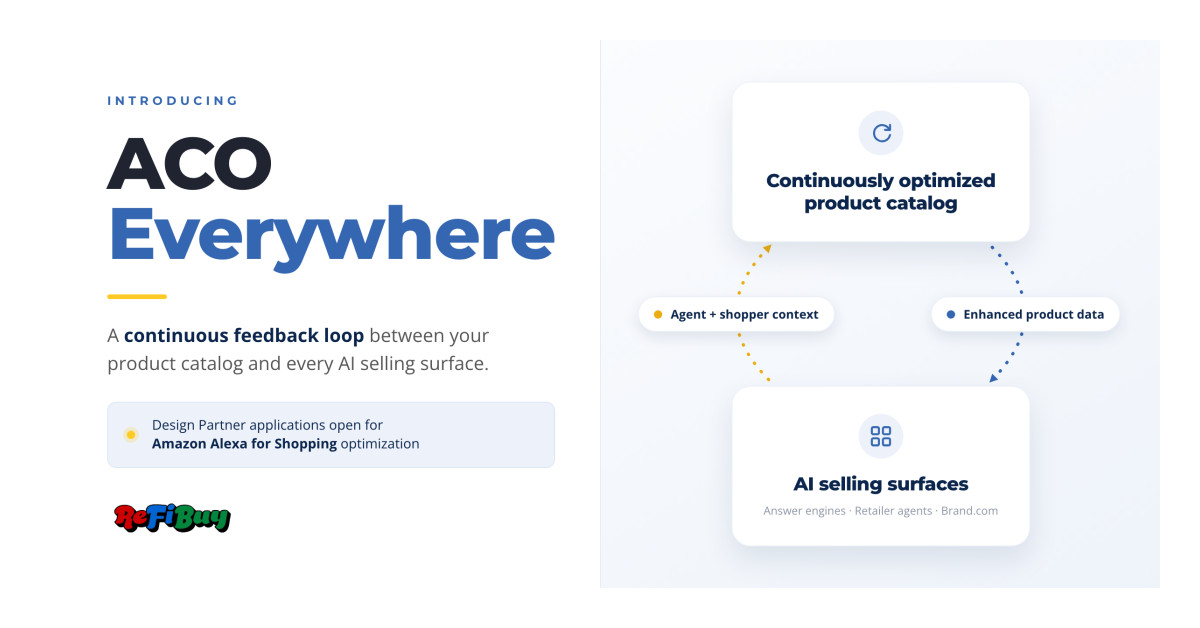
ACO Everywhere extends Agentic Commerce Optimization beyond answer engines to all selling surfaces, now adding Amazon's Alexa for Shopping.
www.newswire.comReFiBuy announced "ACO Everywhere," extending its "Agentic Commerce Optimization (ACO)" for AI agents across all selling surfaces. Beyond answer engines, it is advancing support for Amazon's voice shopping "Alexa for Shopping" and opening a design partner program.
As the paths by which AI discovers and recommends products expand to voice, "agentic optimization," keeping a brand findable on any surface, is drawing attention as a new visibility measure following SEO.
Google AI Overviews Rolls Out in France, Changing the Premise of E-Commerce Acquisition

Google is rolling out AI Overviews and Search Live in France, explaining how AI Mode and visual search reshape e-commerce acquisition.
www.ecommerce-nation.frGoogle has fully rolled out "AI Overviews," which inserts AI summaries into search results, and conversational "Search Live" in France. As AI-led information retrieval that bypasses traditional blue links spreads, the acquisition structure for online retailers is shifting.
From SEO premised on clicks to optimization for being cited and recommended by AI. In Europe too, how to protect search-driven traffic is becoming a concrete challenge.
Payments & Fintech
US Payments Forum Publishes a Primer on Agentic Commerce
The U.S. Payments Forum has published a new white paper, 'Agentic Commerce: A Primer for the Payments Industry.'
www.globenewswire.comThe US Payments Forum published a white paper organizing the basics of agentic commerce for the payments industry. It systematically lays out the terminology, key issues, and challenges the industry must face when AI agents get involved in purchasing and payments.
An industry group issuing an introductory document signals that agentic payments are moving from a handful of early cases into a phase that requires a shared vocabulary.
India Proposes an "AI Payment Protocol," Debating the Death of the Click

NPCI's proposed Unified Agent Protocol could make India the first nation with sovereign rails for AI-led payments.
www.ndtvprofit.comIndia's NPCI proposed a "Unified Agent Protocol" to standardize payments by AI agents. Building on UPI's success, it envisions national rails for AI-driven payments, and if realized, India could become the first nation to hold sovereign infrastructure for AI payments.
In an era where agents handle purchasing, who controls the payment standard and how matters. The move toward nation-level protocol development points to a new front in the contest over payment infrastructure.
Franklin Templeton Bets on Altcoins for an AI-Driven Commerce Future

Franklin Templeton suggests cryptocurrencies will be key for agentic AI commerce, revolutionizing how AI agents conduct onchain transactions.
cryptobriefing.comAsset management giant Franklin Templeton signaled a view that cryptocurrencies will play an important role in AI-driven commerce. The argument is that when AI agents complete transactions onchain, stablecoins and altcoins can serve as payment methods.
The discussion linking AI agent payments with stablecoins has spread over recent weeks alongside proofs of concept from payments firms. An asset manager's remarks reflect that institutional interest is reaching this domain.
Global E-Commerce Trends
China Pushes Back on the EU's AliExpress Penalty, Warns of Countermeasures

China warned of countermeasures after the EU penalized AliExpress and France advanced legislation imposing tougher limits on fast-fashion platforms.
www.caixinglobal.comChina pushed back strongly and warned of countermeasures after the EU imposed a penalty on AliExpress over counterfeit and unsafe products. Combined with France advancing legislation targeting Shein, Temu, and AliExpress, trade friction between Europe and China is sharpening around Chinese e-commerce.
For Chinese platforms that have grown their European presence on low prices, tighter regulation is direct pressure on their business structure. The regulatory environment for cross-border commerce is becoming a factor that will shape the market map ahead.
EU Regulator Sends a Charge Sheet to JD.com Over the Ceconomy Deal

The European Commission outlined its objections to Chinese e-commerce giant JD.com over its acquisition of German electronics retailer Ceconomy.
www.reuters.comThe European Commission sent a charge sheet regarding Chinese e-commerce giant JD.com's acquisition of German electronics retailer Ceconomy. Under the Foreign Subsidies Regulation, it has entered a stage of scrutinizing whether the deal risks distorting competition.
Against Chinese e-commerce expansion into Europe, the EU is tightening oversight on both the penalty and merger-review fronts. JD.com's move reflects the reality that cross-border M&A is running into regulatory walls.
Corporate Moves & Partnerships
Nike Tightens Online Sales in China, Steering Consumers to Official Channels

Nike aims to win back Chinese shoppers by controlling how its products are sold online and steering consumers to official Nike channels.
kelo.comNike signaled a policy of tightening its scattered online channels in China and steering consumers to official channels. The aim is to curb disorderly discounting and gray-market distribution on platforms, and to control brand experience and pricing.
A brand reclaiming control of its channels can be read as a swing back from platform dependence. Amid the competitive Chinese e-commerce market, strengthening direct sales is becoming a pillar of brand strategy.
GrubMarket Completes Acquisition of Canadian Online Grocer SPUD

Food tech company GrubMarket acquires Canadian online grocer SPUD to expand its reach in Canadian markets.
progressivegrocer.comFood tech company GrubMarket completed its acquisition of Canadian online grocer SPUD. For the company that bundles North America's food supply chain, it is a move to expand its business scope in the Canadian market.
Consolidation in food e-commerce also ties into building foundations for AI-powered demand forecasting and inventory optimization. Platform integration is becoming a precondition for improving fulfillment efficiency.
Logistics & Fulfillment
Amazon to Invest $400M in Two Florida Sites, Temporarily Cutting 1,100+ Jobs

Amazon is temporarily shutting down two Florida facilities, laying off 1,100 workers and spending $400 million to retrofit both warehouses.
wwd.comAmazon was reported to be temporarily closing two Florida fulfillment sites, cutting over 1,100 jobs, and investing $400 million to retrofit both warehouses. The investment appears aimed at updating aging facilities for automation.
Warehouse automation investment comes with a shift in employment structure. Efficiency in last-mile and fulfillment remains an area of continued investment as it shapes the overall cost competitiveness of e-commerce.
Consumer Trends
Four in Ten APAC Shoppers Use AI Tools for Online Shopping

A survey found that four in ten shoppers in the Asia-Pacific region use AI tools for online shopping.
retailasia.comA survey found that about 40% of shoppers in the Asia-Pacific region use AI tools for online purchasing. It shows the reality that AI is being embedded into the purchasing process, from product comparison and recommendations to search assistance.
The more consumer acceptance advances, the more important it becomes to build products that are findable via AI. The foundation of agentic commerce is built on this spread of everyday AI use.
Two-Thirds of US Households Now Shop Online Every Week

According to Numerator, 86 million US households, two-thirds of the country's families, now shop online every week.
talkbusiness.netA report from analytics firm Numerator found that about 86 million US households, two-thirds of all households, now shop online every week. It confirms that online purchasing has settled from a special activity into an everyday habit.
Higher purchase frequency means wider room for AI-powered purchase support to land. Within habitual shopping, reducing effort is becoming the focus of platform competition.
China's Cross-Border E-Commerce Shoppers Reach 140 Million in H1
Cross-border e-commerce shoppers in China reached 140 million in the first half of 2026.
english.news.cnChina's cross-border e-commerce shoppers reached 140 million in the first half of 2026. The figure shows that buying overseas products from home is spreading further among Chinese consumers.
Growing cross-border demand is a tailwind for AI-powered transaction agency like Sazo's. Mechanisms where AI absorbs language, tariff, and customs barriers gain weight as this user base expands.
Conclusion
Today, three agentic commerce implementations from different regions and business types, Korea's Sazo, the US's Schnucks, and Asia's Synagie, lined up on the same day. The differences in angle, cross-border, grocery, and enterprise platform, reflect how rapidly the domains where AI touches purchasing are expanding. At the same time, the picture of implementation and regulation running in parallel became clear, with the EU's AliExpress penalty, the JD.com review, and India's AI payment protocol proposal. From tomorrow, we will watch how the contest for control between payments firms and e-commerce platforms unfolds.