Unilog Launches CX1 Sigma, an AI-Native B2B Commerce Platform for Distributors That Builds Production Pages from a URL and Applies AI-Visibility Structure Automatically
A look inside CX1 Sigma, launched by Unilog on August 20, 2026: what Site Studio generates, how the HyperScale Growth Agent Suite maps to acquire, convert and expand, and why product data quality still decides the outcome.

Key Takeaways
- Unilog, a US provider of B2B commerce infrastructure, launched CX1 Sigma on August 20, 2026, an AI-native B2B commerce platform. At its core sit Site Studio, which generates production-ready pages from a plain-language description or a reference URL, and the HyperScale Growth Agent Suite, which covers everything from demand generation to reorders
- The agents are organized by stage of the commercial flow: acquire, convert and expand. They enrich product data, tune visibility in search and AI-driven discovery, and handle quotes and reorders. Every action is previewed and logged in an audit trail before it goes live, keeping the decision with the distributor
- What decides the outcome, though, is not the platform but the product data. In a survey of B2B e-commerce practitioners, data quality was named the single biggest barrier to growth for the second year running, and most respondents graded their own product data a B or a C. Pricing and general availability remain undisclosed
Unilog launches an AI-native platform for wholesale distributors
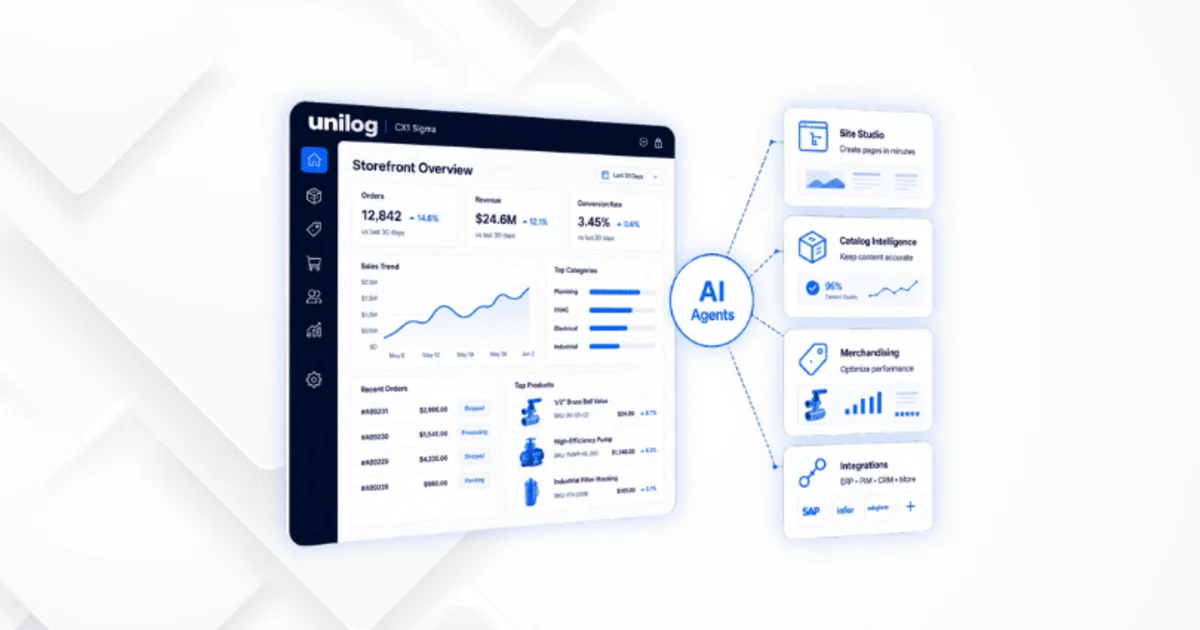
Dubbed CX1 Sigma, the AI-native B2B commerce platform combines commerce, content and AI-powered agents in one system.
www.mdm.comModern Distribution Management, a trade publication covering wholesale distribution, reported on August 20, 2026 that Unilog had launched its next-generation B2B commerce platform. According to Unilog's own announcement issued the same day, the product is called CX1 Sigma and is positioned as a commerce platform built to act on intent.
Unilog is headquartered in Plymouth Meeting, Pennsylvania, and has supplied product content and e-commerce infrastructure to wholesale distributors, manufacturers and specialty retailers. It focuses on the middle of the supply chain across plumbing, PVF, HVAC, industrial supply, electrical and construction materials, and its site states that it actively manages more than 18 million SKUs of product content. CX1 Sigma is a new commerce layer on the existing CX1 Platform, working alongside CX1 Product Content and the CX1 PIM.
The stated target is mid-market distributors that carry complex catalogs, customer-specific pricing and ERP-connected workflows, yet run digital operations with a small team. In other words, the product is framed for companies that cannot staff commerce the way a consumer retailer does, and want to grow digital trade without growing the manual work behind it.
Hand it a URL and you get a page: the Site Studio entry point
The clearest change in CX1 Sigma is where page production starts. Site Studio takes either a plain-language description or a reference URL and produces a page ready for production. Brand, structure, SEO and findability are said to be built in from the moment of generation.
The processing sequence shown on the product page runs as follows: a reachability and robots.txt check on the reference URL, headless capture of the desktop and mobile renderings, extraction of structural primitives by a vision LLM, and a read on design sentiment by the same class of model. The approach reads as visually parsing a competitor site or an existing site of your own, then recomposing the elements from what it finds. Unilog describes this as a way to cut dev tickets and agency dependency.
Worth noting is that AI-visibility structure is applied to the output automatically. Where B2B buyers look for products is shifting from search engines to generative AI. Forrester's 2026 research on business buying found that a typical buying decision now involves 13 internal stakeholders and nine external influencers, and each of them tends to complete their homework in AI tools before contacting a vendor. Whether a page is legible to a model, not just to a person, has become a precondition for demand, and that assumption is written into the product spec.
Agents mapped to acquire, convert and expand
At the center of CX1 Sigma is the HyperScale Growth Agent Suite. Unilog had announced early access to its Unilog HyperScale AI agents in October 2025, at which point the CX1 CIMM2 platform offered a Blog Agent, Synonym Agent, Sales Insights Agent, Connect Agent and Writing Agent. Those have now been reorganized around how distributors actually grow.
| Phase | Agents deployed | Work covered |
|---|---|---|
| ACQUIRE (demand and discovery) | Marketing Agents / Findability Specialist | Outbound demand, site content, and visibility in search and AI-driven discovery |
| CONVERT (browse and basket) | Catalog Agents / Site Studio / Merchandising Agents | Managing and enriching product data, page generation, bundling and cross-sell design |
| TRANSACT and EXPAND (checkout, repeat, share of wallet) | Customer Success Agents / Order Concierge / Integration Agents | CS CoPilot and customer onboarding, quotes, orders, reorders and fraud detection, connectivity via Connect Agent and Punchout Agent |
| Platform Admin (the trust layer) | Applied to all agents as a platform capability | Grounding, role-based access control, NIST compliance |
Unilog's framing is that these are purpose-built specialists rather than generic chatbot features. What stands out in the arrangement is that the Catalog Agents under CONVERT are responsible for enriching attributes, descriptions and taxonomy. The most common reason a distributor's e-commerce project stalls is that product information for tens or hundreds of thousands of SKUs never gets finished. Assigning agents rather than headcount to that work looks like a choice grounded in the reality of the sector.
The Order Concierge in the expand phase follows the same logic. Quotes, orders, reorders and fraud detection are the most repetitive parts of B2B trade and the ones that have consumed the most sales-rep time. B2B purchasing is dominated by the same customer buying the same items again, and that repetition is a rational place to apply agents. The same instinct shows up in commercetools turning Mirion's order intake into an agent workflow and in Alibaba bringing Accio Work to corporate purchasing.
On the operational side, the announcement is explicit that every agent action is previewed and tracked in an audit trail before anything goes live. A trust layer sits under Platform Admin, listing grounding, role-based access control and NIST compliance as platform capabilities. Direction comes from the distributor's team, execution comes from CX1 Sigma.
Up to now, people have logged into software each day to do their work. Going forward with CX1 Sigma, you express intent, and the software does the work for you.Source: Suchit Bachalli, CEO of Unilog
The first named adopter is Audubon Supply Company, a family-owned distributor founded in 1913. It supplies plumbing, HVAC, mechanical, industrial and irrigation contractors in southern New Jersey, and the partnership kicked off in August with Unilog's product and engineering teams working directly with Audubon's team as implementation begins. Which also means there are no live results or performance figures yet. Pricing, general availability timing and customer counts are all undisclosed.
The self-healing claim, and the data constraint on the ground
Unilog describes the platform as self-composing and self-healing, detecting and resolving routine issues before a customer ever notices. The product page depicts monitoring of memory usage and instance availability, a proposed remediation, and application of the fix after approval. That is the vendor's own account, and where automation ends and human approval begins has not been verified independently.
The more fundamental reservation lies outside the platform. According to Master B2B's 2026 research among B2B e-commerce practitioners, data cleanliness and hygiene was the single biggest barrier to growth for the second consecutive year, and it was the only barrier where not one respondent said it was not a barrier at all. Asked at roundtables to grade the quality of their own product data, most gave it a B or a C. AI investment, meanwhile, has become concrete: 81% of practitioners say they are actively spending on AI in the next 12 months, up from 68% a year earlier. The foundation has not moved with it.
Buyers are cautious too. In the Forrester research cited above, only 36% of buyers felt more confident they had made a better-informed decision because of generative AI, while 20% felt less confident after encountering unreliable or inaccurate information. Among procurement respondents, the share who felt less confident because of inaccurate AI output rose to 28%. B2B buyers use AI as a starting point and then go to people to confirm what it produced. The deeper agents sit in the transaction flow, the more directly the accuracy of the underlying product data governs trust.
What this means for e-commerce and wholesale operators in Japan
Applied to Japanese distribution, two implications stand out.
The first is one of sequence. Whether or not you adopt a platform like CX1 Sigma, cleaning up attributes, descriptions, images and taxonomy in the product master comes first. Even in the case where Metcash lifted conversion sharply with Coveo's AI search, the foundation was accurate product information delivered through standards and properly supplied imagery. AI amplifies product data, and there is nothing to amplify when the source is thin.
The second is that the object of visibility is moving from pages to the product data itself. Trade that agencies and wholesalers have run on paper catalogs, fax and phone loses its premise the moment the buyer's staff start delegating research to AI. Whether your products appear in an AI answer depends less on how the site looks than on how much structured product information sits there in a machine-readable form. This is work you can start without replacing any platform.
In closing
What the CX1 Sigma announcement settles is the design philosophy, no more. How much manual effort actually disappears will not be visible until implementation at Audubon Supply progresses. Still, the fact that wholesale distribution is now being chosen as a place to apply AI agents is itself a signal. Ahead of the glossier consumer cases, the return on automation may simply be easier to find in work buried under an ocean of SKUs. We should know within the next few months.