Visa and Lianlian Run Greater China's First Live B2B Agentic Payment, and Agentic Directory Listing Changes How Merchants Decide
Lianlian's LoopXPay agent sourced, ordered and paid a supplier in a single workflow. What its Visa Agentic Directory registration means, and how merchants should handle agent-driven orders.

Key Takeaways
- Visa and Lianlian DigiTech completed Greater China's first live B2B agentic transaction using the LoopXPay agent, which identified the purchasing requirement, recommended suppliers, compared options, placed the order and executed payment in a single workflow.
- LoopXPay was registered in Visa's Agentic Directory, letting merchants identify verified agents from a list. The basis for accepting an agent-driven order is starting to shift from in-house bot defences to whether the network has registered the agent.
- Forrester still calls autonomous B2B buying rare and early stage, and agents are involved in only a few percent of live transactions. The practical task for merchants is to stop blocking legitimate agents and to start recording who authorised each order.
For the first time in Greater China, an agent carried a deal through to payment
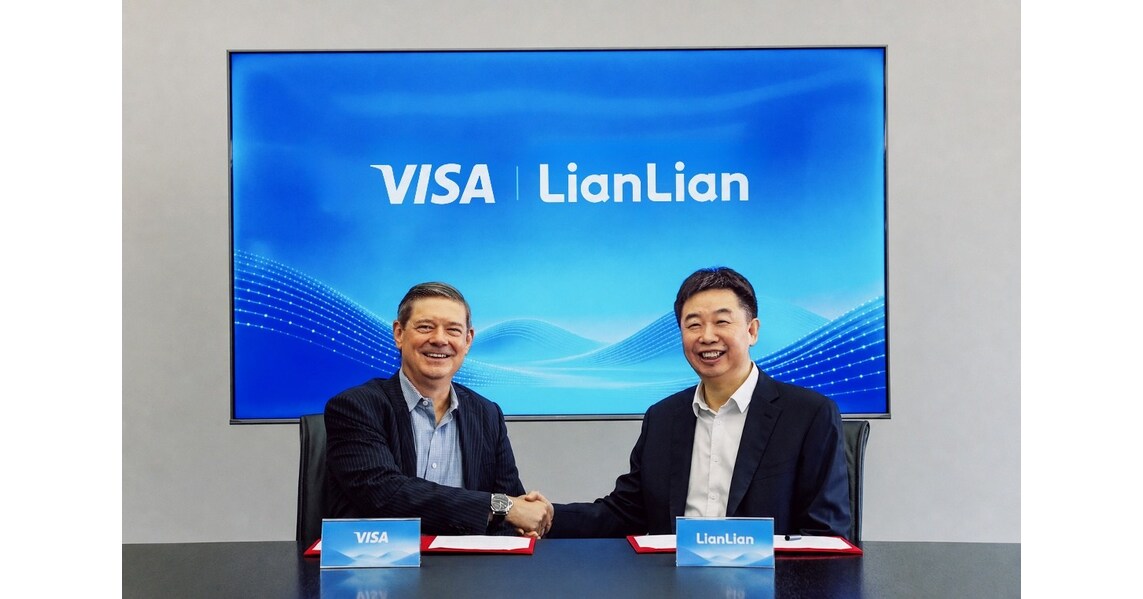
Visa (NYSE: V), a global leader in digital payments, and Lianlian DigiTech Co., Ltd. ('Lianlian'), an AI-native global financial infrastructure provider, announced the first live B2B agentic transaction completed using LoopXPay.
www.prnewswire.comIn an announcement out of Singapore on July 24, 2026, Visa (NYSE: V) and Lianlian DigiTech (2598.HK, listed in Hong Kong) described not a sandbox demo but a live transaction. Lianlian's AI agent LoopXPay sourced a product sample from a supplier and carried the purchase through to completion.
Broken into steps, the agent identified the purchasing requirement, recommended suitable suppliers, compared options, placed the order and securely executed the payment. All of it happened inside a single workflow, within pre-defined spending controls and approval parameters. The transaction value and the buyer involved were not disclosed.
The intended users are small and medium sized businesses without dedicated procurement teams. These are companies where an owner or a couple of staff handle supplier search, quote comparison, ordering and payment on top of everything else. For them, procurement is a fixed time cost they would happily cut.
What the phrase "single workflow" is actually doing
The easy thing to miss is that this transaction joined sourcing and payment into one line. In conventional B2B buying, finding, choosing, ordering and paying sit in four different systems with four different approval paths: a sourcing platform, a core ordering system, and a bank or a card.
Drop AI into that fragmented setup and you get four slightly faster steps. Agents only start to matter when decision and execution run continuously across the handoffs. What this announcement demonstrated is that the continuity was made to work on top of a card network.
Continuity also raises the stakes, because nothing stops the process before money moves. Visa and Lianlian bounded it with pre-defined spending limits and approval parameters. The human approves the envelope the agent may operate in, rather than each individual transaction.
What the Agentic Directory changes as a register of verified agents
The line that matters most to merchants is that LoopXPay has been registered in Visa's Agentic Directory. It reads as a footnote, and it is the structural core of the story.
The Agentic Directory lists AI agents and merchants that Visa has pre-screened. In its Payments Forum 2026 announcements, Visa explained that merchants need to know which agents can be trusted to transact on their sites, and that agents need confidence they are dealing with legitimate merchants. The register works in both directions.
Underneath it sits the Trusted Agent Protocol (TAP), published with Cloudflare on 14 October 2025. It gives an agent a cryptographic way to prove its identity and authorisation directly to a merchant, carrying three elements: agent intent, recognition of an existing customer relationship, and payment information.
Why was this needed? According to Visa, AI-driven traffic to US retail sites grew by more than 4,700% in a year. On the merchant side, that surge is hard to classify: a legitimate agent acting for a customer looks much like a hostile bot. When you cannot tell them apart, the safe move is to block everything, and legitimate orders die with the noise.
A register changes the calculation. Until now merchants wrote their own bot-detection logic and set their own threshold for turning traffic away. As directory usage spreads, the starting point becomes whether the network has verified the agent. Screened agents pass; everything else stays under the old suspicion. It is a two-tier model.
The flip side is that agents absent from the register risk being shut out of the flow. Registration becomes a competitive necessity for agent operators, and for merchants the register becomes an outsourced acceptance decision. That said, Visa has not published what its screening examines, nor the requirements and costs of registration. Delegating a decision to a process you cannot inspect deserves a note of caution.
Visa is building out the surrounding pieces in parallel. Agentic Ready, which lets financial institutions test agent-initiated payments with live cards and real merchants, was set out in April 2026 to expand from more than 20 partners in the UK and Europe to more than 85 across Asia Pacific and Latin America.
What Lianlian brings is cross-border sourcing plumbing
Why Lianlian? The company's profile answers it. Founded in 2009, it holds 68 payment licences and related qualifications, supports services in more than 200 countries and regions, settles in over 140 currencies, connects to more than 180 global e-commerce platforms and has served a cumulative total of over 13.3 million customers. It owns the money path between Chinese suppliers and overseas buyers.
Run an agent on that path and identity verification, transaction authorisation, payment execution and fund settlement all close inside one operator. Founder, chairman and CEO Zhang Zhengyu said the company is assembling exactly that bundle of capabilities for the agent economy.
As businesses increasingly look to embed intelligence into purchasing and payment experiences, trust will become a critical enabler of adoption.
The two companies are now exploring procurement, digital advertising optimisation and B2B platform payments as the next areas. Timing and scale remain undisclosed.
A three-way race for B2B agent payments
Visa is not alone in this space. A rival card network and a Greater China payment infrastructure player are approaching the same conclusion from different entry points.
| Camp | How agent identity is assured | Move in B2B |
|---|---|---|
| Visa | Cryptographic signatures under Trusted Agent Protocol, plus registration in the Agentic Directory | Greater China's first live B2B transaction via Lianlian's LoopXPay. Exploring procurement, digital advertising optimisation and B2B platform payments |
| Mastercard | Agentic Tokens bind card credentials to a specific agent, merchant scope and consent policy | Agent Pay for Machines spans cards, bank accounts and stablecoins, with more than 30 companies joining |
| Ant International | Alipay+ agent-facing payment infrastructure (AI Wallet and Token Pay) | Closed an approximately USD 1.2 billion Series A in July 2026, allocated to cross-border payments and agentic commerce |
The striking part is that all three treat agent identity as the first design problem. Mastercard's Agent Pay binds tokens to an agent, a merchant scope and a consent policy, and in June 2026 Agent Pay for Machines extended that beyond cards. Ant International closed an approximately USD 1.2 billion Series A in July 2026 and is directing it at cross-border payments and agentic commerce.
Different mechanics, converging answer: if agents are going to be transacting parties, a layer that proves who operates the agent has to sit in front of payment.
The volume of announcements is not the pace of adoption
The activity looks large; the field numbers are modest. In its mid-2026 assessment, Forrester notes that most agentic experiences remain conversational rather than genuinely autonomous. The firm describes autonomous B2B buying as rare and early stage and warns that hype is running ahead of behaviour.
Checkout.com's research published in June 2026 found that AI agents are involved in only 3% of live transactions, while 89% of merchants are actively preparing and 72% agree consumers will adopt agent-led shopping faster than merchants are ready for. Volume is tiny, yet preparation is already the majority position.
For B2B procurement the bar is higher still. Ticket sizes are larger, credit terms, contracts, goods receipt and accounting all attach, and the cost of an error dwarfs a consumer purchase. That this first transaction was a product sample reads as a measure of that caution.
What merchants should decide now
From the selling side, two questions matter.
The first is whether you are already blocking agent traffic. Bot rules left tight by default will turn away verified agents along with everything else. A mechanism like TAP only pays off once the merchant side verifies the signature. Stores with no acceptance path accumulate lost demand as the register spreads.
The second is record design. If you cannot record whether an order came from a human or an agent, which agent it was, under whose authority and up to what limit, you will not be able to settle liability for returns or chargebacks after the fact. In B2B, the approver record doubles as the audit trail.
From the buying side, the practical entry point is designing the spending limits and approval parameters. In this transaction the human approved the envelope, not the individual order. Whether an organisation can make that mental switch tends to decide whether adoption happens at all.
Closing thoughts
The headline says Greater China first. The structure matters more: a transaction that ran from sourcing to payment in one line, with its legitimacy underwritten by a card network's register. As the layer that vouches for agent identity matures, merchant acceptance decisions will lean on it.
Watch two things next. How much of the Agentic Directory's registration requirements and screening criteria Visa publishes, and whether merchants and PSPs outside the initial markets begin supporting TAP verification. The businesses that finish preparing while volumes are small will be the ones positioned to capture agent-driven demand.