Gemini Intelligence Automates 40+ Apps: What an OS-Level Agent Execution Layer Means for Merchants
Samsung's Galaxy Z Fold8 and Flip8 ship Gemini Intelligence, which runs tasks across 40+ apps. We break down the final-approval design, the approved-app gatekeeper, and how merchants should prepare for UI-driving agents.


Key Takeaways
- Samsung's Galaxy Z Fold8 and Flip8 are the first devices to ship Gemini Intelligence, making cross-app task execution across 40+ apps a default handset feature
- Execution pauses before payment and personal-data entry and waits for the user's final approval, but that approval is an on-screen confirmation, not a signed transaction credential
- For merchants the two questions that matter are whether their app can get onto the supported list, and whether their own screens can survive an agent driving them
From an AI that answers to an AI that operates apps

Samsung has debuted 'Gemini Intelligence' on the Galaxy Z Fold8 and Flip8, fully embracing agentic AI that links over 40 apps to execute tasks.
finance.biggo.comSamsung unveiled the Galaxy Z Fold8 Ultra, Fold8 and Flip8 at Galaxy Unpacked in London on July 22, 2026. The hardware story was mostly about thinner bodies and new aspect ratios. For anyone working in commerce, though, a different detail matters: these three handsets are the first to ship Google's Gemini Intelligence.
In its blog post that same day, Google presented expanded task automation as the first capability of Gemini Intelligence. The feature began as a beta in February 2026, initially centered on rideshare and food delivery. 9to5Google reports that the beta covered six apps on the Pixel 10 and Galaxy S26 series.
It now spans more than 40 apps. Google lists shopping, dinner reservations, travel experiences and event tickets as the covered areas, and 9to5Google notes that Etsy and Expedia are among the supported apps. On the Galaxy Z Flip8, users can trigger it from the Flex Window with a long press of the power button without unfolding the device.
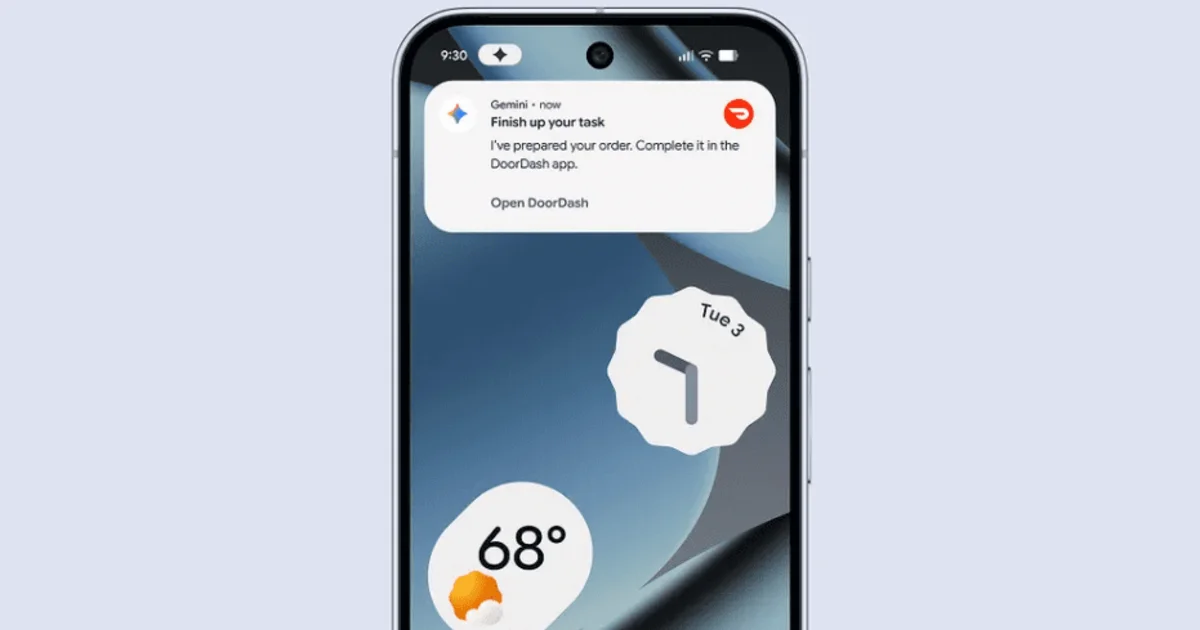
Samsung Newsroom describes the flow concretely. The agent searches for candidates that match the request while the user keeps using other apps, then the user reviews the recommendations and approves only the actions that require confirmation. Google's own phrasing is that Gemini notifies you when the task is ready for review and final confirmation.
Conversational AI has spent two years as a search and summarization layer. The shift to an execution layer is not what is new here. What is new is that it shipped as a factory default on a mass-market handset rather than as an experiment or a separate app.
Is stopping before payment enough of a trust model?
The most repeated question in agentic commerce is where to put the human in the loop. How much do you delegate, and where does explicit human intent become mandatory? The answer Google and Samsung shipped is: delegate the search and the form filling, keep the confirm button with the person.
The real question is how much weight that approval actually carries. Compared with the frameworks the payments industry has been assembling, it behaves quite differently.
AP2 (Agent Payments Protocol), initiated by Google and now discussed under the FIDO Alliance, treats user intent as two kinds of signed credential. The Intent Mandate, used when the human is not present, is signed up front with explicit constraints such as a price cap, a time window and an allowlist of merchants. The Cart Mandate, used when the human is present, carries the user's hardware-backed signature over the exact items and price. Visa's Trusted Agent Protocol takes a parallel approach, delivering the agent's identity, the user's consent and the transaction intent to the merchant as signed HTTP headers. Both exist so that a disputed transaction can be verified after the fact.
Gemini Intelligence's final approval is, for now, a confirmation step rendered on the handset. No signed attestation reaches the merchant. Because the agent operates the user's own logged-in session, the merchant cannot tell an agent-driven order from a manual one. In other words, the fact that a human approved the purchase is not verifiable on the merchant side.
A hands-on review by 9to5Google makes the looseness more concrete. The reviewer found it odd that the agent is not required to confirm anything before it takes control, noting that when he tried a booking task it began working without ever asking about his preferred conditions or preferred provider. He also reports having to take over manually once the flow reached a customer-data entry screen. It sets off with loosely specified parameters and stalls at personal information. That is the current level of maturity.
Google acknowledges the early stage itself. The footnote on its blog post is considerably more conservative than the marketing copy above it.
Includes apps supported across US and KR. Supervise closely, interrupt when needed. Select apps, devices, and markets only. 18+.Source: Google blog, footnote
Supervise closely, interrupt when needed. That is the feature merchants now have to deal with. Note also that the criteria for what counts as an action requiring confirmation, any guarantee that the agent always halts at the payment screen, and whether spending caps can be set are all undisclosed.
The number 40 is the next gatekeeper
Whether 40-plus sounds large depends on your reference point. It is a big jump from six apps in the beta. Measured against the number of shopping apps on a typical phone, it is a very short list.
What matters more is that the list is decided by the platform, not by merchant application. With a protocol integration such as UCP (Universal Commerce Protocol), a merchant implements the API, passes review, and connects to the agent channel by its own decision. Google published UCP in January 2026, co-developed with Shopify, Etsy, Wayfair, Target and Walmart, letting participating merchants surface a checkout button on eligible product listings in AI Mode and Gemini. Merchants opt in.
Gemini Intelligence task automation runs the other way. Inclusion is determined outside the merchant, and neither the selection criteria nor an application route has been published. The conditions in Google's footnote are that supported apps are based on those available in the US and South Korea, limited to selected apps, devices and markets, and restricted to users 18 and over. For merchants outside those markets, the question of getting on the list does not yet arise.
It is telling that Etsy is both a UCP co-development partner and a supported task-automation app. Merchants serious about agent-driven demand are working two structurally different doors at once: protocol integration, and the device-side supported list.
Agents that drive UIs versus agents that speak API
This is the most operational point for merchants.
The 9to5Google review describes the mechanics in detail. The agent manipulates the app's screens inside a siloed window and narrates each step, reporting what it typed into a search box and which option it selected. The user can interrupt at any point, correct course, and hand control back. This is not an API integration. It is automated operation of your app's UI on the user's behalf.
Seen from a merchant's app or site, that implies several things.
Because the agent is working inside the user's own authenticated session, blocking it with bot detection is not realistically an option. At the same time, nothing in your logs separates an agent-driven order from a manual one. The idea of measuring agent-sourced revenue and optimizing that experience does not have anything to attach to.
Screen design also becomes conversion-critical in a new way. Unlabeled buttons, elements that shift position, infinite-scroll lists and stacked modals are all obstacles to an agent even when a human would breeze past them. Part of the two-minute latency 9to5Google observed is the cost of reading those screens. The quality of your accessibility work is now, quite directly, the quality of your agent readiness.
How a device-resident agent differs from a chat agent
ChatGPT, the Gemini web app and Copilot are destinations users go to. An agent that lives in the OS is already where the user is, with access to the calendar, photos, notifications and whatever is currently on screen. Google also announced that Gemini can now reason about on-screen content and take complex images as prompts, so showing it a shopping list photo is enough to start.
Google's retreat from the browser-resident bet reads differently in this light. Project Mariner, the experiment in operating the web the way a person does, ended as a standalone product in May 2026, with its technology folded into Gemini Agent and Chrome's automated browsing. General-purpose web driving gave way to the higher-confidence surface of the device and its apps. This launch sits on that trajectory.
| Dimension | OS-resident agent (Gemini Intelligence) | Chat / browser agent | Protocol integration (UCP / ACP) |
|---|---|---|---|
| Merchant implementation | None. Any installed app can become a target | None in principle. Controlled via crawl rules and bot detection | Required. API build plus review before connecting |
| Point of contact | The agent drives the app's own screens | Web pages and checkout forms | Catalog, inventory, order and payment APIs |
| How scope is decided | The platform selects the supported apps | The agent's model decides | The merchant applies and connects |
| Purchase confirmation | On-screen review and final approval | In-agent checkout or handoff to the merchant site | Defined by the protocol. UCP can pair with AP2 |
| Merchant visibility | Hard to distinguish from normal app usage | Identifiable via user agent or signed headers | Fully visible in API logs |
Apple is chasing the same territory with the opposite philosophy. The next-generation Siri unveiled at WWDC26 on June 8 performs cross-app work through systemwide App Actions and answers questions about on-screen content. Its foundation, though, is developers declaring their app's capabilities and content through App Intents and App Schemas. Google drives the UI without asking developers for anything; Apple asks developers to declare first, then calls them. The former scales faster with unpredictable quality; the latter guarantees quality but stalls without adoption.
On rollout speed Samsung is ahead. Siri AI arrives as a beta within the year, English first. In the EU it is limited to Mac and Vision Pro rather than iOS or iPadOS at launch, and in China it waits on regulatory clearance. For merchants, the Android side is what to watch first.
The background: AI is pushing handset prices up
Behind this feature race, handset economics are under strain. IDC forecast in a May report that global smartphone shipments in 2026 will fall 13.9% year on year to 1.09 billion units, the steepest annual decline on record. Average selling price is projected to rise $100 to an all-time high of $550, so total market revenue still grows 3.8% even as volumes fall sharply. Memory shortages are cited as the dominant driver, and AI features serve as the justification for the higher price tag.
Conclusion
When an agent is resident from the moment the phone is unboxed and can operate 40-plus apps, the first thing a merchant should check is neither its ad spend nor its SEO. It is whether there is any path onto that list, and where demand comes from if there is not.
The effects reach merchants who never make the list, too, because an agent borrowing the user's session will still be filling out their forms. A flow that breaks there looks, from the merchant's side, like unexplained cart abandonment.
How far autonomy advances over the next few quarters is the thing to watch on a feature that Google itself labels "supervise closely, interrupt when needed." Whether the approval step is replaced by a signed credential, or simply stays an on-screen tap while more markets are added, will decide a great deal. The trust design of agentic commerce is increasingly being settled on shipped handsets rather than in protocol specifications.