Adobe Opens Its AI Tools For Free: Brand Visibility and GenStudio Are Two Bets on Agentic Commerce
Adobe is moving Firefly and its creative tools to a freemium model. The bigger story is Brand Visibility and GenStudio for Commerce Media Networks, two practical bets on the AI search and retail media era.


Key Takeaways
- Adobe is moving Firefly and its creative tools to a freemium model and distributing them across ChatGPT, Copilot and other external AI platforms
- The real story is Brand Visibility and GenStudio for Commerce Media Networks, two bets aimed at AI search and retail media
- For merchants, retail media operators and brands, visibility and ad generation become practical priorities once AI mediates product choice
The free release is the surface; the bet is on commerce media
Adobe is shifting to a freemium AI model across its creative tools, rolling out creative AI agents within Firefly, Creative Cloud, Photoshop and Premiere, and launching Brand Visibility and GenStudio for Commerce Media Networks.
finance.yahoo.comAdobe is reportedly shifting its creative tools to a freemium AI model. The company is embedding creative AI agents into Firefly, Creative Cloud, Photoshop and Premiere, opening access to a far wider set of users. The headlines have framed this free release as the main event.
The change unfolding behind that headline matters more to operators. In the same wave of announcements, Adobe introduced Brand Visibility and GenStudio for Commerce Media Networks. The former measures how a brand appears in AI search, while the latter generates advertising creative for retail media.
This article looks past the free release itself and focuses on two bets Adobe is placing on the agentic commerce and AI search era. We will trace how each one affects the day-to-day work of merchants, retail media operators and brands.
Why freemium, and why now
The free release is less generosity than a response to a shifting competitive landscape. In image and video generation, newer models from OpenAI and others are gaining ground quickly. A lead in creative tooling alone is no longer enough to hold the position.
Adobe's move has two stages. First it opened the Firefly AI agent as a public beta and extended it to Photoshop, Premiere, Illustrator, InDesign and Frame.io. Then it began distributing that agent to ChatGPT, Claude, Copilot, Gemini and Slack, bringing creative features to the places where people already work.
Widen the free entry point, maximize exposure across external AI, and convert that into paid and enterprise contracts. That is the logic of the freemium shift. At the same time, expanding the free tier is a bet that pressures Adobe's traditional subscription economics.
Brand Visibility: measuring how AI sees a brand
The first of the two bets is Brand Visibility. It is a way to see how a brand appears to AI in an era when AI recommends products. It responds to a simple reality: the center of search is moving from websites to AI-generated answers.
According to Adobe, Brand Visibility monitors how a brand surfaces across major AI search interfaces including ChatGPT, Google AI Mode, Microsoft Copilot and Perplexity. At its core sit Adobe's own LLM Optimizer and technology from Semrush, which Adobe acquired.
The resolution of that monitoring rests on data volume. Drawing on roughly 300 million real-world AI search prompts from Semrush's database, teams can see which queries their brand wins or loses, how often it is mentioned, and how its exposure compares with competitors. The tool also points to what should change to improve that exposure.
A striking set of figures sits behind this. Adobe reports that AI-driven traffic to U.S. retail sites grew 1,324% between October 2024 and May 2026, with the travel sector up 2,215% over the same period. Anil Chakravarthy, who leads Adobe's Customer Experience Orchestration business, has said that in a world where customers interact with an AI tool before ever reaching a business's website, visibility is everything.
The implication for merchants and brands is clear. Where traditional SEO competed for rank in search results, the new contest is whether a product gets recommended inside the AI's answer. Brand Visibility positions itself as the measurement tool for that new battleground.
GenStudio for Commerce Media Networks: generating retail media ads with AI
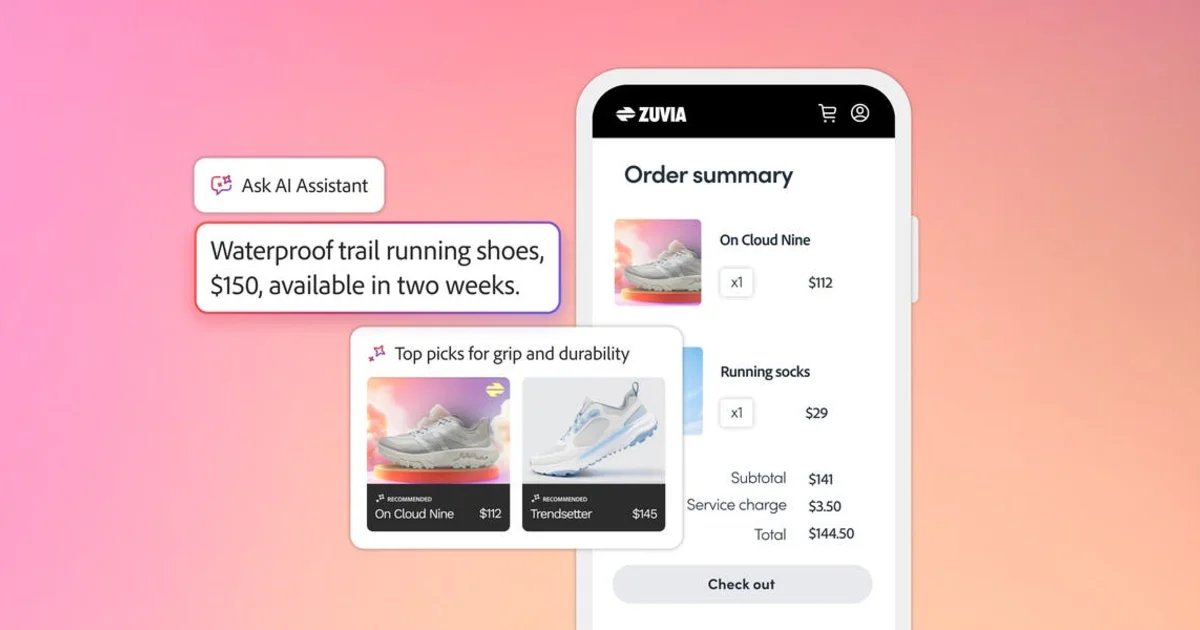
The second bet is GenStudio for Commerce Media Networks. It uses generative AI to produce the advertising creative for retail media, also called commerce media. The goal is to help retailers onboard brand advertisers quickly into the ad networks they operate.
A commerce media network is a business in which a retailer uses its own purchase data and ad inventory to sell advertising to brands. Because it can reach consumers at the exact moment they consider a purchase, it is regarded as one of the fastest-growing advertising channels today.
According to Adobe, GenStudio builds an advertiser profile and creative from existing product listings, website content and category context. The finished ads can be activated directly inside the retailer's ad network. The design lets brands new to commerce media advertising get up and running with far less effort.
The data plumbing is another key point. A native integration with Adobe Real-Time CDP Collaboration lets brands bring customer data from across channels into campaigns on retail networks. A partnership with LiveRamp connects retailers' purchase data, so campaigns can be built around what shoppers actually buy.
For a retail media operator, the appeal is faster onboarding of brand advertisers. For the advertiser, the burden of preparing separate creative for each retail network eases. Reducing that friction on both sides is the essential value of the tool.
What the two bets reveal about the near future of commerce
Brand Visibility and GenStudio are separate products, yet they share a single view of the future. It is a world where AI mediates discovery, recommendation and purchase. The former works the discovery-and-recommendation side, while the latter secures the advertising-and-checkout side.
Adobe is also pairing this with conversational entry points such as Brand Concierge, which turns on-site experiences into dialogue and brings product details and checkout into the conversation. Measuring visibility, generating ads and serving customers through dialogue are beginning to connect into one flow.
The homework for merchants comes down to three items. First, check whether your products appear in AI-generated answers. Next, weigh whether to advertise on commerce media or operate your own network. And finally, structure your product data so AI can interpret it correctly. None of these are easy to keep postponing.
Conclusion
Adobe's free release carries a defensive logic against the competitive landscape, but what operators should watch is the pair of bets behind it. Brand Visibility measures visibility for the AI search era, and GenStudio for Commerce Media Networks handles the generation of retail media advertising.
What unites them is the assumption that AI mediates product choice. The order-of-magnitude growth in AI-driven traffic supports that assumption. How does your product look to AI, and at which touchpoints will it meet consumers? It may be worth checking whether you are ready to face that question.