Amazon Moves Prime Day to June as Prime Saturation and the AI Shift Reshape Its Promotion Model
Amazon has advanced Prime Day 2026 to June 23-26, a month earlier than usual. With US Prime membership saturated, the sale is being redesigned from a member-acquisition engine into a testbed for AI-driven discovery via Rufus and agentic commerce.

Key Takeaways
- Amazon advanced Prime Day 2026 to June 23-26 from its usual July slot, with the AI shift and a rethink of promotion strategy behind the move
- With US Prime membership near 200 million and new-signup headroom exhausted, the sale is shifting from a member-acquisition engine toward a device for getting existing members to order more
- Amazon is placing Rufus (Alexa for Shopping) at the center of discovery and purchase, redesigning Prime Day as a testbed for AI-driven discovery and agentic commerce
What the Earlier Prime Day Signals
Amazon Prime Day has maxed out the addressable market for its membership, so it's changing its Prime Day strategy.
www.businessinsider.comAmazon has officially announced that Prime Day 2026 will run for four days, from June 23 to 26. What stands out is the timing: a sale that has traditionally taken place in July has been moved up by nearly a month. This is the first June Prime Day since 2021.
On the surface, the reason given is a crowded July calendar packed with major events such as the World Cup and the United States' 250th anniversary. Yet a more structural story sits behind the date change. Bloomberg tied the move forward to Amazon's AI shift, and the role of the Prime Day mega-event itself is now being reexamined.
Treating this as merely a season sale moving its date misses the point. The king of membership commerce is reshaping its single largest promotional engine, and the date change should be read as a symptom of that.
Saturated Prime Membership and the Limits of an Acquisition Engine
Prime Day was originally designed as a mechanism to acquire new Amazon Prime members. By restricting access to the year's biggest sale to Prime members, Amazon nudged non-subscribers toward joining. For years, this structure propelled membership growth.
That premise is now breaking down. According to Business Insider, more than 86% of US online shoppers are already Prime members. US Prime membership swelled from roughly 40 million in 2015 to about 200 million in 2025, and growth has slowed in recent quarters. Sky Canaves, an analyst at EMARKETER, notes that "there just isn't much growth to capture."
When the well of new members runs dry, the purpose of Prime Day inevitably changes. The aim shifts from drawing in people who are not yet members to getting people who already are to order more. Indeed, Prime Day 2026 puts groceries and everyday essentials front and center. Previews featured low-cost necessities such as hot dogs, Celsius energy drinks, and the Korean beauty label Mamonde.
It is a striking contrast to the high-margin electronics that once headlined the event. These low-priced items function as loss leaders that raise visit frequency. Through capturing share in the grocery category, Amazon is trying to lift overall household spending.
Competition cannot be ignored either. Nearly 60% of the Prime members shopping Prime Day are reported to also plan to check Walmart's competing sale. As Walmart+ pushes forward with delivery perks and meal services, Amazon finds itself competing head-on in essentials and delivery.
How Rufus Is Reshaping the Front Door to Discovery and Purchase
As its role as an acquisition engine fades, Prime Day is taking on a new meaning: a testbed for AI-driven discovery and purchase experiences. At the center sits Amazon's AI shopping assistant.
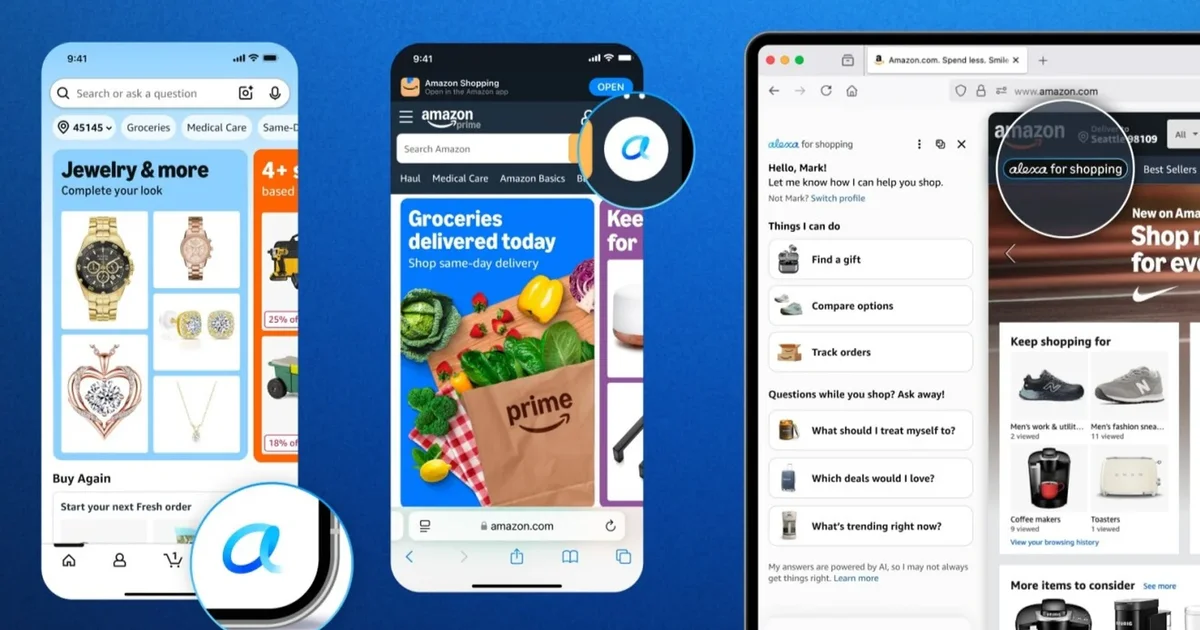
This assistant was long known as "Rufus," but it was renamed "Alexa for Shopping" in the US in May 2026. Integrated into Amazon's search bar, it ships free to every US shopper with no Echo device, no Prime membership, and no app required. Usage is expanding rapidly, with monthly active users up more than 115% year over year and engagement up nearly 400%.
The figures underscore its presence. By Amazon's own account, the assistant reaches roughly 300 million active customers and already drives about $12 billion in incremental annualized sales. CEO Andy Jassy said on the Q3 2025 earnings call that Rufus was on track to contribute $10 billion in additional annual revenue. In a short span, that scale has grown further.
What matters is that this assistant is not a mere replacement for search. Rufus has begun executing agentic actions on shoppers' behalf, including auto cart-add, reorder, price alerts, and auto-buy at target prices. For branded products, a "Buy for Me" button appears, introducing a mechanism in which Amazon completes part of an external purchase flow on the customer's behalf.
The four concentrated days of Prime Day are an ideal window to validate these AI capabilities at scale. Within the surge of traffic, how much discovery can Rufus drive and convert into purchases? For Amazon, the sale is now both a place to clear inventory and earn advertising revenue and a testbed for refining AI-led purchase experiences.
What Merchants Need to Confront
This redesign is not only a matter for sellers on Amazon. The shift toward AI becoming the front door to discovery and purchase presses equally on other marketplaces and D2C brands.
For Amazon sellers, the first question is the quality of product data. For an assistant like Rufus to understand and recommend a product, accurate and structured product information is essential. The shift moves from keyword-stuffed legacy optimization toward information design that lets AI grasp intent. On the advertising side, Rufus has begun surfacing Sponsored Products prompts, making AI-mediated exposure a new axis of competition.
The implication for other marketplaces and D2C brands is just as clear. The center of gravity moves from an era of fighting over search-engine rankings to optimizing for recommendation by AI assistants, what is often called AEO (AI Engine Optimization). As consumers increasingly ask AI what to buy, the decisive battleground shifts from clicks in search results to whether a brand appears on the AI's recommendation list.
The meaning of seasonal sales changes as well. A model that whips up demand with a once-a-year discount may weaken in relative terms in a world where AI continuously suggests the optimal timing and price. As Rufus's auto-buy and price alerts spread, consumers can buy at their desired price without waiting for a sale. The main stage of promotion looks set to diffuse from a specific date toward continuous touchpoints with AI.
Conclusion
Amazon's move to advance Prime Day to June is no mere scheduling tweak. Responding to the structural change of Prime membership saturation, it is part of a broader effort to rebuild the company's largest promotional engine for the AI era. As its role as an acquisition engine fades, Prime Day is being redefined on multiple levels: as a device to raise existing members' purchase frequency, and as a testbed for AI-driven discovery and agentic commerce through Rufus.
For merchants, the central question reduces to how to design their product data and exposure on the assumption that AI is becoming the front door to discovery and purchase. From search to AEO, from seasonal sales to continuous AI touchpoints. Amazon's move shows that the transition to AI commerce has begun to rewrite the promotion model itself.