Adobe Commerce Ships Product Discovery on LLM Surfaces: Machine-Readable Catalogs Now Decide AI Search Visibility
Adobe Commerce makes AI-driven product discovery generally available. How Catalog Agent exposes structured catalog data to AI crawlers, why product pages score only 66% on machine readability, and what merchants should do.


Key Takeaways
- Adobe Commerce has made product discovery on LLM surfaces generally available. Adobe Catalog Agent exposes structured catalog information on product detail pages as a machine-readable layer built for AI crawlers
- AI-sourced traffic to US retail sites grew 125% year over year from April through June 2026. Yet by Adobe's own measurement, individual product pages score just 66% on machine readability, the lowest of any major page type
- What decides the outcome is not how a product page looks but what sits in the catalog itself. How thoroughly attributes, use cases, and compatibility are described becomes a shared competitive condition, Adobe customer or not
Adobe ships product discovery on LLM surfaces as a product feature
Customers now ask AI to recommend products. Explore how agentic AI in Adobe Commerce makes your online presence highly discoverable for AI.
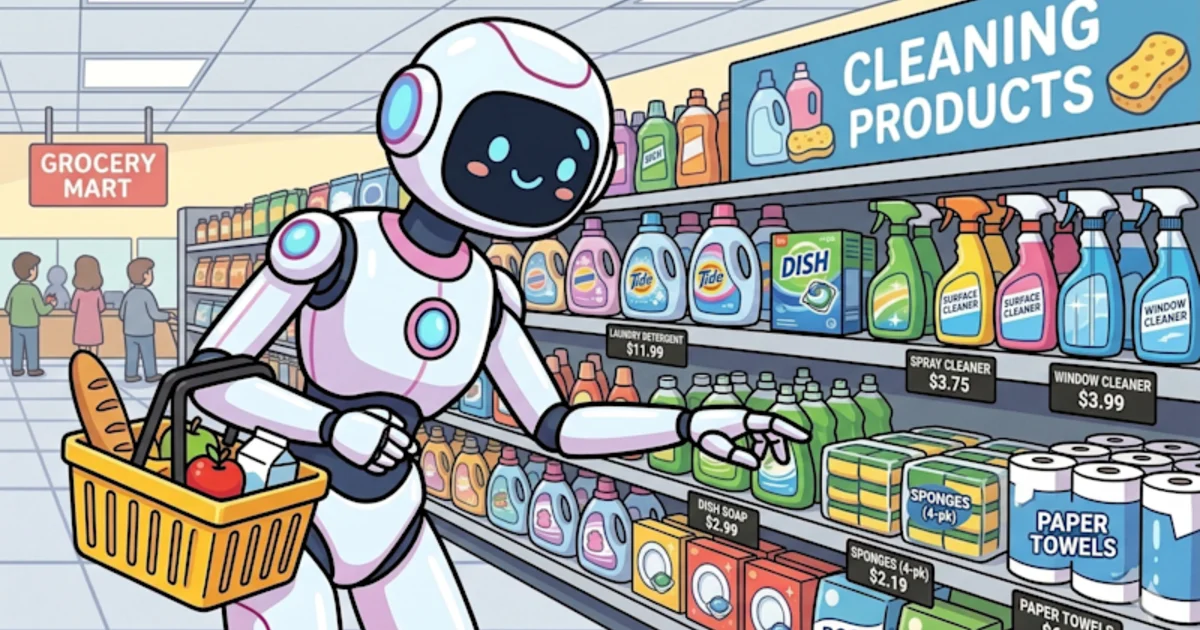
business.adobe.comOn July 27, 2026, Adobe announced that product discovery on LLM surfaces is available in Adobe Commerce. At the center of it sits Adobe Catalog Agent, which takes structured product information held in the Commerce catalog and renders it on product detail pages (PDPs) as a machine-readable layer.
What matters about this design is that nothing changes on the screen a shopper sees. Product names, imagery, and the buying journey stay exactly as they are. Behind that surface, attributes, specifications, compatibility, availability, and pricing context are served to AI crawlers and LLM-powered discovery systems such as ChatGPT, Microsoft Copilot, Claude, and Gemini.
Adobe frames the capability not as an add-on or third-party integration but as a native part of Adobe Commerce, available across all deployment models. Existing customers, the argument goes, can adopt it without redesigning catalog architecture or duplicating product data. That said, the announcement says nothing about pricing or whether the capability carries an additional charge, so that remains undisclosed.
Adobe Commerce committed to both Google's UCP and OpenAI's ACP agentic commerce standards back in February (related article), and rolled out a set of agentic capabilities at Adobe Commerce Summit in June (related article). This release fills in the piece that sits upstream of payments and transactions: discovery itself.
Checking where the numbers come from
The announcement cites Adobe Digital Insights as its evidence. Traffic from AI sources to US retail sites grew 125% year over year between April and June 2026. During the most recent holiday season (November to December 2025), the same metric was up 693%.
Lay the series out along a timeline and a clear shape emerges: the growth rate is decelerating while absolute volume keeps compounding. Adobe's analysis published on April 16, 2026 put the first quarter, January through March, at 393% year over year, with March alone at 269%. Data for May reported by Digital Commerce 360 shows 138% year-over-year growth, while the cumulative figure since Adobe began tracking in October 2024 reaches 1,324%, more than fourteenfold.
The quality metrics tell the more commercially interesting story. In May, AI-sourced traffic converted 54% better than non-AI traffic, visitors spent 53% more time on site, and browsed 23% more pages per visit. Given that AI traffic converted worse than non-AI traffic just a year earlier, that reversal happened at considerable speed. The tendency for AI-referred shoppers to spend more per order was covered in an earlier article.
The 66% problem on product pages
The most revealing part of this announcement is the machine-readability data Adobe gathered on retail sites using its own tooling. The AI Content Visibility Checker scores any page out of 100% based on how much of its content an LLM can actually read. A score of 50% means half the content is invisible to machines.
In the page-type breakdown from that April analysis, US retail sector homepages averaged 75% and category pages 74%. Text-heavy pages sit relatively high: returns and exchanges at 82%, contact pages at 81%, FAQs at 80%. But individual product pages came in at 66%, the lowest of any major page type.
Product pages finishing last may feel counterintuitive. At the scale of thousands to tens of thousands of SKUs, though, it becomes easy for spec tables to be rendered late by JavaScript, for information to be locked inside image text, or for attribute values to be emitted as raw codes. The territory that humans can read but crawlers cannot ends up concentrated on exactly the pages carrying the densest product information.
The gaps by vertical are just as notable. Separately from the page-type breakdown above, Adobe also publishes an overall readability score covering each vertical's sites as a whole. In the May cut of that measure, cosmetics led at 63% and electronics followed at 56%. Sporting goods and apparel sat mid-pack at 51% each, ahead of grocery at 48% and furniture and home at 47%. Verticals that already own text assets such as ingredient lists, tutorials, specifications, and how-to guides are clearly advantaged. Adobe attributes the lower tiers to structural problems in page design that suppress AI citation.
Because the overall score and the page-type scores measure different things, they cannot be compared directly. Grocery illustrates the point: near the bottom on the overall measure, it nonetheless had 70% of its product detail pages machine-readable, according to Adobe. A vertical can score poorly overall and still hold up on a specific page type, which is why diagnosing your own weak spots requires breaking the number down by page type.
Comparing the top and bottom performers on homepage scores produces a spread of 82.5% against 54.2%. Within the same industry, some brands have moved on this far faster than others.
Fixing the source data, not the display
Adobe LLM Optimizer's documentation makes the thinking behind Catalog Agent unusually explicit. The Product Catalog Enrichment page walks through how LLMs fail to understand products, with a concrete example.
A product named "Coffee Grinder X200" described only as "18 grind settings, 450W motor" gives an LLM almost nothing to reason with when a shopper asks for the best espresso grinder for a home barista. AI agents reason through relationships rather than raw data fields, so a list of technical specifications alone cannot connect purchase intent to a product.
Catalog Agent reads each SKU's attributes, category context, variants, and existing name and description, identifies products whose value is not being communicated, and generates a rewritten alternative aligned to shopper intent. Price and inventory are deliberately excluded from enrichment, narrowing the scope to attributes that explain what a product is, how it is used, and why it matters. Generated suggestions can be edited before deployment, and applied enrichments can be rolled back to the original name and description at any time.
One nuance deserves attention here: these capabilities are not all at the same maturity. What went generally available is the discovery capability on the Adobe Commerce side. Product Catalog Enrichment inside LLM Optimizer is explicitly marked Beta, with access granted through an account manager. Whether the full path from catalog rewrite to LLM exposure is usable end to end will depend on how a given contract is assembled.
Writing changes back to the catalog source also produces a secondary benefit. Fixing names and descriptions upstream aligns storefronts, advertising feeds, marketplace listings, and AI integrations on identical wording. When product descriptions diverge across channels, an LLM sees conflicting interpretations of the same item, which makes source-level consolidation more than a housekeeping exercise.
How the platforms differ in stance
Opening product data to AI is a shared industry direction, but the design philosophies behind how it is delivered diverge.
| Platform | How product data reaches AI | Positioning |
|---|---|---|
| Adobe Commerce | Catalog Agent exposes structured catalog information as a machine-readable layer on product detail pages | Makes your own domain readable to AI. Native capability, no additional platform required |
| Shopify | Shopify Catalog auto-syndicates eligible products to ChatGPT, Copilot, Google AI Mode, and Gemini | The platform builds a unified catalog and pushes it to AI surfaces in bulk |
| Salesforce | Agentforce Commerce connects catalogs from Business Manager to external AI surfaces | Opens existing commerce data as the entry point for agent connections |
Shopify published an engineering post on clustering billions of products through the Catalog API that underpins Shopify Catalog, describing an LLM-driven pipeline that reconciles listings across millions of merchants into a unified catalog and syndicates from there to AI surfaces. Salesforce announced a major Agentforce Commerce update in July, providing a path to connect catalogs from Business Manager directly to external AI.
Adobe's position contrasts with the aggregation model by putting its weight on making the brand's own product pages readable to AI. For large brands that want to retain control over product experience and messaging, that is a natural design. The flip side is that visibility depends more heavily on how frequently those pages get crawled than it would under a model where the catalog is ingested by the AI platform itself.
A caveat also applies to how AI traffic should be valued. Similarweb's 2026 generative AI analysis characterizes AI referral traffic as lower in volume but often higher in intent. The same analysis reports that after ChatGPT began surfacing clickable brand links directly inside answers on May 7, 2026, referrals concentrated on homepages: the share of ChatGPT referrals landing on a homepage jumped from roughly 26–32% to about 60%. Investing in structured data at the product page level plays out differently when arrivals skew toward the front door. Machine readability on PDPs and overall site comprehensibility are not substitutes for each other.
What this means beyond Adobe customers
The practical value of this announcement can be read independently of whether you run Adobe Commerce. A major platform productizing two specific moves, adding a machine-readable layer to PDPs and rewriting catalog source data into intent-based language, is itself a statement about the minimum bar for AI-driven product discovery.
The first thing to check is whether your product pages emit attributes, specifications, variants, compatibility, availability, and pricing as structured data at all. The second is whether product names and descriptions articulate who the product is for and in what situation. Adobe's 66% figure suggests that plenty of retail sites satisfy neither.
For the broader picture of building an agent-ready foundation, adjacent products such as Commerce Optimizer are worth tracking alongside this release (related article).
Conclusion
As the primary battleground for product discovery shifts from search results to AI answers, Adobe has shipped a capability aimed squarely at one thing: turning the catalog into an asset that AI can read. It is not a flashy release, but with AI-sourced traffic now converting better than non-AI traffic, delay in this area translates fairly directly into lost opportunity.
The thing to watch is whether measured evidence emerges that these capabilities actually increase visibility. Adobe says it will continue expanding catalog intelligence, enrichment, governance, and discovery. When the Beta-stage pieces reach general availability, and what effectiveness data gets disclosed alongside them, will be the next signal worth reading.