Alibaba Opens Qwen to Outside Brands, Building an AI Commerce Network with KFC and Luckin
Alibaba has opened its consumer AI platform Qwen to outside businesses. Brands build their own AI agents while users browse, order, and pay entirely through chat. Here is what it means for e-commerce operators.

Key Takeaways
- Alibaba has opened its consumer AI platform Qwen to outside brands, letting companies build their own custom AI agents
- KFC, Luckin Coffee, Mixue, and China Eastern Airlines are among the first participants, letting users go from browsing to ordering and payment through chat alone
- For e-commerce operators, this is a marker of a future where platform agents, not your own site, become the customer touchpoint
Qwen Opens the Stage for Brand AI Agents
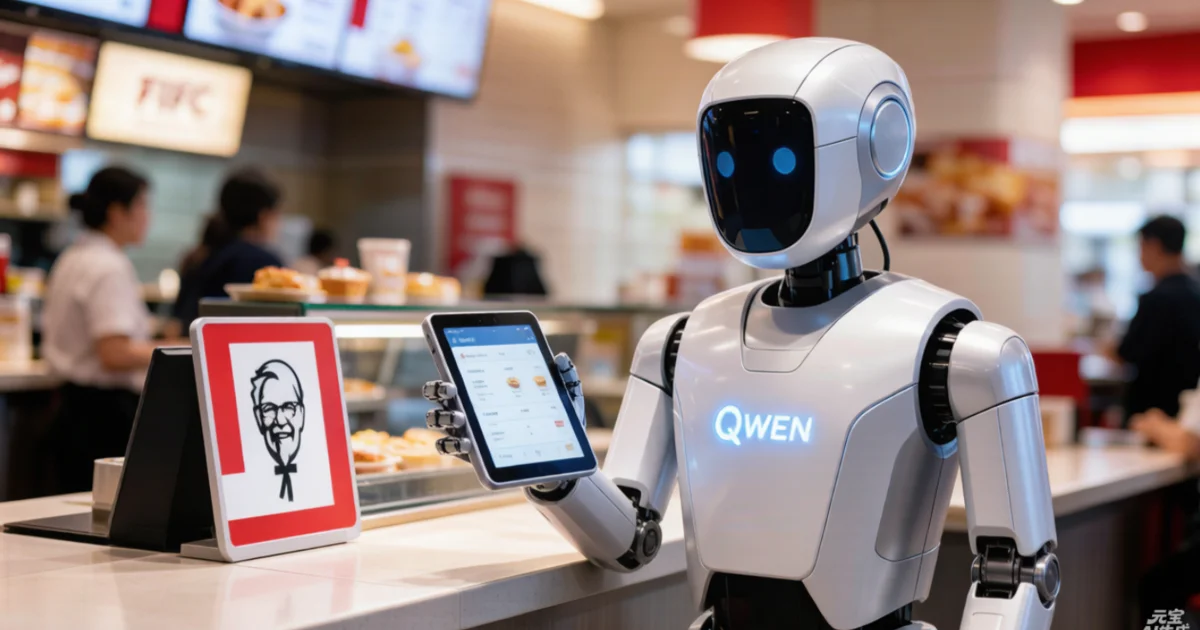
Alibaba is opening its Qwen consumer AI platform to outside businesses, letting brands launch custom AI agents for chat-based browsing, ordering and payment.
www.tradingview.comAlibaba has opened its consumer AI app Qwen to outside companies. Having grown the platform mainly around its own services until now, Alibaba is fully opening it to third-party agents and skills. Brands can place their own dedicated AI agents inside Qwen, and users can complete browsing, ordering, and payment through natural-language conversation alone.
What stands out is that this is not simply the addition of another chatbot. Alibaba positions Qwen as a foundation that drives real-world economic activity, pushing past the stage where AI merely returns answers. According to TechNode's reporting, companies can integrate services in two forms, Agents and Skills. The former handles memory and proactive suggestions, while the latter executes concrete tasks such as orders and reservations.
Through this opening, Alibaba is evolving Qwen into a commerce network where outside brands gather. The aim of keeping users inside Alibaba's ecosystem while expanding revenue opportunities for participating brands is clearly visible.
What the First Brands Reveal About the Experience
The first to join were Yum China, which operates KFC, along with Luckin Coffee, Mixue, and China Eastern Airlines. From food chains to an airline, the lineup covers a broad range of everyday consumer behavior.
The experience is concrete. When a user says, "order a two-person meal under RMB 60 for pickup at the nearest KFC," Qwen identifies nearby stores, automatically applies available coupons, and even calculates the pickup time. Luckin Coffee's agent encourages advance ordering to avoid peak hours, and China Eastern Airlines' agent handles everything from itinerary search to ticketing, seat selection, and check-in within a single chat.
The China Eastern Airlines tie-up was the first case in which Qwen opened its capabilities to an outside partner. According to Alibaba's newsroom, the design even envisions monitoring real-time traffic and flight status, calculating the time needed to reach the airport, and proactively offering to book a car. The details are described in Alizila's announcement.
From "Search and Buy" to "Talk and Delegate"
Traditional e-commerce assumed a sequence of operations: a user types keywords into a search box, picks from a product list, adds to cart, and pays. What Qwen aims for is a world where this sequence is replaced by conversation.
The keys are the agent's memory and proactivity. Qwen's agents remember a user's habits, schedule, and contextual information, then make personalized suggestions based on them. An airline agent might propose itineraries from past travel history, while a coffee agent advises the best time to order based on store congestion patterns.
The reason Alibaba can scale this experience all at once lies in its vast in-house ecosystem. Qwen can bundle functions into a single chat screen, including Taobao and Tmall for finding products, Ant Group's Alipay for payment, and Cainiao for logistics. South China Morning Post's analysis frames Qwen's ability to complete discovery, purchase, payment, and delivery in a single interface as a move toward becoming China's "digital fixer."
The Scale of Agentic Commerce Already Live in China
This move is part of a broader wave in which agentic commerce is rising rapidly across China. Alibaba says Qwen holds more than 140 million AI shopping users across consumer surfaces such as Taobao and Tmall.
Implementation on the payment side is also ahead. Ant Group's Alipay reportedly processed 120 million AI-agent transactions in a single week during the Spring Festival period in February 2026. The scale at which agents autonomously execute payments has clearly moved beyond the experimental stage.
Competition is intensifying as well. Not only Alibaba, but also Meituan, JD.com, and ByteDance's Doubao are deploying similar AI shopping agents at scale, making China a market that leads the world in agentic commerce implementation. The contest to capture the starting point of the user's conversation across platforms has come into sharp focus.
The Structural Shift E-commerce Operators Should Read
What this news poses to e-commerce operators is a question about where the customer touchpoint now lives.
Instead of visiting a brand's own site or app directly, users encounter products and services through agents on AI platforms like Qwen. If this pattern becomes the norm, brands will have to think about which platform's agent represents them and how. Just as optimizing for search engines became standard, optimizing for agents emerges as a new challenge.
Another important point is control over data and memory. Qwen's agents remember user habits to personalize, but that memory accumulates on the platform side. How much of the customer understanding a brand has cultivated in-house can be reflected in the platform's agent becomes a point of debate, in terms of both profitability and brand experience.
Qwen will not simply spread into the Japanese market as is. Yet the structure in which agents become the entry point to purchasing is likely to advance regardless of region. The practical preparation is to organize your product data in a form that agents can correctly interpret, and to consider a setup that can handle orders and payments coming through agents.
Conclusion
Alibaba's opening of Qwen to outside parties is an attempt to elevate AI agents from entities that return answers to entities that drive economic activity. Brands like KFC, Luckin, and China Eastern Airlines have begun offering experiences where users complete orders and reservations inside a chat.
What is happening here is a structural shift in which the starting point of purchasing is moving from a brand's own channels to agents on a platform. In an era where agents hold the customer touchpoint, how do you get your products and services understood and chosen by agents? China's early cases pose that question to Japanese e-commerce operators as well.