Amazon Merges Rufus and Alexa+ Into 'Alexa for Shopping,' an Agentic AI Built Into the Search Bar
Amazon combined its Rufus site assistant and Alexa+ personal assistant into Alexa for Shopping, an agentic AI that searches, compares, tracks prices, and auto-buys across the app, web, and Echo Show.

Key Takeaways
- Amazon merged Rufus and Alexa+ into Alexa for Shopping, an agent that lives in the search bar
- Agentic features take center stage, from price-triggered Auto-Buy to scheduled recurring purchases
- Winning visibility in Amazon's ecosystem now hinges on structured product data and review quality
Amazon Bundles Rufus and Alexa+ Into Alexa for Shopping
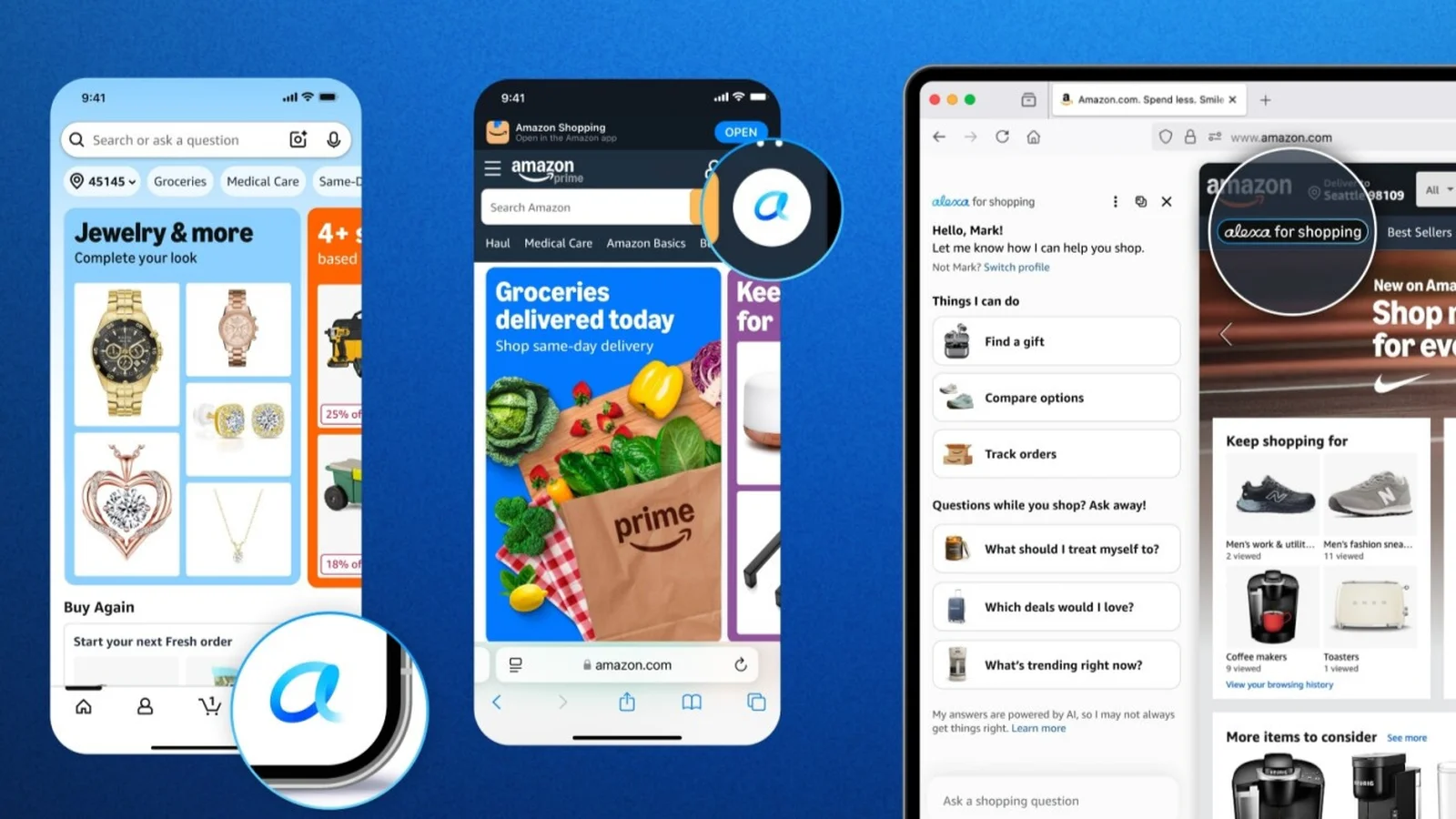
Amazon has combined its Rufus online site assistant and its Alexa+ service to create 'Alexa for Shopping,' for its app and website.
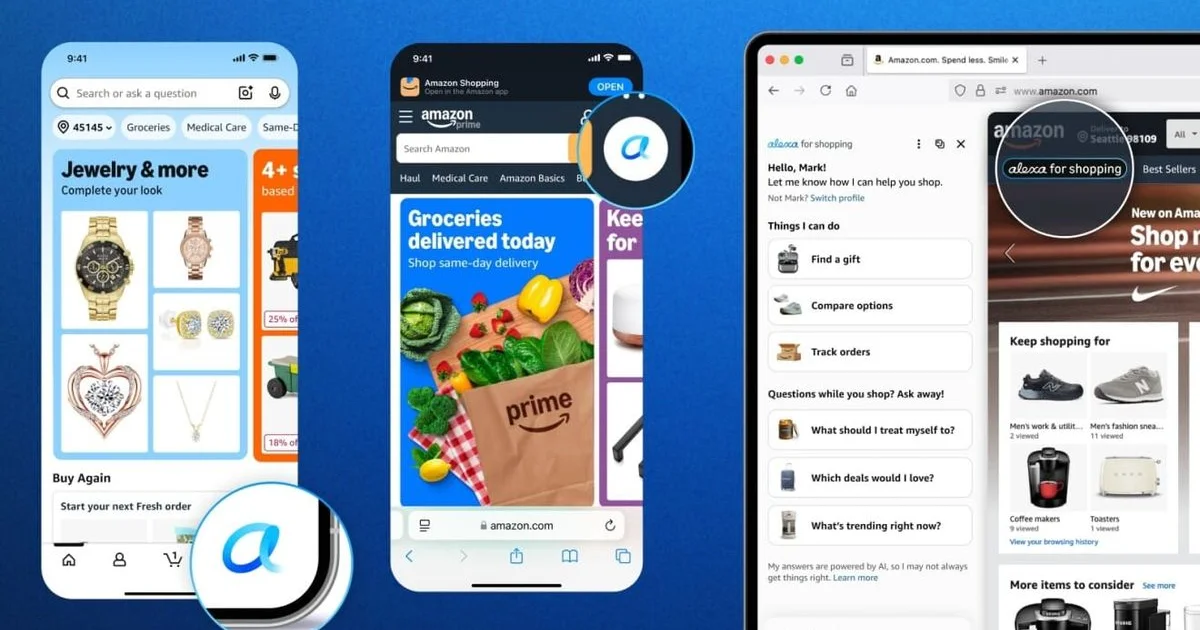
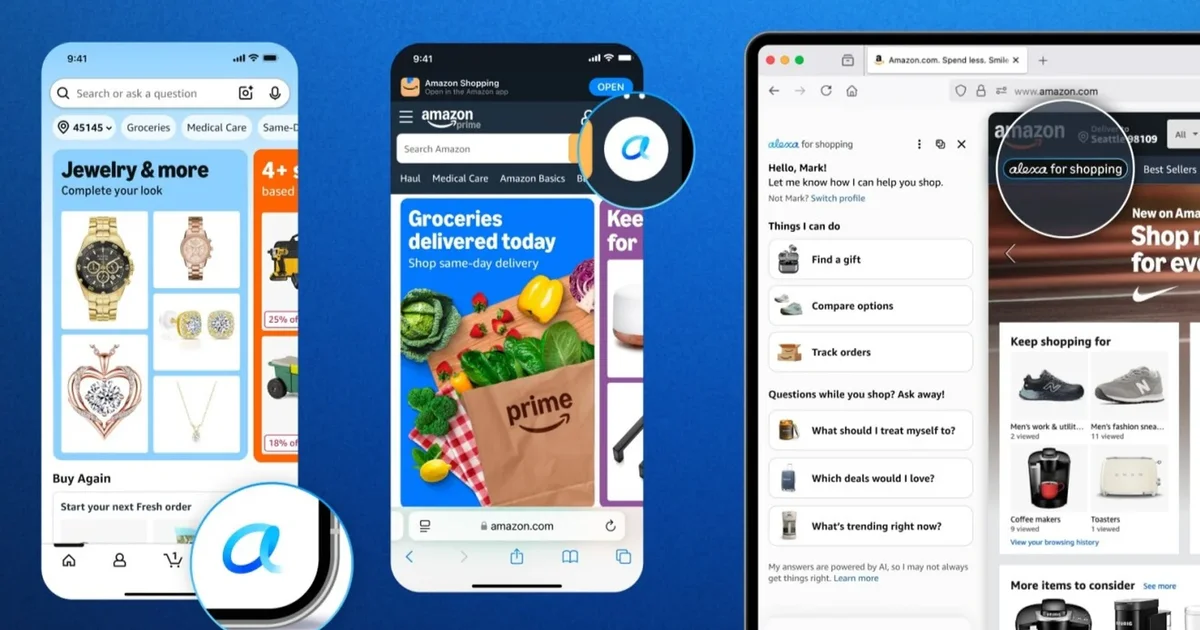
www.retailcustomerexperience.comIn May 2026, Amazon unveiled a new feature that folds its Rufus shopping assistant and its Alexa+ personal assistant into a single experience. The name is Alexa for Shopping. It is positioned as a personalized, agentic shopping AI that runs across the Amazon app, the website, and Echo Show screens.
What stands out is that it does not live in a separate chat window. It is woven directly into Amazon's main search bar. When a shopper types a question into the bar, the system recognizes it as a query rather than a product lookup, and Alexa for Shopping answers it. The rollout reached U.S. customers over roughly a week, free for everyone with an Amazon account, with no Echo device or Prime membership required.
According to Amazon's announcement, Rufus helped more than 300 million customers research, compare, and buy products in 2025. The design idea is to fuse that product knowledge and Amazon purchase history with the conversational context and personal preferences that Alexa+ carries.
What Rufus Was, and What Alexa+ Adds
Rufus arrived inside the Amazon app in 2024 as a generative AI shopping assistant. It answered comparison and use-case questions in the context of product pages and search results. With this announcement the Rufus brand name retreats from the surface of the app and web, but the capability itself does not disappear. As CNBC reported, Rufus continues to power parts of the experience behind the scenes.
Alexa+, for its part, is Amazon's revamped personal assistant. Its strength is remembering a user's conversations, preferences, and context, and delivering a consistent experience across devices. Pair Rufus, deep on product knowledge, with Alexa+, deep on user understanding, and Amazon aims for the feel of a personal shopper who already knows you.
Rajiv Mehta, who leads conversational shopping at Amazon, described Alexa for Shopping as "an expert personal shopper who already knows you and remembers your preferences, your past purchases, and your conversations, and carries that knowledge across your phone, laptop, and Echo devices," in the release. The pitch is that research started yesterday does not have to begin again on another device.
The numbers back the bet. Rufus monthly active users grew more than 115% year over year, with engagement up nearly 400%. Amazon's own data shows that demand for AI-assisted shopping is real and rising.
From Search and Compare to Auto-Buy
The capabilities of Alexa for Shopping go well beyond question answering. In the search bar, it fields everything from open-ended advice like "What's a good skincare routine for men?" to product comparisons such as "Breville Barista Express vs Pro," and order lookups like "When did I last order AA batteries?" AI summaries appear in search results and on product pages, and shoppers can view up to a full year of price history.
The feature worth watching is its purchasing agency. Auto-Buy completes a purchase automatically once an item hits a target price. Scheduled Actions add recurring purchases to a cart or surface recommendations for review. Reordering household staples, tracking prices, and alerting users to new products all fit the pattern of acting on the shopper's behalf.
The agent reaches into conditional automation, too. A request like "add sunscreen if the price drops to $10" becomes something the AI watches for and executes. The shopper hands part of the decision over to the AI. Amazon's announcement also references "Buy for Me," which handles purchases from other retailers across the web, not just Amazon's own store.
Echo Show is in scope as well. U.S. customers can now browse and shop the full Amazon store using voice, touch, or both.
Why Now, and the Competitive Backdrop
Reading this as a standalone feature would miss the point. The backdrop is general-purpose AI assistants flowing into shopping. ChatGPT, Google's AI Mode, Gemini, and Perplexity are all reaching to capture discovery through purchase. As GeekWire's headline put it bluntly, this is a merger made as AI rivals move into online shopping.
Amazon's edge lies in its closed environment. Alexa for Shopping reads Amazon's proprietary product graph directly and can rank, compare, schedule, and transact entirely within Amazon. The marketing platform Paz.ai calls this a walled-garden advantage. Open-web agents can only redirect to merchant sites and cannot reach Amazon's catalog depth.
In short, if customers start relying on AI to shop, Amazon wants to own that entry point. The merger of Rufus and Alexa+ reads naturally as a statement of that intent.
What E-Commerce and Brand Operators Should Fix Now
Here is the part that matters for sellers on Amazon. Alexa for Shopping works as a new layer above Amazon search. Per a guide from the product-analytics firm Amalytix, the AI does not rely on keyword matching alone. It reformulates a vague query like "podcast microphones" into a multi-signal structure that reflects price expectations, quality tiers, and use-case fit.
Given that mechanism, a clear set of priorities emerges.
Treat product data as one coherent whole - Titles, bullets, descriptions, and A+ content modules should be handled as an interconnected semantic system, not as isolated fields. The AI reads across fields to understand a product. Fragmented copy risks being passed over before it ever reaches the answer slot in the search bar.
State the use case and the problem solved - Going beyond a feature list to spell out who benefits and what problem is solved pays off. The AI selects products against usage scenarios. Technical specs, price history, and availability data all feed the judgment.
Manage review quality - According to Amalytix, the system typically excludes products rated below 4.0 stars from recommendations. Reviews and Q&A are read as validation of claims, so rating hygiene directly shapes discoverability. It is a second lever for visibility, alongside conversion optimization.
There is also a world outside Amazon to mind. This is Paz.ai's "two stacks" argument. Inside Amazon, Amazon controls the agent, the catalog, and checkout, while on the open web of ChatGPT and Google AI Mode, brands keep their own data and checkout. In the latter, structured data and feed quality decide the outcome. Paz.ai argues the two should run as parallel, separate workstreams.
In practice, the realistic first step is to audit your own product data and shape it into a form the AI can read. From an AI engine optimization lens, the move is to verify display quality both inside Amazon and across the open web.
Conclusion
Alexa for Shopping is Amazon pulling the entry point for AI shopping into its own search bar. By merging Rufus and Alexa+, the company has pushed agentic features to the front, from price-triggered Auto-Buy to scheduled recurring purchases that act on the shopper's behalf. As general-purpose assistants move into shopping, Amazon is leaning hard on the strength of its closed ecosystem.
The implication for operators is plain. To be chosen by the AI, structured product data, copy that articulates use cases, and reviews held above 4.0 stars become table stakes. Building an organization that runs Amazon-side optimization and open-web discoverability as separate, parallel efforts looks set to be the dividing line. Watch next for how far Alexa for Shopping expands geographically and how the Buy for Me feature widens its reach into third-party retail.