ASOS × Bambuser ChatGPT Stylist — Inside the Video Commerce Stack and Its Structural Dilemma for Agentic Fashion
ASOS launches Stylist inside ChatGPT, powered by Bambuser's Intelligence Layer. We unpack the video × LLM × inventory stack and the structural dilemma of building on someone else's intelligence layer.

Key Takeaways
- On May 20, 2026, Asos shipped its "Stylist" app inside ChatGPT, powered by Bambuser's Intelligence Layer, which converts product catalogue and video library into structured, machine-readable data that LLMs return as shoppable videos
- Bambuser launched GEO Discovery in March, productising the infrastructure layer that turns brand video assets into structured data for answer engines like ChatGPT, Claude, Perplexity, and Gemini — Asos is the first major fashion proof-point
- Early field tests already exposed a structural dilemma — the AI surfaced "Tom Ford Oud Wood" and linked out to a competitor, because building on someone else's intelligence layer means inheriting its definition of a good answer
The Day Video Commerce Walked Into ChatGPT
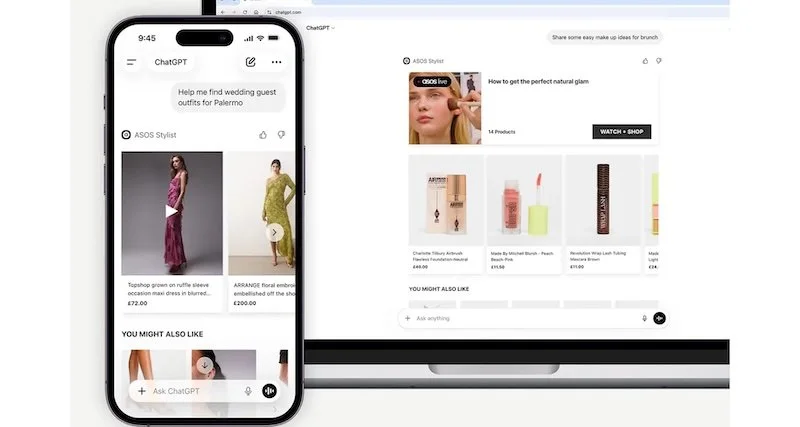
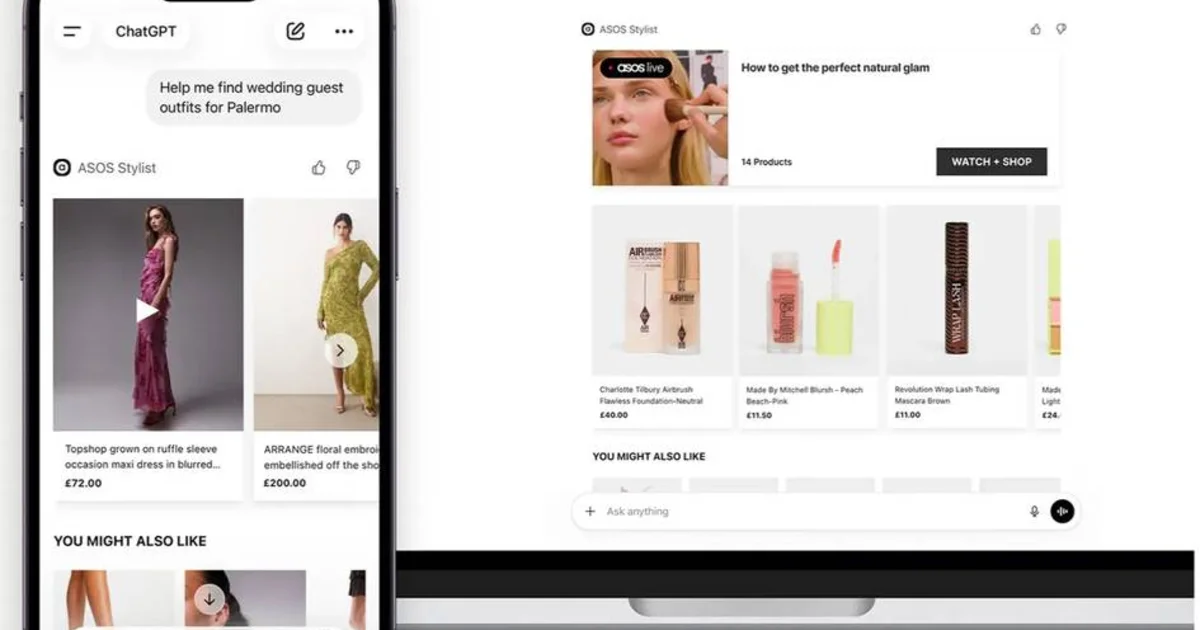
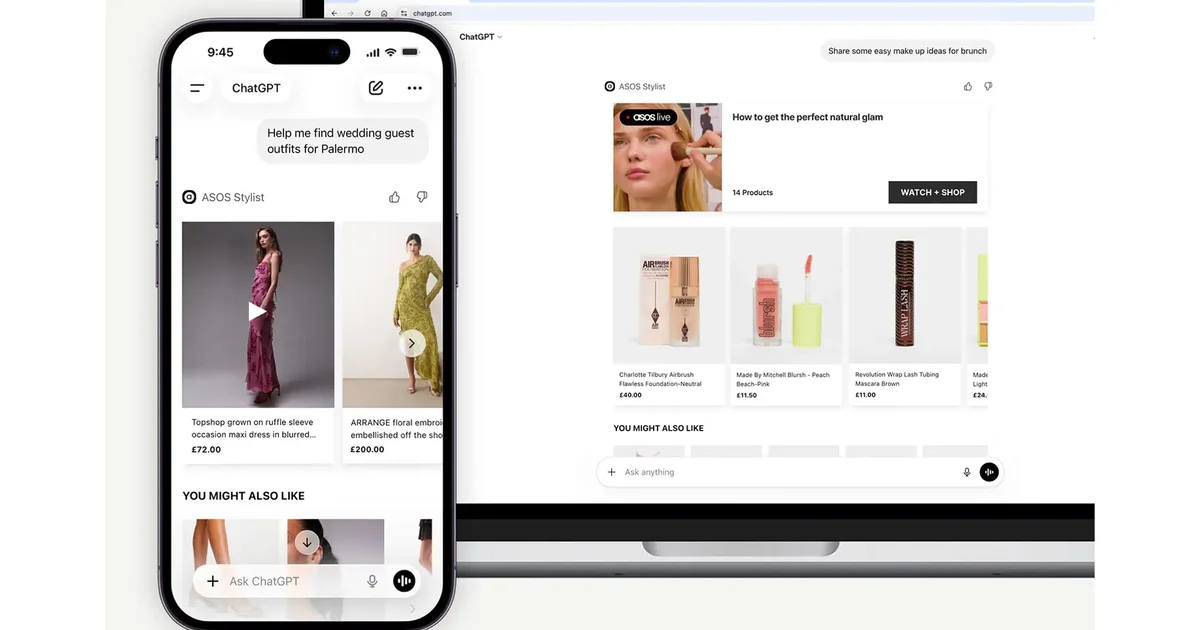
ASOS launches Stylist app inside ChatGPT, powered by Bambuser's video commerce intelligence layer.
retailtechinnovationhub.comOn May 20, 2026, UK online fashion giant Asos launched ASOS Stylist, a native app that runs inside ChatGPT, available to UK and US shoppers. Product search, trend browsing, styling advice — all delivered inside the ChatGPT conversation. If that were the whole story, you could file it next to Walmart Sparky and Etsy's gifting app as "yet another retailer dropping into ChatGPT."
What makes the Asos launch worth a closer look is the stack underneath. The app is powered by a new product from Swedish video commerce platform Bambuser called the Intelligence Layer, paired with Bambuser's shoppable video player widget. This is the first time the video commerce world has walked head-on into an answer engine, instead of staying in its native habitat of livestreams and embedded player widgets on retailer sites.
Asos's official press release frames Stylist as a move "beyond today's AI shopping tools, which are primarily limited to text and static images." When a shopper types "show me pastel floral A-line dresses for spring," Stylist searches across the Asos brand portfolio, returns a curated edit with video, and hands the user off to Asos.com to close the purchase. Discovery happens in ChatGPT; the transaction lives on Asos.com.
Intelligence Layer — A Video-to-Structured-Data Pipeline
To understand what Bambuser's Intelligence Layer is solving, it helps to step back. Fashion brands sit on enormous video libraries: runway clips, lookbooks, livestream archives, influencer wears. Every one of those clips contains rich implicit signals about which products show up, in which context, on which body type. From a machine's perspective, though, video is an opaque box. LLMs can't directly index pixels. Unless the content is converted into text or structured data, it cannot be cited in an answer.
Bambuser productised exactly that conversion layer on March 10, 2026, when it launched GEO Discovery — short for Generative Engine Optimization Discovery. The Intelligence Layer inside that product handles transcription, product tagging, SEO copy generation, FAQ generation, and schema.org markup automatically. It emits the kind of structured data that ChatGPT, Claude, Perplexity, Google AI Overviews, and Gemini all consume.
Bambuser's VP of Data & Intelligence, Bruno Giordani, framed the strategic logic of AI-era search bluntly.
AI answer engines don't crawl websites the way traditional search did. They assemble answers from structured data. We've built the Intelligence Layer that automatically produces that data at scale. One thing is becoming clear: the companies that control the structured data layer will define which products get discovered in the AI era.
In Asos's case, the Intelligence Layer ingests products from ASOS DESIGN, ARRANGE, COLLUSION, Topshop, Topman, plus hundreds of partner brands, alongside years of livestream and lookbook footage, and ships it out as "shoppable structured data" that ChatGPT can call.
Why Video × LLM × Inventory Now
Anyone who has worked in fashion will intuitively grasp why text-only AI shopping has felt thin. "Pastel floral A-line dress for spring" hides a thicket of decisions: hem length, silhouette movement, fabric sheen, how the cut sits at the shopper's height. Still images close some of that gap; video closes far more. There is information that simply does not travel until the garment moves.
What Asos is attempting is to stitch together three different layers: the video content layer, the conversational understanding layer of the LLM, and the inventory layer of products, prices, and size runs. Bambuser owns the video layer; OpenAI owns the conversational layer; Asos brings the catalogue and partner brands. The three sit on top of each other, and a shopper's prompt traverses all three before a video grid lands in the chat.
McKinsey estimates around $750 billion in US consumer revenue will be routed through AI-driven discovery in the next two years. For categories where "you have to see it to decide" — fashion being the canonical example — leading with video to capture that flow is the strategically obvious move.
Where Asos Sits Among the Earlier ChatGPT Apps
The original Apps SDK launch partners were Booking.com, Canva, Coursera, Expedia, Figma, Spotify, and Zillow. In physical goods, Walmart deployed its in-house agent "Sparky" as a ChatGPT app in March 2026, and Etsy followed with a gifting-focused app.
Slot Asos into that lineup and the difference jumps out. Walmart brought "huge retailer plus in-house agent." Etsy brought "long-tail discovery." Asos brought something else: a strategic asset — video — paired with a dedicated infrastructure vendor, Bambuser, that productised the pipeline to expose it to ChatGPT. That pattern generalises far beyond fashion. Beauty, automotive, furniture, appliances — any category where motion matters — can run the same play.
Bambuser itself is telegraphing the same idea. Around the same time as the Asos launch, Audi Sweden expanded its partnership with Bambuser to adopt GEO Discovery for automotive content. Bambuser is quietly positioning itself as the infrastructure layer for any brand sitting on video assets and wanting them cited correctly inside answer engines.
The "Linked Out to a Competitor" Problem
Up to this point the story is about strategic strength. But building a commerce experience on top of someone else's knowledge layer has structural risk, and a hands-on test surfaced it within days of launch.
UK e-commerce executive Steve Webster put Stylist through its paces, with the test write-up later picked up by Retail Technology Innovation Hub. He asked ChatGPT, via Stylist, to assemble a smart casual wardrobe for a middle-aged man. The result was competent: a Mango blazer, Jack & Jones shirts, Thomas Crick Evers trainers — all reasonable picks from the Asos catalogue. Then came the fragrance section.
Stylist recommended Tom Ford Oud Wood. As a styling choice it's defensible, but Tom Ford fragrance is not stocked by Asos. And the link did not stay inside the ecosystem — it went straight to tomfordbeauty.co.uk. Asos deployed an AI stylist inside ChatGPT, and within three minutes that AI had sent a customer to a competitor's site.
What gives Webster's critique weight is that he's not pointing at a bug. He's pointing at the architecture.
When you build a commerce experience on top of someone else's intelligence layer, you inherit that layer's associations, its breadth of knowledge, and its definition of a good answer. ChatGPT knows Tom Ford Oud Wood is the right fragrance for a mature man building a smart casual wardrobe. It also knows Asos does not stock it. So it linked out, because the right answer for the customer is not always the commercially convenient answer for the retailer.
A human stylist working exclusively for Asos would have steered around that gap, redirecting to an in-house alternative or deferring the fragrance pick. An LLM doesn't operate under those constraints. It optimises for the stated need, not for the retailer's conversion rate. Webster calls this "the fundamental tension in AI-mediated commerce" — and it is one that almost no one is examining honestly.
Limits of the "Discover in ChatGPT, Buy on Asos" Model
The decision to keep checkout on Asos.com is rational. Walmart already learned, in its own checkout experiment, that the in-ChatGPT flow converted at roughly one-third the rate of its native site. OpenAI itself pivoted in March 2026, conceding that "Instant Checkout didn't provide the flexibility we aimed for" and shifting focus to product discovery.
What the Tom Ford episode shows, though, is that retreating to your own checkout doesn't insulate you from risk upstream. The discovery step itself can leak intent to competitors. In every multi-turn conversation, products outside the Asos catalogue can surface organically, and ChatGPT can hand the user off there.
This is not a problem you can patch in code. LLM neutrality and brand-specific conversion optimisation are, by construction, at odds. What Asos can do is operational: measure the share of Stylist-surfaced recommendations that are in-catalogue versus out-of-catalogue, and use the Intelligence Layer to broaden and deepen the data fed in until "the answer that's right for the customer" overlaps more often with "the answer that's commercially right for Asos."
Implications for Fashion and D2C Operators
ChatGPT's shopping features still have regional limits, but the Asos launch already covers the UK; broader EU and APAC rollouts are a matter of time. For US, UK, and Japanese fashion retailers and D2C brands — ZOZOTOWN, Baycrews, Uniqlo, Adastria all qualify — three prep tasks are worth starting now.
The first is making product data "LLM-edible." Names, prices, size runs, style attributes, occasion tags, in-store stylist commentary — clean them, normalise them, and expose them as JSON Schema or schema.org Product markup. This is the shared substrate for both Apps SDK integrations and Agentic Commerce Protocol (ACP) catalog feeds, and it's adjacent to the broader AEO (AI Engine Optimization) discipline.
The second is designing a video-to-structured-data pipeline. What Bambuser's Intelligence Layer does for Asos — link livestream and lookbook clips to product IDs, auto-generate transcripts, tags, and schema — should exist for any video-heavy brand. The build-versus-buy decision turns on scale, but the operating assumption has to be that video assets are invisible to answer engines unless they're rendered into machine-readable data.
The third is making competitor leakage measurable. The Tom Ford incident is not an Asos-specific embarrassment; it's a category warning. Whenever the Intelligence Layer's coverage is shallow in a sub-category, ChatGPT will fill the gap from external knowledge — and may link out. Choosing what to feed into the data layer has stopped being an SEO chore. It has become a strategic decision about the probability that you're the one chosen inside the conversation.
Conclusion — Another Infrastructure-Vendor Era Begins
Asos and Bambuser's collaboration will be remembered as the moment fashion took up residence inside ChatGPT. Its deeper significance, though, is about infrastructure. Video commerce has stopped being a closed loop of livestreams and onsite player widgets. It is becoming a structured-data supply layer feeding LLM answer engines, with Bambuser's GEO Discovery as the first explicit productisation.
For categories where motion drives purchase decisions — fashion, beauty, automotive, furniture, appliances — putting video on your own site is no longer enough. The shelf war now starts at the structured-data layer, deciding whether ChatGPT, Claude, and Perplexity cite your product with motion attached. That shelf grab has already begun. And the structural dilemma Steve Webster put his finger on — what it costs to live inside someone else's intelligence layer — is a question every participant in agentic commerce will have to answer next.
Asos Stylist will be the case study people return to as that conversation matures.