AI Commerce News Digest (May 7, 2026)
Today's roundup: Google expands UCP checkout to main search, Solana × Google Cloud launches Pay.sh, Wayfair's everywhere strategy, Meesho's 75% AI-driven orders, Visa's agentic commerce push, and more.


Key Takeaways
- Google has extended UCP Checkout from AI Mode to mainstream search results, while Solana and Google Cloud unveiled "Pay.sh," a payments infrastructure built specifically for AI agents — the platform layer of agentic commerce is in full motion.
- Wayfair declared a "be everywhere" strategy spanning Perplexity, OpenAI, and Google, while Meesho disclosed that 75% of its orders are now AI-initiated.
- Visa's Q2 2026 earnings positioned agentic commerce as the next growth engine, and District (a16z-led) joined a growing list of new infrastructure rounds.
Today's Top Stories
Google Expands UCP Checkout from AI Mode to Main Search Results

UCP-powered checkout initially went live only in AI Mode but it now seems to be available for some retailers in Search.
searchengineland.comGoogle has extended its Universal Commerce Protocol (UCP)-powered checkout beyond AI Mode and into the mainstream Shopping section of standard search results, a move confirmed in same-day reports from Search Engine Land and SE Roundtable on May 6.
A "Buy" button now appears in Wayfair's product detail overlays inside Google Search, allowing shoppers to complete purchases via Google Pay without ever visiting Wayfair's site. A Google Search impression can now translate directly into a transaction, upending the long-standing assumption that retailers must claim the click before they can claim the order.
UCP launched in January 2026 with co-developers Shopify, Etsy, Wayfair, Target, and Walmart, and has been endorsed by Adyen, AmEx, Mastercard, Stripe, Visa, and more than 20 other ecosystem partners. For merchants, this raises the prospect that traffic from Google increasingly converts without a site visit — forcing a fundamental rethink of the funnel.
Detailed coverage: Google UCP Checkout Expands to Main Search
Solana × Google Cloud Launches "Pay.sh" for AI Agent Payments

Solana and Google Cloud have launched Pay.sh, a payments infrastructure product designed explicitly for AI agent transactions rather than human-initiated
startupfortune.comThe Solana Foundation and Google Cloud have unveiled Pay.sh, a payments stack designed specifically for AI agent transactions rather than human-initiated ones. Built around programmable settlement, Pay.sh aims to handle micro-transactions between AI agents, or between AI agents and human-facing services, in seconds and on autopilot.
Until now, the agentic payments race had been led by Visa's Trusted Agent Protocol, Mastercard's Agent Pay, and the open x402 protocol. Pay.sh introduces a fundamentally different option — a blockchain-plus-cloud rail — leveraging Solana's low-cost, high-throughput design to bring stablecoin settlement onto the autonomous commerce track.
For merchants, this points to a near-term reality where AI agents purchase goods, APIs, and data on a per-second basis, normalizing micro-transaction economics in ways that conventional card rails struggle to support.
Detailed coverage: Solana × Google Cloud "Pay.sh" Launch
Agentic Commerce
Wayfair Wants "to Be Everywhere" in Agentic AI Commerce
Its CEO said Wayfair is working with Perplexity, OpenAI and Google on agentic commerce in addition to other AI offerings.
www.digitalcommerce360.comWayfair CEO Niraj Shah confirmed the home-furniture retailer is simultaneously pursuing agentic commerce initiatives with Perplexity, OpenAI, and Google. Wayfair was a co-developer of Google's UCP and is the first retailer surfaced in the May 6 expansion of UCP Checkout into mainstream Search.
Shah's emphasis was on not betting on a single platform, but instead being present "wherever consumers shop." Furniture is a high-consideration, high-AOV category in which AI agents can plausibly span discovery, comparison, and purchase — making cross-platform availability strategically critical.
For merchants, Wayfair's stance illustrates that committing to UCP, OpenAI, Anthropic, or Perplexity in isolation will likely be insufficient.
Detailed coverage: Wayfair's Agentic Commerce "Everywhere" Strategy
Meesho: 75% of Orders Now AI-Driven, Q4 FY26 Losses Sharply Narrowed
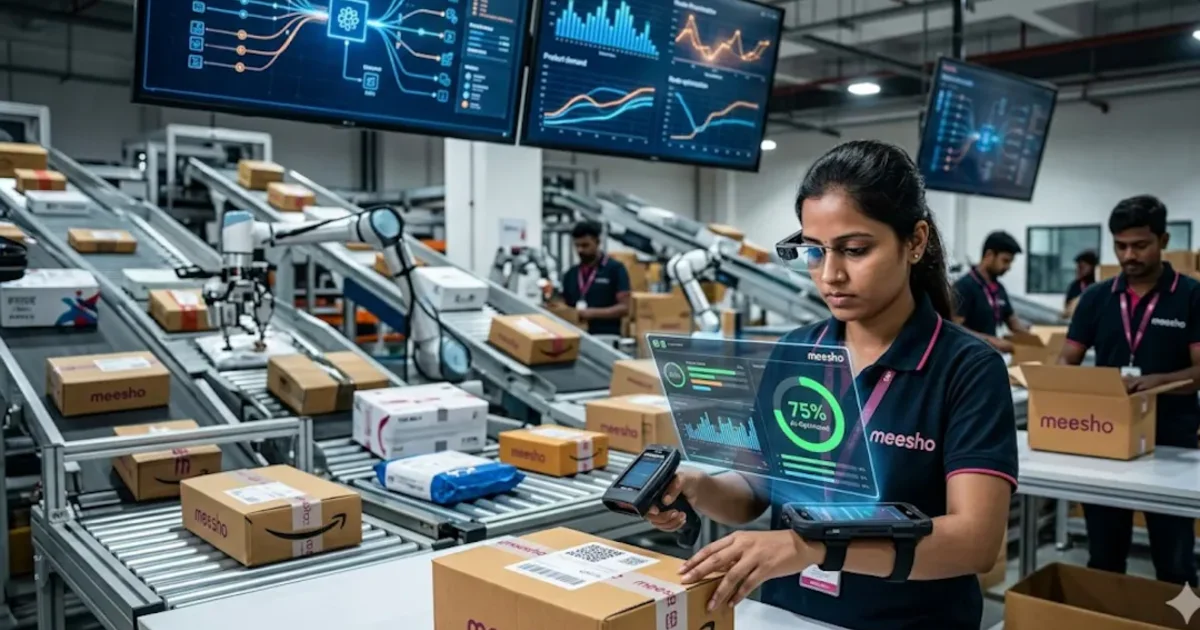
The data suggests that AI-led efficiencies are not just improving user experience but also strengthening unit economics.
www.ndtvprofit.comIndian e-commerce unicorn Meesho disclosed in its Q4 FY26 results that 75% of its orders are now AI-driven. CEO Vidit Aatrey credited AI for both improved user experience and stronger unit economics, with the company sharply narrowing losses on the back of efficiency gains.
With Meesho widely reported to be readying an Indian IPO, the simultaneous deployment of AI across recommendation, search, and logistics has clearly delivered visible bottom-line impact.
For merchants, this is one of the clearest signals to date that AI adoption in emerging markets has moved past experimentation and is now a primary driver of order volume — including for SMB-scale sellers.
Detailed coverage: Meesho's 75% AI-Driven Orders
District Raises $14.7M Seed Led by a16z to Reimagine AI Commerce Infrastructure

District: A16Z-led AI commerce infrastructure seed round.
www.citybiz.coStartup District has closed a $14.7M seed led by Andreessen Horowitz to rebuild AI commerce infrastructure. Following ZyG ($60M) and ReFiBuy ($13.6M) in the past week, a16z's concentrated bets on agentic commerce middleware are increasingly visible. Product details are limited, but District appears to target the layer between e-commerce platforms and AI agents.
Gladly Announces Agentic Commerce Capabilities at Connect Live
Gladly, the customer experience AI platform trusted by leading retail and consumer brands, today announced new agentic commerce capabilities.
www.prnewswire.comCustomer experience AI platform Gladly used its Connect Live conference to announce agentic commerce capabilities spanning the full customer journey — moving its AI agents from support-only to discovery, recommendation, and purchase assistance. The blurring of CS and sales suggests merchants will increasingly evaluate vendors on whether one platform can handle both motions.
Forbes: How Retailers Can Thrive With Agentic Commerce

How retailers can reinvent their ecommerce platforms to allow for consumer agents for recommendation and selection.
www.forbes.comAccenture's Jill Standish, writing in Forbes, lays out three priorities for retailers — restructuring product data, opening APIs, and redefining brand loyalty — to thrive in an agent-first commerce world. A useful synthesis of the platform announcements that have piled up since April.
AI Commerce Tools
Lucidworks Unveils a Conversational Q&A AI Agent
Lucidworks, the leader in AI-powered search and discovery solutions, today announced the launch of its Conversational Q&A AI Agent.
www.globenewswire.comEnterprise-search vendor Lucidworks has launched a "Conversational Q&A AI Agent" tuned for B2B and e-commerce queries — grounded in proprietary domain data, where generic chatbots typically fail. A candidate platform for merchants looking to overhaul autonomous, catalog-aware response surfaces.
Riskified Unveils Next-Gen AI Suite at Ascend 2026

Riskified unveils next-generation AI suite at Ascend 2026, empowering merchants with unprecedented visibility and control over ecommerce risk
www.businesswire.comFraud-prevention vendor Riskified used its Ascend 2026 conference to release a next-generation AI suite focused on letting merchants better distinguish legitimate AI shopping agents from malicious bot traffic. False declines on agent traffic are quickly becoming a significant lost-revenue source.
Chargebacks911 Warns of an AI-Agent "False Decline" Crisis
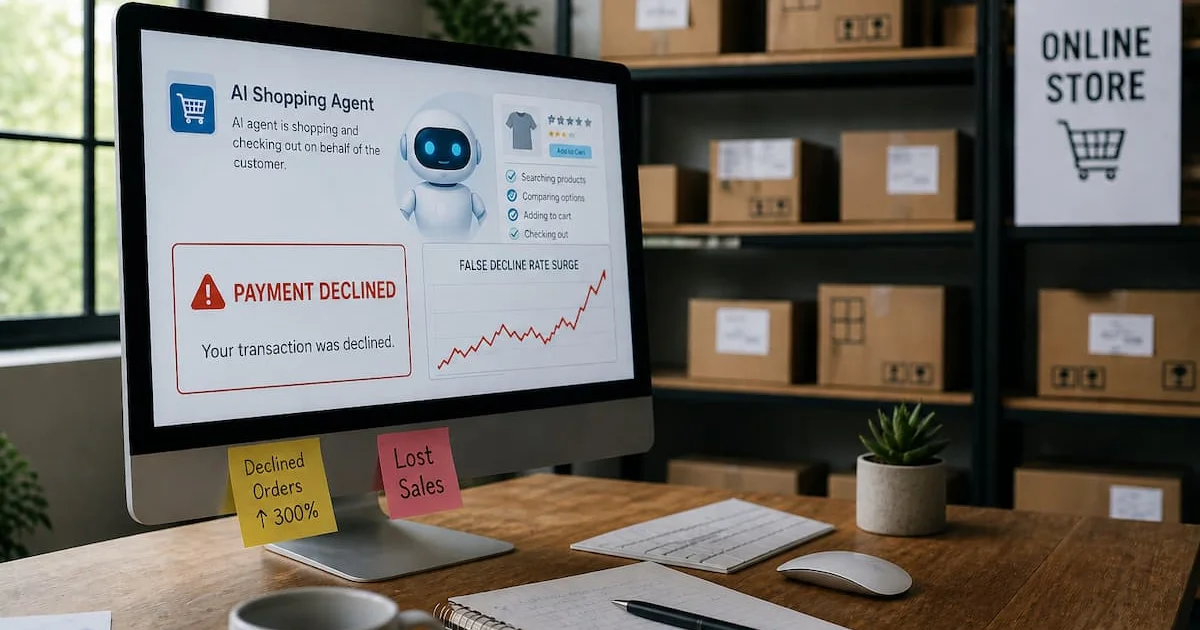
Chargebacks911 warns that agentic AI shopping is being misclassified as bot traffic, causing false declines, revenue loss, and outdated fraud systems in global commerce.
thefintechtimes.comChargebacks911 reports that legitimate AI shopping agents are increasingly being misclassified as bots, costing merchants real revenue. Existing fraud-prevention logic has not kept pace with agentic commerce adoption, and merchant-level recalibration is now urgent.
Payments and Fintech
Visa Q2 2026: Agentic Commerce as the Next Growth Engine

Visa's first quarter underscored a payments model that is broadening beyond cards into stablecoins, AI and new commerce flows.
www.pymnts.comVisa positioned agentic commerce as a core pillar of expansion beyond cards in its Q2 2026 results — 17% revenue growth, 20% EPS growth, an extension of its Agentic Ready Program into APAC and Latin America, and the worldwide launch of stablecoin and Bitcoin-linked debit cards via Lightspark. Management explicitly framed AI agents as a multiplier on transaction volume, micro-transaction creator, and B2B tokenization driver.
Block (SQ) Launches New AI Commerce Tools and Partnerships
In late April 2026, Bank of America Securities began covering Block, highlighting AI-driven efficiency efforts alongside new products such as Square's Managerbot and expanded partnerships with merchants and platforms like Uber Eats and Black Seed Bagels.
finance.yahoo.comBlock (formerly Square) has announced Square Managerbot — an AI assistant for store operations — alongside new partnerships with Uber Eats and others, signaling a shift from pure payments toward AI-led merchant operations. The competitive contest is moving from "process payments" to "automate the entire merchant back-office."
Corporate Moves
Naver Invests $22.8M in Kurly to Reshape Korean E-Commerce

Naver expands e-commerce reach with Kurly investment.
pulse.mk.co.krKorean search giant Naver will invest KRW 33B (~$22.8M) in online grocer Kurly. With Coupang facing a Q1 swing to net loss following its data-breach fallout (covered May 6), Naver is moving to capture share — a likely precursor to deeper SmartStore-Kurly logistics and traffic integration.
Coupang Doubles Down on Japan and Taiwan as Korea Slows
Coupang Inc. is scaling up its operations in Japan and Taiwan.
www.kedglobal.comFollowing its Q1 loss (covered May 6), Coupang is doubling down on Japan and Taiwan operations. In Japan, Coupang Eats and product sales are expected to scale together, intensifying competition with Wolt and Uber Eats Market.
Creator E-Commerce
POP.STORE Becomes VidCon Anaheim 2026 Title Sponsor — Launching Agentic AI Commerce Platform "ECHO-ME"

POP.STORE, a creator monetization platform and subsidiary of CommentSold Group, will serve as the official title sponsor for VidCon Anaheim 2026, where it will unveil ECHO-ME, an agentic AI commerce platform built for creators.
www.netinfluencer.comCommentSold Group's creator monetization platform POP.STORE will sponsor VidCon Anaheim 2026 and use the event to launch ECHO-ME, an agentic AI commerce platform built specifically for creators. The signal that creator economy infrastructure has now made AI commerce its central theme is unmistakable.
Wrap-Up
May 7 was a day in which the infrastructure-layer race and merchant-side implementation phase advanced in parallel. Google's UCP expansion, the Solana × Google Cloud Pay.sh launch, and Visa's Agentic Ready Program extension all targeted the foundation layer of autonomous commerce — and several standards now look set to coexist for the foreseeable future.
At the same time, Wayfair's "everywhere" strategy and Meesho's 75% AI orders milestone are evidence that agentic commerce is already a working revenue driver. For merchants, the conversation is shifting from "which infrastructure to back" to "how to run multiple infrastructures in parallel and accumulate operational know-how."