AI Commerce News Digest (September 14, 2026)
Visa demonstrates live agentic payments with 10 Indian partners at Global Fintech Fest, Ant International rolls out its Agentic Mobile Protocol to 10 wallets and 7 acquirers, and Bernstein puts agentic commerce at under 1% of e-commerce. AI commerce news from September 11 through the weekend, curated for e-commerce operators.


Key Takeaways
- Visa runs live agentic payment demos with 10 Indian banks and payment firms at Global Fintech Fest
- Ant International's AMP moves into implementation with 10 wallets and 7 acquirers
- Agent-driven transactions remain under 1% of e-commerce, as surveys expose the gap between expectation and reality
Here is the AI commerce news for September 14. This edition covers developments from September 11 through the weekend, including a few announcements from September 10. Payment infrastructure took center stage. At Global Fintech Fest 2026 in Mumbai, Visa demonstrated agentic payments with 10 Indian banks and payment providers, while Ant International named the wallets and acquirers adopting its Agentic Mobile Protocol. Taken together with Mastercard's Agent Connect for merchants covered last week, both card networks and wallet networks now have concrete entry points for agents. At the same time, a Bernstein report estimates that agent-mediated transactions account for less than 1% of e-commerce, a reminder that infrastructure is well ahead of actual demand.
Today's Top Stories
Visa Demonstrates Live Agentic Payments at Global Fintech Fest 2026 with 10 Indian Banks and Payment Providers
Visa showcased AI agentic commerce payments at Global Fintech Fest 2026 in Mumbai, demonstrating AI-driven transactions from discovery to payment with secure authentication.
www.storyboard18.comAt Global Fintech Fest 2026, held in Mumbai from September 9 to 11, Visa ran live demonstrations in which AI agents handled product discovery, comparison and payment. The participants were three banks, Federal Bank, IndusInd Bank and RBL Bank, and seven payment companies: Cashfree Payments, CCAvenue, Juspay, Paytm Payments Services, PayU, Pine Labs and Razorpay.
The demos start from two entry points: a general-purpose large language model, or a merchant's own AI agent. In either case the agent interprets a natural-language request, narrows the options and carries the shopper through to payment. The payment step runs on existing infrastructure, namely tokenisation and Visa Payment Passkey authentication, and Visa stressed that human involvement is retained where required. Use cases included food ordering, lifestyle purchases and general online shopping.
Visa also cited McKinsey's estimate that AI agents could facilitate between 3 and 5 trillion dollars in global commerce by 2030. Yet Visa's own research finds that only 23% of consumers trust an AI agent to make payments on their behalf. The showcase proves technical feasibility; transaction volumes in live operation have not been disclosed. The line-up of ten partners, spanning Indian banks, payment gateways and UPI-focused players, says a lot about how the market is structured.
Related article: Visa Demonstrates Agentic Commerce Payments With 10 Indian Partners at GFF 2026: How Tokenisation and Payment Passkey Carry AI Agents to Checkout
Ant International's AMP Signs 10 Wallets and 7 Acquirers for Phase I, Begins KYA Interoperability Work with Mastercard and Visa
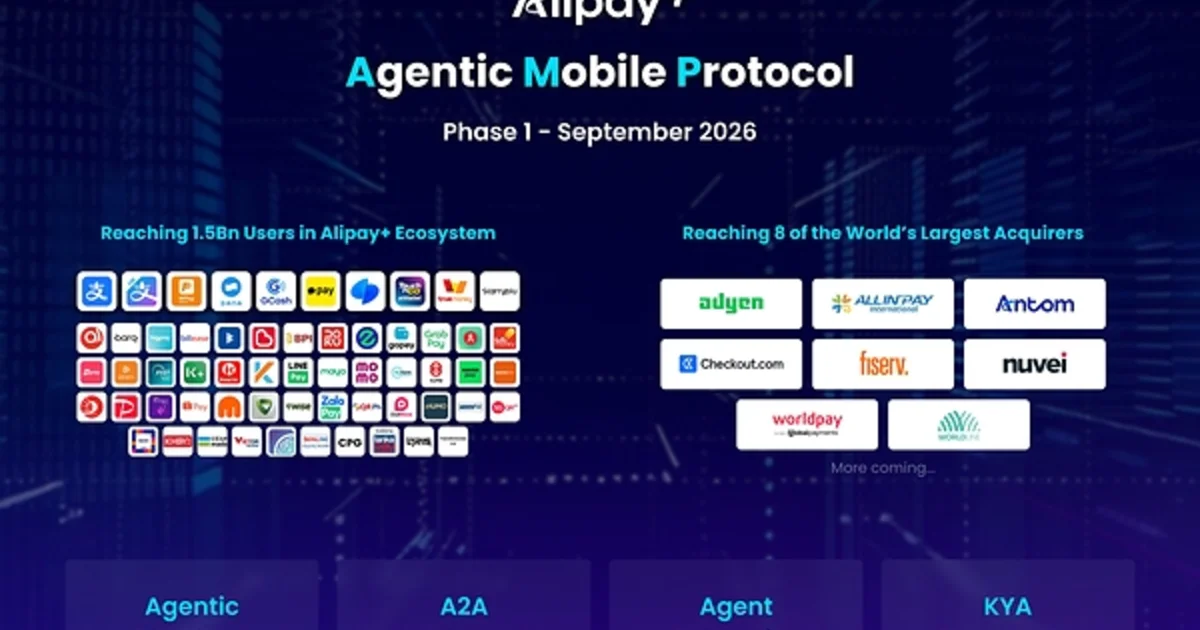
With payment leaders accelerating adoption, the Alipay+ ecosystem, with 50+ mobile payment partners, over 10 national QR schemes and serving over 2 billion consumer accounts, is evolving into the world's largest agentic payment network for mobile commerce.
themalaysianreserve.comOn September 11, Ant International announced the Phase I partners for its Agentic Mobile Protocol (AMP), the open protocol for mobile payments it released in April. On the wallet side are Alipay, AlipayHK, DANA, GCash, KakaoPay, MPay, TNG eWallet, TrueMoney, Toss and Starryblu, together serving 1.5 billion user accounts. On the acquiring side are Adyen, Allinpay, Checkout.com, Fiserv, Global Payments, Nuvei and Worldline.
AMP defines how an AI agent executes a payment on a user's behalf inside wallets, super apps, smart devices and other mobile payment surfaces. The underlying Alipay+ network links more than 50 mobile payment partners and over 10 national QR schemes, connecting 150 million merchants to 2 billion consumer accounts. What is new since the open-source release we covered in June is that the protocol now comes with a named list of implementing companies.
The second pillar is trust. Ant International, Mastercard and Visa have begun collaborating on a Know-Your-Agent (KYA) interoperability framework, building on the Monetary Authority of Singapore's SAFR framework and working through the BuildFin.ai industry platform. The idea is to align agent onboarding and identification on shared principles while each network keeps its own verification and decisioning. Transaction volumes and per-wallet implementation timelines have not been disclosed.
Related article: Ant International's AMP Signs 10 Wallets and 7 Acquirers for Phase I, Starts KYA Interoperability Work with Visa and Mastercard
Agentic Commerce
Pine Labs Bets on Voice AI, Agentic Commerce and Cross-Border Payments, Stages an AI-Versus-Human Checkout Race at Global Fintech Fest (Follow-up)

Pine Labs is prioritizing Voice AI, agentic commerce, and cross-border payments as key growth drivers.
www.fortuneindia.comIndian payments company Pine Labs told Fortune India that voice AI, agentic commerce and cross-border payments are its three growth engines. At Global Fintech Fest 2026 it showed P3P, its agentic payment protocol running on UPI and cards, along with UPI Engage, a product aimed at monetising UPI transactions. On the show floor it staged "The race to checkout challenge," pitting AI agents against human shoppers to see who reaches payment first.
Financially, revenue for the first quarter of fiscal 2027 (April to June) rose 20% year on year to 7.37 billion rupees, and net profit quadrupled from 50 million to 200 million rupees. The company obtained a cross-border payment aggregator (PA-CB) licence at the end of 2025 and is now scaling international acceptance for merchants.
On voice AI, the plan is to embed voice-based queries and operations into its merchant applications. Building the agentic payment rails first and then widening the entry point to voice reflects the realities of India's small and mid-sized merchant base.
Glance Pivots from Lockscreen Content to Agentic Commerce, with the US Now Over Half of Revenue (Follow-up)

Glance, which started out as a smartphone lockscreen-based commerce platform, has pivoted to become an agentic commerce company, while also expanding to the US and making the country its biggest source of revenue, according to a top company executive.
www.tradingview.comInMobi subsidiary Glance has shifted its core business from content to agentic commerce, its chief operating officer Mansi Jain told Mint. "The biggest shift in the evolution of Glance has been from content to agentic commerce," she said. The US has become its largest market, now generating more than half of revenue.
Glance was founded in 2019 as a content and shopping platform for the Android lockscreen and launched Glance AI, which generates outfit recommendations from a user's photos, in May 2025. Beyond smartphone apps, it is now expanding to laptops and televisions. The premise is that transactions will move from apps to agents, and Glance wants to own the entry point where consumers discover products with AI, particularly in fashion.
The pivot comes as parent InMobi prepares for an IPO. According to a Bloomberg report, it appointed bankers in July and is seeking to raise about 1 billion dollars in India at a valuation of 5 to 6 billion dollars. Redseer projects that agentic commerce will mediate 10 to 25% of US e-commerce sales by 2030, and Glance's move reads as a bet on that forecast.
Bernstein: Agent Transactions Are Under 1% of E-Commerce, Yet Anyone Trying to Cut Out Cards Is "Likely Doomed"

Agentic commerce accounts for less than 1% of overall e-commerce activity, even as new AI shopping tools from Meta and Anthropic launched this week, Bernstein said.
www.investing.comA Bernstein research note sizes up where agentic commerce actually stands. Agent-mediated transactions remain under 1% of e-commerce, even as this single week brought Meta's Muse, Anthropic's Commerce Agents and the invite-only personal agent Instinct. The note also points to OpenAI's retreat from Instant Checkout and Google's focus on standards and infrastructure rather than controlling payments.
On payments, the conclusion is blunt: "Any entity that tries to disintermediate cards for agentic payments is likely doomed." None of the recent agent launches attempt to control merchant payments; instead they smooth the consumer side, as with the single-use virtual cards used by Muse. Visa and Mastercard have built their own agentic tokens and standards, including Trusted Agent Protocol, Verifiable Intent, Agent Pay and Intelligent Commerce, and Bernstein expects 100% of agentic transactions to be tokenised.
Agent-to-agent micropayments are still at the proof-of-concept stage: the x402 protocol from Coinbase and Cloudflare has generated roughly 0.5 to 1 million dollars in monthly volume a year after launch, with an average ticket of about 20 cents. Added complexity for merchants creates a differentiation opportunity for processors such as Adyen, the note says. Generative AI referrals reached 39% of referral traffic for Wayfair, 28% for Walmart and 25% for Target as of August 2026, but still only 1 to 2% of total traffic.
When Agents Shop on Specs, the Brand Premium Becomes the Margin at Risk

With only four days remaining until Dreamforce 2026 and NRF Europe converge on September 15-17, the transition to the agentic enterprise has become the primary focus for platform providers, yet a quiet disconnect persists between the infrastructure being built and the actual behavior of the software agents tasked with spending consumer capital.
forkast.newsA Forkast analysis lays out the structural effect of agent-mediated buying on brand value. According to a Checkout.com report, 42% of merchants are testing agent-mediated systems and 89% are preparing for them, but only 3% of transactions currently involve an AI agent. Investment is running well ahead of demand.
The friction lies in how agents decide. Human shoppers respond to brand narrative, aesthetics and emotion; agents prioritise structured data, price and availability. To get an agent to choose a product priced 30% above a rival, a brand needs machine-readable proof, such as data showing 50% greater durability. Without it, the agent reroutes to the cheapest SKU. The closer a category is to a commodity, the harder the logic of a brand premium becomes to sustain.
Dreamforce 2026 and NRF Europe overlap on September 15 to 17, and merchant readiness is expected to dominate both. The practical takeaway for online retailers is clear: whether the reason for a price gap can be written into product data as a number will shape gross margin in the agent era.
AI Commerce Tools
Ecommerce.com Emerges from Stealth with a Free Audit That Scores Whether AI Agents Can Find Your Brand, Opening in October
Duran Inci named CEO of Ecommerce.com; Sarah Evans named CEO of Zen Media; the free AI commerce readiness audit and full technology suite open the first week of October.
www.globenewswire.comEcommerce.com, developed over two years by marketing firm Zen Media and development shop Optimum7 Technologies, came out of stealth on September 10. At its core is an AI commerce readiness audit that scores how well AI agents can find, read and recommend a brand. It opens in the first week of October together with a free suite of AI-powered commerce tools.
The business model uses the audit to surface gaps and then funnels brands into services combining PR, SEO, GEO (generative engine optimisation) and conversion rate optimisation. Brands with a combined monthly budget of 5,000 dollars or more across those areas get access to the same technology that powers the site. Duran Inci, who runs Optimum7, is CEO of Ecommerce.com, and Sarah Evans has been named CEO of Zen Media.
Visibility services for getting recommended by AI are appearing from many vendors, and giving away the diagnostic while monetising the upper tier is becoming the standard pattern in this space. For online retailers, it is one more entry point for checking how their brand is treated in AI answers.
Advertising and Retail Media
YouTube Launches Shopping Affiliates in the Netherlands, with Bol as the First Major Partner

YouTube is also entering the growing social commerce market in the Netherlands with the launch of its Shopping affiliate program. The online retailer Bol is the first major partner to join the initiative.
www.retaildetail.euYouTube has launched its Shopping affiliate program in the Netherlands, with the country's largest online retailer Bol as the first major partner. Creators tag products from participating retailers in videos, Shorts and livestreams, and earn a commission when viewers click through and buy. Channels need at least 500 subscribers to take part.
The Netherlands is an unusual market where Bol has pulled ahead of Amazon, so YouTube partnering with the local leader carries weight. Shortening the path from watching to buying is also a front in the competition with TikTok Shop.
For online retailers it adds another creator-driven sales channel. Exposure depends on what creators choose to feature, however, so clean product data and stable inventory are prerequisites.
Kroger's Retail Media Profit Rises 24%, Its Best Since 2021, Helped by Ads Inside the AI Shopping Assistant and In-Store Screens

Retail media is becoming increasingly critical to one of the nation's largest grocery chains.
www.modernretail.coIn Kroger's second-quarter results, profit at its retail media arm Kroger Precision Marketing grew 24% year on year, the strongest increase since 2021. E-commerce sales rose 20%, marking a second consecutive quarter of profitable growth.
Growth came from higher on-site traffic, new formats including ads placed inside the AI shopping assistant, and off-platform distribution through Google's Display & Video 360 and TikTok. In stores, Kroger expanded digital screens to nearly 600 wine-and-spirits departments and end-cap placements. CEO Greg Foran opened the earnings discussion with retail media and e-commerce, crediting closer collaboration between merchandising and media teams for expanding ad inventory.
Foran previously led Walmart U.S. and built Walmart Connect, and Kroger has kept connecting purchase data to external ad surfaces, including joining Google's Commerce Media Suite. Placing ads inside an AI assistant's conversation is worth watching as an early attempt to secure revenue as more purchases flow through agents.
Global E-commerce
Amazon's Reach in the EU Levels Off at 193.9 Million Monthly Users, with Growth Coming from the Nordics and Smaller Markets

Amazon has seen the number of recipients of its shopping services in the European Union decline slightly. In the first half of this year, the company reported an average of 193.9 million recipients per month, down from 195.2 million in the second half of last year.
ecommercenews.euAccording to Digital Services Act transparency figures Amazon submitted to the European Commission, average monthly active recipients of its shopping services in the EU came to 193.9 million in the first half of 2026, down slightly from 195.2 million in the second half of 2025. Recipients are not necessarily buyers, but the figure shows reach has stopped growing.
Germany remains the largest market at 52.8 million but fell 1.7%; France was 38.8 million, down 4.0%; Italy 38.1 million, flat; and Spain 27.9 million, down 1.0%. Among the five biggest markets, only the Netherlands grew, up 4.0% to 6.6 million. Bol still leads there, and Amazon is investing 1.4 billion euros over three years to close the gap. The fastest growth came in Denmark (+18.4%), Sweden (+13.9%) and Ireland (+12.1%), while Greece fell the most, down 20.2%.
Flat in the big markets, growing in the small ones: the pattern suggests European marketplace competition has entered a new phase. The numbers need to be read alongside the rise of later entrants such as Kaufland, Temu and TikTok Shop.
Kaufland Marketplace Enters the Netherlands with Over 9 Million Products and 3,000 European Sellers

German retailer Kaufland has launched its e-commerce marketplace in the Netherlands via Kaufland.nl.
www.esmmagazine.comGerman retailer Kaufland has opened its marketplace in the Netherlands. Kaufland.nl lists more than nine million items across 6,400 categories, including home furnishings, electronics, computers, DIY, toys, clothing, shoes and watches. About 3,000 of the platform's 15,000 European merchants are participating at launch, joining more than 1,200 Dutch retailers that previously sold cross-border through the existing marketplace.
Kaufland has steadily expanded a marketplace that lets sellers reach Germany, Austria, the Czech Republic, Slovakia and Poland from a single listing. The Netherlands becomes the newest surface.
While Amazon's reach in the EU flattens, European retailer-run marketplaces keep expanding across borders. Whether a late-arriving multi-country marketplace can build presence in a market with a strong local leader like Bol will be a test worth watching.
Rivals Push Back on JD.com's Concessions for the Ceconomy Deal, Raising the Prospect of a Longer EU Foreign Subsidies Review

JD.com's attempt to address EU foreign subsidy concerns over its $2.5bn takeover of German electronics retailer Ceconomy has faced opposition from competitors, Reuters reported.
www.retail-insight-network.comRivals have reacted negatively to the commitments JD.com submitted to the European Commission over its 2.5 billion dollar takeover of Ceconomy, the German electronics retailer behind MediaMarkt and Saturn, Reuters reported. The Commission informed JD.com this week, according to sources cited in the report.
The review falls under the EU's Foreign Subsidies Regulation, which scrutinises acquisitions by companies that receive government support from outside the bloc. JD.com submitted commitments last month, including access for smaller rivals on fair, non-discriminatory terms, but the pushback raises the possibility of revised conditions and a longer review.
Acquiring a European store network to gain logistics and customer touchpoints in one move is among the largest plays by a Chinese e-commerce company in Europe. The outcome will also shape the European strategies of Temu, AliExpress and other Chinese players.
Payments and Fintech
Europe's Account-to-Account "Wero for Merchants" Launches for E-Commerce, with Fnac Darty Rolling It Out on fnac.com in Early 2027
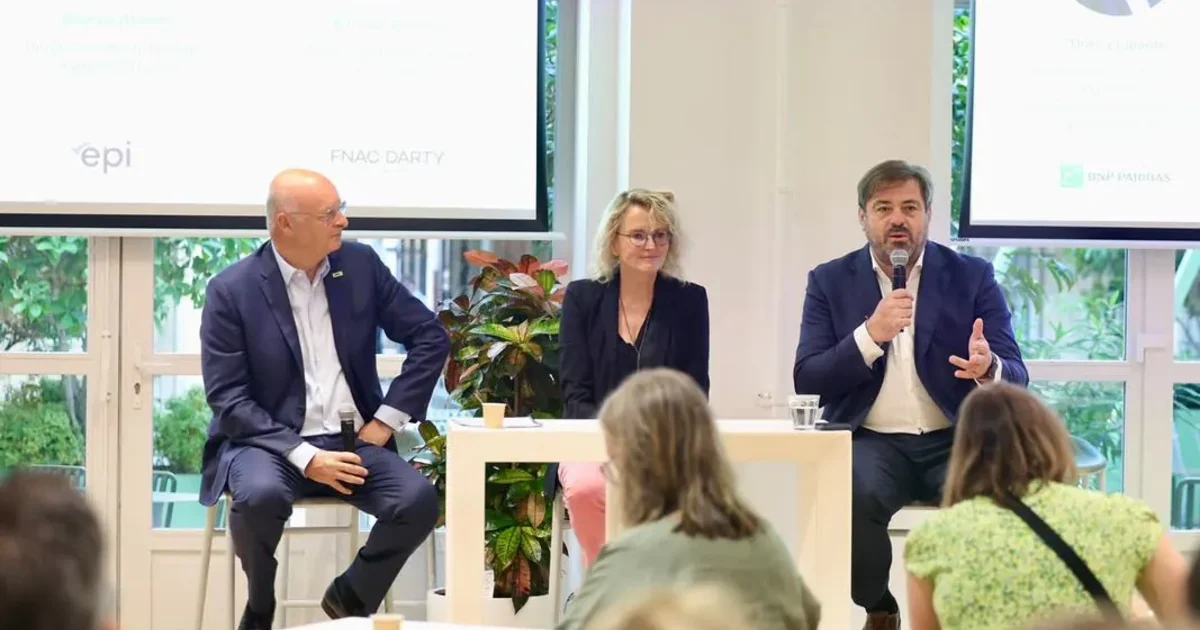
Wero is entering a new phase of its development with Wero for Merchants, a European payment solution designed for e-commerce. To support this launch in France and Europe, BNP Paribas organized a press conference in Paris on September 8, 2026, which Fnac Darty joined alongside Wero and other major corporations.
www.fnacdarty.comWero, the payment scheme backed by European banks through the European Payments Initiative, has moved from peer-to-peer transfers into e-commerce. At a press conference hosted by BNP Paribas in Paris on September 8, Fnac Darty, Orange, Decathlon and Air France appeared alongside the scheme, with Fnac Darty CEO Enrique Martinez, EPI Company CEO Martina Weimert and BNP Paribas Deputy COO Thierry Laborde speaking. Fnac Darty will roll out Wero for Merchants on fnac.com in early 2027 before extending it to stores and its other European markets.
Wero for Merchants is an account-to-account payment built on instant transfer rails. Shoppers authenticate strongly inside their own banking environment and complete the purchase without entering card details. For merchants, the promise is an alternative to established card networks and digital wallets, and a single integration that covers multiple European markets.
Martinez said payment is not merely a technical step or a commodity but part of the customer experience and a strategic choice that drives performance. He added that success will depend on consumers adopting it as a daily habit. While the agentic payments debate is dominated by card networks, Europe is building account-to-account rails in parallel, and that is worth keeping in view.
Bain Warns Card Issuers and Banks Risk Being Pushed to the Margins of AI Shopping, and Sets Out Four Conditions for Winning

Financial services incumbents must rapidly integrate their value proposition into AI shopping.
www.bain.comBain & Company has published an analysis aimed at card issuers, payment service providers and banks. As more consumers shop through AI tools and agents, it warns, incumbent financial firms risk being relegated to the margins of e-commerce.
Bain lists four conditions for winners. Make sure your payment methods are fully visible and enabled inside AI shopping flows. Reshape your value proposition, such as rewards and credit, into a form agents can evaluate. Decide clearly whether to compete or cooperate with AI platforms. And invest in the technology foundations needed to build agentic experiences on proprietary data.
For issuers, the question is whether their card can become the default when an agent chooses how to pay. Where Bernstein stresses the durability of card networks, Bain points out that the issuers and banks riding on those networks could still fail to capture value. The two views landed in the same week and read well together.
Elliptic Publishes the "Elliptic Standard," Eight Rules for Managing On-Chain Risk in Agentic Transactions

As spending enabled by stablecoins picks up momentum, payments players are beginning to see a need to guard against agentic transaction fraud involving cryptocurrency as the medium of exchange.
www.digitaltransactions.netLondon-based blockchain analytics firm Elliptic has released the Elliptic Standard, eight rules for managing the risk of transactions that AI agents conduct in cryptocurrency. The eight are data quality, model transparency, AI safety, choice among models, configurability, human oversight, business resilience and employee training. Business resilience refers to fallback rules that let the business stay in control when something goes wrong.
The backdrop is a surge in agent-driven crypto transactions, which Elliptic's analysis shows grew 522% between May 31 and August 31. Total volumes were not given, but Artemis Analytics data cited by the firm puts stablecoin-based spending at 33 trillion dollars last year. CEO Simone Maini said blockchain analytics was built for a pre-agentic world and that a new approach is needed that can execute at agentic speed.
Agent micropayment rails such as x402 are still around a million dollars a month, yet the risk-management side is building frameworks ahead of demand. For online retailers considering stablecoin acceptance, agent-specific risk controls are becoming part of the requirements.
Consumer Behavior
Contentsquare: 97% of Shoppers Rethink an AI-Recommended Purchase When the Website Falls Short

Repercussions range from customers switching brands to giving up on the purchase altogether, a Contentsquare survey found.
www.customerexperiencedive.comA Contentsquare survey of 2,000 consumers in the US and France found that 97% would reconsider an AI-recommended purchase if the brand's website falls short of expectations. Of those, 57% would keep researching, 23% would switch to another brand and 16% would abandon the purchase altogether.
AI's influence keeps widening. Some 47% said AI has changed their mind about which brand to buy, and two-thirds trust AI more than social media when evaluating an unfamiliar brand. A further 36% said AI has replaced traditional search for some shopping tasks, used for finding the best price or ideas (53%), comparing products (52%) and discovering new brands (29%).
CMO Jean-Christophe Pitié said visibility only creates value if it converts or drives loyalty, and that a slow or confusing experience afterwards means AI-driven discoverability will not deliver the expected return. Getting recommended by AI and delivering a site that lives up to the recommendation are two halves of the same problem.
Wrapping Up
If these few days had a single theme, it was that payment infrastructure started naming names. Visa demonstrated with ten banks and payment firms in India, and Ant International listed ten wallets and seven acquirers. The center of gravity is shifting from standards debates to adoption.
The demand numbers counsel patience. Bernstein puts agent-mediated transactions at under 1% of e-commerce, and Checkout.com's survey finds agents involved in just 3% of transactions. Contentsquare's finding that 97% of shoppers reconsider when the post-recommendation experience disappoints is a reason to fix your own site and product data before worrying about the rails.
This week Dreamforce 2026 and NRF Europe overlap, and merchant readiness will be the headline topic. Product data that agents can select on, an entry point for agent payments, and the experience that follows a recommendation: how to prioritise those three is the decision to make ahead of the holiday season.