Anthropic Open-Sources a Claude Commerce Agents Blueprint Under Apache 2.0: How to Build an On-Site Shopping Agent That Leaves Payment With the Retailer
Anthropic released reference implementations for shopping and merchant agents on Claude. We break down the design that keeps payment with the retailer, what Visa, Mastercard and Shopify are doing with it, how it differs from OpenAI and Google, and how to read the 35% larger cart claim.

Key Takeaways
- On September 2, 2026, Anthropic released "commerce-agents", a blueprint for building commerce agents on Claude. It ships reference implementations of a customer-facing shopping agent and an operator-facing merchant agent, a Claude Code plugin, and demos for retail, travel, telecom and ticketing, all under the Apache License 2.0.
- The core design principle is separation: the model proposes, people and systems execute. Payment is handed to the retailer's existing checkout or an agentic payments provider, and the backend the agent calls has no charge method at all. Prices and products are constrained to catalog data, and merchant-side changes stay staged until a person approves them.
- Anthropic cites carts up to 35% larger and a 60% higher likelihood of completing a purchase, but both figures come from a single partner as reported by Anthropic, with no third-party verification. For merchants, the real question is whether catalog, cart, order and policy APIs are ready to support a conversational touchpoint inside their own site.
What was released as a blueprint
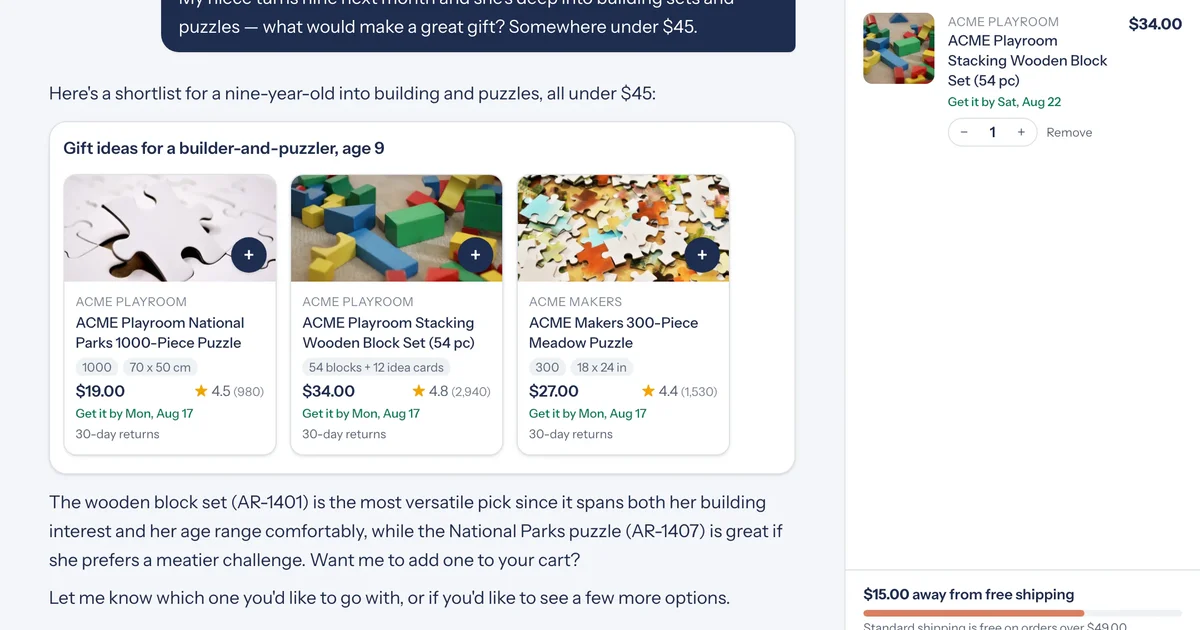
We're launching a blueprint to help build commerce agents on Claude. It contains the harnesses, patterns, and guardrails an engineering team needs to get a commerce agent running in days.
claude.comThe timing was aimed at holiday season planning. On September 2, 2026, Anthropic published "Building commerce agents with Claude" on its official blog, releasing a blueprint for commerce agents. It consists of working reference implementations of two agents and a Claude Code plugin for adapting them to a company's own catalog and policies.
The two agents are a shopping agent that a retailer embeds in its site or app, and a merchant agent used by the people running the store. The former handles catalog search, multi-item requests, comparisons, cart building, and answers about order status and return policies within one conversation. The latter covers sales analysis, inventory anomaly detection, pricing and promotion recommendations, and drafting campaign copy. Runnable demos for four verticals, retail, travel, telecom and ticketing, are included, all set at a fictional company called ACME.
According to the README in the GitHub repository, the license is Apache License 2.0, and the same prompts, skills and tool contracts run on three paths: the Messages API, the Claude Agent SDK, and Claude Managed Agents, which is in beta. Deployment targets include the Claude API as well as Amazon Bedrock, Microsoft Foundry and Google Cloud Vertex AI. From Claude Code, commands such as /scaffold-commerce-agent generate a project skeleton against your own stack. One line deserves attention: the README states this is a reference implementation that is not maintained and does not accept contributions.
A design that never lets go of payment, where the model only proposes
What matters most in this blueprint is not the number of features but what the model is not allowed to do. The shopping agent stops at assembling the cart and handing it to checkout; payment goes to the retailer's existing checkout or an agentic payments provider. The README opens by declaring that nothing places an order, charges a card, or changes a live listing.
The engineering deep-dive published the same day shows that this boundary is implemented in code structure rather than as a prompt instruction. On the consumer side, the checkout tool only renders the cart with a button to place the order, and the backend interface the agent calls has no charge method at all. The checkout URL is returned by the backend and rendered by the host, so the model never even sees it.
The merchant side is even more cautious. Every write tool, such as a price change or a campaign launch, produces only a staged change with a server-generated ID, and the change is applied only for IDs approved through the operator's portal or CLI. At apply time, price movement, discount depth, restock size and campaign budget are re-checked against the limits in force at that moment, not the limits when the change was staged. The deep-dive puts it this way: the most dangerous thing the model can do is propose, and approval routes through the maker-checker flow the business already uses.
Another pillar is the provenance gate. The cart accepts only product IDs the server returned in that session; an ID generated by the model, pasted by a user, or planted in a review is refused before the backend sees it. Text written by third parties, such as product descriptions and reviews, is sanitized and wrapped in a fence with a fixed label before reaching the model. The guardrails of constraining prices and products to catalog data and avoiding manipulative upsell patterns rest on these mechanisms.
The architectural choices are also distinctive. Anthropic rejects splitting the system into subagents per domain, and instead recommends a single agent that loads five skills per role. Every handoff loses shared context such as the cart and conversation history, and adds tokens and latency. UI components such as product cards and comparison tables are treated as tool calls, so the model emits a schema rather than text.
What it means that Visa, Mastercard and Shopify lined up
The announcement page carries endorsements from eleven companies. The two card networks stand out. Jack Forestell, Visa's Chief Product and Strategy Officer, said the following.
AI will fundamentally reshape commerce, but trust must remain at the center of every transaction. Merchants are telling us they want more control over how AI engages their customers.
Mastercard's Sherri Haymond added that "trust is the currency of commerce, and it is even more critical in the agentic era," positioning the company as a supporter of merchants building their own agents. The blog names Accenture, Visa and Mastercard as partners "working with us to enable clients and merchant communities to leverage the blueprints." However, which payment capabilities the two networks will actually connect to this blueprint, and how it relates to existing efforts such as Visa Intelligent Commerce and Mastercard Agent Pay, remains undisclosed.
| Company | Role | Involvement stated in the announcement |
|---|---|---|
| Visa | Partner | Helping clients and merchant communities use the blueprint; which payment capabilities connect is undisclosed |
| Mastercard | Partner | Helping merchants build their own agents; which payment capabilities connect is undisclosed |
| Accenture | Partner | Combining retail and consumer goods expertise to move clients from concept to production |
| Shopify | Platform | Building a reference storefront implementation that connects to stores through Catalog, UCP and Shop Sign-in |
| Wix | Platform | Had a commerce agent taking prompts within fifteen minutes; piloting for SMB merchants |
| Klaviyo | Platform | Continues building on Claude to turn customer data into campaigns and personalization |
| Square | Platform | Building agents that watch sales, labor and inventory and return next steps |
| Zomato / Fetch | Adopter | Ran the blueprint with no blockers; both agents running locally in well under an hour |
| Priceline / Intuit | Adopter | Claude powers the Penny travel assistant and financial experiences |
The move most directly relevant to merchants comes from Shopify. VP Product Vanessa Lee revealed that Shopify is building a reference storefront implementation that connects the blueprint to a merchant's store through Catalog, UCP and Shop Sign-in. Shopify has already been advancing its ChatGPT integration; this opens a path for Claude-based agents running inside the merchant's own site. Wix reported that its engineers had a commerce agent taking prompts within fifteen minutes.
In travel, Priceline said the latest generation of Penny was built on Claude, which continues the story covered in an earlier article. The focus this time is the cross-industry foundation.
How this differs from the OpenAI and Google routes
Digital Commerce 360 framed the release as a clear statement of intent to compete with OpenAI and Google. The three companies are not playing on the same field, though.
OpenAI owns ChatGPT, an enormous consumer touchpoint, and Google pulls retailer catalogs and checkout into its own surfaces through AI Mode and the Universal Commerce Protocol (UCP). According to the publication's comparison piece, OpenAI pivoted away from its in-ChatGPT checkout plans in March 2026 and shifted toward experiences driven by ChatGPT apps and the Shopify integration. The route of completing payment inside the chat has retreated at least once.
Anthropic's blueprint places the agent inside the retailer's site and app from the start. Conversation data, the cart and checkout all stay with the retailer, while Anthropic limits itself to supplying the model and implementation patterns. Set alongside the growth in AI-referred retail traffic noted in our Claudeforce article, a picture emerges of Claude engaging on both sides: the referral source and the on-site assistant at the destination.
The deep-dive closes with a line that shows how far the design reaches. Some storefront traffic will eventually come from external agents shopping on behalf of users, and the same provenance, staging and approval rules that keep a retailer's own agent in bounds are what will let it open its tools to those agents safely.
How to read the 35% larger cart and 60% completion lift
The blog leads with "carts up to 35% larger and shoppers 60% more likely to complete a purchase." Speaking to Reuters, Angela Jiang, head of product for the Claude platform, described it as "cart size up about 30 to 35% for one partner, and customers about 60% more likely to complete a purchase."
These are results from a single partner as relayed by Anthropic. The partner's name, the comparison period and whether a control group existed are all unstated, and there is no third-party verification. The Adobe Analytics figure Reuters cited alongside it, that AI-driven retail site visits convert at a 60% higher rate than other traffic, is a separate metric about referrals from AI and should not be conflated with the effect of an on-site agent. Digital Commerce 360 observed in April that OpenAI and Google remain the most established players in agentic commerce, so Anthropic's track record is still being built.
Implementation caveats are also spelled out. The bundled examples have no authentication, and the README states that business rules, authorization and compliance belong to the deployment. API usage costs and the effort of connecting existing systems are not part of the blueprint either, so Zomato's remark about skipping weeks of trial and error applies to the foundation layer only.
What merchants should get in order first
What the blueprint ultimately demands is neither model selection nor prompt craft but whether your own systems can be exposed cleanly as APIs. The shopping agent calls catalog, cart, order and policy systems through an interface called StorefrontBackend. The deep-dive advises against reimplementing search and ranking logic inside the agent: pass results already ranked by your existing search engine, and leave the model only the judgment of which results to show, how many, and how.
The README anticipates a phased start. A shopping pilot can implement only search and product details, with the remaining methods stubbed to return an unavailable result. A merchant pilot can implement the eight read methods and have writes refuse, which lets daily digests and metrics run first.
The other easily overlooked area is memory. The deep-dive frames facts such as a customer's shoe size or dietary constraints as a data-handling design problem rather than a storage one, calling for limits on which memory types are held, a way for users to see, correct and delete what is stored, and a retention period. For merchants operating under personal data regulations, this is where the first internal discussion should land.
As traffic from AI search grows, whether the landing site offers a conversational way to narrow down products will show up as a difference in experience. Structuring the catalog and building inventory and order APIs serves both the investment in being found by AI and the investment in serving customers on site.
Conclusion
Anthropic's blueprint proposes pulling the main arena of agentic commerce back from inside AI platforms to inside the retailer's own site. Leaving payment and approval with people and existing systems while letting conversation handle discovery and comparison gives merchants an entry point they can test without giving up control.
The next things to watch are when Shopify publishes its reference storefront implementation and which payment capabilities Visa and Mastercard actually connect. Whether the headline figures get updated with verification from multiple companies will largely determine how this blueprint is judged.