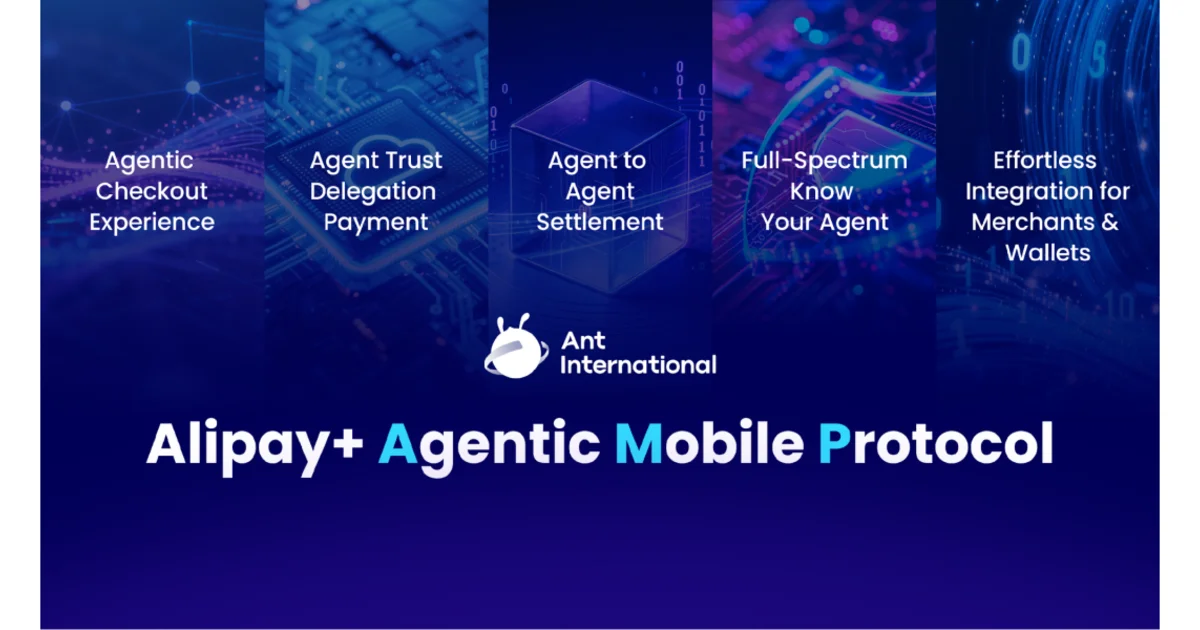
Ant International's AMP Signs 10 Wallets and 7 Acquirers for Phase I, Starts KYA Interoperability Work with Visa and Mastercard
Ant International's Agentic Mobile Protocol (AMP) enters Phase I with 10 Alipay+ wallets such as Alipay, GCash and KakaoPay and 7 acquirers including Adyen and Worldline. We unpack the Know-Your-Agent interoperability work with Visa and Mastercard, what remains undisclosed, and what changes for cross-border and inbound merchants accepting Alipay+.

Key Takeaways
- Ant International named 10 wallets and 7 acquirers including Adyen as Phase I adopters of its Agentic Mobile Protocol (AMP)
- Work with Visa and Mastercard on KYA interoperability has begun, but it remains an agreement on principles with no specifications, dates or transaction volumes disclosed
- Eight of the 16 wallets accepted at Alipay+ merchants in Japan are in Phase I, so cross-border and inbound merchants will feel the change through their PSPs
Five Months After Release, AMP Gets a Roster of Adopters
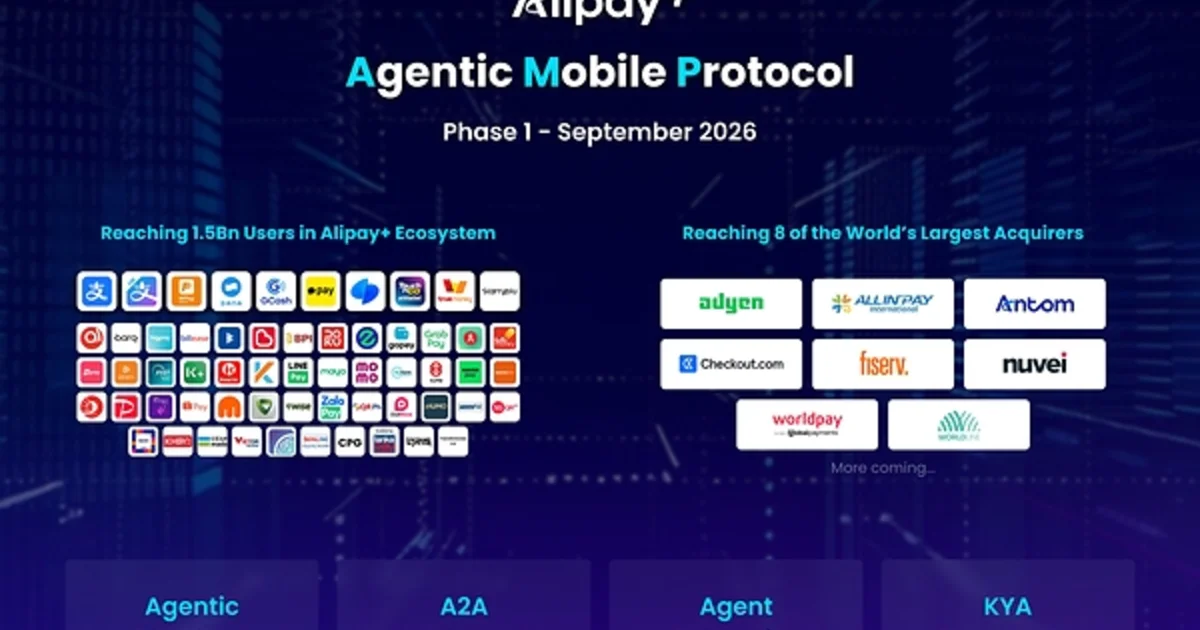
With payment leaders accelerating adoption, the Alipay+ ecosystem, with 50+ mobile payment partners, over 10 national QR schemes and serving over 2 billion consumer accounts, is evolving into the world's largest agentic payment network for mobile commerce.
themalaysianreserve.comOn September 11, 2026, Ant International published an update on the global rollout of its Agentic Mobile Protocol (AMP). Five months after the April release, this is the first time the company has named which wallets and which acquirers are implementing it. We covered how AMP works in our article on the April release, so this piece focuses on two questions: who signed up, and how far interoperability with the card networks has progressed.
The news came in two parts. On September 9, Ant International, Mastercard and Visa jointly announced the start of work on a KYA interoperability framework. On September 11, the rollout release followed with the Phase I partners and the official open-source release on GitHub.
The Phase I wallets are Alipay (Chinese mainland), AlipayHK (Hong Kong SAR), DANA (Indonesia), GCash (Philippines), KakaoPay (South Korea), MPay (Macao SAR), TNG eWallet (Malaysia), TrueMoney (Thailand), Toss (South Korea) and Starryblu (Singapore), said to serve 1.5 billion accounts between them. The acquirers are Adyen, Allinpay, Checkout.com, Fiserv, Global Payments, Nuvei and Worldline. The release also cites the 2 billion accounts of the wider Alipay+ ecosystem, but Phase I covers 10 wallets and 1.5 billion of those accounts.
What the Ten Wallets Say About the Mobile and QR Sphere
| Wallet | Home market | Among the 16 wallets accepted at Alipay+ merchants in Japan |
|---|---|---|
| Alipay | Chinese mainland | Yes |
| AlipayHK | Hong Kong SAR | Yes |
| DANA | Indonesia | Not listed |
| GCash | Philippines | Yes |
| KakaoPay | South Korea | Yes |
| MPay | Macao SAR | Yes |
| TNG eWallet | Malaysia | Yes |
| TrueMoney | Thailand | Yes |
| Toss | South Korea | Yes |
| Starryblu | Singapore | Not listed |
Geographically, the list clusters into Greater China, South Korea and five major Southeast Asian markets, regions where QR codes and wallets became the everyday payment method before cards did.
The detail that matters most is that the majority of these ten wallets are already accepted in Japan. Through the PayPay and Alipay+ partnership, 16 wallets and banking apps can pay via Alipay+ at more than 3 million merchants in Japan, and eight of those 16, namely Alipay, AlipayHK, MPay, KakaoPay, Toss, TNG eWallet, GCash and TrueMoney, overlap with Phase I. Stores and online merchants that accept Alipay+ are automatically on the receiving side once implementations go live.
The wallets differ in temperature, however. TNG Digital, the operator of TNG eWallet, says it is "exploring how this technology could support more convenient experiences", while MPay describes itself as "among the first digital wallets around the world to support" AMP. The release gives no launch date for any individual wallet.
Why Seven Acquirers Matter: An Acceptance Point on the Merchant Side
A wallet supporting the protocol achieves nothing if the merchant side cannot accept the transaction. In practical terms, the weightier part of this announcement is the seven acquirers. Adyen, Checkout.com and Worldline are European players with large cross-border merchant bases; Fiserv and Global Payments are North American majors; Nuvei is an integrated PSP covering more than 200 markets; Allinpay is a major Chinese acquirer.
The comment from Brian Sze, General Manager of Asia Pacific at Checkout.com, explains the significance most directly. Describing agentic commerce as "a channel expansion, similar to how mobile was" that "to date has been largely card-based", he says Checkout.com will be "allowing a consumer buying through an AI surface like Gemini or ChatGPT to pay with Alipay+ just as they would anywhere else". Worldline says that by supporting AMP on top of its existing Alipay+ integration, merchants can accept agent-initiated transactions "without the need to integrate separate systems", and Nuvei's Chair and CEO Phil Fayer says "merchants don't need another payment silo, they need one connection to every agent that comes to them".
One point worth holding onto: Adyen is also among the 12 launch partners of Visa's Trusted Agent Protocol, released in October 2025 (Forkast). Large acquirers are not picking a camp. They are connecting to both the card networks and the wallet networks and hiding the difference from merchants.
Whose Problem Does the KYA Interoperability Framework Solve
The September 9 announcement from the three companies has a longer reach than the AMP rollout itself. Know-Your-Agent (KYA) is the process of confirming, for an AI agent attempting a transaction, which agent it is, who operates it, who authorised it and what it is permitted to do. Visa has its Trusted Agent Protocol, Mastercard has Agent Pay and Verifiable Intent, and Ant has the KYA and Agent Trust Rating inside AMP. Seen from the platforms that build agents, an agent had to be onboarded and vetted three separate times for three separate networks.
Three principles were agreed: cross-network operator traceability (every agent is linked to a validated operator, cardholder or organisation), shared certification requirements (agents are assessed against common security and behavioural requirements) and continuous transaction monitoring (identity and transaction signals determine whether certification is maintained) (Biometric Update). The work is explicitly to proceed "while preserving each network's own verification and decisioning processes"; it is not a single registry where one review clears an agent everywhere. The realistic destination is aligning trust signals into a form each network can read, and cutting duplicated verification.
The foundation is SAFR (Safeguards for Agentic Finance at Runtime), published on July 3, 2026 under BuildFin.ai, the industry platform convened by the Monetary Authority of Singapore (MAS). SAFR is a reference design for a runtime governance layer that validates an AI agent's actions before they execute, and its eight industry authors include Ant International, Mastercard and Visa alongside Circle, HSBC, JPMorgan Chase, Manulife and OCBC (Charltons Quantum). SAFR is non-binding industry guidance, and the KYA interoperability work is likewise voluntary.
Where AMP Stands Next to the Card Networks, AP2 and ACP
| Framework | Led by | Payment rail | Agent identification | Status (as of September 2026) |
|---|---|---|---|---|
| AMP (Agentic Mobile Protocol) | Ant International | Alipay+ wallets and QR | KYA with Agent Trust Rating, task-scoped delegation | Released April 2026. 10 wallets and 7 acquirers joined Phase I in September |
| Trusted Agent Protocol / Intelligent Commerce | Visa | Visa card network | Agent credentials with a signed intent payload | Released October 2025 with 12 launch partners including Adyen, Shopify and Stripe |
| Agent Pay / Verifiable Intent | Mastercard | Mastercard card network | Agentic Tokens and Verifiable Intent | Verifiable Intent open-sourced with Google in March 2026 |
| AP2 (Agent Payments Protocol) | Rail-agnostic (cards, bank, stablecoins) | Signed Mandates (verifiable credentials) | Released September 2025 | |
| ACP (Agentic Commerce Protocol) | OpenAI and Stripe | Cards (Shared Payment Token) | Delegated token issued by the payment provider | Released September 2025, used by ChatGPT Instant Checkout |
In a table, AMP stands out as the only framework whose rail is wallets and QR. Rather than competing with the card networks, AP2 or ACP, its role is to bring the 1.5 billion accounts the card networks did not reach into the scope of agentic payments.
That AMP, framed in April as a third pole, put forward interoperability with Visa and Mastercard in September is a shift in positioning. Jiang-Ming Yang, Chief Innovation Officer at Ant International, says the company will keep investing in its own security solutions while "strengthening collaboration with card networks, policy leaders like MAS and other stakeholders on new accountability mechanisms". Where Ant Group's domestic AHA protocol pursues depth within a closed ecosystem, AMP pursues breadth of open connection.
What the Announcement Does Not Say
Because this is the promoter's announcement, the omissions need listing. First, no live transaction volume is disclosed. Forkast notes that while AI-driven traffic to US retail sites has surged, "this volume remains largely experimental", and the same caveat applies to AMP.
Second, there are no implementation dates per wallet, and no timeline beyond Phase I taking place "in 2026". Third, the KYA interoperability work is an agreement on principles; no technical specifications, governance body or rollout schedule has been published. Forkast calls this a critical gap between announcement and execution. Fourth, the coverage limit of AgentSafePay, the protection scheme presented alongside AMP, the definition of covered risks, exclusions, who bears the cost, and the pricing of AMP transactions are all undisclosed. Finally, the GitHub repository had its README updated only on September 9 and consists mainly of Python sample implementations and specification documents. As a codebase it is still early, and not yet a set of production-ready SDKs for seven acquirers to integrate against.
What Changes for Cross-Border and Inbound Merchants
The affected group is specific: businesses that already accept Alipay+.
For cross-border e-commerce into East and Southeast Asia, the change happens behind the checkout. A KakaoPay or Toss user in South Korea, or a GCash user in the Philippines, searches for a product through an agent embedded in their home wallet or through ChatGPT or Gemini, and pays from their wallet balance. A merchant receiving that payment as Alipay+ through Adyen, Checkout.com, Worldline or Nuvei will begin receiving agent-initiated orders without rebuilding its checkout, at the point the PSP supports AMP.
For physical stores and online shops serving inbound visitors to Japan, AMP's design philosophy is more directly relevant. The backgrounder describes an agent acting on a traveller's request, searching, comparing and recommending, and then, once authorised, paying through the user's existing wallet. From the perspective of a store displaying a QR code, the Alipay+ QR and the PSP settlement flow are the same whether the payer is a person or an agent. The open question, separate from payments, is whether the store's product and stock information is published in a machine-readable form when the agent compares options before the visit.
What to do now is not large. Check whether your PSP is one of the seven Phase I acquirers and, if not, whether AMP support is on its roadmap. Ask the PSP how agent-initiated transactions will be treated by your fraud rules and whether KYA trust signals (operator, certification status, Agent Trust Rating) can eventually be passed through. And publish structured product data, the same preparation required by Visa's Intelligent Commerce Connect. What to avoid is rushing to build a bespoke AMP integration. With all seven acquirers speaking of "one connection", the design does not envisage merchants connecting to the protocol individually.
Conclusion
AMP was published as a specification in April; with the September announcement it gained a roster of implementers, ten wallets and seven acquirers. Choosing to make agent identity interoperable with Visa and Mastercard, rather than to compete with the card networks, is another change since April.
At the same time, live transaction volume, each wallet's implementation date, the specification and governance of KYA interoperability, and the terms of AgentSafePay are all still to be disclosed. The next things to watch are when a Phase I wallet actually opens agent-initiated payments to the general public, and whether the KYA work moves from principles to specifications. Merchants in Japan that accept Alipay+ will be among the first to learn of both, through a notice from their PSP.