
AI Commerce News Digest (September 25, 2026)
AI commerce news for September 25, 2026: Shopify makes direct checkout for Meta active by default, Cleverbridge completes France's first Passkey-authenticated agentic payment, and LTK and Shopee strengthen AI product discovery.


Key Takeaways
- Shopify's direct checkout for Meta is on by default
- Cleverbridge completes France's first Passkey agentic payment
- LTK and Shopee ground AI product discovery in their own strengths
Here is the AI commerce news for September 25. The story around Meta's Muse agent, covered in yesterday's digest, has moved to a concrete question for merchants: their Shopify settings. Shopify has made direct checkout for Meta active by default for eligible stores, so, as with Google's AI Mode, merchants who want out have to change the setting themselves. On the payments side, France has now joined Canada, Denmark and the UK with its first live agentic payment. In product discovery, LTK, which builds on creator recommendations, and Shopee, which trained its own LLM, are both leaning on strengths that general-purpose AI does not have.
Today's Top Stories
Shopify makes direct checkout for Meta active by default, so Muse users can buy unless merchants opt out

The distribution platform didn't ask merchants to opt in. It flipped the switch. On the same day, Amazon locked its door. Agent commerce just split into two models.
forkast.newsYesterday's deep dive covered Shop Pay coming to Meta's AI agent Muse, and there is an important follow-up for merchants. According to Shopify's "Selling on Meta" help center page, direct checkout on the Meta channel is active by default for eligible stores. Merchants do not sign up. Instead, those who want to stop it go to Sales channels, then Agentic, then Meta in the admin and turn it off. Forkast reports that the switch was applied to eligible merchants all at once on September 21 and puts the number at about one million stores.
Turning off direct checkout does not hide products. They still appear on Meta through Shopify Catalog, and shoppers are sent to the merchant's online store to complete the purchase. The help center says direct checkout is shown only to customers in the United States, Canada and Mexico, and that there are no fees beyond standard payment processing. Subscriptions, customizable products, B2B-only products, checkout blocks, custom pixels and product bundles are not supported. Legal disclosures in product descriptions must appear within the first 6,000 characters.
Google's AI Mode and Gemini, covered yesterday, also switched on direct checkout by default for eligible Shopify merchants. Agent-side checkout has been switched on across the board, without waiting for each merchant to decide. Merchants that rely on subscriptions or tracking tags should check before the holiday season what they would lose sight of if part of their sales moved to agent-made purchases.
Cleverbridge completes France's first live agentic payment with Visa and Revolut, using Passkey authentication to meet European strong customer authentication

Cleverbridge completed the first live AI agent-initiated payment in France, with Visa and Revolut, on a Passkey-authenticated consumer card.
www.businesswire.comCleverbridge, which runs a global commerce platform for software companies, announced on September 24 that it had completed France's first Passkey-authenticated agentic payment in a live checkout. The transaction was part of a pilot with Visa and Revolut announced earlier this month.
Here is how it worked. Visa's test agent, My Agent, started the purchase. Cleverbridge recognized it as an approved agent through Visa's Trusted Agent Protocol and completed the checkout. A Visa Payment Passkey authenticated the transaction, meeting Europe's strong customer authentication (SCA) requirements, and Revolut authorized the payment on a French consumer card. In July, Cleverbridge had said it was among the first merchants to enable the Trusted Agent Protocol and Agentic Directory and had started running agent transactions in its own environment.
Yesterday's digest covered "first agentic payments" in Canada, Denmark and the UK. What stands out here is that two conditions came together on a real consumer card: the merchant knew which agent it was dealing with, and the issuing bank stayed in control of the payment. Cleverbridge CEO Richard Stevenson said that only when both are true can agentic commerce carry real volume.
Related article: Cleverbridge Completes France's First Live AI Agent Payment with Visa and Revolut: How Trusted Agent Protocol and Payment Passkey Meet Europe's SCA Rules
Agentic Commerce
Pine Labs and Google Cloud partner to bring India's smaller merchants into agentic commerce (follow-up)
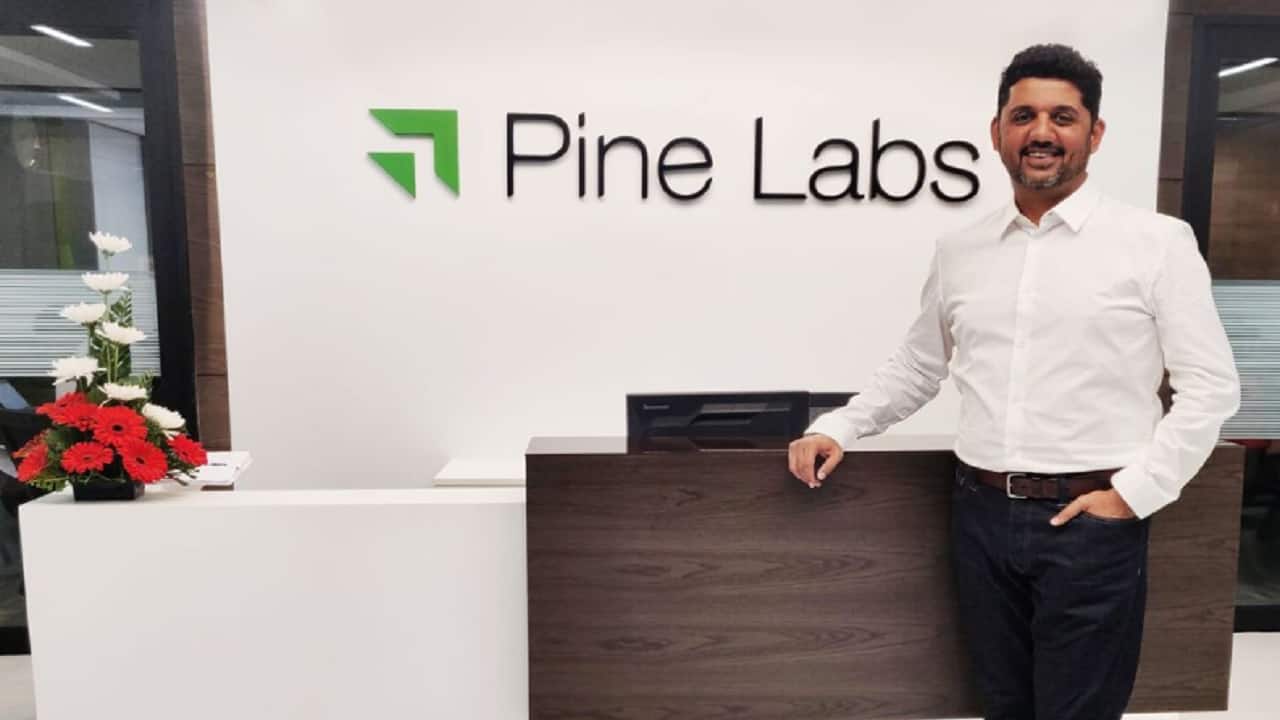
Pine Labs on September 24 announced a strategic collaboration with Google Cloud to expand agentic commerce among Indian merchants.
www.moneycontrol.comIndian payments company Pine Labs announced a strategic collaboration with Google Cloud on September 24. The aim is to help Indian merchants, from large enterprises to fast-growing small businesses, take part in agentic commerce.
The partnership focuses on three areas: discoverability, payments and governance. Pine Labs will use the Gemini Enterprise Agent Platform for catalog enrichment and agent deployment, with native support for the Universal Commerce Protocol (UCP) and Agent-to-Agent (A2A) frameworks. The company says the merchants that benefit from agent-led buying are typically those with structured, AI-readable catalogs, live inventory and automated checkout.
CEO Amrish Rau said the question is whether India's 60 million small businesses get to be part of the shift from the start. Pine Labs has already announced work with OpenAI and its own payment protocol, and its approach is becoming clear: give merchants a gateway to several agent platforms rather than tying them to one AI company.
Mastercard executive says merchants want AI shoppers without losing the customer relationship

Mastercard's Gaurang Shah sits down with PYMNTS' Karen Webster to discuss why, for merchants, agentic participation is becoming unavoidable.
www.pymnts.comIn a conversation with PYMNTS CEO Karen Webster, Gaurang Shah, executive vice president for global acceptance and merchant solutions at Mastercard, described the current state of agentic commerce as a "trust equation." Transactions will not scale unless trust exists on both sides: consumers letting agents transact and merchants agreeing to accept those transactions.
Shah said searches are already happening through agents. At checkout, a merchant wants to know whether the agent is legitimate, whether the consumer authorized it, what it was allowed to do, and whether the transaction stayed within those limits. The conversation also touched on a gap in expectations: consumers assume they will be protected, while merchants feel liability should sit with whoever runs the agent.
Discovery, comparison and ranking are already happening on AI, and consumers return to familiar sites only for the final purchase. Read alongside Shopify's default-on move, his point rings true: the customer's entry point is shifting away from merchants before they have even decided to take part.
AI Commerce Tools
LTK rebuilds its app's search tab around AI search and conversational AI grounded in creator picks, with click-outs to retailers up 84%
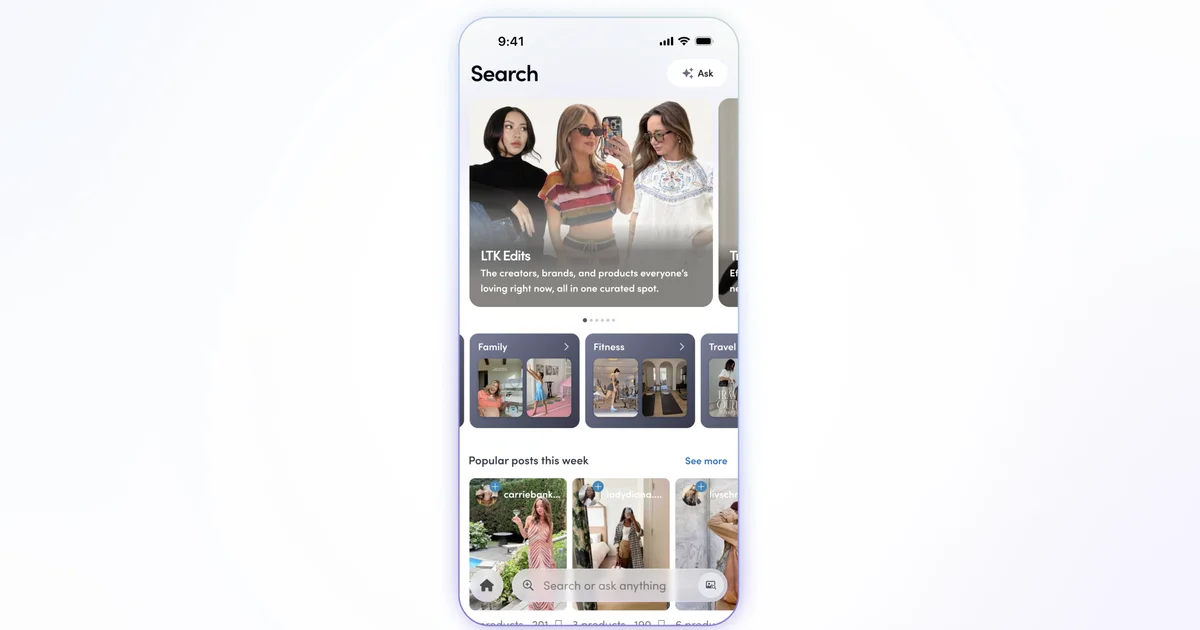
New LTK app Search tab brings together personalized interest-based discovery, AI-powered search and conversational shopping.
www.businesswire.comCreator commerce platform LTK announced a new Search tab in its app on September 24. It brings together three things in one place: personalized interest-based discovery, search with AI-generated overviews, and the conversational assistant LTK AI. Search was already the second most-used function in the app.
What sets it apart is that the AI's answers are grounded in real creator recommendations. LTK draws on its own commerce intelligence graph to surface creator posts, products and brands. Since launching earlier this month, product click-outs from search to retailer websites are up 84%, creator-profile views from search are up nearly 50%, and daily users of LTK AI are up 89% month over month.
LTK drives more than $6 billion in annual retail sales. As general-purpose AI assistants start to handle product recommendations, making human experience the "trust layer" behind AI answers changes what creator-driven exposure means for brands and retailers.
Related article: LTK Launches a New Search Tab Grounding AI Search and Conversational Shopping in Creator Recommendations, With Click-Outs to Retailers Up 84%
Shopee builds its own LLM, Compass, for Southeast Asian e-commerce and runs most of its AI traffic on it
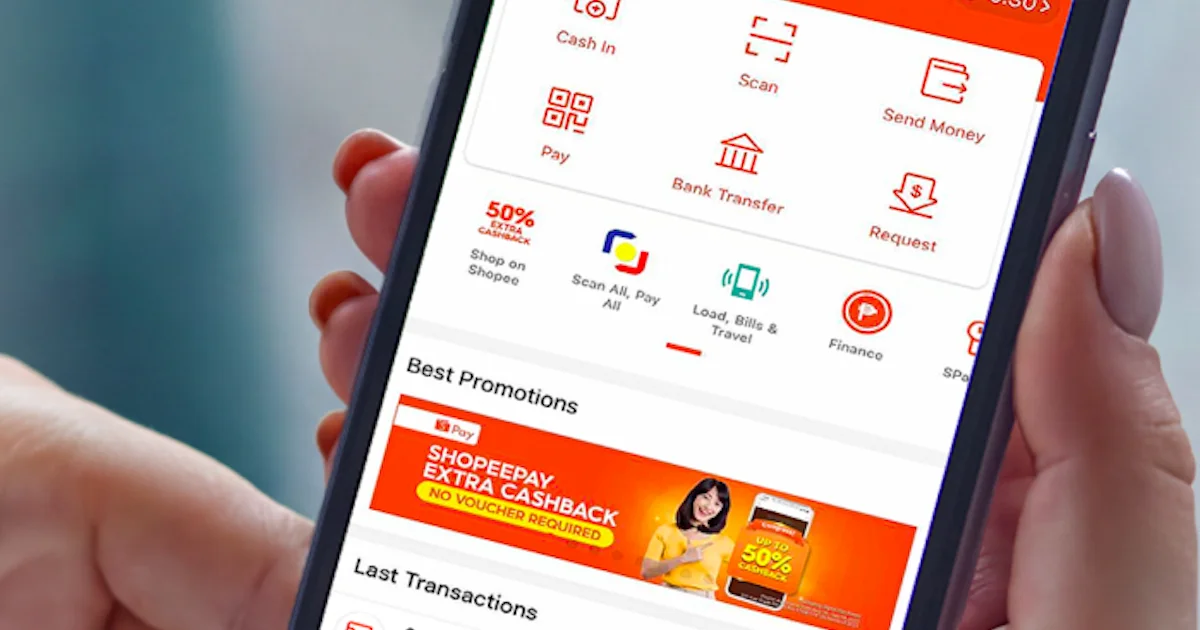
Southeast Asian e-commerce giant Shopee has built Compass, a family of specialised, multilingual Large Language Models, with the NVIDIA AI Factory.
www.frontier-enterprise.comShopee, which runs e-commerce in eight markets centered on Southeast Asia, has built Compass, a family of multilingual LLMs specialized for e-commerce, using the NVIDIA AI Factory. General-purpose LLMs do well on English tasks but fall off on Indonesian shopping queries, Thai product categorization and Vietnamese purchase intent. To measure that gap, Shopee also created EcomEval, a benchmark dedicated to Southeast Asian e-commerce.
The latest model, Compass-v3, is a mixture-of-experts model with 245 billion total parameters, 71 billion of which are active per token. Training runs through five stages, from pretraining through instruction following and preference alignment to agentic reinforcement learning. Compass now handles most of Shopee's AI traffic across search, recommendations, fraud detection, parcel recovery and customer service. Monthly API tokens grew from 3 billion to 340 billion in eight months, and fraud detection is reported to be 50 times more efficient than manual review at 90% lower processing cost.
When a platform with more than $136 billion in annual gross merchandise value decides to own its understanding of purchase intent rather than hand it to an outside general-purpose model, it says a lot about where competitive advantage lies in the agent era.
Related article: Shopee Brings Most of Its AI In-House With Compass, Its Own E-commerce LLM Built With NVIDIA, as Monthly Tokens Grow 113x in Eight Months
Walmart evolves its supplier data platform Scintilla into a "commerce intelligence platform," with conversational AI linking analysis to action

Walmart Data Ventures unveiled a roadmap at Inspire 2026 to evolve Scintilla into a commerce intelligence platform.
theshelbyreport.comWalmart Data Ventures, Walmart's data business, laid out a roadmap at its Inspire 2026 supplier event in Rogers, Arkansas, to turn its data platform Scintilla into a "commerce intelligence platform." More than 2,000 people attended, up from about 1,200 in 2024, the year the platform was renamed Scintilla.
Next year, brands selling through both first-party and Marketplace models will be able to see their whole Walmart.com business in one view. The in-platform assistant Marty for Scintilla is set to evolve into conversational AI grounded in Walmart's first-party data, able to explore complex business questions and build custom dashboards.
The goal is to shorten the distance between insight and action. Walmart gave the example of spotting a key item at risk of going out of stock in 50 stores and moving straight into the replenishment system. Insights are already connected to Walmart Connect, its retail media business.
Boll & Branch says its AI bed design tool has doubled average order value

Boll & Branch is using AI to scale its bed installation program.
www.retailbrew.comUS luxury bedding brand Boll & Branch shared results from its first AI tool, a virtual bed designer. Speaking on a panel at eTail Boston, chief commercial officer Katia Unlu said customers who use the tool, which went into testing in April, have on average doubled their order value.
The brand already had a service where staff style beds in customers' homes, but it was hard to scale because many people do not want others in their bedrooms. The AI tool recreates that styling so customers can try it themselves on the website, while in-store ambassadors use it with shoppers in stores.
Beyond revenue, the tool is surfacing demand for categories the brand did not sell much of, such as throw blankets and pillows. It is an example of taking what staff learned in stores and putting it into an AI tool so the same advice is available online.
Related article: Boll & Branch's AI Virtual Bed Designer Doubles Average Order Value: A Cross-Selling Case That Moves In-Store Styling Advice Into AI
Advertising and Retail Media
OpenAI expands ChatGPT Ads to six Southeast Asian markets and Taiwan, opening self-serve access to smaller businesses

OpenAI is rolling out ChatGPT Ads across Indonesia, Malaysia, the Philippines, Singapore, Thailand, Vietnam and Taiwan.
marketech-apac.comOpenAI extended ChatGPT Ads to seven more markets on September 24: Indonesia, Malaysia, the Philippines, Singapore, Thailand, Vietnam and Taiwan. The product is now available in more than 60 countries. In Asia Pacific, it had already launched in Australia, New Zealand, Japan, South Korea and India.
Advertisers can work through OpenAI's ads team or major agency groups, and eligible businesses can run campaigns themselves in the self-serve Ads Manager. Ads appear only to users on the Free and Go plans. Delivery is based on the current conversation and, when available and enabled, the broader context of the user's ChatGPT experience.
E-commerce platform Shopee was named as a partner, following the two companies' partnership in Brazil. OpenAI describes the moment when users explain their goals and constraints in a conversation as an advertising opportunity that did not exist before.
YouTube expands Amazon product tagging to India and Brazil and plans to take its shopping affiliate program to 35 countries this year

YouTube is bringing Amazon product tagging to India in the coming weeks as part of a broader Made on YouTube rollout.
www.storyboard18.comAt Made on YouTube 2026, YouTube announced that Amazon product tagging, already available to eligible US creators, will expand to India and Brazil in the coming weeks. Creators can tag Amazon products in their content and earn affiliate income.
YouTube is also introducing affiliate campaigns, through which brands and retailers can offer creators higher commission rates or bonuses for featuring specific products. The YouTube Shopping affiliate program is set to reach 35 countries by the end of the year.
According to YouTube, Shopping tags generate more than twice as many clicks as links placed in video descriptions. The path from finding a product in a video to buying it is spreading to major emerging markets.
Consumer Trends
NIQ: 51% of US consumers used an AI tool to shop in the past month, crossing half for the first time

51% of U.S. consumers report using at least one AI tool for shopping in the past month, marking a tipping point in purchase behavior.
ca.finance.yahoo.comConsumer intelligence company NIQ (NielsenIQ) released new results from its monthly Agentic Commerce Tracker on September 24. 51% of US consumers said they used at least one AI-powered tool to support their shopping in the past month, the first time adoption has crossed the halfway mark. Usage has grown steadily over the past two quarters.
AI-powered personal shopping assistants were used by 16%. AI is being used across the whole path to purchase, from product discovery through final decisions, to compare options, evaluate value and narrow choices. NIQ's reading is that AI is not replacing shopping but compressing decision-making.
Liz Buchanan, president of North America at NIQ, said the brands and retailers that win will be those that optimize not only for consumers but also for the AI systems helping them choose. The numbers show that product content quality and structured product data now matter as much to sales as merchandising and search visibility.
Global E-commerce Trends
China's "Lipstick King" Li Jiaqi faces slowing livestream growth and the rise of AI hosts

AI technology is reducing livestream costs by up to 90%, but human hosts remain vital for building trust and influencing buyers.
www.straitstimes.comA Reuters report looks at where Li Jiaqi, China's "Lipstick King" of livestream shopping, stands today. Li, who has more than 100 million followers, said growth is no longer as explosive as it was four or five years ago but that the industry has entered a "stable and healthy phase." China's retail sales rose just 0.4% year on year in August.
AI digital hosts that can stream around the clock are spreading. JD.com made its AI hosting service free to merchants in December 2025 and says AI hosts can cut the operating costs of livestreaming by 80% to 90%. At the same time, rules requiring clear labeling of AI-generated content took effect in September 2025, and Douyin has banned fully AI-generated livestreams and requires disclosure of digital hosts.
Li sees AI as a tool for efficiency, not a replacement for human hosts. Hosts on the ground say a person can answer even a simple sizing question in a way that builds trust, and the division of labor between AI and people is being reconsidered.
Amazon plans to invest $3 billion in India's quick commerce by 2030, Reuters reports
US e-commerce retailer Amazon will invest $3 billion to expand its India quick commerce business by 2030, two sources said.
www.channelnewsasia.comReuters reported on September 24, citing two sources, that Amazon plans to invest $3 billion in its India quick commerce business by 2030. It will put in $1 billion by the end of 2027 and another $2 billion by 2030, adding small neighborhood warehouses for fast delivery. The store count is set to grow from about 750 now to around 1,300 by next April.
India's quick commerce market is worth $19 billion and is expected to more than double to $41 billion by 2030. Local players Blinkit, Swiggy and Zepto hold 77% of the market, Walmart's Flipkart has 11%, and Amazon has just 6.2%.
Amazon declined to comment on the investment figures but said its quick commerce business has crossed $1 billion in annualized gross sales over the past three months, making it the fastest-growing business in Amazon India's history. In a market where deliveries within minutes are changing how people buy everything from milk to smartphones, the late-arriving giant is making a serious push to catch up.
Logistics and Fulfillment
Amazon lets Multi-Channel Fulfillment merchants offer Prime delivery on their own websites at no added cost

Amazon is expanding the reach of its fast, free Prime delivery service and letting retail shipping partners reinvest in their growth.
chainstoreage.comStarting September 24, US merchants using Amazon's Multi-Channel Fulfillment (MCF), part of Amazon Supply Chain Services, can offer Prime delivery on their own websites at no additional cost. They do not need to change payment processing, order management or store policies, and because Prime membership is verified after checkout, shoppers do not have to log in to Amazon.
Merchants can enable it through MCF, the Buy with Prime integration with Shopify, or the Selling Partner API, with partner integrations from Fulfil, LingXing and WebBee coming soon. At early retail adopters, more than 40% of delivery orders have been placed with the new Prime option.
Amazon also launched a program that combines MCF fee discounts with FBA credits, saving sellers 15% to 25% on fulfillment fees for the first six months. New multichannel selling tools let sellers connect their eBay, Shopify, TikTok and Walmart accounts to Seller Central to manage listings and orders in one place, extending Amazon's logistics to other channels.
Payments and Fintech
Amazon brings Affirm installment payments to the UK, with interest-free Pay-in-3 and plans of up to 48 months
Amazon has partnered with Affirm to offer UK customers instalment payment options at checkout on Amazon.co.uk.
thepaypers.comAmazon has partnered with Affirm to offer installment payments on Amazon.co.uk. The option will roll out to eligible customers over the coming weeks and cover millions of products across most categories.
Shoppers can choose between two plans: "0% Pay-in-3," which splits the purchase into three interest-free monthly payments, and a longer-term plan with a fixed representative APR of 22% for terms of up to 48 months. Both require a minimum basket of £50 and carry no late fees or early repayment penalties. Purchases above £100 are also covered by Section 75 of the UK Consumer Credit Act.
Gift cards, groceries and digital content such as music and e-books are excluded. The two companies are emphasizing payment choice and clear terms. The question is whether installments become an established way to reduce cart abandonment for big-ticket electronics and holiday purchases.
Wrap-up
The main theme today is that the buying windows for AI agents are opening without waiting for merchants to decide. Shopify's direct checkout for Meta and, as covered yesterday, Google's AI Mode both went default-on. Yet, as Cleverbridge's case in France showed, growing real transaction volume requires both that merchants can identify the agent and that the issuing bank keeps control of authorization. The "trust equation" described by the Mastercard executive is about exactly whether those two conditions come together.
On the discovery side, LTK is grounding AI in creator recommendations and Shopee in its own multilingual data. With general-purpose AI assistants taking hold of the entry point, the difference will come from how companies connect their own proprietary data and trust to AI. Given NIQ's finding that most US consumers now use AI to shop, there is not much time left.
Retail media platform Topsort is set to unveil new technology on September 30, another development to watch where retail media meets AI. Ahead of the holiday season, we will keep tracking how each platform's default settings for agents change.