Google Adds Cart Transfer to the UCP Integration Hub in Merchant Center, Turns On Native Checkout by Default for Shopify Merchants: What to Check Before the Holidays
Google added cart transfer and checkout testing to the UCP integration hub in Merchant Center and opened native checkout in AI Mode and Gemini to eligible Shopify merchants by default. We explain the three UCP paths, what merchants lose, how to opt out, and what remains undisclosed.

Key Takeaways
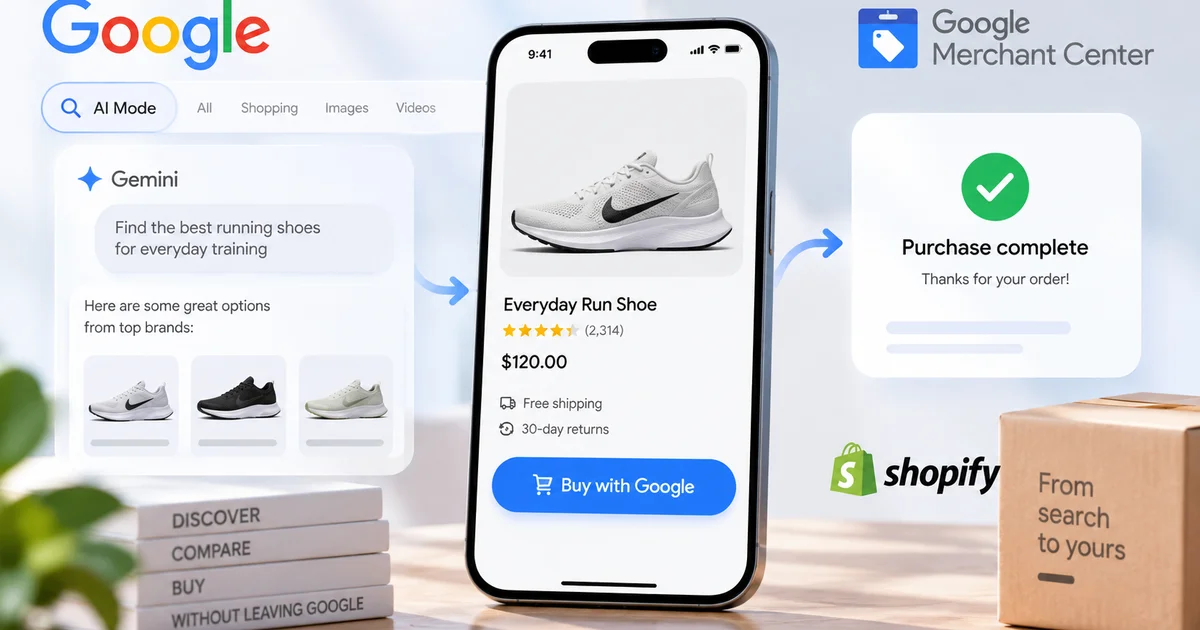
- On September 16, 2026, Google added cart transfer and checkout validation to the UCP integration hub in Merchant Center, and around September 22 it began notifying eligible Shopify merchants that native checkout in AI Mode and Gemini had been turned on by default
- Retailers on their own platforms can now choose between transferring the cart to their site and completing the purchase on Google, while Shopify merchants are enrolled in the latter with no setup. Google's agentic buying path widened again ahead of the holidays
- Google Analytics and custom pixels do not fire in native checkout, and subscriptions and bundles are not supported. Merchants need to decide for themselves whether to keep it on, and close the measurement gap first
Ahead of the Holidays, Google Widened Where Shoppers Can Buy in Two Directions

Help boost holiday sales with agentic commerce updates and product feed best practices from Google.
blog.googleOn September 16, 2026, Ashish Gupta, Google's VP/GM of Merchant Shopping, announced a set of holiday updates for retailers on Google's official blog. One of its pillars is an expansion of the integration hub for the Universal Commerce Protocol (UCP), the open standard that connects AI agents with retailers' systems.
According to the announcement, merchants who use the hub in Merchant Center for UCP-powered checkout can now enable cart transfer to a merchant site and enhanced checkout flow testing, with analytics and more "coming soon." The capabilities are rolling out gradually in the U.S., with Australia and Canada to follow early in 2027. Google also says UCP already enables direct checkout for hundreds of thousands of brands and retailers.
Six days later, a second move surfaced. Search Engine Roundtable reported that Merchant Center had started sending emails saying "your products are now eligible for native checkout." The recipients are merchants whose e-commerce platform has UCP built in, with Shopify as the prime example. The same day, Search Engine Land reported that eligible Shopify merchants are being automatically enrolled in native checkout across AI Mode and Gemini.
Google is giving retailers on their own platforms more choice, while pulling Shopify merchants in by default. The sections below walk through what each change requires and what it sets in motion.
Three Paths in the UCP Integration Hub
The hub lives under "Settings" > "UCP integration" in Merchant Center. What stands out in the developer guide (updated September 16) is that the validation steps change depending on the capabilities a merchant selects. There are three capabilities, and each differs in implementation effort and in where the purchase completes.
| Path (name in the hub) | Where the purchase completes | What the merchant implements | Checks before going live |
|---|---|---|---|
| Transfer to merchant cart | The merchant's own site (the cart built on Google is handed over) | Cart API (Create is required; Get, Update and Cancel are optional) | Matching product ID configuration, cart transfer tests |
| Native checkout on Google | Inside Google's surfaces (the merchant stays the seller) | Three REST endpoints to create, update and complete checkout, plus order status webhooks | Full account configuration, paysheet validation, order status validation, agreement to the UCP Program Addendum |
| Identity linking | Used together with either path above | OAuth 2.0 endpoints and published metadata | Identity linking validation (optional for native checkout) |
Cart transfer is the lightest. The guide states that choosing this path puts merchants on a fast-track validation that does not require full product feed setup, resolving product warnings, or customer support information. All that is needed is the matching product ID configuration between Merchant Center and the merchant site, plus Cart API tests.
Native checkout takes more work. Beyond the three endpoints, merchants set up webhooks that send order status to Google and agree to the UCP Program Addendum. The Google Support team then reviews the integration before it goes live.
The "enhanced testing" is a sandbox. Merchants provide separate API keys for staging and production, register the location of their /.well-known/ucp file (the profile that declares supported capabilities), and can then send cart and checkout requests from the interface to check their server's responses. Production validation requires that the capabilities selected in the hub and those declared in the profile match exactly.
Access is not immediate, though. The help page lays out the order: complete the technical implementation first, submit an interest form, and gain access to the hub once selected. Selection criteria and timelines are not stated.
Cart Transfer Answers Retailers Who Want Shoppers Back on Their Sites
The Cart capability entered the spec as a draft in March and was mentioned at Google Marketing Live in May. It has now become a formal path that merchants can select in Merchant Center validation.
Retailers have been wary of letting purchases finish on Google. Search Engine Journal revisited concerns it reported in January: shoppers never visit the store, never see accessory suggestions, and feel less connected to the brand. The publication frames cart transfer as a response to those concerns. When shoppers arrive at the merchant's own checkout with a filled cart, existing tools such as member sign-in, bundle suggestions and tracking tags keep working as before.
The trade-off is one extra step for the shopper: a site transition. Choosing between cart transfer and native checkout comes down to the information a merchant gains on its own site versus the purchases lost in the transition. Google has not yet published data showing which performs better.
Shopify Merchants Are Switched On Without Doing Anything
For Shopify merchants, this is a question of defaults rather than choice. The email shared by Search Engine Roundtable says the Shopify store was matched to Merchant Center, enabling native checkout, and adds, "There's nothing for you to set up."
Shopify's help center lists the main requirements:
- The store is based in the U.S. and sells to U.S. customers
- A valid Merchant Center account with products available in it
- Terms of service, privacy policy, and return and refund policy completed
According to Shopify, there are no fees for selling through this channel beyond standard payment processing fees. Shopify Functions (custom logic for shipping, discounts and cart validation) and discount codes work in native checkout.
The problem is the length of the list of what does not work. Shopify's help center states that the following are unsupported in native checkout:
- Google Analytics and custom pixels (only server-to-server "started" and "completed" events fire)
- Subscriptions, product bundles, customizable products and B2B-only products
- Local delivery, pickup in store and pickup points
- Requiring customers to sign in before checkout
- Some checkout blocks (upsells, loyalty experiences, consent collection, chat, trust badges and others)
For stores that rely on these, part of their purchases will quietly drop out of their own analytics. Search Engine Land also recommends checking the settings, noting that some merchants may find native checkout enabled without having activated it themselves.
Turning it off is quick. In the Shopify admin, go to Sales channels > Agentic and deactivate "Allow Shopify to manage for me." Then click "Google AI Mode and Gemini," deactivate "Direct checkout," and save. Products remain discoverable in AI Mode and Gemini, and shoppers are redirected to the merchant's site only at the point of purchase. Both Google and Shopify say merchants retain ownership of customer relationships, data and sales.
Measurement Now Comes in Two Layers
Measurement in Merchant Center has split into two tools, depending on the stage being observed.
The first is AI performance insights, now generally available in five countries including the U.S. It shows share of voice (visibility relative to other brands) in AI Mode and AI Overviews, but according to Search Engine Journal it covers only English-language queries and organic traffic, and has no click metric.
The second is the UCP analytics dashboard in the hub's "Analytics" tab. The developer documentation lists metrics such as Clicks to Buy, purchases, purchase rate, average order value and cancellations. The documentation says it is available to all UCP-enabled merchants, while the official blog calls analytics "coming soon," a discrepancy Search Engine Journal pointed out.
Visibility and purchase metrics sit in separate places within Merchant Center, and native checkout purchases do not flow into a merchant's own Google Analytics. Connecting AI-driven sales to internal numbers is still the merchant's job.
The Tapestry Case, and What the Numbers Do Not Say
The adopter Google highlighted is Tapestry, parent of Coach and Kate Spade. According to Chain Store Age, the company integrated UCP-powered checkout and made select products from both brands purchasable directly in Search (including AI Mode) and the Gemini app. A separate Chain Store Age article describes a "Buy" button appearing inline in AI responses, with checkout completed in a few taps using Google Pay.
Google also says merchants adopting core Merchant Center feed best practices see an average 5% increase in conversions the following month.
That is Google's own figure, however. Neither the breakdown of the "hundreds of thousands of brands and retailers" nor the number or value of purchases made through UCP has been disclosed. Search Engine Land cautions that the holiday season will test whether conversational commerce can move shoppers from discovery to checkout, and whether retailers see enough incremental sales to justify further investment. PYMNTS Intelligence research cited by PYMNTS likewise finds that only 24% of consumers would let an AI agent shop and buy for them, and 14% would let an AI app hold their card.
What Has Not Been Disclosed
Cross-checking the official blog, help pages and developer documentation, the following remain unstated:
- Selection criteria for the UCP integration hub and the time from interest form to access: undisclosed
- Actual purchase volume, revenue, and a comparison of purchase rates between native checkout and cart transfer: undisclosed
- Availability of the analytics dashboard: the blog says "coming soon" while the documentation says "available"
- Plans for markets beyond the U.S., Australia and Canada, including Japan: undisclosed
- Detailed allocation of responsibility for returns and chargebacks in native checkout: undisclosed (only that the merchant remains the seller of record)
What Merchants Should Check Now
Merchants selling to U.S. customers on Shopify should first open the Agentic settings in their admin and confirm whether direct checkout for Google AI Mode and Gemini is on. If they keep it on, they need to decide how to count purchases that never reach GA4, and confirm that their return policy matches what is in Merchant Center.
For merchants on their own platforms, the question is which path to start with. Cart transfer has lighter validation and preserves the assets of an existing checkout, which makes it a realistic first step. Both paths go through an interest form and selection, so whether they are ready for the holidays depends on how early they move.
Merchants in Japan are not covered for now, but the underlying shift is the same: Merchant Center product data has become the entry point not only for being found but for being bought. Consistent product IDs and well-maintained return policies are preparations that can start before availability expands.
Conclusion
Google's latest expansion moves UCP from a question of whether to use it to a question of which path to use. Retailers on their own platforms can now choose between cart transfer and native checkout, while Shopify merchants are placed in the latter by default.
The next thing to watch is whether, once the holiday season ends, Google publishes results for native checkout and cart transfer. The actual availability of the analytics dashboard and the timing of expansion beyond the U.S. will also shape merchants' decisions.