Shop Pay and PayPal Join Meta's Muse Checkout as Amazon Blocks the Agent: Agentic Payments Split Into Partnered Rails and Unannounced Browsing
Shopify's Shop Pay and PayPal now power checkout in Meta's Muse AI agent, while Amazon has blocked Muse for shopping without permission. What Shopify merchants need to check, the measurement gaps, and where Amazon's argument holds and falls short.

Key Takeaways
- On September 21, Shopify announced agentic checkout with Shop Pay for Meta's personal AI agent Muse across all Shopify stores, and on September 22 PayPal said its customers can use Muse to shop and check out across PayPal merchants
- The same week, Amazon blocked Muse, saying the agent browses its site without identifying itself and stores customer credentials. Buying through payment rails that stores have agreed to and shopping by browser without consent have clearly split into two paths
- For Shopify merchants, product sharing with Meta and direct checkout are on by default. Merchants now need to understand that pixels do not fire and some products are unsupported, and decide which path they will use to accept AI agents
Three Payment Rails Connected to Muse Within Two Weeks of Launch
Meta has partnered with Shopify to integrate Shop Pay agentic checkout into its Muse AI assistant, expanding AI-driven commerce features.
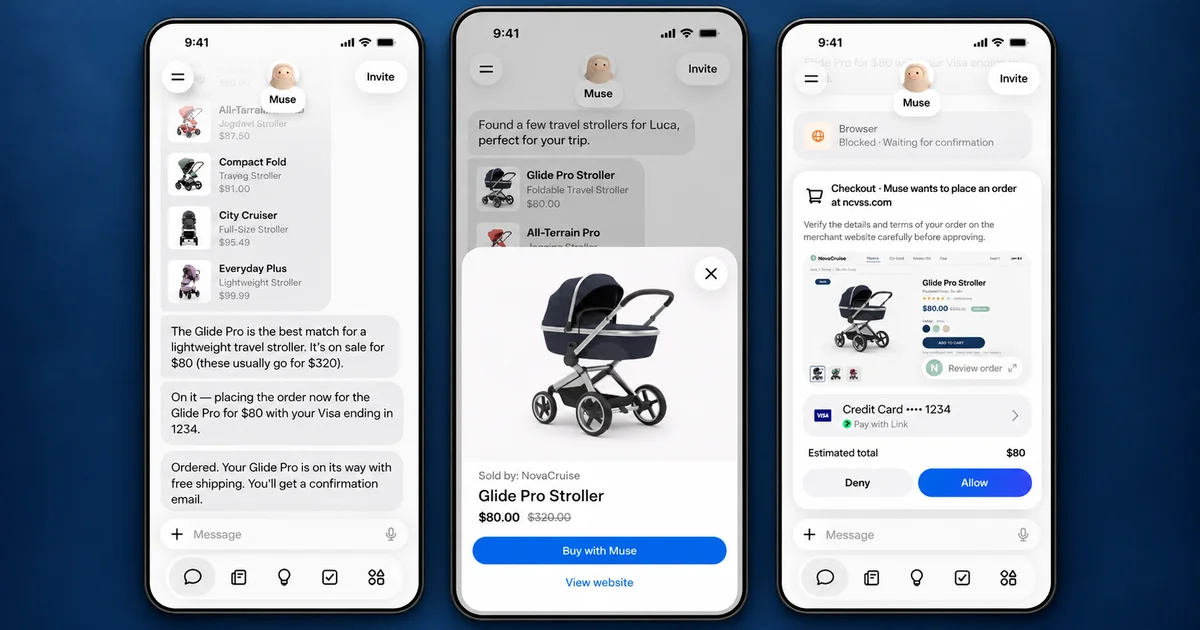
thepaypers.comMeta launched Muse on September 8, 2026. It is a personal AI agent that carries out multi-step tasks such as filling out forms and shopping on a user's behalf, and it runs on the Muse Spark model. It is available in the US through its apps, the web and WhatsApp, and is free for most uses.
At launch, the payment method was Stripe's Link wallet. According to Stripe's announcement, Muse can check out instantly with a saved payment method at more than 1 million businesses that accept Link, and at other stores Link issues a single-use virtual card scoped to the approved purchase. Users approve the total in the chat, and Muse never sees the underlying card details. Meta also said at the time that Shop Pay support was coming.
That promise materialized on September 21, US time. Shopify CEO Tobi Lütke posted on X that Shopify is partnering deeply with Muse to enable agentic checkout with Shop Pay on all Shopify stores. About four hours later, Mark Zuckerberg posted "More partnerships like this coming soon," and on September 22 PayPal followed, saying it would let PayPal customers shop and check out with Muse across PayPal merchants worldwide. On the evening of the 22nd, grocery delivery company Instacart was also reported to have launched a Muse connector.
Laid side by side, the paths show that "buying with Muse" reaches the store in very different ways.
| Path | Which stores | How it reaches the store | Merchant control |
|---|---|---|---|
| Link (Stripe, since launch on Sept. 8) | More than 1 million businesses that accept Link. For other stores, Link issues a single-use virtual card | Arrives as a Link payment at Link merchants and as an ordinary card payment elsewhere. Link purchase protections apply | Link merchants have already accepted Link as a payment method. No separate mechanism for non-Link stores has been disclosed |
| Shop Pay (Shopify, announced Sept. 21) | All Shopify stores. Meta's direct checkout is shown to customers in the US, Canada and Mexico | Orders come through a Shopify sales channel, are attributed to Meta and appear in the Shopify admin. The merchant stays merchant of record | On by default. Catalog sharing and direct checkout can each be switched off in the admin |
| PayPal (announced Sept. 22) | PayPal's post says 'PayPal merchants worldwide' | The integration method has not been disclosed | Not disclosed |
| Browser operation (no API, no partnership) | Services without a public API. Meta says Muse can use them 'through a browser the way you would' | Hard for the store to identify as an agent. This is the path Amazon blocked | Does not assume merchant consent. Stores can refuse mainly through terms and detection |
The last row is at the center of the dispute. In its launch materials, Meta explained that Muse connects to services with a public API using credentials the user provides, and that when there is no API, it "can use the service through a browser the way you would" (GeekWire). The design still lets Muse reach stores it has no partnership with.
What Changed in the Shopify Admin
For merchants, the most practical question is what happens on the Shopify side. According to the Shopify Help Center, Meta is one of the AI channels inside Agentic Storefronts, Shopify's sales channel for AI surfaces, managed in the same admin section (Sales channels > Agentic) as ChatGPT, Google AI Mode and Microsoft Copilot. Products reach Meta through Shopify Catalog, and merchants do not need to do anything for their products to be discoverable. Since the day Muse launched, stores with products in Catalog that ship to the US have been included (Naughton & Bird's explainer).
Direct checkout, which lets customers finish a purchase without leaving Meta, is also on by default for eligible stores. The Help Center lists these requirements and conditions:
- The store must sell to customers in the United States, Canada or Mexico. Direct checkout is shown only to customers in those three countries
- Orders are attributed to Meta and appear in the Shopify admin like orders from any other sales channel. The merchant remains merchant of record and continues to handle fulfillment, returns and customer service
- There are no fees for selling through direct checkout beyond standard payment processing fees
- Terms of service, privacy policy and return and refund policy must be set, and the merchant must agree to the Agentic Storefronts Supplemental Terms of Service
The unsupported features are easy to miss. Subscriptions, product bundles, customizable products and B2B-only products cannot be sold through direct checkout. Local delivery and pickup in store are not available, and checkout blocks are not supported. On top of that, Google Analytics and custom pixels do not fire, and only server-to-server events (started and completed) are sent. Stores that measure ad performance with browser pixels will find sales from Muse harder to see.
Shopify Functions for shipping and discount logic, along with discount codes, do work. To opt out, merchants turn off "Allow Shopify to manage for me," then switch off Catalog access or direct checkout individually under Meta. Shopify notes, however, that even with Catalog access off, Meta may still reference products through web crawling.
Shopify's eagerness reflects scale: Shop Pay passed $400 billion in lifetime accelerated gross merchandise volume in June. CFO Jeff Hoffmeister has also said shoppers who start in an LLM show roughly an 80% uplift in conversion, though the methodology has not been shared (PYMNTS).
Amazon's Objection Is Not That Muse Is an Agent
Amazon went the other way. According to GeekWire, starting on the evening of September 20, US time, people trying to shop on Amazon.com with Muse began seeing a popup: "Continued access by an unauthorized AI agent violates Amazon's Conditions of Use, to which our customers have agreed." Amazon had asked Meta to exclude it from Muse, and Meta reportedly declined.
Amazon's complaints come down to three points. It was not told in advance that Muse would access its store, the agent does not identify itself when it browses, and it appears to capture and store customer credentials. A spokesperson said third-party applications that make purchases on behalf of customers should operate openly and respect service provider decisions about whether or not to participate (Retail Dive).
Meta's own account differs. Muse runs on a dedicated virtual machine called Muse Secure VM, and everything Muse sends to the internet must be approved by a separate agent called Sentinel. Muse has no visibility into passwords or payment methods, and credentials a user shares go into secure storage so that Muse can use them without seeing them, Meta says. The real issue, then, is less whether data leaks and more whether the store can identify the visitor as an agent and whether it has consented to that access.
The legal context matters too. Amazon won a preliminary injunction against Perplexity's Comet AI browser in March, but the Ninth Circuit vacated it on August 4, ruling that under federal anti-hacking law the user, not the AI company, is the one accessing Amazon's computers. A petition for rehearing was denied on September 10. The Next Web noted that the popup Muse users see cites the Conditions of Use rather than hacking. Amazon added an Agent Terms section to those conditions on May 30, 2025, requiring agents to identify themselves in the user-agent string as "Agent/[agent name]". With the anti-hacking route weakened, contracts and terms have become the main battleground.
The business motive is also clear. Amazon generated more than $68 billion in ad revenue last year, according to GeekWire, a business that depends on shoppers viewing pages and seeing sponsored products. An agent that skips the pages hits that revenue directly. Amazon says it is in direct conversation with Meta and declined to comment on possible legal action.
Questions About Amazon's Argument
Amazon's "consent first" position has weak spots, though. Its own agent feature, Buy for Me, completes purchases of products from outside businesses, and according to Retail Dive, listings are pulled in without express permission and businesses must email Amazon to opt out after the fact. TheStreet, citing CNBC's report that more than 180 sellers objected to unauthorized listings in January 2026, pointed out that this is the opposite of the ask-first rule Amazon now wants from Meta (TheStreet). Amazon counters that Buy for Me identifies itself and lets brands opt out, which it says sets it apart from Muse.
Matthew Hassett, CEO of smart alarm clock brand Loftie, which sells on Amazon, told CNBC that "respect service provider decisions" is the polite version of "not on our shelf." In practice, a block justified by security and a defense of the customer relationship are hard to separate.
Markets Rewarded the Open Door, but Revenue Is Not Yet Visible
Investors reacted decisively. Shopify shares closed up 7.3% at $137.92 on September 21 (TheStreet), and according to Reuters, they were up 11.4% for the week as of the 23rd. The same report said Muse recorded 2.8 million downloads in its first two weeks, according to Sensor Tower.
None of the partnerships have disclosed financial terms, however. The Paypers also notes there is no disclosed timeline for when Shop Pay's agentic checkout will reach all Muse users. As TheStreet put it, the rally is pricing a channel that has not yet produced revenue. On the consumer side, University of Pennsylvania professor emeritus Joseph Turow told CNBC that people are going to be very wary.
Merchants Decide Which Door Agents Come Through
There are at least two ways to accept AI agents. One welcomes agents through rails agreed with payment providers or platforms, in a form where the store knows whose order it is. The other lets agents come in through a browser the way a human would. In the second case, the store either does not notice or can only refuse through terms and detection.
For Shopify merchants, the first door is already open. Start by checking the Meta settings in the Agentic section of the admin. If you keep direct checkout on, rework ad measurement on the assumption that pixels will not fire, identify unsupported product types, and keep policies and product data current. Stores outside Shopify can also receive Muse orders if they accept Link or PayPal.
If you do not want browser-based agents on your site, the starting point is to require agents to identify themselves in your terms, as Amazon does, and set a policy for unidentified access. If you welcome agents, partnered paths make order attribution and customer data handling clearer. Note that Muse is currently offered in the US, and no timeline for Japan has been disclosed.
Conclusion
Within two weeks of launch, Muse gained three payment rails and was shut out of Amazon at the same time. The things to watch now are which retailers and payment companies join the "more partnerships" Zuckerberg promised, how Meta responds to Amazon's request to be excluded, and whether Amazon makes its next move on the basis of its terms. The question for merchants is no longer whether to sell to agents, but through which path and on what terms.