Estée Lauder Partners with Rezolve Ai to Roll Out Agentic Commerce Across 70 EMEA Markets
The Estée Lauder Cos. taps Rezolve Ai's Brain Suite to power AI-driven search and discovery across Clinique, MAC, Tom Ford and other brand sites in 70 EMEA markets — a brand-led counterpoint to retailer-led plays like Ulta x Google Gemini.

Key Takeaways
- The Estée Lauder Companies (ELC) used Shoptalk 2026 to announce a partnership with AI start-up Rezolve Ai, deploying Rezolve's Brain Suite to power AI-driven search, discovery and automated merchandising across 70 EMEA markets and brand sites including Clinique, MAC, Bobbi Brown and Tom Ford.
- While the headline reads as another beauty x AI x agentic commerce story, the strategic vector contrasts sharply with the Ulta x Google Gemini move announced four days earlier. Ulta went outward to external AI surfaces; ELC is rebuilding the discovery experience inward, on its own brand sites — a brand-led architecture rather than a retailer-led one.
- Rezolve Ai's Brain Suite, built on its commerce-tuned brainpowa LLM, is already in production with Adidas, Burberry, H&M, Sephora, Asos and Target. For Japanese beauty manufacturers and brand operators, the question now becomes a binary executive call: deepen owned D2C with brand-led AI, or board the platforms — and most multi-brand groups still lack the foundation to even compare the two.
ELC x Rezolve Ai Marks a Brand-Led Take on Agentic Commerce

The beauty company is partnering with AI start-up Rezolve Ai to power AI-driven search and discovery across 70 markets in EMEA.
www.msn.comThe Estée Lauder Companies (ELC), one of the largest prestige beauty groups in the world, used the Shoptalk 2026 stage to make a consequential call. ELC will deploy AI start-up Rezolve Ai's Brain Suite across 70 EMEA markets and across the digital ecosystems of its brand portfolio — including Estée Lauder itself, Clinique, Bobbi Brown, MAC and Tom Ford.
Rezolve Ai is a NASDAQ-listed AI infrastructure company whose customer roster already includes Adidas, Burberry, H&M, Sephora, Target and Asos. ELC now joins that list as a flagship reference on the brand-manufacturer side. Per WWD's reporting, the partnership replaces manual product ranking, category curation and search optimization with AI-driven automation, with the goal of running real-time personalized discovery experiences in 70 markets at once.
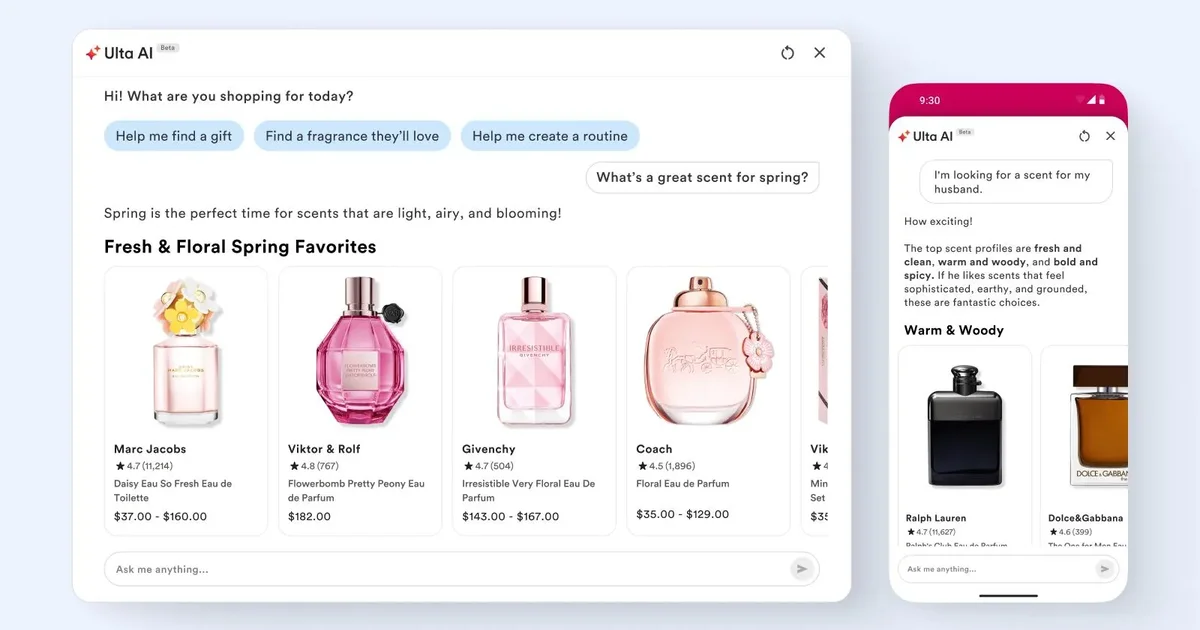
What is easy to miss is the strategic vector contrast with Ulta Beauty's Gemini partnership announced four days earlier (April 23). Ulta moved on two fronts: an owned Ulta AI assistant, plus catalog exposure on Google Search and the Gemini app. ELC is doing the opposite — staying inside brand-owned channels and rebuilding search and discovery internally with AI. Same headline category — beauty x agentic commerce — but the underlying design philosophy on who keeps the primary customer relationship is almost mirror-opposite.
What Rezolve Ai's Brain Suite Actually Is
To read the partnership properly, the Brain Suite itself needs unpacking. At Shoptalk 2026, Rezolve CEO Daniel Wagner framed it bluntly: "AI has learned to converse; now it must learn to convert." Brain Suite is the platform engineered to support that translation.
| Component | Function | Likely use at ELC |
|---|---|---|
| Brain Commerce | AI-native search, conversational discovery, recommendations | Replace traditional product search and category browsing |
| brainpowa LLM | Commerce-tuned proprietary LLM | Handle ingredient, formulation and skin-concern queries in beauty |
| Automated merchandising | AI-driven product ranking and curation | Cut manual merchandising work across 70 EMEA markets |
| Brain Checkout | Conversational checkout and fulfillment | Future expansion (current focus is search and discovery) |
At its core sits brainpowa, a proprietary commerce-tuned LLM. Unlike general-purpose ChatGPT or Gemini, brainpowa is fine-tuned around commerce context — product attributes, inventory, pricing, purchase intent — and was made available on Microsoft Foundry in April 2026. Layered above are Brain Commerce, which handles discovery, search, recommendations, SEO and merchandising, and Brain Checkout, which covers conversational transactions.
Rezolve's published case studies are concrete. Eyewear retailer Eyebuydirect saw 29x ROI from AI-powered visual recommendations. UK furniture retailer DFS lifted conversion 10%. India's Myntra grew visual-search adoption 35% year-on-year. Luxury resale platform Rebag reported a 50% jump in search-driven revenue and a 24% increase in purchases.
ELC's quoted comment came from Omer Iqbal, Senior Vice President of Omnichannel and Consumer Technology: "Rezolve's solution has helped ELC enhance merchandising efficiency and automate advanced ranking capabilities, enabling us to scale search and discovery experiences across 70 EMEA markets, ultimately improving operational efficiency for our brand e-commerce teams." Stripped of press-release polish, the underlying claim is that the cost and speed bottleneck of having country-by-country teams individually tune 70 sites can now be solved by a shared AI substrate.
Why EMEA, and How It Connects to "One ELC"
The framing — EMEA, 70 markets — is not arbitrary. On April 1, 2026, ELC announced that its "One ELC" operating model had reached the milestone phase. The program consolidates regionally fragmented media buying, digital operations and supply chain into a unified, data-and-AI-driven global system.
A symbolic move came in October 2025, when ELC announced it was standardizing its global D2C foundation on Shopify, retiring the patchwork of brand-specific commerce stacks. The Rezolve partnership now extends that same logic upward: a shared discovery, search and personalization layer riding on top of the unified commerce platform.
EMEA is the messiest theater in ELC's footprint. The UK, France, Germany, Italy and Spain anchor the region, but tax regimes, languages and distribution conventions vary enormously across the Nordics, Eastern Europe, the Middle East and Africa. The "70 markets" number captures that complexity — and signals ELC's deliberate decision to give up local hand-tuning in favor of AI-driven automation at scale. Crispin Lowery, Rezolve Ai's Chief Revenue Officer, framed the same point: "By deploying a scalable, platform-based approach to search and discovery, ELC is moving faster across markets and brands while improving relevance and materially reducing operational complexity."
ELC has been an active AI partner for years — Microsoft (Copilot, Azure OpenAI), Google Cloud (Vertex AI, BigQuery), Adobe (Firefly), OpenAI (ChatGPT Enterprise with 240+ custom GPTs). Almost all of those investments, however, sat in marketing content production, trend forecasting and internal productivity. The Rezolve partnership is the first time ELC has put AI directly into the commerce surfaces consumers actually touch. That qualitative shift is what makes this announcement a phase change rather than an incremental rollout.
Brand-Led vs Retailer-Led: Two Templates for Agentic Commerce
Set against the Ulta x Google move four days earlier, the structural difference becomes hard to miss.
| Dimension | Estée Lauder x Rezolve (brand-led) | Ulta x Google Gemini (retailer-led) |
|---|---|---|
| Starting point | Upgrade search and discovery on owned brand sites | Owned AI assistant plus catalog exposure on external AI surfaces |
| AI substrate | Rezolve Ai Brain Suite (brainpowa LLM) | Google Gemini Enterprise CX plus Universal Commerce Protocol |
| Scope | ELC's brand-owned e-commerce (Clinique, MAC, Tom Ford, etc.) | 1,500 stores, 30,000 SKUs, ~600 brands as one catalog |
| Discovery control | Stays inside brand sites, fully owned | Reaches outside via Google Search, AI Mode, Gemini app |
| Customer relationship | Held directly by the brand (D2C model) | Shared between retailer and AI platform |
Ulta is a retailer with 1,500 stores and 46 million loyalty members. It moved on its own site and on Google's external surfaces simultaneously, using the Universal Commerce Protocol (UCP) to push its catalog into Search and the Gemini app. The strategic logic is reach-driven. Of the ~140 million U.S. beauty enthusiasts Ulta targets, only 46 million are inside its loyalty program; the remaining ~100 million can only be reached cost-efficiently through borrowed discovery surfaces.
ELC is taking the inverse approach. Customers of Clinique, La Mer or MAC already navigate directly to brand sites. ELC's investment is concentrated on raising the probability that those existing visitors find the right product, by adding Rezolve's search and recommendations engine inside the owned experience. ELC has not declared external AI surfaces off-limits, but the priority order clearly puts owned D2C experience quality at the top.
Several forces drive this call. Prestige beauty is a category where brand equity carries a large share of perceived product value. Handing those products to price-comparison engines or generic shopping agents strips out the brand story and ingredient narrative, exposing them to commoditization. The same logic that kept LVMH off wholesale Amazon for years applies again in the agent era.
Data sovereignty is the other axis. ELC has integrated its data into Google Cloud's Vertex AI for years, but that is back-end analytics. The Rezolve choice signals that front-end signals — conversation logs, expressed intent, recommendation outputs — are something ELC wants to keep inside its own CDP, not hand over to a third-party AI platform that also serves retailers and competitors.
Risks and Underrated Watch-Items
The strategy is internally coherent, but it carries real risks.
The first is that absence on external AI surfaces becomes a customer-acquisition tax. Bain's Consumer Lab finds 30% to 45% of U.S. consumers are already using ChatGPT, Perplexity or Gemini for product research. If ELC brands cannot be bought from inside those conversations, the discovery moment for younger and net-new shoppers leaks elsewhere. ELC and Ulta are betting on opposite sides of the same dial; how fast the AI-mediated discovery share grows will decide which call ages better.
The second is the operational difficulty hidden in "70 markets." Rezolve provides a strong engine, but tuning it for local language patterns, skin type distributions, seasonality and regulation (EU cosmetics rules, country-level cookie regimes) cannot be outsourced wholesale. Whether ELC's omnichannel and consumer-tech function can run a continuous-learning loop with each local brand team will determine whether the rollout actually delivers the promised efficiency.
The third is Rezolve's own moving strategy. In 2026 alone, the company acquired Smartpay (gaining a payments rail), launched brainpowa on Microsoft Foundry and went directly to Commerce.com shareholders with an acquisition proposal. If Rezolve evolves from a "AI inside the brand" partner into a competing agentic commerce platform that goes head-to-head with Google, ELC's status as a privileged early customer depends on the contract structure.
The flip side is upside. Rezolve's other clients — Adidas, Burberry, H&M, Sephora — are exactly the kind of cross-category benchmark set that makes commerce-specific continuous learning compounding. The more brands feed the model, the better the model gets at commerce-native tasks general LLMs cannot match. Sitting inside that ecosystem is a long-horizon technical hedge for ELC.
Implications for Japanese Brand Manufacturers and Beauty E-Commerce
This is where the news lands operationally for Japanese brand operators, beauty manufacturers and retail-DX leaders. The ELC x Rezolve move is becoming a workable template for any business whose product economics depend on brand equity.
Three implementation questions follow. First, how far to push AI into owned-site search and recommendations. Most Japanese brand sites still rely on basic keyword search and category trees, with weak product-to-product navigation. Layering in conversational discovery, ingredient-based natural-language search or AI-driven ranking can move AOV and conversion by double-digit percentages. Rezolve, Bloomreach, Algolia AI, constructor.io and the in-house Rakuten RMS stack are all real options.
Second, whether to refuse external AI surface exposure across the board. ELC's "protect brand world-view" stance is defensible for prestige labels, but it does not generalize to mass brands or low-awareness D2C labels that need new-customer acquisition. The decision to appear inside ChatGPT, Perplexity, Gemini or Copilot shopping surfaces should be made brand-by-brand, indexed to brand positioning.
Third, whether the company can run a "One Group" platform strategy at all. For multi-brand Japanese cosmetic groups — Shiseido, Kose, Pola Orbis — ELC's "One ELC" is the directly comparable reference. Without consolidated commerce, AI and CDP foundations across brands, the economics of a shared AI engine like Rezolve cannot even be evaluated. The infrastructure conversation has to come first.
Wrap-Up
The ELC x Rezolve Ai partnership makes one thing clear: agentic commerce is not only a competition for placement on external AI surfaces. Rebuilding owned discovery and purchase experiences from the inside is a legitimate, distinct answer. The fact that Ulta announced its outward retailer-led play on April 23 and ELC announced its inward brand-led play on April 27 should be read as the moment the two paths separated visibly, not as coincidence.
Watch what happens next: how ELC's choice flows into earnings, whether Sephora (LVMH) and L'Oreal lean Ulta-style or ELC-style, and which Japanese players go which way. In Japan, what Shiseido and Kose decide will likely set the standard for beauty e-commerce as a whole. The window to choose — brand-led inward or retailer-and-platform-led outward — is closing well before generative-AI-mediated discovery crosses the 10% mark.