Glovo Opens Product Discovery to ChatGPT and Claude but Keeps Checkout In-House
Glovo has opened quick-commerce product discovery to both ChatGPT and Claude while keeping payment inside its own app. Why that boundary was drawn, how it differs from ACP-based in-chat checkout, and what e-commerce operators should prepare now.


Key Takeaways
- Glovo has released a Shopping Assistant that lets users browse its inventory conversationally from both ChatGPT and Claude. Type "@Glovo" with your requirements and you get back up to five products actually purchasable from nearby stores.
- The defining choice is that payment was never handed to the agent surface. Discovery and comparison happen in ChatGPT and Claude, while payment and order confirmation stay in the Glovo app, the exact opposite of the Instacart model that closes the sale inside ChatGPT.
- That design lines up with what consumer research actually shows. Demand for letting AI narrow the options is real, but willingness to let AI make the purchase decision still barely clears one in ten.
Type "@Glovo" and the local shelf comes back five items deep

Glovo, a leading multi-category tech company, today announced its integration into the generative AI ecosystem with the launch of its 'Shopping Assistant' for ChatGPT and Claude. Users can now discover retail products, compare prices, and seamlessly order any item using natural conversational language with the AI systems.
techcabal.com"A last-minute gift for a coffee lover under 50 euros." Typing that sentence and getting an answer is the shortest possible description of what launched here. Opening the app, picking a category, applying filters, re-sorting: that entire sequence collapses into a single request.
Founded in Barcelona in 2015, Glovo runs an on-demand delivery platform across 22 markets in Europe, Central Asia and Africa. The Shopping Assistant it has now released is an integration that exposes its catalogue to search from both ChatGPT and Claude. Once a user connects the plug-in and writes "@Glovo" followed by a request, the AI side handles semantic search, location validation and product curation.
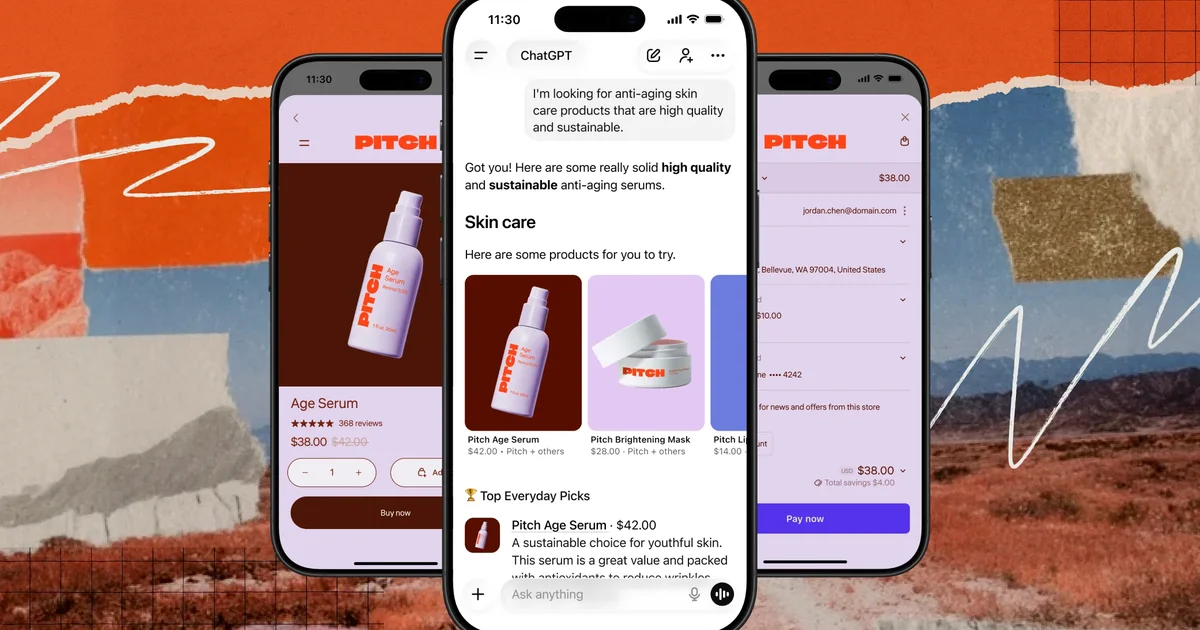
What comes back is a carousel of up to five items. Each card carries the product image, name, store, user rating, price and availability. The conversation continues and remembers earlier turns, so follow-ups like "something cheaper" or "drop that one" work as expected. Constraints such as a budget ceiling are held across the exchange.
We are always looking for new ways to be closer to users and accessible through the channels they already use. Thanks to our presence on Claude and ChatGPT, people can now explore Glovo's offering in a completely natural and simple way.
One caveat on the timeline. This was not a single global launch. It was announced in Spain on 28 May 2026, reached Kenyan newsrooms on 13 July, and was carried by Nigeria's TechCabal on 30 July. The same release has rolled out market by market on a delay, with the example currency swapped to match each country. The accurate reading is that the feature has been live for two months.
Discovery goes out, payment does not
This is the part that matters most.
Every product in the carousel carries a "View on Glovo" button. Pressing it moves the user to the Glovo mobile app or website, where payment and order confirmation are completed exclusively. No transaction happens inside the conversation. What went out to the agent surface was discovery and comparison only, while the transaction stayed firmly in-house.
The significance of that boundary becomes clear in comparison. For grocery shopping on the same ChatGPT surface, Instacart got there first with an app that closes the purchase inside the conversation. That implementation uses the Agentic Commerce Protocol (ACP), co-developed by OpenAI and Stripe, to take the shopper from cart assembly through payment without ever leaving the chat. Two takes on "buying groceries with AI", with the boundary drawn in opposite places.
| Glovo (discovery only) | Instacart (checkout completed in chat) | |
|---|---|---|
| AI surfaces supported | Both ChatGPT and Claude | ChatGPT |
| What happens inside the conversation | Semantic search, price and stock comparison, up to five suggestions | Everything from cart assembly through payment |
| Where payment sits | Glovo mobile app or web, outside the conversation | Inside the conversation, using ACP and Stripe payments |
| Main advantage | Customer relationship, order data and experience design stay in-house | No hand-off screen, so fewer drop-offs before the order |
| Main cost | The app hand-off remains a drop-off point | Discovery and checkout both depend on a single AI surface |
Exposing discovery alone has clear upside. As long as the payment screen stays in-house, card details, order history and purchase data accumulate in-house too. Coupons, subscriptions, delivery time slots and substitution logic all remain tunable within an owned UI. It also keeps a comfortable distance from the fee conversation. Whether any revenue share or fee arrangement exists between Glovo and OpenAI or Anthropic was not disclosed in this announcement.
There is a cost. The jump from conversation to owned app is itself a drop-off point. The moment a competitor that closes the sale in-chat appears on the same shelf, what gets compared is not the product but the number of steps. Quick commerce sells delivery in minutes, so added friction before the order is precisely the compromise the category should least want to make.
The design still makes sense because of what is being sold. Delivery address, time window, drop-off instructions, substitution preferences when an item is out of stock, tips, live tracking. Confirming a quick-commerce order carries several times more conditions than selecting the product. Rather than cramming all of that into a chat carousel, sending confirmation back to a purpose-built app is, at least for now, the lower-risk call.
Shipping on ChatGPT and Claude at the same time
It is easy to overlook, but supporting both surfaces at once is still unusual.
Retail and grocery integrations in the US are overwhelmingly ChatGPT-only, and the implementation formats differ by surface. On Claude the integration ships as a connector, built on Anthropic's Model Context Protocol (MCP), the standard mechanism for calling external services from a conversation. On ChatGPT it appears in the apps directory. Glovo chose to expose the same catalogue across two surfaces with different specifications.
The motivation is presumably diversification. When the entry point for product discovery consolidates onto one assistant, the business becomes subordinate to that surface's ranking rules and fee structure. Being present on two is insurance against single-surface dependency.
Announcement and actual availability do not match, however. Tech-ish, which tested it hands-on in Kenya, reported that adding the connector on Claude did pull real products from stores near Nairobi, while Glovo could not be found in the ChatGPT apps directory. Whether the carousel renders on a free plan was also left unverified. The "both platforms" line in the press release describes a state that varies by market and by surface.
Tailwinds in the data, and the reservations that remain
The numbers explain why Glovo moved.
Adobe Analytics recorded a 393% year-on-year increase in AI-assistant-referred traffic to US retail sites in the first quarter of 2026. The shift in quality matters more. Per the same data as reported by TechCrunch, as of March 2026 visitors arriving via AI converted 42% better than other channels and generated 37% more revenue per visit. A year earlier AI traffic converted 38% worse, so the positions flipped in a short window.
Applying those figures directly to Glovo would be premature. Adobe's data covers US retail, and in the same March category breakdown grocery was among the weaker segments for AI-referred traffic. Retail and grocery, the categories Glovo chose to start with, are not clearly where the tailwind blows hardest.
Consumer attitudes carry a more direct reservation. In a Gartner survey of 322 US consumers in January 2026, willingness to let AI make purchase decisions topped out at 11% even in low-stakes categories such as household supplies. Willingness to let AI narrow the choices, by contrast, reached 31%. In a separate Gartner survey of 846 consumers in late 2025, 54% of those who used AI while shopping said they had to double-check all the information provided, and 62% said it ended up wasting their time.
Gartner's analyst frames the demand as being for better information rather than outsourced judgement. Read plainly, that puts Glovo's boundary closer to reality than not. Let AI narrow it down, keep the deciding for yourself. The feature boundary has simply been aligned to that line.
How to earn one of only five slots
For e-commerce operators, this is where the practical question starts.
In-app search returns a long scrollable list. A conversational answer returns five items. That gap amounts to the same thing as physically shrinking the shelf. Tech-ish notes that Glovo Kenya carries roughly 6,000 merchants, and the rules governing those five slots have not been published. Visibility collapses by an order of magnitude while the criteria driving it stay undisclosed. For sellers, that is a structural change worth taking seriously.
So what drives selection? Working backwards from the implementation, the answer reduces to the quality of structured data. What sits on a single carousel card is the image, product name, store, rating, price and stock. Behind it run semantic search and location validation. Connecting a vague request like "for a coffee lover, under 50 euros" to specific inventory requires price and stock to be machine-readable in real time, with attributes organised at a granularity that survives semantic search.
Glovo can do this because it is a marketplace holding store-level inventory. Turn that around and it becomes the weak point for most e-commerce operators. Product pages are written for humans, stock and price cannot be pulled instantly via API, and review scores are not structured. Preparing for handover to agents has to be redesigned deliberately, as agent-ready product data.
The unavoidable business question is whether to draw the same line Glovo drew. Expose discovery alone, or put checkout on the agent surface too. The former protects the customer relationship and the data at the price of accepting drop-off; the latter removes friction at the price of lending part of payment and the customer touchpoint to the surface. Which is right varies by category and order value. Goods with many order-time conditions, such as fresh food and daily essentials, lean toward the former; goods with clear pricing and few conditions lean toward the latter.
Finally, there is the legal and data-governance thread. Connecting an account means location, search history and potentially order history get processed on the AI provider's infrastructure. The lawful basis for cross-border transfer, and the disclosure owed to users, need to be worked out separately from how appealing the feature is.
Conclusion
The line Glovo drew captures the realistic landing point for conversational commerce as of 2026. Let AI search, let people decide, keep payment in-house. It maps almost exactly onto the tolerance that consumer research describes.
What to watch is how long that line holds. Once checkout-complete experiences become the norm on ChatGPT, how often will a design with a hand-off screen keep getting chosen? And will the rules behind those five slots ever be published, or quietly harden into a fait accompli? Preparing for a smaller shelf is something that starts too late if it waits for the announcement.