Google Unveils UCP (Universal Commerce Protocol) Design at Open Source Summit 2026: Open Rails for Agentic Commerce Linking AP2, A2A and MCP
At Open Source Summit North America 2026, Google walked through the architecture of UCP. A guide for e-commerce operators to its co-development with Shopify, how it relates to AP2, A2A and MCP, and how it differs from OpenAI and Stripe's ACP.

Key Takeaways
- At Open Source Summit North America in June 2026, Google walked through the architecture of UCP (Universal Commerce Protocol), an open standard that lets AI agents transact with any merchant.
- UCP was co-built with Shopify and is designed as a layer that pairs with AP2 for payments and A2A or MCP for transport, with platform-agnostic interoperability at its core.
- Where OpenAI and Stripe's ACP delegates to a platform, UCP is decentralized and keeps merchants in control on their own domain. E-commerce operators are now at the point of planning for both.
A common language for commerce, shown on an open source stage

Universal Commerce Protocol (UCP) builds open rails for agentic commerce. See our architecture walkthrough from Open Source Summit North America.
opensource.googleblog.comThe actor doing the shopping is shifting from the human to the AI agent. Anticipating that shift, Google used Open Source Summit North America 2026 to walk through the architecture of the Universal Commerce Protocol (UCP), positioning it as the open rails for agentic commerce.
Agentic commerce refers to a model in which an AI agent autonomously handles searching, comparing, buying, and paying on a user's behalf. Bain forecasts that this kind of agent-driven shopping could reach roughly 10% to 25% of U.S. e-commerce by 2030. As the market grows more concrete, the foundational question of how to connect agents and merchants moves to the foreground.
Google returned repeatedly to one problem: commerce today is fragmented. Every new surface adds more integration work, and every bespoke connection adds complexity. UCP responds by offering a standard that lets agents and systems talk in a common language.
What UCP is, and why it is built in layers
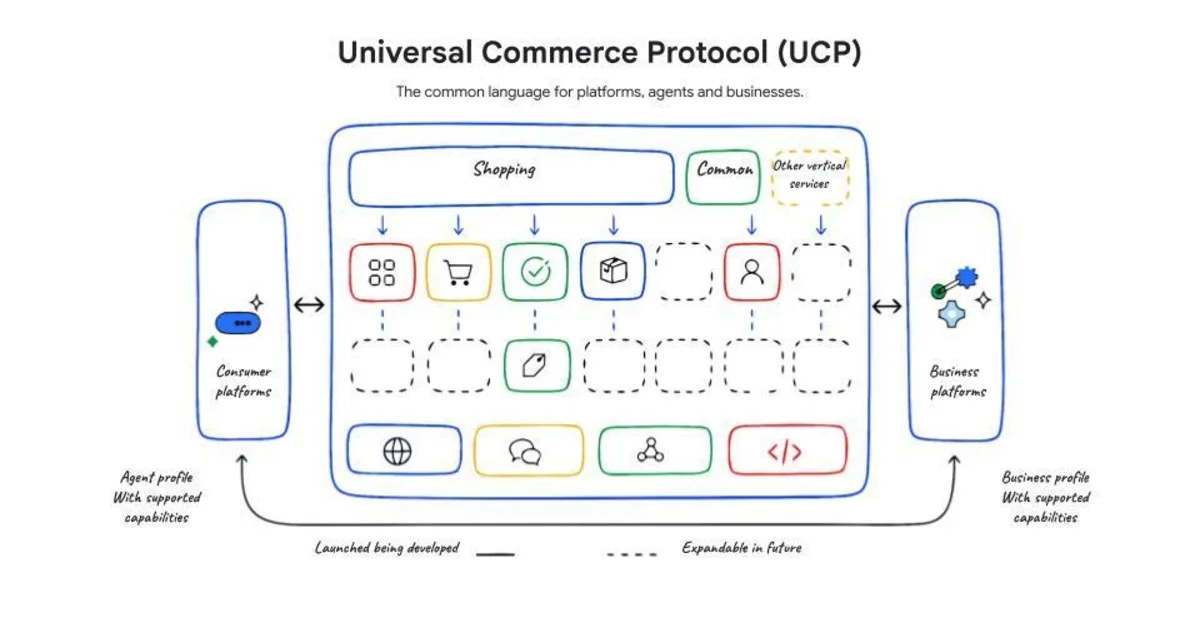
UCP is the machinery that lets an AI agent discover a business's capabilities, negotiate what it can handle, and then complete a transaction. According to Google's technical deep dive, the design centers on extensibility through layers.
At the bottom sit services, which group domains such as shopping. Above them are capabilities that define the basic actions of commerce: checkout, catalog, cart, and orders. On top, extensions add specific requirements. Discounts, for instance, are expressed as an extension of checkout, while fulfillment, loyalty, and post-purchase flows are absorbed at this layer too.
Why divide things up this much? Shopify, the co-developer, explains in its engineering blog that commerce rules vary widely by cart contents, buyer location, and each market's regulations. A single monolithic API cannot handle that diversity. By separating layers and versioning them independently, UCP achieves a state where "merchants implement only what they need, and agents negotiate only what they can handle."
This captures the philosophy of UCP. Not every business needs every capability; a transaction is settled by computing the intersection of the capabilities both sides have published.
How discovery and negotiation work
The mechanism hinges on merchants publishing a JSON profile at a fixed location on their own domain, /.well-known/ucp, describing supported capabilities and payment configuration. By reading that declaration alone, an agent can dynamically discover available features and endpoints without any hardcoded, bespoke integration.
Payment handling is designed as a two-sided negotiation as well. The merchant side indicates the payment handlers it accepts, and the agent side declares the credentials it can use. The protocol then works out which options are actually available given the cart contents and buyer location at that moment.
For moments that require a human, such as identity verification or extra input, UCP provides the Embedded Checkout Protocol (ECP). It hands off processing through a continue_url and exchanges bidirectional JSON-RPC 2.0 messages between agent and merchant, smoothly bridging full automation and human involvement.
It also matters that the transport layer is not tied to one method of communication. Alongside REST, UCP supports multiple bindings, including Google's A2A (Agent2Agent) and the Anthropic-originated MCP (Model Context Protocol). Agents can keep using the communication backbone they already run on.
Sorting out the relationship with AP2, A2A and MCP
UCP is not a self-contained standard; it works in combination with several specifications. Because they are easy to confuse, it helps to fix their distinct roles.
Payments are handled by AP2 (Agent Payments Protocol). Announced in September 2025 with more than 60 partners including Mastercard, PayPal, and Coinbase, it is a payment-agnostic open standard. The question AP2 answers is "did the user really authorize this purchase," and it standardizes that answer as a chain of cryptographically signed mandates. The rail that actually moves the money, whether a card network, a real-time bank transfer, or a stablecoin, can be chosen freely underneath.
To put it plainly, UCP defines the grammar of commerce of what to buy and on what terms, while AP2 guarantees that the purchase is properly authorized. A2A and MCP then provide the channels over which all of this travels. Because the roles complement rather than overlap, Google groups them together as the open rails for agentic commerce.
The UCP coalition, starting with Shopify
UCP is not a solo Google project. Shopify, Etsy, Wayfair, Target, and Walmart are named as co-developers, and more than 20 additional companies have endorsed it. The lineup is broad, spanning payment networks and major retailers alike, including Adyen, American Express, Best Buy, Flipkart, Macy's, Mastercard, Stripe, The Home Depot, Visa, and Zalando.
Shopify's involvement is especially telling. Speaking from a position with millions of merchants and an enormous volume of transactions, it brought the real-world complexity of commerce into the protocol's design. It is also notable that payment heavyweights like Stripe, Visa, and Mastercard stand alongside Google. Having the operators of payment rails help shape the standard influences whether UCP can become a foundation that holds up in production.
UCP creates a common language for agents and systems to operate together across consumer surfaces, businesses, and payment providers.Source: Google Open Source Blog
How it differs from OpenAI and Stripe's ACP
UCP is not the only standard for agentic commerce. The ACP (Agentic Commerce Protocol) led by OpenAI and Stripe is the other strong option. The two compete, yet their design philosophies differ sharply.
| Aspect | UCP (Google / Shopify) | ACP (OpenAI / Stripe) |
|---|---|---|
| Scope | The entire purchase journey, from discovery to payment | Standardizes mainly the checkout conversation |
| Mechanism | Merchants publish a profile on their own domain | Merchants submit a catalog and delegate operations to the platform |
| Payments | Payment-agnostic, paired with AP2 | Stripe processes payments |
| Led by | Coalition of Google, Shopify and 20+ others | OpenAI and Stripe (centered on ChatGPT) |
| Optimizes for | Control and interoperability | Ease of adoption and distribution |
The biggest difference is where control sits. UCP is decentralized: merchants publish a profile on their own domain, and any AI agent can access it without prior registration. ACP, by contrast, delegates to a platform: merchants submit their catalog to OpenAI, Stripe processes payments, and ChatGPT surfaces products within the conversation.
ACP has the edge on ease of adoption. Because you can get going by submitting a catalog and connecting Stripe, integration is said to take only a few hours. UCP requires the effort of publishing and running your own profile, but in return you gain control and interoperability. Rather than picking one or the other, the realistic question for e-commerce operators is how to design support for both. Our in-depth comparison of UCP and ACP covers this in more detail.
What e-commerce operators should prepare
Google is currently in an early rollout with a set of large retail partners and plans to widen the scope through 2026. Precisely because the standard has not fully settled, operators have room to prepare.
The first thing to check is whether your product information and checkout specs are in a form that an agent can read mechanically. Since UCP assumes a published profile at /.well-known/ucp, organizing your catalog, inventory, and shipping rules as structured data is the starting point. Unlike ACP, which you can leave to the platform, UCP support tests how well your own side is set up.
On the payments side, you will eventually need the ability to handle AP2 mandates. As long as agents buy on a user's behalf, a mechanism that leaves a verifiable record of who authorized what and when is unavoidable. Even if you are watching from the sidelines for now, tracking the protocols and getting your data and payment foundations in order is how you avoid missing demand that comes through agents.
Summary
The UCP that Google showed at Open Source Summit is an attempt to free agentic commerce from any single company's enclosure and place it on an open, shared foundation. Designed to complement AP2 for payments and A2A or MCP for transport in distinct layers, it reflects a philosophy that puts interoperability first. How the coalition built around Shopify, Visa, and Mastercard coexists with OpenAI and Stripe's ACP, and the very process by which the standard settles, will shape what commerce looks like next.