Shopify Spring '26 Opens Catalog API and UCP to Every Developer, Making Agentic Commerce Approval-Free
At its Spring '26 Edition on June 17, 2026, Shopify opened the Catalog API and the Universal Commerce Protocol (UCP) to all developers with no approval and just an API key. Here is what changed and what it means for merchants.


Key Takeaways
- Shopify's Spring '26 Edition opened the Catalog API and UCP (Universal Commerce Protocol) to every developer with no approval required, needing only an API key.
- Anyone can now use the product data of millions of Shopify merchants to build end-to-end agentic commerce experiences, from discovery through checkout, from scratch.
- For merchants, it means a distribution network that automatically surfaces their products not only in ChatGPT and Copilot, but in the countless AI apps yet to be built.
The day the approval gate disappeared and the barrier to agentic commerce fell

Anyone can now build end-to-end agentic commerce on Shopify, and the platform underneath every app gets a foundational rebuild.
www.shopify.comOn June 17, 2026, Shopify unveiled its Spring '26 Edition at Editions, its twice-yearly product event. The heart of this release is that the agentic commerce infrastructure, which previously required approval, is now self-serve for every developer. The message is plain: anyone can now build end-to-end agentic commerce on Shopify.
Agentic commerce refers to a form of buying in which an AI agent, acting on the user's behalf, searches for products, compares them, adds them to a cart, and completes payment autonomously. Shopify went all-in on this space in the previous Winter '26 release and rebuilt its developer platform for AI. Spring '26 takes a step further and, in Shopify's own words, throws the doors wide open.
Building on Shopify's agentic commerce layer used to require approval. Removing that requirement is the single biggest change here. Instead of applying, developers register their agent profile in the Developer Dashboard and call the public MCP endpoint, after which they can build the full flow from product search to checkout.
The two foundations behind agentic commerce: UCP and the Catalog API
The key to understanding this release is to separate the roles of its two foundations: one is the shared language for transactions, the other the discovery layer for finding products.
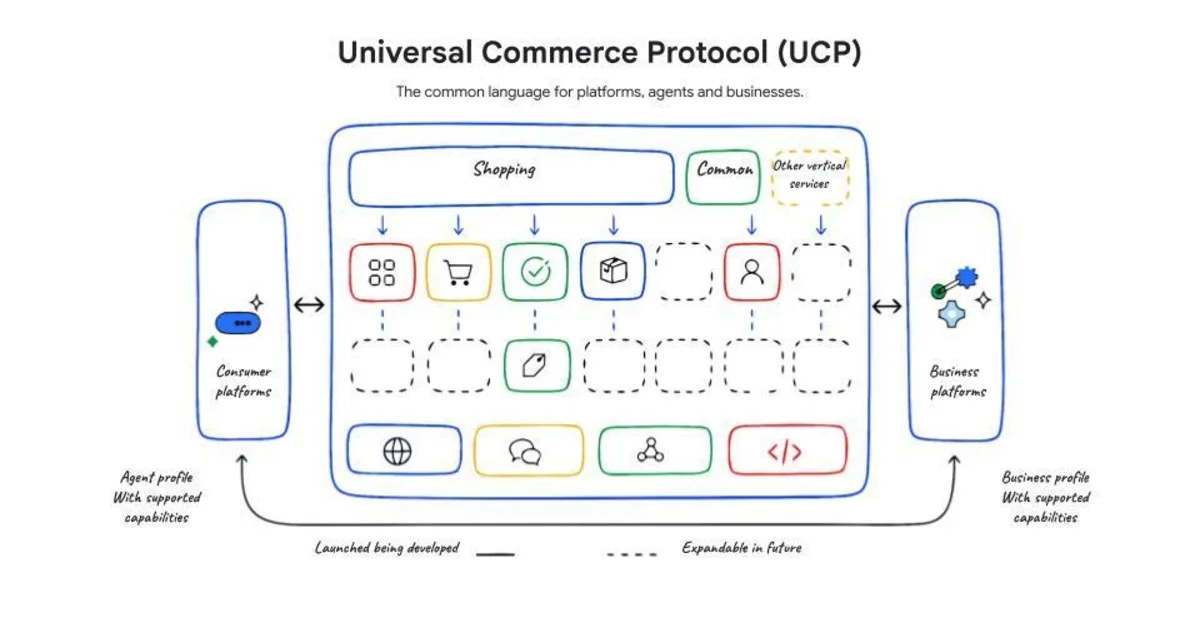
UCP (Universal Commerce Protocol) is the open standard for how AI agents transact with merchants. Co-developed by Shopify and Google, it covers the entire commerce journey from discovery to carts to checkout. It has broad backing from companies including Amazon, Meta, Microsoft, Salesforce, Stripe, Etsy, Target, and Wayfair. Google's developer blog describes it as the standard that defines the discovery and negotiation mechanisms between agent and merchant. The specification ships on GitHub under Apache License 2.0 and is already wired into Google's AI Mode and the Gemini apps.
What changed in Spring '26 is that any developer can now access UCP using Shopify's tools. As part of the open-source AI Toolkit, Shopify offers the "UCP Skill," which packages 20 years of commerce knowledge so that an agent can introspect available operations, pull schemas, and learn the shape of any operation without a human wiring it up. A UCP CLI provides structured commands alongside it.
The Catalog API, meanwhile, is UCP's discovery layer. It turns the products of millions of merchants into standardized, structured data so that AI can discover, understand, and present them accurately. This Edition added three important changes here.
First, access now takes just an API key, with no approval needed. ChatGPT, Copilot, and the Shop App are the most visible surfaces today, but the same product data can power the apps, agents, and marketplaces forming around them. Second, the capabilities got smarter: image search now returns visually similar products across Catalog, multi-modal search combines text and image, and a lookup endpoint resolves a list of product URLs into real Catalog matches. Richer metadata like size, color, and delivery estimates is included too. Third, monetization is coming, with "Promoted placements" giving developers and partners a future path to earn revenue when their Catalog-powered experiences drive sales.
One number stands out: Shopify states that AI searches powered by Shopify Catalog convert at twice the rate of those using scraped data. Clean, structured data is easier for agents to read and to present products accurately.
An era where a commerce app needs only an API key and an idea
The five demo apps Shopify published show concisely what this opening makes possible. Tellingly, a small group of designers and engineers built them in just a few days.
"Showroom," for example, lets you tap furniture or clothing in a show you are watching and surfaces in-stock items of the same material and style from other merchants. The trip-planning app "All Set" returns a shoppable list of real, buyable products that fit your destination and season. Shopify put it this way in its write-up of the five demo apps.
Not long ago, this would have meant dedicated engineering teams, custom backends, and integrations with merchant systems for every store you wanted to feature. Now it's just an API key, structured data, and an idea.Source: Shopify
The point is that Catalog bridges what AI is good at, like visual recognition and contextual reasoning, with the part that guarantees a product is real, in stock, and correctly priced. The foundation is now in place to turn AI's reasoning into recommendations you can actually act on.
Rebuilding the foundation developers depend on
This Edition is not only about flashy AI features; it also rebuilds the unglamorous layers underneath. In Shopify's framing, it tends to the kind of foundational layer most people do not notice until it breaks, fixing it before it does.
A prime example is "Next Gen Events," a webhook system redesigned from the ground up. Developers can subscribe to specific field-level changes such as customer address or inventory updates, and customize GraphQL payloads to receive exactly the data they need. Also introduced were the "App Events API," which logs an app's own events into Shopify's Dev Dashboard, "App Pricing," which has Shopify handle complex billing, and "Static Apps," which let developers build and deploy without running a server.
On the developer experience side, the AI Toolkit reached general availability. A single plugin gives editors such as Cursor, Claude Code, Codex, and VS Code direct access to Shopify's reference guides, live store data, and admin tools. For merchants, "Sidekick App Extensions" lets partner apps surface their data and actions inside the Sidekick AI assistant, launching with 15-plus partners including Klaviyo and Yotpo.
What it means for merchants
For merchants on Shopify, the essence of this change is that the places their products appear keep growing without them lifting a finger. Catalog and UCP are enabled by default for merchants, and every new experience a developer builds becomes another place those products can show up.
This trend is spreading beyond retail. Microsoft's Copilot Checkout began integrating with Shopify in early 2026, and purchases via UCP are running in Google's AI Mode and Gemini. Shopify abstracts both ACP (Agentic Commerce Protocol), led by OpenAI and Stripe, and UCP, so merchants can list across multiple AI channels without worrying about individual protocols.
Industry outlet Retail Brew framed the throughline of the announcement as connecting every surface, from the online store to POS and the Shop App, into one smooth experience. With more than 250 million shoppers reported across the Shop App and Shop Pay, both AI channels and physical stores are being integrated on top of that buyer base.
What merchants should consider now is whether their product data is in a state that agents can read accurately. The more that attributes like size, color, inventory, and price are structured and current, the more directly it ties to exposure and conversion in AI search. With the approval barrier gone, the work shifts from choosing which channels to sell on toward sharpening how well agents understand your products.
Conclusion
The Spring '26 Edition turned agentic commerce from something for a select few developers into shared infrastructure that anyone with an API key can touch. With Catalog and UCP both opened up, commerce no longer needs a destination and instead blends into the activities people are already doing. What to watch next is which niche apps emerge once monetization formally goes live. The number of places where products can be found is set to grow quietly, but surely.