Salesforce Acquires Fin (Formerly Intercom) for ~$3.6 Billion: An Agentic AI That Resolves 76% of Support Comes to Agentforce
Salesforce will acquire Fin, the AI customer service company formerly known as Intercom, for approximately $3.6 billion. A practical look at the agent that resolves up to 76% of support end-to-end and what its Agentforce integration means for e-commerce.

Key Takeaways
- Salesforce has signed a definitive agreement to acquire Fin, the AI customer service company formerly known as Intercom, for approximately $3.6 billion. Fin's core is an agentic AI that resolves customer queries end-to-end on its own
- Fin's edge is its proprietary model, Apex, which Salesforce says resolves up to 76% of support volume without a human. Salesforce will fold it into Agentforce as a ready-to-deploy service agent
- For e-commerce operators, this can reshape the economics of customer service. Automating routine queries around returns, shipping and payment issues becomes realistic with a much shorter ramp-up
Salesforce buys the former Intercom, now Fin, for $3.6 billion
Enterprise software giant Salesforce has signed a definitive agreement to acquire Fin, an AI customer service company, for approximately $3.6 billion. Fin is the company that was previously known as Intercom, long famous for its customer messaging tools. The deal was announced on June 15, 2026.
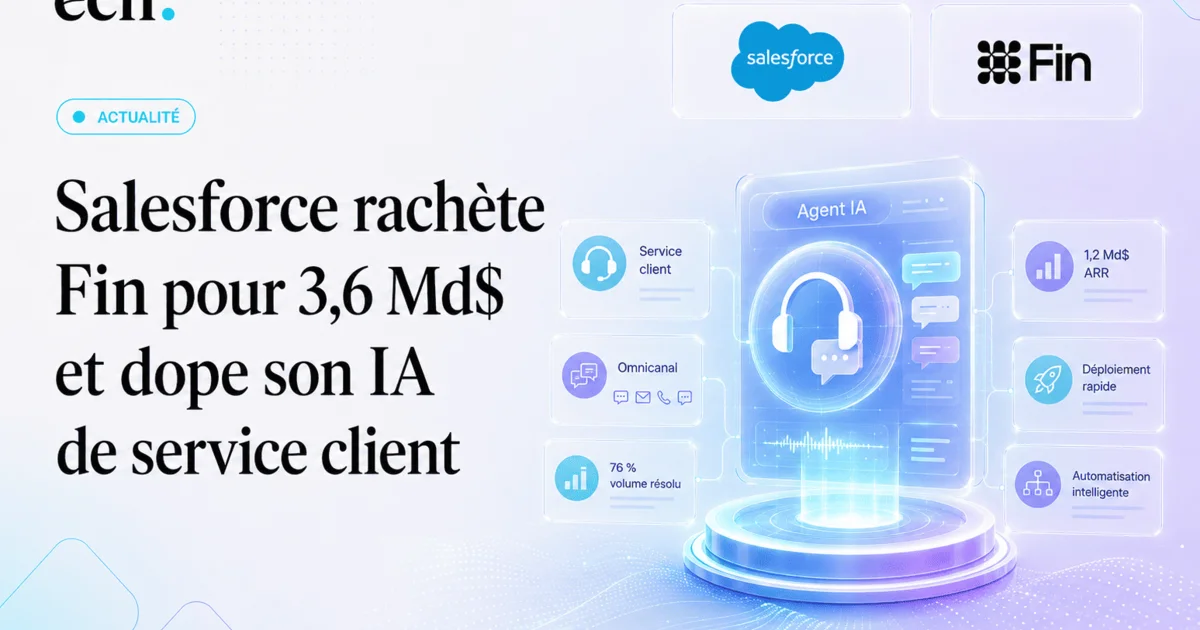
Salesforce annonce le rachat de Fin (ex-Intercom) pour 3,6 milliards de dollars. Decouvrez comment cette IA agentique va transformer le service client des e-commercants.
www.ecommerce-nation.frWhat stands out is that the target is not a legacy chat tool. Intercom was founded in Ireland in 2011 and led the customer messaging market for years. The company pivoted toward AI agent development from 2023, and just one month before the deal it renamed itself Fin. Dropping a 15-year-old brand is itself a signal that the center of gravity has fully shifted to AI agents.
Salesforce plans to integrate Fin's technology into Agentforce, its AI agent platform. Subject to customary closing conditions and regulatory clearance, the transaction is expected to close before the end of Salesforce's fourth fiscal quarter of 2027. CEO Eoghan McCabe and R&D leader Des Traynor are expected to stay on. Details are in the official Salesforce announcement.
What Fin is: an agent that resolves 76% of queries on its own
At the heart of Fin is the AI agent that bears its name. This is different in kind from a chatbot that simply answers questions in text. It is designed as an agent that understands a request, consults the right systems, applies policy, and carries the task through to completion. It works across live chat, email, phone, WhatsApp, SMS and Slack, handling complex queries end-to-end.
Powering this agent is Fin's proprietary AI model, Apex. Built specifically for customer support, Apex is described by Salesforce as showing industry-leading resolution rates that outperform top commercially available frontier models. The claim is that specialization for support, rather than a general-purpose large language model, is the source of the performance.
The numbers are specific. According to Salesforce, Fin's agent has resolved up to 76% of support volume end-to-end without a human in some deployments. That figure is meaningful in context. Salesforce's existing Agentforce Help Agent is cited at roughly 62% case resolution, so Fin's number sits above it. When weighing the logic of a deal this size, that gap matters.
Fin has also shipped Operator, a dedicated system that lets back-office teams configure, monitor and improve the agent. Owning not just the model but the machinery to keep raising accuracy in production lifts Fin above a mere model provider.
Why Salesforce wanted Fin
Behind the deal is the rapid growth of Salesforce's own AI agent business. Agentforce reached $1.2 billion in annual recurring revenue (ARR) in the first quarter of fiscal year 2027, up 205% year over year. That figure speaks loudly to how AI is shifting from an assistive layer inside CRM software to a standalone product in its own right.
So if Agentforce is growing, why buy something that looks overlapping? The answer lies in their different characters. Agentforce is a highly customizable platform for large enterprises that goes into full production after teams design data connections, governance and security. It is powerful, but standing it up takes effort. Fin, by contrast, is a more packaged, ready-to-deploy product whose hallmark is a short time-to-value.
Laying out the difference makes the rationale for owning both clear.
| Aspect | Fin (formerly Intercom) | Agentforce (existing) |
|---|---|---|
| Positioning | Packaged, ready-to-deploy service agent | Customizable agent platform for large enterprises |
| Speed to deploy | Short time-to-value, fast to stand up | Design data, permissions and integrations first |
| Primary fit | SMBs and some commercial organizations | Enterprise-wide CRM transformation |
| Resolution benchmark | Up to 76% of support volume resolved end-to-end | About 62% case resolution with Help Agent |
| Channels | Live chat, email, phone, WhatsApp, SMS, Slack | Cross-functional across Salesforce clouds |
In short, Salesforce is trying to cover the full spectrum of adoption, from lightweight agents that SMBs can use right away to large-scale transformations for enterprises backed by data and integrations. Equally notable is the customer base of more than 30,000 businesses that Fin brings, including names such as Asana, Shutterstock and Riot Games. Analysts note this could lift Salesforce's total customer count by around 20%. It is a deal that buys a market, not just technology.
CEO Marc Benioff framed the rationale this way.
Together, we'll help companies of every size seize this opportunity, accelerating time to value with trusted agents that deliver measurable outcomes at scale.
What it means for e-commerce operators
This is the most practical part for e-commerce and booking businesses, because the deal touches cost and quality of customer service, an area no operator can avoid.
Online selling generates a steady stream of queries about orders, returns, refunds, shipping, cancellations and payment issues. The more products, channels and markets a business adds, the harder this load becomes to absorb with people alone. During sales and campaigns when demand spikes, the support team tends to become the bottleneck.
Fin promises to automate part of that pressure. If up to 76% of query volume can be resolved autonomously, the economics of support change. There is a precondition, though. Response quality, accurate product data, commercial rules for returns and refunds, and a well-designed escalation path to humans for sensitive cases all need to be in place. A high automation rate only means something when the foundation is solid.
The key point is that this is not a chatbot swap. What a service agent must do is understand a request, consult the right systems, apply a return policy, update a status, trigger an action, and hand off to a human when a case turns delicate. It is this ability to execute, more than fluent text generation, that explains Fin's strategic value. What operators should assess is reliability of execution, not eloquence.
The context: an agent land grab in enterprise software
The deal also reflects accelerating consolidation in enterprise software. In 2025 Salesforce announced it would acquire data integration leader Informatica for $8 billion to strengthen its data and AI foundation. The Fin acquisition stacks a customer-facing layer, conversational automation, on top of that base.
The driver is intense competitive pressure. Microsoft, Google and ServiceNow are all racing to embed AI agents into their software suites. Customer service has become the first battleground because it combines high volumes, measurable costs and a direct impact on user experience. Returns on investment are easy to see in numbers here, which is precisely why each player is concentrating resources on it.
At the same time, European decision-makers are voicing concerns about dependence. Companies already on Salesforce will benefit from an agent tightly integrated into their CRM environment, but they will also deepen their reliance on a US technology ecosystem. Amid debate over the AI Act and the Digital Markets Act, this consideration is likely to weigh more heavily in procurement going forward.
Conclusion
Salesforce's acquisition of Fin shows that customer service is becoming the most concrete proving ground for agentic AI. Resolving 76% of queries autonomously is a symbol of AI shifting from assisting conversations to executing work.
What e-commerce operators should watch is not the headline automation rate itself, but whether the underlying product data, commercial rules and escalation design are in place in their own organization. For those with a solid foundation, this move is a chance to rewrite the economics of customer service. The deal is expected to close in the fourth quarter of fiscal year 2027, and the next thing to watch is how far the integrated Agentforce can deliver agents that are genuinely ready to use.