Naver to Pilot In-Agent Payment in Its AI Shopping Agent: What 4x Transactions and a 40% Electronics Share Reveal
Naver will pilot checkout inside its AI shopping agent for selected categories this year. We break down the 5x user and 4x transaction growth, why electronics account for 40%, what remains undisclosed, and what agentic checkout means for e-commerce operators and marketplace sellers.

Key Takeaways
- Naver plans to pilot a payment feature inside its AI shopping agent for selected product categories before the end of the year. Until now, tapping a recommended product sent shoppers to the Naver Smart Store product page to order and pay there. The pilot categories and start date have not been disclosed
- In August, the agent's monthly active users and average daily conversations were each about 5x their March levels, and average daily transaction value through the agent was about 4x. Digital devices and home appliances account for 40% of that transaction value, and Naver Plus Membership subscribers account for 78%
- Conversational shopping is taking hold first in high-involvement products that require spec comparisons and installation checks. Whether decision inputs such as dimensions, installation requirements, delivery dates, and membership benefits are machine-readable is becoming the line between products that sell through an agent and those that do not
From Recommendation to Payment: The Last Gap Naver Wants to Close

Naver’s AI Can Find What You Want. Soon It Could Help You Buy It, Too. SEOUL, Sept. 28 (Korea Bizwire): Ask an artificial …
koreabizwire.comPick a product by talking to an AI, then finish the purchase in that same conversation. According to a Yonhap News report carried by Financial News, Naver plans to pilot a payment feature inside its AI shopping agent for selected product categories before the end of the year. The information came from people in the ICT industry, and English-language outlet Korea Bizwire reported the same on September 28.
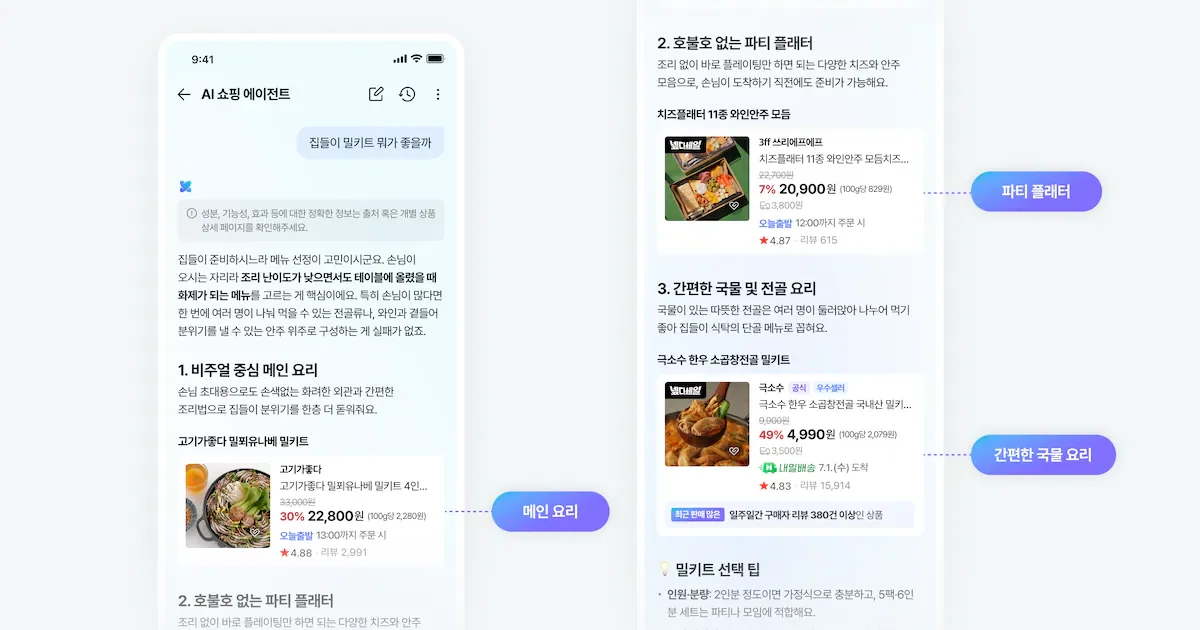
According to Money Today, shoppers still cannot pay inside the agent. Tapping a recommended product takes them to the Naver Smart Store product page, where they place the order and pay separately. Once the pilot begins, discovery, recommendation, and payment will all happen within the agent's screen for the covered categories.
When the agent officially launched at the end of June 2026, Naver set its second-half goal as "agentic shopping from search to payment," and this plan puts that goal into concrete form. However, which categories will be tested first, when the pilot starts, and how Naver Pay will be integrated as the payment method have not been made public.
Competitors are moving too. Upstage, which operates the Daum portal, plans to release a beta commerce agent early next year that connects search and comparison through to purchase. Money Today expects that by next year's Lunar New Year shopping season, both of Korea's major portals will offer flows in which AI handles shopping on the user's behalf.
Reading the 5x and 4x Figures
The baseline for usage metrics has shifted with each announcement. The June and September figures come from Naver's announcements, and the August figures from Yonhap's report.
| Period (baseline) | Metric | Change |
|---|---|---|
| June 2026 (vs. March) | Daily users | Up more than 50% |
| June 2026 (vs. March) | Transaction value | More than 2.7x |
| Through Sept. 17, 2026 (vs. June) | Average daily conversation sessions | Up about 60% |
| Through Sept. 17, 2026 (vs. June) | Transaction value | Up 82% |
| August 2026 (vs. March) | Monthly active users, average daily conversations | About 5x each |
| August 2026 (vs. March) | Average daily transaction value | About 4x |
Because daily and monthly users, and transaction value and average daily transaction value, are mixed together, the figures cannot be chained into a single growth rate. Still, as the September 17 feature announcement shows, the direction is clear: conversations and transactions have kept growing since the official launch in June.
What should not be overlooked is that 78% of transaction value came from Naver Plus Membership subscribers. Paid members already have benefits such as discounts and free exchanges and returns, and they shop repeatedly inside Naver. The agent's growth reads less like new customer acquisition and more like loyal customers shifting their buying behavior to a conversational format.
Why Appliances Account for 40% of Transaction Value
Digital devices and home appliances were the largest category by transaction value through the agent, at 40% of the total. Yonhap attributes this to heavy use of AI comparison and summarization in high-involvement categories, where shoppers need to compare specifications and features and check whether a product can be installed or placed.
Consider buying a washing machine. Beyond capacity, dryer function, and power consumption, a shopper needs to check the width and depth of the installation space, the width of the delivery path, and the position of the water supply and drain. With conventional search, shoppers opened several product pages and cross-checked spec sheets themselves. That cross-checking is exactly the work that AI, which reads and summarizes large volumes of product information, does best.
Put the other way, appliances sell through the agent partly because the comparison information is already on the product pages. Products whose spec tables have gaps, or whose installation requirements appear only inside images, cannot be matched against a shopper's conditions. Naver recently added an AI summary module to product detail pages and plans to add an FAQ-style feature in the fourth quarter that anticipates questions shoppers are likely to have. Both support the same cross-checking on the product page side.
Which categories the payment pilot will start with is undisclosed. What the appliance share does show is that conversational buying advances first in products with clear specifications, where comparisons lead to a conclusion easily.
The Pieces Built Up Ahead of Payment
The payment feature is not being added in isolation. Over the past few months, Naver has been adding the pieces that come just before payment so the agent can judge what to buy, when, and on what terms.
Delivery sits at the center. The September 17 update added a feature that suggests products able to arrive by a desired date based on the shopper's address. Ask for "a hot pot meal kit that arrives by tomorrow because I'm going camping," and the agent shows products that can arrive in time and even gives the order cutoff, such as "order by 10 p.m. tonight to receive it early tomorrow morning." When the conversation signals urgency, it prioritizes fast-delivery products even if the shopper does not ask.
Gift recommendations now reflect the recipient's age and preferences, occasions such as anniversaries, and gift-related reviews, and the agent explains why it recommended each product. The opening screen has also gained conversation starters that highlight trends, so shoppers can begin before they have a search term in mind.
Membership benefits are being built in as well. The agent presents member discounts and free exchanges and returns alongside recommended products, and it has been improved to prioritize products with benefits that are more favorable to the individual shopper. Naver plans to bring the agent to PC by the end of the year and to use real user reviews (UGC) to strengthen the evidence and trustworthiness of its recommendations. Lee Jung-tae, Naver's head of shopping search and AI, said the following in the September announcement.
We will combine shopping data such as product specs, real-time delivery information, and review data with personalized recommendation technology to grow a differentiated AI commerce experience.
A Closed Ecosystem Makes Payment Possible
In the U.S., OpenAI launched Instant Checkout, which allows payment inside ChatGPT, in September 2025. According to a Sisa Journal-e article covering a Forrester webinar, however, about five months later OpenAI scaled back its own payment function and shifted to having shoppers pay in merchants' apps or websites. Even the early movers have not settled on how in-chat payment should work.
Naver's conditions are very different. On the second-quarter earnings call, CEO Choi Soo-yeon described Naver as "the only full funnel platform in Korea that seamlessly connects search, shopping, Naver Place, and payments." Product data sits in Smart Store, payment in Naver Pay, benefits in the membership program, and delivery in N Delivery. The inputs the agent uses to decide and the means to execute the transaction are all in-house. Naver Pay's second-quarter payment volume reached KRW 25.2 trillion, up 21.0% year over year.
According to Edaily, Naver and Coupang are not opening their platforms to external AI agents and are instead deepening AI use within their own ecosystems. A Naver Shopping representative told the outlet that the strategy is to complete everything from discovery to payment inside Naver's ecosystem. That stands in contrast to Gmarket, which is considering a phased opening.
Part of the revenue design is also visible. According to Money Today, Naver currently shows no ad products inside the shopping agent, and products sold through the agent are charged the regular Smart Store sales commission with no additional fee. However, that describes the current flow, and whether the fee structure will change with in-agent payment is undisclosed.
Trust in Delegated Payment Has Not Caught Up
Naver's own numbers alone do not reveal how hard this is. According to the same Sisa Journal-e article, Forrester's research found that about 60% of answer-engine AI users searched for products, but fewer than 17% completed payment within that service. About 85% rated the AI as useful, yet the share who fully trusted its answers was 71 points lower. Asking for a recommendation and handing over payment are separate matters.
Responsibility is also unresolved. In the same research, about 45% of consumers said that if something went wrong in a transaction through an AI agent, they would hold the answer-engine AI service responsible rather than the company that sold the product. As Herald Economy reported, citing Reuters, financial institutions including Bank of America, Capital One, and ING have warned that it is unclear whether consumers, financial institutions, sellers, or AI companies bear responsibility for mistaken purchases or fraudulent transactions made by AI.
There are also issues on the seller side. As Edaily points out, the more purchases are completed inside the conversation, the less shoppers pass through store pages, and the more customer touchpoints, data, and add-on purchase opportunities are left to the platform. For Naver's in-agent payment, how final confirmation before payment will be requested, who bears returns and responsibility for mistaken purchases, and how much of sellers' store pages and related products will be shown have not been made public.
Implications for E-commerce Operators and Marketplace Sellers in Japan
The most useful lesson from Naver is that it shows which products conversational buying takes hold in first. Appliances accounting for 40% of transaction value means that the more decision inputs a product has, the more valuable it is to let AI handle the comparison. For operators selling appliances, furniture, PC peripherals, or baby products in Japan, holding comparison attributes such as dimensions, installation requirements, supported standards, and included items as structured text data rather than in images becomes a prerequisite for the agent era.
Delivery promises have become recommendation inputs too. Once "arrives by tomorrow" is a recommendation criterion, products whose stock levels, delivery lead times, and order cutoffs cannot be read accurately from systems drop out of the candidate list in urgent contexts. This is a question of operational data quality, separate from advertising or promotions.
Marketplace sellers may find themselves in the same position as Naver's sellers. In Naver's design, membership benefits and delivery conditions feed into recommendation priority, and reviews serve as the evidence. When payment is completed inside the conversation, there are also fewer chances to convey a brand's identity on its store page. Sellers need to grow marketplace sales while separately maintaining touchpoints where they keep their own customer relationships, such as membership programs and after-sales service.
Conclusion
Naver's in-agent payment is still at the stage of a pilot planned for this year, and the categories, start date, payment method, fees, and allocation of responsibility are not yet visible. Even so, the decision to close the last gap between recommendation and payment inside its own ecosystem is one that only a platform owning everything from product data to payment could make. The points to watch next are which categories the pilot covers and what payment design Daum's commerce agent, due early next year, will choose. For e-commerce operators, the preparation is to get product data in shape now so that AI can compare without hesitation and deliver as promised.