
AI Commerce News Digest (October 1, 2026)
AI commerce news for October 1, 2026. Amazon brings brand-supplied ads into Alexa for Shopping conversations, and Mastercard tests a score that identifies AI agent-initiated transactions. Plus DoorDash text ordering and new data on how product data and reviews shape AI recommendations.


Key Takeaways
- Amazon announced ads that live inside Alexa for Shopping conversations
- Mastercard is testing a score that flags agent-initiated transactions
- Product data and reviews are emerging as the conditions for being picked by AI
This edition covers developments from September 29 through the morning of October 1. The biggest shift is that advertisers will be able to shape what an AI shopping assistant actually says. Amazon will launch an ad format in January 2027 in the U.S. that lets brands feed their own information into Alexa for Shopping conversations. On the payments side, Mastercard began testing a score designed to keep agent-placed orders from being mistaken for fraud. The September 29 digest covered Shopify and Naver building the pathways for agents to buy. This time, the conversation has moved on to the rules that run on top of those pathways: who gets chosen, on what basis, and how the purchase gets approved.
Today's Top Stories
Amazon unveils Branded Conversations, bringing brand expertise into Alexa for Shopping

Amazon Ads introduces Branded Conversations and Review Requests to help brands connect with shoppers in AI-powered shopping experiences. Learn more.
advertising.amazon.comAt its annual unBoxed 2026 advertising event, Amazon announced Branded Conversations, a new ad format for Alexa for Shopping. Until now, tapping a Sponsored Brands prompt opened a conversation in which Alexa drew on Amazon's own signals, such as detail pages and the Brand Store. The new format lets brands supply their own expertise, which Alexa then reflects in its answers.
Amazon's example is a skin care brand. The brand can explain which cleanser suits oily skin, sensitive skin, or a first routine, and how toners and serums fit alongside it. When a shopper taps a prompt like "Help me build a daily routine," Alexa draws on that information. In early testing, nearly 20% of shoppers who interacted with a Sponsored Brands prompt continued the conversation about that brand. The ads are clearly labeled as Sponsored and will launch in the U.S. in January 2027.
Amazon also announced Review Requests, which invites verified buyers to leave a review with a single tap from busy pages like the homepage; products in early tests received about three times as many ratings and reviews per week. The ad platform itself was renamed Amazon Ads Agent and rebuilt around agentic AI. As assistant answers become the starting point for product choice, a slot inside those answers becomes something to sell. How shoppers react to it, alongside concerns about neutrality, is the next thing to watch.
Related article: Amazon Unveils Branded Conversations for Alexa for Shopping: How Brand Information Enters AI Answers and What Merchants Should Prepare
Mastercard begins U.S. testing of a score that estimates whether an AI agent initiated a transaction
Today, Mastercard announced an expansion of Agent Pay, its agentic payments program, with new trust and intelligence services that provide greater context fo...
www.businesswire.comOn September 30, Mastercard announced new trust and intelligence services for Agent Pay, its agentic payments program. The first is a probability score indicating how likely it is that a transaction was initiated by an AI agent, now rolling out for testing in the U.S. Issuers can use it to approve legitimate agent-led purchases with more confidence.
The underlying problem is that agent shopping often looks unusual to existing fraud systems. Rapid purchases across several merchants, with no human at the screen, used to be red flags. Mastercard plans to strengthen the score over time with signals on behavior, merchant risk, credential risk and consumer propensity. It is also working with Cloudflare on combining web and payment network signals, and with Skyfire, a provider of Know Your Agent (KYA) identity technology.
For merchants, whether agent orders get approved translates directly into revenue. How accurate the score will be, and how it will sit alongside the approaches of Visa and other networks, remains to be seen.
Agentic Commerce
DoorDash launches an AI agent you can text to order, with routine restocks over 30% of assistant grocery orders
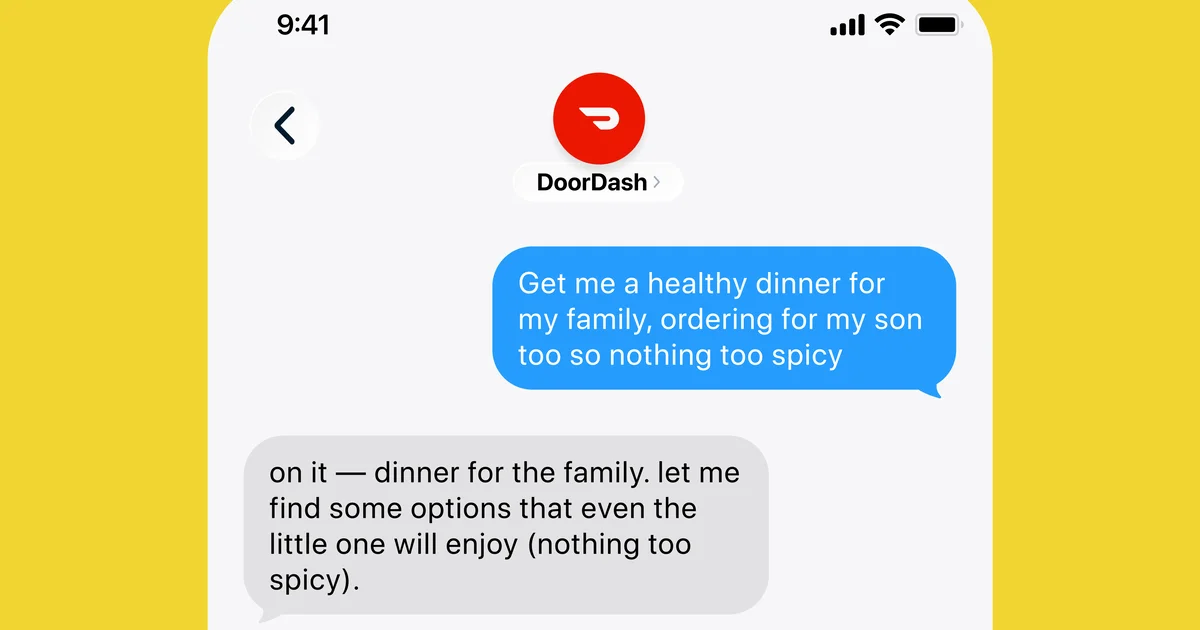
App users can also restock groceries with a tap
progressivegrocer.comOn September 30, DoorDash announced a beta of text-to-order: users text what they want, and DoorDash handles the product search and checkout. The feature builds on Ask DoorDash, the in-app assistant launched in June, and includes suggested carts, photos of food recommendations and group orders, all confirmed inside the text thread. Users can simply text "order my usual," and suggestions become more personal the more they use it. It runs in Apple's Messages app, and U.S. iPhone users can join a waitlist.
In the app, DoorDash added one-tap restocking from a preferred grocery store. When a cart is built with Ask DoorDash, DoorDash also scans store shelves in real time and suggests cheaper equivalent swaps that users can accept or decline. According to the company, more than 30% of grocery orders placed through Ask DoorDash are routine restocks, baskets are built five times faster, and basket values average nearly 50% higher than the same users' traditional orders. Buying everyday goods without opening an app is starting to show real numbers.
Related article: DoorDash Launches Text-to-Order AI Agent: How Grocery Restocks and Price Swaps Change Food E-commerce
Meta offers its AI agent Muse to small businesses for free, with Shopify, Stripe and other integrations (follow-up)

The tech giant says the agent can help owners run their business and find new customers.
techcrunch.comOn September 29, Meta announced Muse for Small Business. It connects to tools owners already use, including Shopify, Stripe, Klaviyo, Intuit QuickBooks, Canva and Slack, as well as Instagram professional account analytics, Facebook Pages and Meta ad accounts. It is free with usage limits, and businesses can buy a subscription for more usage.
The Muse checkout integration we covered on September 24 was about consumers buying inside Muse. This time Meta is handing the same agent to sellers and having it learn what a business sells, how the brand sounds and what customers ask most. A day earlier, Meta also introduced Meta Enterprise Platform, signaling that it wants Muse on both sides of the transaction.
Swiggy opens ordering to outside AI agents through four MCP servers and 66 tools

Swiggy is opening its commerce services to AI agents while building flexible, secure systems to improve model choice, customer experiences and delivery rider support today.
inc42.comIndian delivery platform Swiggy is making its food delivery, Instamart quick commerce and Dineout reservation services usable by external AI agents. CTO Madhusudhan Rao described the approach at Inc42's CTO Summit. The company runs four Model Context Protocol (MCP) servers with 66 tools, covering discovery, menus, carts, ordering, reservations and tracking.
Rao gave the example of connecting Swiggy's MCP to any LLM and asking it to plan meals around a dietary schedule. Instead of building a feature for every use case inside the app, Swiggy lets agents use the ordering infrastructure directly. At the same time, it deploys agents in separate environments with tightly restricted ingress and egress. Designing for openness and control together is a useful reference for any retailer exposing its APIs to agents.
AI Commerce Tools
Commerce adds AI-ready data enrichment to BigCommerce and Feedonomics

New capabilities help B2C and B2B merchants create richer, AI-ready product data at scale and form the foundation of Commerce’s broader agentic commerce...
www.globenewswire.comOn September 29, Commerce, formerly BigCommerce, announced Feedonomics Enrichment and BigCommerce Catalog Enrichment. Starting from a merchant's existing product information, they generate titles, descriptions, feature bullets, FAQs and SEO metadata. They also create the structured facts and Q&A fields that generative AI uses to understand what a product is, who it is for and why it matches a question.
Feedonomics Enrichment covers fields used by advertising and marketplace destinations such as Google, Meta, Amazon and eBay, as well as agentic surfaces like Gemini, ChatGPT and Copilot. A scorecard evaluates accuracy, consistency and brand adherence. The work of rebuilding product pages written for humans into something AI can read is becoming a product of its own.
Related article: Commerce (Formerly BigCommerce) Launches AI Product Data Enrichment: What Makes Product Data Selectable by AI Agents, and How Merchants Should Prepare
Bazaarvoice and Bluefish partner to monitor how reviews show up in AI recommendations

Brands risk losing sales when AI shopping tools cite the wrong details, as the new tie-up flags errors and boosts review visibility.
ecommercenews.com.auReview platform Bazaarvoice has partnered with Bluefish, which measures brand visibility in AI. Bluefish will monitor share of voice and sentiment in generative AI answers and issue alerts when AI engines produce incorrect brand information. Gaps it finds go to Bazaarvoice for action through review collection, product sampling and review displays that AI crawlers can read more easily.
In the companies' research, 57% of consumers named authentic reviews and star ratings as the main reason they trusted an AI product recommendation. Among product detail pages cited by ChatGPT, Google AI Overviews and Perplexity, 59% had 100 or more reviews, 92% were rated four stars or higher, and 65% showed a review summary near the top of the page. Whether AI cites a product appears to depend heavily on the volume and presentation of reviews.
AI assistant Instinct draws backlash over unsolicited product recommendations

Instinct is rolling out human-curated product and travel recommendations, but some users aren’t happy about getting suggestions they never asked for.
techcrunch.comAI assistant startup Instinct began pushing product suggestions to users through a new feature called Instinct Selections, and some users pushed back. According to TechCrunch, the company says it is partnering with local chefs, designers and others to bring human-curated picks. Instinct says 35% of its users use it for personal shopping, and it is working with Shopify to bring product discovery and checkout into one conversation.
Investor Shruti Gandhi posted on X that she was recommended carry-on luggage and sunglasses she did not need. Another user described an "ewwww" moment when the assistant suggested products based on email and upcoming plans. Suggestions that arrive unrelated to the conversation read as advertising rather than help. The more personal data an agent touches, the more its recommendation style decides whether it is trusted.
Payments and Fintech
IDEMIA Secure Transactions unveils infrastructure that lets domestic and private-label schemes join agentic payments

IDEMIA Secure Transactions (IST), a global leader in payment and connectivity solutions, today unveiled its Agentic Commerce solution, designed...
www.prnewswire.comOn September 29, France's IDEMIA Secure Transactions (IST) unveiled an Agentic Commerce solution that helps domestic schemes, regional networks and private-label card issuers support AI agent-driven checkout. It combines IST's Token Platform and FIDO2-certified authentication with new features for consent capture, verification and dispute-ready evidence.
The solution releases tokenized credentials only after consent is verified, restricts tokens by merchant, amount, category or time period, and preserves proof of consent that can be produced months later in a dispute, even if the agent no longer exists. As Visa and Mastercard build agentic payments inside their own environments, IST aims to let every other network compete on equal footing. The issue is relevant to Japan's domestic card brands as well.
Fed Governor Waller splits agentic commerce into "assisted" and "delegated" models

Federal Reserve Governor Christopher Waller sets out the remaining steps needed to make agentic commerce possible. | Global Finance Magazine
gfmag.comSpeaking at Sibos 2026 in Miami, Federal Reserve Governor Christopher Waller said AI agents will fuel the next leap in payments. He divided agentic commerce into an agentic-assisted model, in which the agent handles search and discovery while the buyer stays in control, and an agentic-delegated model, in which the buyer grants authority and the agent shops and pays autonomously.
Because delegated commerce raises the risk of unintended purchases, Waller called for more extensive trust mechanisms and guardrails. He also noted that B2B purchasing, already governed by approved suppliers and budget limits, is well suited to agents. A central bank official laying out this framework publicly gives the industry a shared vocabulary for the debate.
Consumer Trends
Salesforce: agentic search as the first step in shopping grew 200% year over year

More shoppers now start with a question to an AI, in a large language model conversation or in an AI assistant on a retailer's own site. Use of agentic search as the first step in the shopping journey grew 200% year over year, according to Salesforce's Fourth Edition State of Commerce report.
www.salesforce.comSalesforce's fourth State of Commerce report found that use of agentic search as the first step in the shopping journey grew 200% year over year, whether in LLM conversations or retailer site assistants. Behavioral data from more than 1.5 billion shoppers showed traffic referred from AI chats growing 150% to 428% year over year in every quarter measured, while overall traffic grew in the single to low double digits.
Businesses are lagging. Only 28% of commerce organizations use agentic AI today, though 52% plan to adopt it within six months. The most common actions were improving product content quality, optimizing content for conversational queries and submitting data feeds to AI search platforms. That is the same problem the product data enrichment story above is trying to solve.
Synchrony study: protection, transparency and control decide whether consumers let AI buy
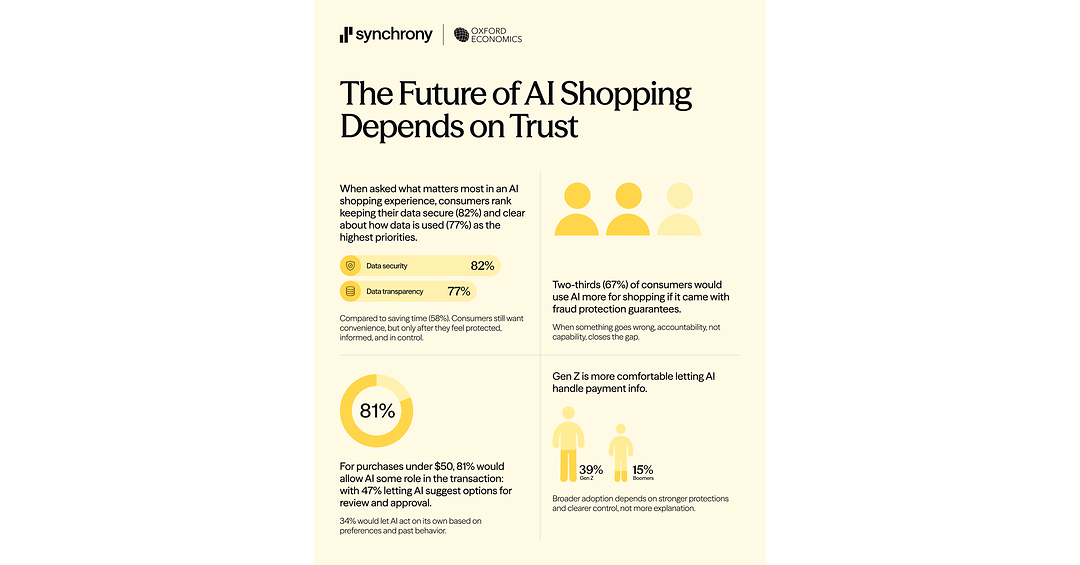
New research shows consumers are more willing to let AI make purchases when they have clear protection, transparency and control Key Highlights Security and...
www.prnewswire.comConsumer financing company Synchrony released its 2026 AI in Commerce study with Oxford Economics. Consumers rated keeping data secure (82%) and transparency about how it is used (77%) above saving time (58%).
Price makes a clear difference. For purchases under $50, 47% would let AI suggest options for review and approval, and 34% would let AI act based on their preferences and past behavior. For purchases of $5,000 or more, however, 46% would not use AI at all. The results support the view that agent purchasing will spread from low-ticket everyday goods first.
Spreedly survey: 63% of Americans would let AI choose brands if it saved them 20%

With the holiday shopping season approaching, new data reveals the frequency with which AI and ChatGPT are influencing how consumers research products and make purchases.
www.forbes.comForbes reported on a survey by payment orchestration company Spreedly. Some 63% of Americans would consider letting AI choose their brands if it consistently saved them 20%. Among Gen Z, 31% said they trust ChatGPT over Google for product research.
Consumers are not handing over the wallet, though. And 64% would not let AI make purchases without approval, and only 19% would share payment information even for guaranteed lowest prices. People are willing to delegate the decision but want to confirm the payment themselves. The findings also suggest brand loyalty could shift toward trust in the agent that finds the best price.
Bain: about eight in 10 Southeast Asian shoppers use AI for product discovery
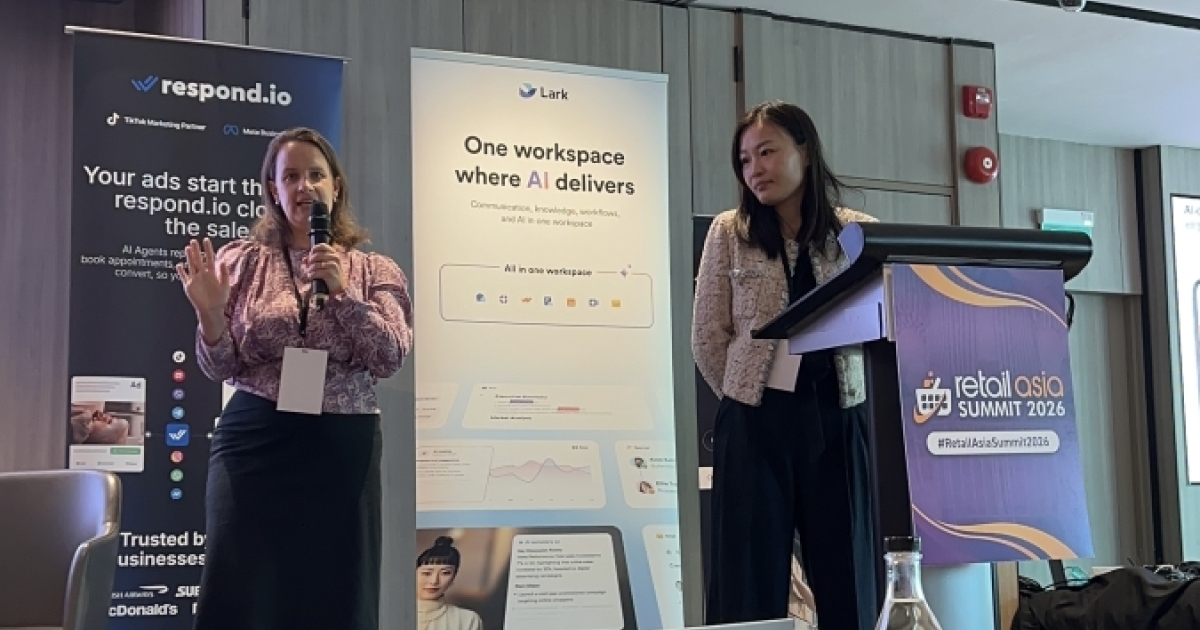
Around 80% of shoppers across Southeast Asia are already using artificial intelligence (AI) in their shopping journey,
retailasia.comAt the Retail Asia Summit 2026 in Singapore, Bain & Company partner Nina Kaspar said around 80% of shoppers across Southeast Asia already use AI in their shopping journey, mainly for recommendations, finding promotions and comparing products.
Use remains concentrated at the top of the funnel, and few shoppers let AI complete purchases. "Today, there is still a trust gap," Kaspar said, while adding that the direction toward delegated buying, such as asking AI to find and buy a birthday gift under a set price by a set date, is clear. She urged retailers to rethink the whole customer journey rather than bolt on individual AI applications.
Global E-commerce Trends
AliExpress trials an invitation-only membership for shoppers spending over $800 a year

Chinese e-commerce company AliExpress, owned by Alibaba Group Holding Ltd., is testing a VIP membership program, the Information reported on Wednesday. According to a person familiar with the matter, ...
breakingthenews.netAlibaba-owned AliExpress is testing a VIP membership program called Elite, The Information reported, citing a person familiar with the matter. There is no fee; instead, it is invitation-based and open only to customers who spend more than $800 a year. Perks reportedly include an extra 5% discount on a wide range of products, always-on customer service and hassle-free returns.
The program is being trialed in the U.K., Germany, Spain and Australia, with plans to expand to more European countries and South Korea next month. AliExpress expects around 1 million members by the end of 2026. A cross-border marketplace built on low prices is now borrowing the retention playbook of programs like Amazon Prime to hold on to its best customers.
Rakuten France, formerly PriceMinister, shuts down on October 1

The online marketplace Rakuten, formerly PriceMinister, will cease operations on October 1, according to a banner on its website stating that 'no new purchases or sales will be possible.'
ww.fashionnetwork.comRakuten France, the marketplace run by the Japanese group's French subsidiary, stopped accepting new purchases and sales on October 1. The company said in July that talks with potential buyers had not produced a viable solution. A transition period runs until November 10 so sellers and buyers can complete final steps, and around 180 employees are affected.
Rakuten acquired PriceMinister in 2010 and renamed it Rakuten France in 2018. Management reported that customers fell 33% and traffic fell 42% over 10 years. As a third-party marketplace for electronics and household goods, it could not hold its scale against competitors like Amazon, Temu and Shein.
Logistics and Fulfillment
Flexport lets businesses quote, book and track freight from ChatGPT or Claude via MCP

Flexport's new AI tools will let business owners just talk to ChatGPT or Claude to figure out shipping headaches or tricky tariff questions.
www.inc.comGlobal logistics company Flexport announced that businesses can now connect ChatGPT, Claude, Microsoft Copilot, Muse or their own AI assistants to its platform. Through Model Context Protocol (MCP), customers can generate delivery quotes, book freight and receive tracking updates inside a chat. Founder and CEO Ryan Petersen said 70% of its more than 13,000 customers are small businesses.
Flexport also expanded its customs software with AI help for choosing tariff codes and a human-in-the-loop review of customs paperwork before filing. With tariffs still shifting, handing sourcing and shipping admin to AI agents is becoming a realistic option for e-commerce sellers that import products.
UPS-owned Happy Returns brings box-free, label-free returns to TikTok Shop

Happy Returns offers box-free, label-free returns on TikTok Shop, reducing fraud and enhancing the shopping experience.
wwd.comHappy Returns, the returns company owned by UPS, is now integrated into TikTok Shop. For eligible orders, shoppers start a return in TikTok Shop and drop the item at one of nearly 10,000 Return Bar locations with no box or printed label. It works whether merchants handle their own fulfillment or use fulfillment by TikTok.
At the Return Bar, items are scanned and verified, and behavioral risk signals plus AI-based Return Vision help flag risky returns. Returned items are consolidated and moved through the UPS network. For a platform where shopping starts in videos and livestreams, easy returns remove one reason to hesitate before buying.
UPS launches UPS Secure Commerce to guard against shipping fraud and loss

Built on decades of proven solutions, industry-leading offerings help customers take greater control of their supply chains and ship smarter across carriers and modes of transportation
www.ajot.comUPS launched UPS Secure Commerce, which brings together InsureShield shipping insurance, Parcel Pro for high-value shipments, and CommerceShield technology for proactive shipping and e-commerce risk mitigation. The goal is to act on data before fraud, delivery problems or lost shipments turn into costly losses.
UPS Chief Digital and Technology Officer Bala Subramanian said the company is combining decades of data with its agentic AI to move customers from reactive to proactive supply chain management. From returns to delivery risk, carriers are building out services that carry the trust side of e-commerce.
Comau validates a cobot-based order preparation system in Decathlon's e-commerce fulfillment

Comau has designed and validated an order preparation solution tested within Decathlon’s e-commerce fulfillment operations as part of “MASTERLY”, a European initiative designed to accelerate the tr…
roboticsandautomationnews.comItalian robotics company Comau designed and validated an order preparation system within Decathlon's e-commerce fulfillment operations. The work is part of MASTERLY, a European initiative to speed the shift from mass production to flexible, customized manufacturing.
The system combines Comau's MyCo collaborative robot with ROS2-based software, intelligent sensors and a modular gripper to autonomously handle picking, handling and palletizing across variable product flows. It aims to reduce physical strain on workers while allowing quick reconfiguration as the product mix changes.
Advertising and Retail Media
Kroger predicts e-commerce conversion of ad creative with 81% accuracy before launch
The grocer, in partnership with Vidmob and MMA Global, was able to forecast e-commerce conversion of ad creative with 81% accuracy.
www.marketingdive.comKroger, working with creative data firm Vidmob and trade association MMA Global, tested scoring ad creative before campaigns launch to forecast e-commerce purchase conversion. AI analysis of more than 1,900 video and image assets from Kroger campaigns on Meta and Google's DV360 found that predictive creative scoring could forecast e-commerce conversion with 81% accuracy.
Creative aligned with the recommendations delivered an average fourfold improvement in conversion rates, and shifting media toward higher-scoring creative could potentially generate more than twice as many conversions from the same budget. Tying a retailer's purchase data to the content of the ads themselves adds to the value of retail media.
Summary
Taken together, these two days of news show the mechanics of "what gets chosen, and why" becoming concrete on top of the flow where AI agents find and buy products. Amazon is creating ad inventory inside the assistant conversation itself, while Commerce and Bazaarvoice are shipping products that make product data and reviews readable by AI. As the Salesforce study shows, AI-referred traffic is surging, yet fewer than three in 10 businesses have responded.
On the payments side, Mastercard's score and IDEMIA's proof of consent are pinning down approval and accountability when an agent pays on someone's behalf. Meanwhile, the Synchrony and Spreedly surveys show consumers are not yet ready to give up the final say on payment. Along with the backlash against Instinct, how transparent recommendations are and how user approval is designed will set the pace of adoption.