Alipay Unveils China's First Full-Stack Agentic Commerce Infrastructure and AHA Protocol, Forming an Interconnection Alliance with 20-Plus Partners Including Huawei and BYD
At its inaugural AI ecosystem conference in Hangzhou, Alipay announced China's first full-stack agentic commerce infrastructure and the AHA interconnection protocol suite. We break down the three-layer protocol stack, the 20-plus partner alliance, Abao's progress, and what it means for e-commerce businesses.

Key Takeaways
- On August 17, 2026, Alipay held its inaugural AI ecosystem conference in Hangzhou, unveiling what it calls China's first full-stack agentic commerce infrastructure alongside AHA (Agent Hub Access), a multi-agent cross-device interconnection protocol suite
- More than 20 partners, including Qwen, Huawei, and BYD, spanning devices, automobiles, and large models, co-launched an interconnection ecosystem initiative. The Abao (Ah Bao) agent has already AI-enabled over 10,000 services, reaching 5 smartphone brands (over 70% market share) and 16 automakers
- An "agent shelf" where a single integration distributes services across many terminals is taking shape in China. The race to standardize product and service data into agent-callable form is no longer a distant story for e-commerce businesses in Japan either
The Full Picture of the "Full-Stack Agentic Commerce Infrastructure" Unveiled in Hangzhou
On August 17, 2026, Alipay hosted its inaugural AI ecosystem conference in Hangzhou, unveiling China's first full-stack agentic commerce infrastructure and the AHA multi-agent interconnection protocol suite.
www.crowdfundinsider.comChinese payments giant Alipay, operated by Ant Group, held its first AI ecosystem conference in Hangzhou on August 17, 2026. The event had two centerpieces. One was the release of what the company calls China's first full-stack agentic commerce infrastructure. The other was AHA (Agent Hub Access), a protocol suite for interconnecting agents and terminals from different vendors. Crowdfund Insider covered the announcement in the US, while outlets such as NetEase Tech reported the conference details in China.
We have been tracking Alipay's moves continuously on this site. With AI payments and the AI Wallet in May, the AI-native app Abao in June, and the merchant-facing AI Open Platform in July, the three layers of payment, entry point, and supply were already in place. This announcement bundles them into a single stack and fills in the missing final layer: interconnection between agents from different providers.
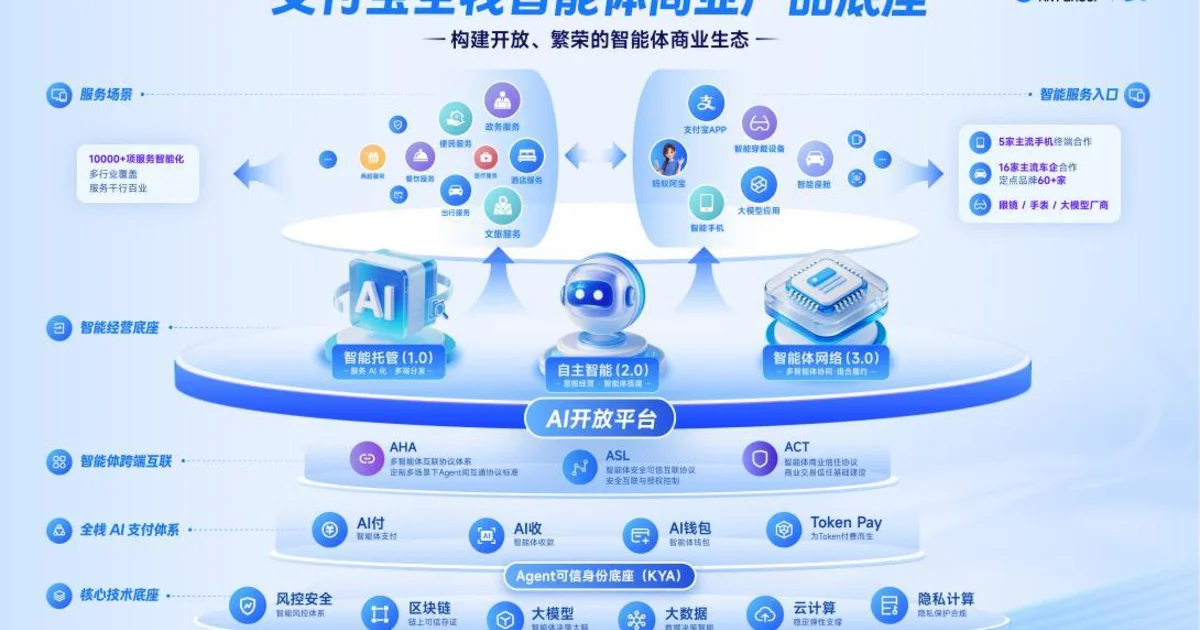
The official architecture diagram makes the stacking clear. At the top sit service scenarios (over 10,000 AI-enabled services) and entry points (smartphones, in-car systems, AI glasses, and large-model apps). Below them come the AI Open Platform serving as the merchant operations layer, an interconnection layer made up of AHA, ASL, and ACT, an AI payment suite bundling AI Pay, AI Collect, AI Wallet, and Token Pay, a trusted agent identity foundation (KYA), and a technology base including risk controls and blockchain. Owning everything from payments to protocols to identity within one company is what "full stack" means here.
What merchants receive is organized by capability level. For businesses without AI expertise, the platform converts existing pages, product catalogs, and service workflows into standardized callable units such as Skills and MCP tools. Merchants that already operate AI services can go further into agent creation, skill orchestration, task execution, and operations management. In parallel, Ant Group's digital technology arm released the Agentar ecosystem edition, which offers more than 200 specialized skill packages for high-frequency commercial scenarios plus digital expert agents, and supports coordinated fulfillment across multiple merchant agents through A2A (agent-to-agent) capabilities.
What the Three Layers of the AHA Protocol Suite Standardize
The technical core of the announcement is AHA. According to the official slides published by NetEase Tech, the AHA protocol suite consists of three protocols: the Skill Interaction Standards governing dialogue between users and agents, the Agent Hub Access protocol connecting agents to one another, and the device perception and execution protocol (X User Interface) linking agents with smart terminals. Their respective roles are making intent readable across terminals, letting information flow seamlessly between terminals, and executing merchant services across terminals.
Why are these three layers necessary? In an agent economy, a single user utterance triggers cooperation among distinct parties: the smartphone assistant, the merchant's agent, and in-car or IoT terminals. Systems built by different manufacturers and operators have had no shared way to adapt services or guarantee safety. AHA defines these procedures as an industry-wide standard, using domain-specific authorization and data isolation to maintain trust boundaries while allowing agents from different vendors to handshake efficiently. For the user, a single spoken or typed request completes the entire flow from multi-agent collaboration through secure fulfillment and payment.
It also helps to note how AHA divides labor with existing protocols. On the trust side, ACT (Agentic Commerce Trust Protocol) 2.0, developed by the IIFAA internet trust alliance with more than 20 partners, defines delegation, audit trails, intent verification, and payment channels, and sits alongside AHA and the ASL secure-connection protocol in the interconnection layer of the architecture diagram. As we covered in July, cross-device service invocation is being standardized under the AI agent interconnect framework led by China's Ministry of Industry and Information Technology (MIIT), and AHA serves as the implementation core of that effort.
A working demonstration was previewed at WAIC (World Artificial Intelligence Conference) in July. According to Alipay's announcement, when a user asked the assistant on StepFun's AI-native device StepX Neo to "find the nearest EV charger and order me a coffee to my home," the assistant interpreted the intent, activated the charging and coffee agents on Abao, and generated a ready-to-confirm order. Because skills are invoked at the protocol level rather than by simulating screen taps, there is no need to switch apps or show the agent a screen. A similar integration has begun with OPPO's assistant Breeno, where a user watching a short video can simply say "buy me a ticket for this movie" and Abao handles everything from selecting the theater and showtime to completing the booking.
The 20-Plus Partner Alliance and Where Abao Stands Today
Protocols only matter once participants gather. At the conference, Alipay launched a joint multi-agent interconnection and collaboration ecosystem initiative with more than 20 companies, including large-model players Qwen and StepFun, device makers Huawei, OPPO, vivo, Xiaomi, Honor, and Rokid, and automakers BYD, Geely, Li Auto, and NIO. What separates this from an ordinary partnership announcement is that payments, devices, and models, three different industries, sat down at the same protocol table.
Jun Li, president of the Alipay business group, laid out the view that service entry points will spread from single apps to smartphones, in-car systems, AI glasses, IoT, and large-model applications. What matters for merchants is the structure: adapt a service once, and it is distributed to multiple terminals through Abao. Since separate development for each terminal and assistant becomes unnecessary, the cost of connecting in a multi-terminal era changes fundamentally.
Abao's progress came with concrete numbers. In the two months since invite-only testing began in June, more than 10,000 services have completed AI adaptation, covering eight major scenario categories including transportation, dining, culture and tourism, and government services. Brands with strong daily usage, such as McDonald's, Mixue, Luckin Coffee, Gaode ride-hailing, Didi, Deppon Express, YTO Express, and Hive Box, are already connected. On the cross-device front, Abao works with five smartphone brands holding a combined market share above 70%, covers 16 major automakers, with additional partnerships underway. Since the AI development platform opened in July, merchant demand has been concentrated enough that some development projects are queued into next year.
Incentives to accelerate adoption were also announced. Under the intelligent operations incentive program, merchants get 100 million free compute tokens, reduced payment fees, and token subsidies tied to real transactions, along with free access to 57 "atomic business capabilities" such as membership systems and Sesame Credit.
"Explosive Growth in 6 to 12 Months": CEO Cyril Han's Thesis and the Remaining Caveats
The most quoted line of the conference was the explicit timeline from Ant Group CEO Cyril Han Xinyi.
Agentic commerce is poised for rapid growth over the next 6 to 12 months. AI agents will become a new interface connecting hundreds of millions of users with tens of millions of merchants, unlocking a new intent-driven commercial ecosystem.Source: Cyril Han (CEO, Ant Group)
According to National Business Daily's report, Han grounded this timing in three conditions maturing simultaneously: advancing AI capability, a leap in user demand, and the formation of a closed value loop. He described the traditional traffic era as a "funnel" model that narrows through exposure, clicks, and conversion, and argued the agent era replaces it with an "intent understanding" model. As the transaction costs of searching, comparing, and trusting fall by orders of magnitude, fine-grained demand that was previously "not worth serving" gets activated. In his framing, the resulting revenue is incremental, created by new supply, new demand, and a new division of labor rather than a re-slicing of the existing pie.
Before taking this thesis at face value, some caveats are in order. Even within China, transaction-layer standards have not converged: JD.com champions its autonomous payment protocol A2P2, while WeChat and UnionPay run their own agent payment initiatives. Ant Group itself, through its international arm Ant International, is open-sourcing a separate Agentic Mobile Protocol for overseas markets, so there is no guarantee AHA will cross borders as is. Biggo Finance's analysis of Han's remarks also notes that no single company can monopolize this ecosystem, and that coordinated participation by platforms, merchants, hardware makers, and developers is a precondition for success. Whether agent-driven discovery delivers returns on par with ad-driven discovery also remains to be proven.
What This Means for E-Commerce: Adapting to the "Agent Shelf" Has Begun
Reading this news from the perspective of e-commerce operators in Japan, the implications come down to three points. First, the shift in the unit of distribution from "apps" to "agent-callable skills" has now been endorsed by a cross-industry alliance of more than 20 companies. The work of structuring product, inventory, and service data so machines can read and execute it is the same homework arriving in every market, whether the standard is AHA in China or MCP and ACP internationally.
Second, the convenience and the dependence of the hub model are two sides of the same coin. A structure where one integration reaches every terminal dramatically lowers connection costs, but it also means the hub controls both the entry point of discovery and the path of fulfillment. Watching which standard becomes the de facto one matters as much as the decision to connect itself.
Third is how to take the timeline. A 6-to-12-month prediction is a promoter's claim and should be discounted accordingly. Even so, the fact that payments, devices, automobiles, and large-model providers all started moving through a concrete protocol at once is a far weightier leading indicator than any single product launch. Auditing whether your own product data is "visible" to agents is something any business, in any market, can start now.
Conclusion
Payments in May, the entry point in June, supply in July, and interconnection plus an alliance in August. Alipay has added roughly one layer per month, elevating its agent-economy infrastructure from a standalone app strategy to an industry-alliance phase. The AHA protocol suite in particular is a head-on attempt at the practical bottleneck of the multi-agent economy: service adaptation and secure coordination between different parties. Whether the explosion truly arrives within 6 to 12 months remains to be seen. When it does, the only businesses on the shelf will be those that have laid out their information in a form agents can read.