Contentsquare Launches an Experience Platform That Measures Human and AI Agent Visits Separately: How to Measure LLM Referrals and Agentic Commerce Journeys
Contentsquare unveiled a platform that separates human, LLM-referred and AI agent visits and lets AI run experiments. How it works, what remains unproven, and what e-commerce merchants should check in their own analytics now.

Key Takeaways
- On October 13, 2026 (U.S. time), Contentsquare announced that it had rebuilt its Experience Platform as "AI-first." It measures human visits, LLM (large language model) referrals and autonomous AI agent activity separately, and its AI layer, Sense, runs experiments end to end, from forming a hypothesis to validating revenue impact
- Counting AI agent visits together with humans distorts bounce rates and conversion rates. Blocking them all as bots hides a new sales channel. The significance of this launch is that an analytics vendor has put the question of who actually visited at the center of its product
- The new platform is in beta for selected customers, and pricing and detection accuracy are undisclosed. Merchants do not need to wait for it: they can already check where LLM referrals are hidden in their own analytics and whether the pages AI recommends live up to expectations
Contentsquare's New Platform for Human and Agent Journeys
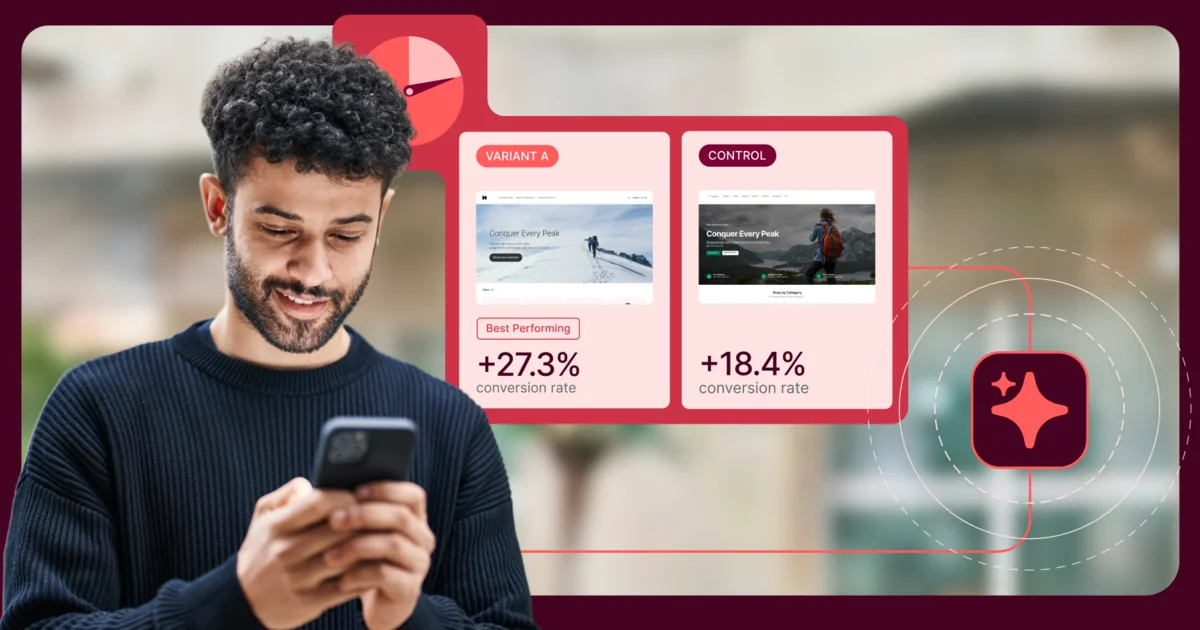
Contentsquare's AI-first Experience Platform tracks human, LLM and AI agent journeys, adding Sense agentic AI and testing integrations.
www.demandgenreport.comContentsquare, the behavioral analytics company known for heatmaps and session replay, announced its reimagined Experience Platform in a press release on October 13, 2026. The launch took place at its annual CX Circle event, and Demand Gen Report covered it in detail on November 2.
The core idea is to capture, in real time and on one foundation, not only human behavior on web and apps but also multi-device journeys, voice and chat conversations, and interactions by LLMs and autonomous AI agents. The new or expanded capabilities are these four:
- Human, LLM and agent interaction analytics, which separates LLM and agent traffic from human sessions so brands can optimize journeys for both LLM referrals and agentic commerce
- Conversation intelligence and chatbot analytics, which treats voice and text conversations as journey events and links them to on-site friction
- Multi-session journey analysis and automated WebMCP monitoring, capturing autonomous agent activity most tools cannot see
- A multi-touch attribution model that credits every touchpoint, including LLM and AI-referred traffic, rather than only the last click
The data is also available through MCP (Model Context Protocol, a shared standard that lets AI tools call external data) from tools such as Claude, ChatGPT and Copilot.
Founder and CEO Jonathan Cherki said businesses need a consolidated view of every interaction, covering not only customers but also "the LLMs and AI agents acting on their behalf." An executive at customer Crocs described shoppers bouncing between the app, the site, a chatbot and sometimes an AI agent the brand cannot see directly.
Why Separate Who Actually Visited?
The heart of this announcement is that it treats site visitors as three distinct types. The first is the familiar human visitor. The second is the LLM referral: a person who researched in ChatGPT or Gemini and followed a link. A human arrives, but the entry point is an AI answer. The third is an AI agent that operates the site itself on a person's instructions.
Mix the three together and the numbers lose meaning. An agent reads a product page quickly and takes away only what it needs for comparison. By human standards it is a visitor who left immediately, so bounce rates rise and funnel conversion falls. Agents also leak into retargeting audiences.
Treating every automated visit as bad bot traffic is just as risky. ContentGrip's analysis notes that an agent arriving at an e-commerce site may be carrying out a shopper's legitimate request, and that blanket exclusion can hide a new distribution channel. We covered a similar argument when Spreedly called for payment design that does not block "good bots".
So how does Contentsquare see that third type? The product page offers clues. The Agent Intelligence page organizes the features into four parts: Channels, which shows conversion and revenue by AI source; Bot view, which shows which content AI crawlers can read; Agent readiness, which scores how well a site is prepared for AI; and WebMCP tracking, which shows what agents try to do on the site and where they fail.
WebMCP is a mechanism that lets a website register its functions as "tools" in the browser, so browser-based AI agents can call them with structured input. We have covered Shopify extending it to checkout and WebMCP being enabled by default for BigCommerce merchants. Because tool calls happen inside the page, this activity is hard to see in analytics built on pageviews and clicks.
The roadmap in the same page's FAQ deserves attention. Agent tracking starts with protocols observable on the client side, such as WebMCP, and will expand through upcoming server-side event tracking to capture complete agent-driven conversion paths across emerging standards like UCP and ACP. Purchases made by agents through UCP (Universal Commerce Protocol) or ACP (Agentic Commerce Protocol) can complete without the store's pages ever being opened, so a browser tag alone cannot capture them. In other words, what can be seen today is only part of agent-driven commerce.
Sense Brings A/B Testing Close to "Just Approve"
The other pillar is Sense, the platform's AI layer. Sense finds friction and improvement opportunities, quantifies their financial impact and ranks them by business impact. It writes the results into the team's existing workflow as emails, tickets and notifications, and delivers insights to Teams or Slack every morning.
The new addition is agentic experimentation. Sense forms hypotheses, designs and codes variations, launches tests and validates revenue impact in one place. In the announcement's words, all you need to do is approve. A Benchmarks capability that compares interface elements against industry peers was also added.
For companies running tests in dedicated tools, Contentsquare also announced deeper integrations with Dynamic Yield, Optimizely and Kameleoon.
What Happens on the Site After an AI Recommendation
Contentsquare's direction reflects a concern it laid out in its own research. In a survey of 2,000 consumers in the U.S. and France published in September 2026, only 3% said they would still buy when an AI recommendation led to a disappointing website experience. The other 97% would reconsider: 57% would keep researching, 23% would switch brands and 16% would abandon the purchase entirely.
In the same survey, 21% said an AI shopping assistant gave them information that differed from the brand's website, and 20% said AI did not give enough detail to buy with confidence. When AI shapes expectations first and the site then contradicts them, the recommendation does not turn into a sale.
The traffic itself keeps growing. Adobe data reported by Digital Commerce 360 shows AI-referral traffic to U.S. retail sites rose 62% year over year in July 2026. AI-referred visits converted at a rate 60% higher than non-AI traffic and generated 53% more revenue per visit. It was the 11th straight month AI traffic outperformed on conversion. The competition among analytics tools is shifting toward how accurately they can count this growing, high-quality traffic and carry it through to a purchase.
Caveats: A Beta, With Detection Accuracy Still Unknown
Much remains unconfirmed. Start with availability. The new Experience Platform is in beta for selected customers, with broader access rolling out in phases, and there is no date for when every capability will be generally available. Pricing is undisclosed.
Detection accuracy is undisclosed too. ContentGrip advises prospective buyers to ask how the platform labels verified agents, crawlers, LLM referrals and ordinary visitors. It also points out that observing an AI referral does not prove which earlier recommendation caused the sale. That limitation matters before multi-touch attribution figures are used to set budgets.
The same applies to Sense handling everything from hypothesis to test launch. Its usefulness depends on whether people can trace a proposed change back to the evidence and whether results can be verified as incremental against a control. Amplitude, Fullstory and Quantum Metric compete in the same space, and similar feature lists alone do not settle which tool is better.
What Merchants Should Check in Their Own Analytics
Even without Contentsquare, there are checks to take away from this launch. The first is where LLM referrals are being classified. According to the company's blog, AI services do not always pass referrer information, so those visits land in "direct" or "unassigned." In GA4, filtering sessions by sources such as chatgpt.com, gemini.google.com and perplexity.ai with a regular expression, or building an AI channel group, at least isolates the portion you can see.
Next, look at the pages where AI-referred visitors land. These visitors have already done their research in the AI answer, so they tend to be closer to purchase. If the landing page is a general article with a weak path to products, they leave there. It is also worth checking price, stock, specifications and shipping terms for the kind of mismatch between AI descriptions and site content that 21% of respondents reported in Contentsquare's survey.
Agent visits themselves show up more in server and CDN logs than in analytics tools. The same blog explains that agents using headless browsers (browsers that load pages without displaying them) can trigger analytics tags and appear as anomalous traffic with very high bounce rates and short time on page. When traffic suddenly spikes or drops, the first question should be whether it came from people or agents.
Then decide what agents can do on your site. Will you expose tools through WebMCP, accept transactions from outside through specifications like UCP or ACP, or allow read-only access for now? Whichever path you choose, you cannot measure its effect unless agent visits are countable.
Conclusion
Contentsquare's announcement puts a three-way view of visitors (humans, humans referred by LLMs, and AI agents) at the center of a behavioral analytics product. Handing everything from analysis to running experiments over to AI sits on the same foundation.
What to watch next are the accuracy and impact figures that emerge from beta customers, and how far the platform can follow server-side transactions made through UCP and ACP. The more shopping agents finish without opening a page, the riskier it becomes to judge by visible visits alone.