DoorDash Launches Text-to-Order AI Agent: How Grocery Restocks and Price Swaps Change Food E-commerce
DoorDash announced an AI agent that takes orders by message, plus one-tap grocery restocks and price swaps. We explain the Ask DoorDash numbers and what completing purchases outside the app means for CPG brands and grocers.

Key Takeaways
- On September 30, 2026, DoorDash announced a beta of text-to-order: users message what they want, and an AI agent handles search, cart building and checkout. U.S. iPhone users can join a waitlist to try it
- For groceries, DoorDash added one-tap restocks in the app and "swaps" that scan the store's shelves in real time to suggest cheaper equivalent products. The company says more than 30% of grocery orders through Ask DoorDash are routine restocks, with basket values nearly 50% higher
- When purchases complete outside the app and an agent proposes replacements, brands compete to be remembered as "the usual" and to be chosen as the equivalent. How swaps define "equivalent" and how they relate to advertising remain undisclosed
From Ask DoorDash to Messages: ordering without opening the app
App users can also restock groceries with a tap
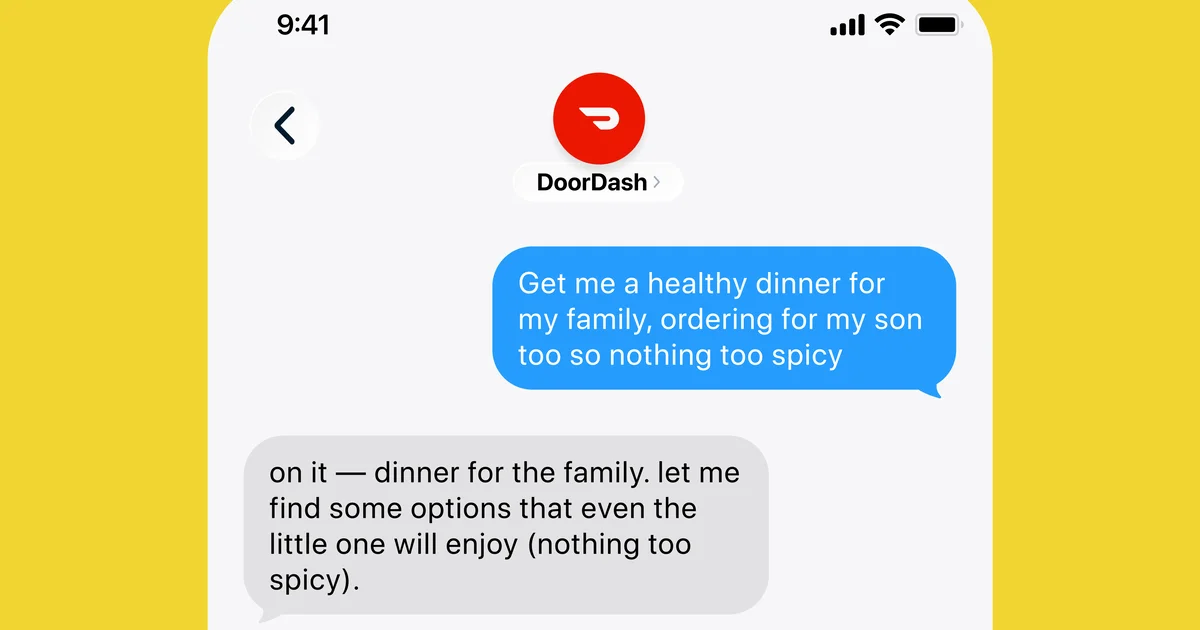
progressivegrocer.comBetween meetings or while walking the dog, you type a message as you would to a friend: "a healthy dinner for the family, nothing too spicy for my son." You check the reply, approve it, and the food arrives. That is the experience DoorDash is aiming for with text-to-order, unveiled at its annual Dash Forward 2026 event.
According to DoorDash's announcement, when a user sends a request, DoorDash searches nearby stores and menus and suggests a cart. Photos of the recommended dishes arrive in the same thread. The order is confirmed inside the message thread, and DoorDash handles checkout. The app never has to be opened.
The channel is Apple's Messages app. 9to5Mac and Digital Trends report that it is a beta for U.S. iPhone users and requires joining a waitlist. No Android version or broader rollout date has been announced.
The feature builds on Ask DoorDash, the in-app assistant launched in June. Ask DoorDash was an entry point for searching in natural language. What is new this time is that the entry point itself has moved outside the app.
It does three main things.
- Send "order my usual" and it reproduces your regular order, including the store, the dish and the modifiers (it also learns preferences such as no cilantro or extra sauce)
- Add it to a group chat and it consolidates orders from several people with different dietary needs and quantities into one order
- If the user opts in, it reaches out first based on daily habits, asking whether to order the usual coffee
In a post on X (reported by Dexerto), co-founder Andy Fang also showed users sending a photo of their fridge to find ingredients missing for a recipe, and described agents as a new app paradigm. In the official announcement, he said:
Managing tasks like ordering lunch or groceries shouldn't feel like work. We built a personal shopper that helps you discover and compare thousands of items while identifying ways for you to save on DoorDash.
The three-month numbers: over 30% restocks, basket value up about 50%
What stands out in this announcement is less the new features than the three months of results from Ask DoorDash. DoorDash shared the following figures.
| Metric | Figure | Basis |
|---|---|---|
| Share of grocery orders via Ask DoorDash that are routine restocks | Over 30% | Grocery orders from mid-August to mid-September 2026 |
| Speed of building a grocery basket | 5x faster | DoorDash Marketplace data, June 2026 |
| Basket value (vs. the same users' traditional orders) | Nearly 50% higher | Orders placed in August through early September 2026 |
| Unique items (same comparison) | About 60% more | Orders placed in August through early September 2026 |
| New restaurants discovered via Ask DoorDash | More than 40,000 | Restaurant orders, June to August 2026 |
The fact that more than 30% of grocery orders were routine restocks of usual items says a lot about how conversational assistants are used. People are not only using Ask DoorDash to discover new dishes or products, but to cut the work of rebuying nearly the same basket every week. The new one-tap restock rebuilds the app around that behavior.
Basket value and item count matter even more for grocery e-commerce. Compared with the same users' traditional orders, basket value is nearly 50% higher and baskets contain about 60% more unique items. One reading is that when building a basket takes less effort, fewer items are forgotten and fewer orders are skipped as too much hassle, so each order gets bigger.
These numbers need careful reading, however. The comparison is with "the same users' traditional orders," but users may be choosing Ask DoorDash for occasions when they want to stock up. The figure does not separate the effect of the feature itself from differences in the occasions it is used for. The measurement periods also differ by metric: the 5x speed comes from June Marketplace data, the restock share from mid-August to mid-September, and basket value and item count from orders placed in August through early September. There is no third-party verification, and no results for text-to-order itself have been published yet.
On the restaurant side, DoorDash says users discovered more than 40,000 new restaurants through Ask DoorDash, and nearly half of restaurant orders went to places the user had never tried. The same agent is handling both jobs: running "the usual" by remembering preferences, and steering users toward new stores.
How one-tap restocks and price swaps work
Two features were added to the app for groceries.
The first is one-tap restock. When you open your preferred grocer's store page, a prompt offers to reorder your usuals, and a single tap builds the cart. You can remove items you don't need to replenish or add others before checking out.
The second is suggested swaps. When you ask Ask DoorDash to build a cart from your preferred grocer, DoorDash scans that store's shelves in real time to find cheaper price swaps for the same or equivalent products. Potential savings are totaled right before checkout, and users can accept or decline the swaps. Nothing is replaced automatically; the final decision stays with the user.
According to Chain Store Age, the same event also introduced drone delivery and an MCP (a standard for connecting AI with external services) connector that lets companies call DoorDash from their internal AI tools. Both are part of a push to turn DoorDash into a purchasing function that can be invoked from many entry points.
How swaps change the competition on the shelf
For shoppers, swaps are an easy-to-understand way to save. For food manufacturers and retailers, they change the rules of shelf competition.
In stores, brands have won attention through shelf position, promotions and packaging. Online, the same competition continues through top search placement and ad slots. Swaps work differently: the agent offers a "cheaper equivalent" for an item the shopper has already placed in the cart. That opens room for a national brand bought by name to be replaced, right before checkout, by a cheaper equivalent or a private label product.
This shift ties into the analytics DoorDash offers manufacturers. Brand Center, announced on September 23, includes consumer substitution insights that show what shoppers choose when an item is unavailable and which brands capture that demand. For now this covers out-of-stock substitutions, and whether price swap outcomes will feed into it has not been disclosed. Still, DoorDash is clearly in a position to measure substitution and show it to manufacturers.
The industry is aware of the change. In a Progressive Grocer article, an executive at data company SPINS said that not showing up in the first three or four spots of AI recommendations is a huge missed opportunity for a brand. The same article describes how Mars Snacking is working to make products across 18 brands discoverable by AI agents.
With swaps in the picture, being found by AI is no longer enough. Even after landing in an existing customer's cart, a product needs to avoid being flagged as a swap candidate on price and equivalence. DoorDash has not published which attributes define "equivalent," or how differences in size, ingredients or origin are treated. Nor has it disclosed whether products that pay for advertising get priority as swap candidates. For manufacturers, this is the point they most need to confirm.
What it means for purchases to complete outside the app
The essence of text-to-order is that the entry point to purchasing moves outside a company's own app or site.
Until now, grocery e-commerce has competed "on the screen": the app home page, the search box, the recommendation slots. With ordering by message, shoppers never see a product list; they simply approve what the agent proposes. TechCrunch framed the launch as DoorDash seeking an edge over Uber Eats and Grubhub, amid a broader push toward personal agents that handle tasks without users navigating apps or websites themselves.
The contrast with competitors is clear. Uber Eats' Cart Assistant, launched in February, builds a cart from inputs such as a photo of a handwritten shopping list, but it lives inside the app. DoorDash has taken the same "cart building on your behalf" idea into messaging, a channel with no app of its own.
For retailers, the question is who holds the customer relationship. It is DoorDash's agent, not the retailer, that remembers what "the usual" means. If orders finish without the store page ever being opened, the merchandising work retailers have done in stores and apps loses its chance to be seen. Grocers selling on DoorDash need to check how their loyalty programs and promotions are treated on this path.
Caveats: privacy, wrong orders, and costs for manufacturers
Some issues do not show up in the company's own description.
The first is privacy. Reproducing "the usual" accurately and reaching out ahead of time based on habits requires continuously learning order times, frequency and preferences. DoorDash describes proactive messages as something that happens "if you want," but the announcement does not explain in detail what data is handled through the messaging app or how far it is used for learning.
The second is wrong orders. Misinterpretation is more likely when a group chat consolidates several people's requests, or when "the usual" means different things in different contexts. There is a step to approve the order in the thread before it is placed, but this check tends to be lighter than comparing a list on screen. Whether cancellations and refunds for text orders are handled the same way as regular orders has not been specified.
Finally, shoppers are not yet ready to hand over everything. In the Progressive Grocer article above, an executive at marketing agency Blue Chip said consumers are not handing AI all of their shopping, and that AI's role is mainly in list building and meal planning. With text-to-order still a waitlisted beta, its scale and retention have yet to be measured.
What e-commerce businesses and food manufacturers should check now
Even when the channel moves to messaging, what the agent reads is product data, inventory and price. If attributes such as size, ingredients and specifications are not in a machine-comparable form, a product may be at a disadvantage when "equivalence" is judged.
Manufacturers need to understand which products their items could be considered equivalent to, and prepare structured data that shows differences beyond price (ingredients, origin, certifications). Retailers have reached the point of deciding whether to capture routine restock demand in their own apps and loyalty programs, or to leave it to platform agents.
Summary
DoorDash's text-to-order takes a conversational assistant outside the app and lets a single message complete a purchase. Results showing restocks above 30% and basket values up about 50% confirm that grocery is more about "repeat shopping" than "searching."
The next things to watch are how quickly the beta waitlist clears and how large text-based ordering grows. Whether DoorDash discloses how swaps define "equivalent" and how they relate to advertising will shape where shelf competition goes for food manufacturers.