
AI Commerce News Digest (July 29, 2026)
AI commerce news for July 29, 2026: Michaels reports its Ask Mike assistant converts at more than double traditional search, GoKwik and PayU put multi-brand D2C shopping inside ChatGPT, and Corpay launches agent-issued virtual cards.


Key Takeaways
- Michaels reports its AI assistant converts at more than double traditional search
- GoKwik and PayU build a multi-brand D2C purchase flow inside ChatGPT
- Measured results and regulatory attention landed on the same day
Here is the AI commerce news roundup for July 29. Two threads ran side by side today: hard numbers on what AI selling actually delivers, and the first signals about who answers for it. Michaels disclosed that shoppers using its assistant convert at more than twice the rate of search users, while in India GoKwik and PayU stood up a multi-brand buying experience inside ChatGPT. At the same time, New York's financial regulator raised the question of liability for agent-driven transactions, and a Malaysian survey found most consumers still refuse to hand over the payment step. Where yesterday's Adobe and Alibaba stories were about tooling for discovery, today was about results and guardrails.
Today's Top Stories
Michaels says its Ask Mike assistant converts at more than double the rate of traditional search

Michaels said shoppers using its Ask Mike AI shopping assistant converted at more than double the rate of customers using traditional search.
www.marketingtechnews.netUS craft retailer Michaels has published early results for Ask Mike, its first customer-facing AI shopping assistant. According to the July 21 announcement, shoppers who used Ask Mike converted at more than twice the rate of those using traditional search.
Rather than keyword search, Ask Mike takes a natural-language description of a project or budget and asks follow-up questions about project type, materials, color and price range before narrowing down products. It runs on Google Cloud's Gemini Enterprise for Customer Experience and was built in six weeks.
Since the May launch, roughly 75,000 conversations have taken place, with 27% resulting in a product click or an add to cart. More than 60% of interactions were product discovery. The same Google Cloud foundation is in use at Ulta Beauty, Macy's and The Home Depot, which suggests retailers are standing up this conversational layer on short timelines.
Whether the conversion lift reflects the tool itself or simply that high-intent shoppers gravitate to the assistant cannot be separated from the published figures. Even so, few retailers have disclosed measured results at all, which makes this a useful reference point for investment decisions.
Full article: Michaels' Ask Mike Converts at More Than Double Traditional Search: Inside the AI Shopping Assistant Built in Six Weeks
GoKwik and PayU put a multi-brand D2C purchase flow inside ChatGPT

GoKwik and PayU have unveiled India's first multi-brand D2C commerce experience, letting consumers discover, compare and purchase across brands inside a single AI conversation.
www.fintechbiznews.comIndian commerce platform GoKwik and payments provider PayU announced on July 28 that consumers can now discover, compare and buy across multiple brands entirely within a ChatGPT conversation. The companies describe it as a first for India.
An Agentic Commerce Protocol (ACP) built jointly by the two firms handles in-chat checkout, while PayU's payment rails cover UPI, cards, net banking and wallets. Hyphen, Beardo and Kilrr are the launch brands, with more expected to follow from GoKwik's merchant base.
Planned additions include NPCI's UPI Circle, the RuPay Agentic Payment Framework and passkey-based methods from Visa and Mastercard. "Indian D2C built itself on the open web; the next chapter will be built inside conversations," said Chirag Taneja, co-founder and CEO of GoKwik.
What makes this notable is that it is not a single-brand chatbot but a cross-brand comparison surface. Once comparison happens inside the conversation, what a brand still controls narrows to the quality of its product data and the reliability of its checkout.
Full article: GoKwik and PayU Launch India's First Multi-Brand D2C Shopping Inside ChatGPT, and the Open Question Around Their ACP
Agentic Commerce
Algolia adds guardrails and cost controls to Agent Studio

Algolia announced capabilities that give retailers AI shopping experiences built on trusted product data.
www.businesswire.comSearch platform Algolia announced production-grade controls for Agent Studio on July 28. The centerpiece is a pair of features covering guardrails and cost controls, available to Algolia customers from the same day.
On the guardrail side, retailers can define disallowed content, filter inputs and outputs, and set fallback messages. On the cost side, the controls include global request limits, per-IP limits, token restrictions, conversation-depth limits and approved-domain settings. Both address what happens when conversational selling meets real storefront traffic and neither spend nor model output stays predictable.
Heather Hershey, senior research director at IDC, noted that retailers need guardrails that keep AI agents safe, governed and economically manageable in live shopping environments. Where yesterday's Adobe Commerce catalog work was about making data readable to outside AI, this is about controlling AI running on your own site.
Amazon lets shoppers interrupt its audio product summaries with questions
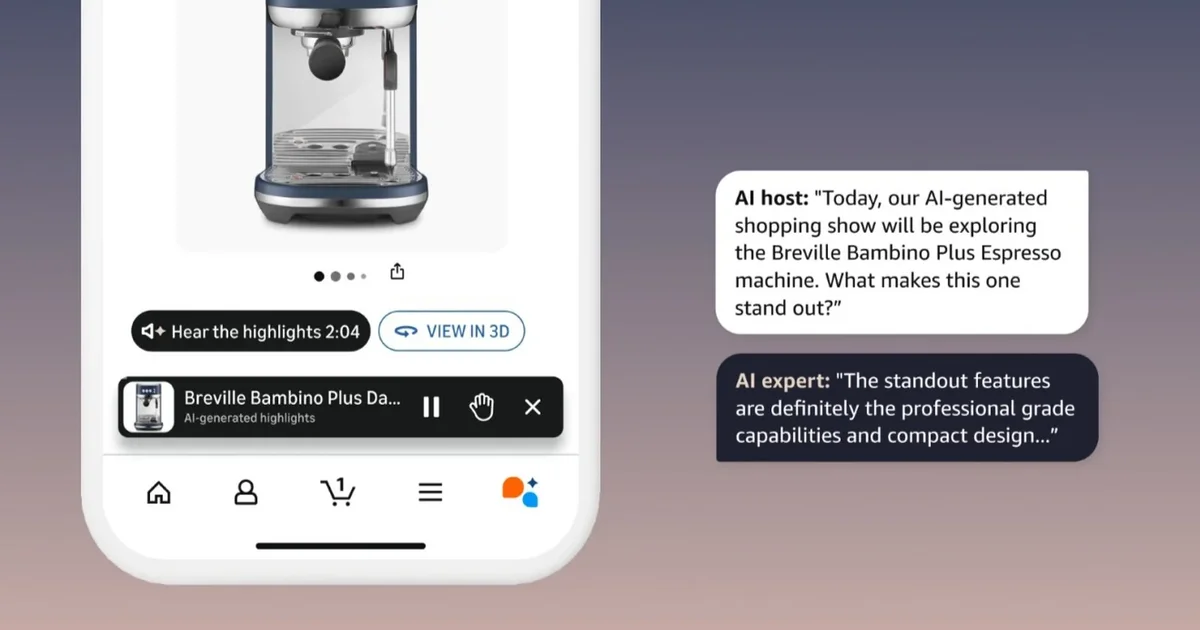
Amazon has launched an AI-powered shopping feature called 'Hear the highlights' where consumers can ask questions and get real-time answers.
www.retailcustomerexperience.comAmazon has added Join the chat to Hear the highlights, its AI-generated audio product summaries. Shoppers can now interject with a question by text or voice while the summary is playing.
Answers draw on product details, customer reviews and other publicly available information, after which the AI hosts resume where they left off. Example questions cited include whether a coffee maker suits a beginner or someone with barista experience, and whether people find a sweater itchy. Rajiv Mehta, vice president of conversational shopping at Amazon, describes it as customers moving from listening to participating.
The pattern here is reading a product page giving way to listening and asking. When review text becomes the raw material for those answers, the quality of that text turns into the quality of the service itself.
Korea's e-commerce players race on AI shopping as Coupang and Gmarket move in

South Korea's e-commerce companies are accelerating their AI shopping push as major players roll out new AI-powered services.
pulse.mk.co.krSouth Korean e-commerce companies are stepping up their AI shopping efforts. Coupang has launched a pilot comparison service that analyzes product categories, customer behavior and reviews to compare performance, features and prices. Coverage starts with electronics such as laptops and washing machines, with expansion planned by year end.
Comparison is not the endpoint. Coupang says its longer-term goal is a full AI shopping agent that understands user needs, recommends multiple products and eventually completes purchases and payments on the shopper's behalf. Gmarket is preparing a hyper-personalized agent for next year that infers purchase intent from images, prices and reviews as well as product names.
Naver's numbers are driving the competition. After converting its February pilot agent into a commercial service in June, daily average users of Naver Plus Store rose more than 50% from March and gross merchandise value increased 2.7 times. More than 70% of users type queries of at least 15 characters, which the company reads as conversational shopping taking hold.
Choi Bo-reum, a professor at Yonsei University's Graduate School of Information, argues that if AI selects products in place of consumers who previously decided after seeing ads, the shift reaches beyond advertising into the business structure of platform companies.
Payments and Fintech
Corpay introduces Agent Card, letting AI agents issue their own virtual cards

Corpay announced Agent Card, a capability that lets AI agents generate virtual payment cards for business transactions on behalf of the organizations they serve.
www.businesswire.comCorporate payments provider Corpay announced Agent Card on July 28, a capability that lets AI agents generate virtual payment cards themselves on behalf of the businesses they serve. Spending controls and governance remain defined and enforced by the business, not the agent.
Each virtual card is scoped to a specific purpose, so the agent operates inside an authorized boundary rather than with open purchasing authority. The design supports both user-directed and machine-to-machine workflows.
Danny Martucci, president and general manager of Commercial Card at Corpay, said agentic commerce is creating a new frontier for business payments. The framing is that the open question is not whether agents can technically initiate purchases, but whether businesses can retain the authorisation and visibility their spending policies require.
Full article: Corpay Launches Agent Card: AI Agents Issue Virtual Cards While Businesses Keep Control
Citi argues instant payments are the natural rail for agentic commerce

AI agent transactions need machine-native payment infrastructure, and instant payments supply the speed, finality and rich data those transactions require.
www.citigroup.comCitigroup published an analysis on July 28 linking agentic commerce to instant payments. The argument is straightforward: transactions executed by AI agents need API-native payment infrastructure, and instant payments meet that requirement.
Beyond speed, the piece points to settlement finality and data rich enough for reconciliation as the binding constraints. Redirects and deferred settlement assume a person is present at the screen, which sits poorly with agents operating at machine speed.
Markets such as India, Brazil and Thailand, where regulation and incentives aligned, have already achieved scale with instant payments, and Citi positions them as the natural landing ground for agent transactions. That reading lines up with the Indian launch from GoKwik and PayU built on UPI.
AI Commerce Tools
THG Ingenuity brings its AI Stylist to Google Cloud Marketplace

THG Ingenuity has made its AI Stylist virtual try-on product available on Google Cloud Marketplace, reporting improved conversion rates.
ww.fashionnetwork.comTHG Ingenuity has made its AI Stylist virtual try-on product available on Google Cloud Marketplace. It was built with Google Cloud on the Gemini Enterprise Agent Platform.
Shoppers upload a personal photo and see how items on a product page would look on them before buying. Performance data from an earlier deployment on THG's own Myprotein brand shows that UK customers who generated at least one image with AI Stylist were nearly six times more likely to convert, spent 6.3 times longer on site and had a 2.5% higher average order value than site-average activewear shoppers.
Those figures come from a limited rollout on an in-house brand, and whether the same effect holds across categories and price points is untested. Still, the combination of fewer returns and longer dwell time makes it an easy pitch to apparel retailers.
Full article: THG Ingenuity Puts Its AI Stylist Virtual Try-On on Google Cloud Marketplace: How to Read the 6x Conversion Number
Advertising and Retail Media
WPP Media partners with Indian autonomous commerce startup Kily

WPP Media's Integrated Commerce Planner and Kily's agentic stack aim to help brands drive scale, agility and measurable business outcomes.
www.medianews4u.comWPP Media announced a technology partnership with India's Kily on July 28. Kily builds AI agents that autonomously run commerce operations including listings, pricing and ads across marketplaces and quick commerce platforms.
WPP Media contributes its Integrated Commerce Planner, with the stated aim of keeping planning, activation and measurement continuously aligned. Ashwin Padmanabhan, COO for WPP Media South Asia, described the goal as bringing scattered moving parts into a more connected system.
Sankalp Mehrotra, co-founder and CEO of Kily, said the company is focused on bringing autonomy to commerce management. Agencies absorbing operational agents is worth watching as an early sign of retail media itself being rebuilt around agents.
Consumer Trends
74% of Malaysians shop with AI, but most will not let it pay

Adyen's 2026 Malaysia Retail Report finds AI is now mainstream in shopping, but weak payment trust could stall the shift towards enabling agentic commerce.
fintechnews.myNearly three in four Malaysian consumers now use AI while shopping, according to the Adyen Index 2026 Malaysia Retail Report. Yet 52% are uncomfortable letting an AI complete a purchase for them. YouGov ran the survey online in March and April 2026, covering 1,031 consumers aged 18 and over and 314 senior retail managers at companies with annual turnover of at least RM75 million.
Payment experience shows up clearly in the numbers. 59% say payment errors damage their view of a business, and 26% have abandoned a purchase over security or trust concerns. On the retailer side, 97% were affected by payment performance issues in the past year and 94% were targeted by or fell victim to payment fraud.
Awareness is not the obstacle: 85% of retailers say they are familiar with agentic commerce and nearly half plan to invest during 2026. Lee Soon Yean, country manager for Malaysia at Adyen, said the harder task is building trust across the journey, particularly at checkout.
Millennials fold AI into the decision layer of buying, PYMNTS finds
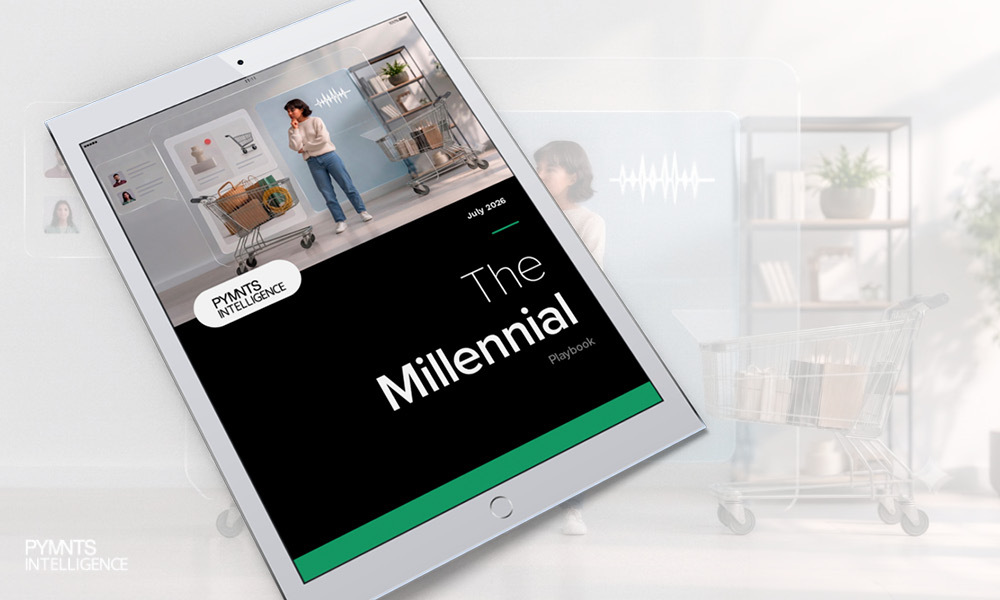
Millennials aged 30 to 45 are adopting AI as a decision layer in their purchasing journey, potentially shifting when and where merchants encounter shoppers.
www.pymnts.comRoughly half of millennials aged 30 to 45 are very or extremely interested in AI shopping agents that research products, compare prices and complete transactions, according to PYMNTS Intelligence. Another 26% report some interest.
Discovery habits are moving too. Around four in ten used a dedicated AI app such as ChatGPT, Claude or Perplexity for their most recent product discovery, putting it roughly level with plain search. About 40% say AI has fully or mostly replaced their previous research methods.
As more pre-purchase research finishes inside AI, the point at which merchants can reach shoppers moves upstream of their own site. That sits consistently with the Malaysian split noted above: discovery delegated to AI, payment kept in human hands.
Global E-commerce
New York's financial regulator turns its attention to agentic commerce

The New York Department of Financial Services is monitoring autonomous AI agent transactions and evaluating how existing consumer protections apply.
perkinscoie.comKaitlin Asrow, acting superintendent of the New York Department of Financial Services (DFS), addressed autonomous AI agent transactions at the New York Fed's Innovation Conference on June 26. Law firm Ashurst Perkins Coie covered the remarks in an insight published July 28.
The comments are preliminary observations rather than formal guidance. The substance is that regulated entities remain responsible for autonomous transactions conducted through AI agents, and that while there is no single correct way to deploy agentic AI, there are many ways to get it wrong. Adequate systems and controls are flagged as a supervisory focus.
The audience extends past regulated institutions such as banks, card issuers and lenders to merchants offering financing at checkout, fintechs enabling agent-driven transactions and service providers automating them. Liability gaps in autonomous purchasing and financing arrangements were named as an open question.
Shein discloses an FTC review as regulatory pressure builds ahead of its Hong Kong IPO
Shein has disclosed that its U.S. operations are under investigation by the Federal Trade Commission, adding another regulatory hurdle ahead of a planned Hong Kong listing.
www.pymnts.comShein has disclosed that its US operations are under investigation by the Federal Trade Commission. The disclosure comes as the company pursues a Hong Kong listing, and the filing gives no indication of the investigation's focus, scope or timeline.
Reuters has reported that Shein posted a first-quarter 2026 loss after the US ended its de minimis duty exemption for many low-value imports, with US revenue declining over the period. The company has said it is weighing measures including higher US prices to offset increased tariff and customs costs.
The FTC enforces consumer protection law and also serves as one of the principal US antitrust authorities. Nothing in the disclosure points to competition issues, but it fits the broader pattern of tightening oversight of large digital commerce platforms.
Wrapping Up
July 29 was the day AI selling started producing real numbers. A more than doubled conversion rate at Michaels, 2.7 times gross merchandise value at Naver Plus Store, 6.3 times dwell time at THG. Numbers unlock budgets, and budgets accelerate competition, which is exactly what the wave of Korean launches shows.
At the same time, consumers still balk at handing over the payment step, and regulators have begun asking who answers when an agent gets it wrong. Malaysia's 52% and the DFS remarks point at the same gap from opposite sides. Automating discovery and service now has evidence behind it. Automating payment does not yet have the trust design to match.
Corpay's Agent Card and the GoKwik and PayU launch are both attempts to close that gap. From here, the deciding factor for adoption looks less like what the agent chose and more like who approved it and who carries the liability.